

1. ADFF:STIR Delhi
  2. Pavilion Park
Pavilion Park

Seven studios,
seven pavilions.

Within the 16th-century walls of Purana Qila, Jaquar Pavilion Park takes the form of a Pavilion City, co-curated by Aric Chen, director of the Zaha Hadid Foundation, and Rahul Mehrotra, founder principal of RMA Architects.

Co-curated by

Aric Chen
Aric Chen
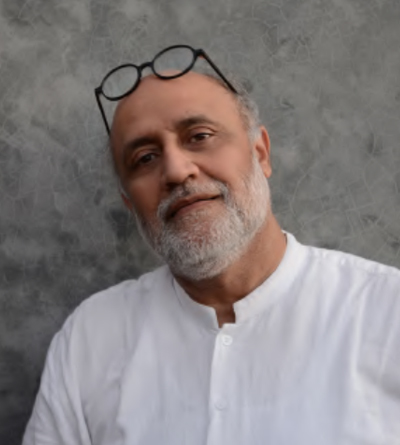
Rahul Mehrotra
Rahul Mehrotra

Drawing on pavilion urbanism and the ephemeral city, it brings together seven architects from India and abroad: Sumayya Vally, Xu Tiantian, Rohan Chavan, Sandeep Bogadhi, Nuru Karim, Pooja Khairnar and Ambrish Arora. Deployable and reversible, their pavilions form an aggregation shaped by congregation and pragmatism: a speculative settlement for new forms of urbanism.

  1. Pavilion of HopeStudio Lotus · Studio Lotus's Pavilion of Hope traces a journey from waste to craft to shelter. The 7-metre circular pavilion is built from scaffolding pipes, mesh, reclaimed timber and recycled fabric, aspiring to be a transient civic shelter, a ‘Ren Basera’, in its afterlife. Open the pavilion →
  2. SundialCounterspace · Sumayya Vally Sundial explores architecture as a vessel carrying several temporalities simultaneously. Referencing the five Salah prayers, the pavilion invokes markers of time: sun, ritual and movement to shape corresponding spatial transitions against the backdrop of the Old Fort. Open the pavilion →
  3. The StupaEarthling Ladakh · Sandeep Bogadhi The pavilion proposes the Himalayan stupa as a symbol of continuity, referencing the idea of impermanence through its temporality. Conjured objectively through the ‘void’ and thematically as a site for contemplation, the pavilion is revealed in its inherent degradation. Open the pavilion →
  4. HOPEPK_iNCEPTiON · Pooja Khairnar HOPE addresses the rising disparity between the public and private in educational and urban infrastructure. The pavilion shifts between a learning space and a civic platform for gatherings, markets, workshops and everyday interactions, instating inclusivity and communal engagement at the core of public space in India. Open the pavilion →
  5. The Habitat KitRC Architects · Rohan Chavan Architecture is reimagined as a ‘kit of parts’: metal, tension cables and fabric. In different configurations, they form suggestions of habitable space, adaptive to changing occupations, from classroom to community spaces and temporary shelters. Open the pavilion →
  6. Solar TempleNUDES · Nuru Karim Solar Temple invokes the Sun as a source of light, life and resilience. Harnessing solar energy through its surface, the pavilion strives to power public infrastructure, reiterating the temple as a source of energy beyond its spiritual connotations. Open the pavilion →
  7. The Bridge | The CanopyDnA_Design and Architecture · Xu Tiantian A passage, a shelter, a gathering space: the pavilion serves multiple functions by simply referring to the bridge as both a physical shelter and motif for connection. The construction references a thousand-year-old Chinese woven bridge technique. Open the pavilion →