Design04 mins. read
Not just a chair: Urs Fischer elevates the banal through absurdity in Shucks & Aww
by Bansari PaghdarJan 31, 2026




by Chahna TankPublished on : Dec 22, 2025
Furniture designer Joyce Lin’s latest work feels fantastical—vines creeping up the legs of a chair, metal rippling across surfaces as if in motion and spirals overtaking objects like a curse. These surreal furniture pieces—evocative of a fictive landscape rather than ordinary interiors—anchor the Houston-based designer’s second solo exhibition titled Hypernaural, on view at R & Company in New York from November 3, 2025 – January 9, 2026. The design exhibition explores ‘themes of artifice, illusion and altered realities’.
Works on display in Hypernatural include seven new furniture designs by Lin across two collections—Fictive Matter and Kudzu Series—which include chairs, a table, a lamp, and a ladder. While functional, these products operate as sculptural objects—each one shaped by Lin’s long-standing engagement with history, literature, philosophy and science. Working within this interdisciplinary terrain, she crafts furniture that navigates the fuzzy boundary between truth and fiction, hovering somewhere between the real and the fabricated. Rather than translating theoretical references into literal forms, Lin describes her process as largely intuitive. “It happens subconsciously at first,” she explains in a conversation with STIR. “I’ll think of an idea, and as I continue to sketch, I notice patterns that remind me of things I’ve learned or read.” This internal ‘moodboard’, as she calls it, helps her hone a particular feeling—especially one that's abstract—while keeping the work anchored in a coherent identity.
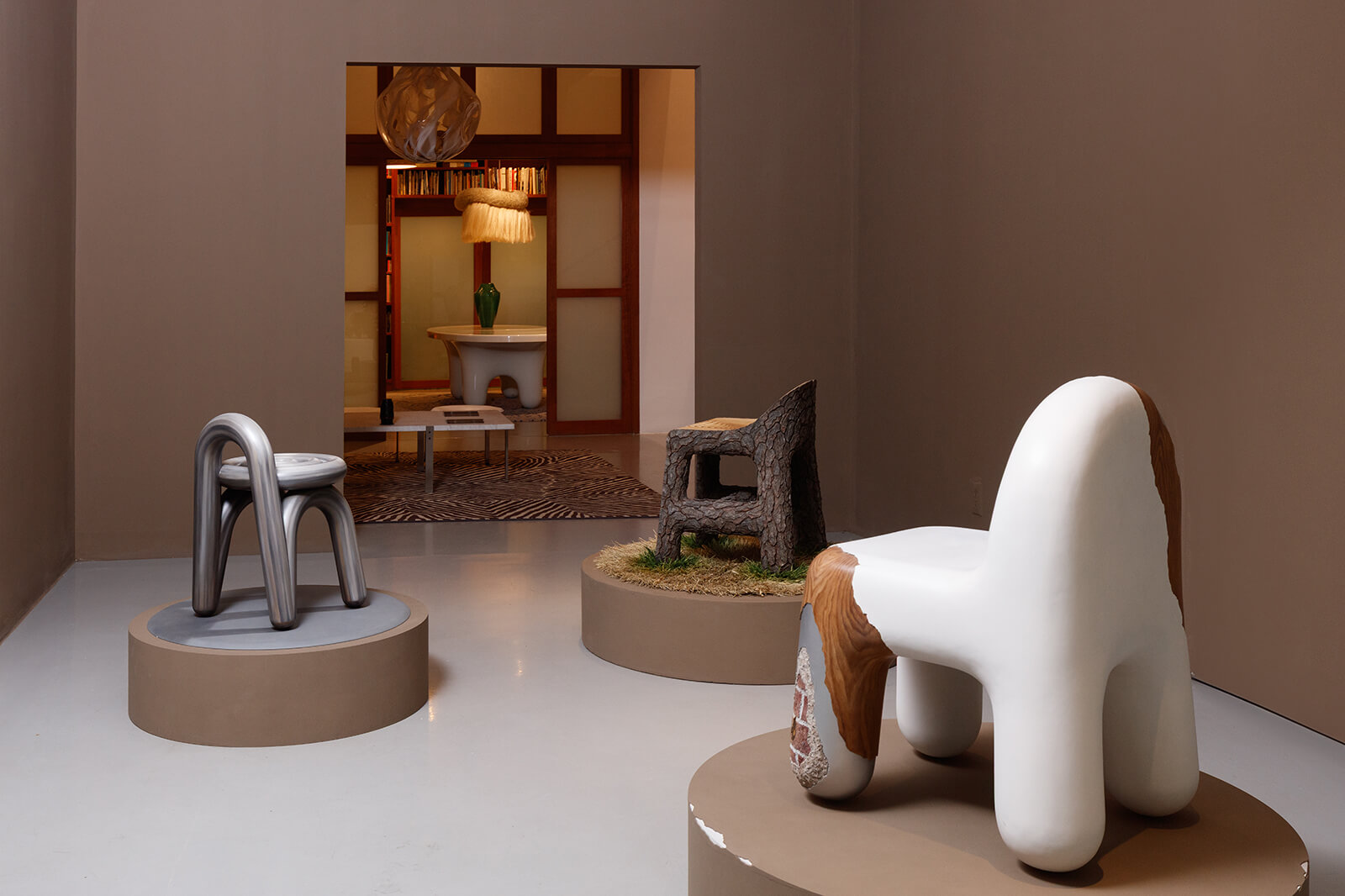
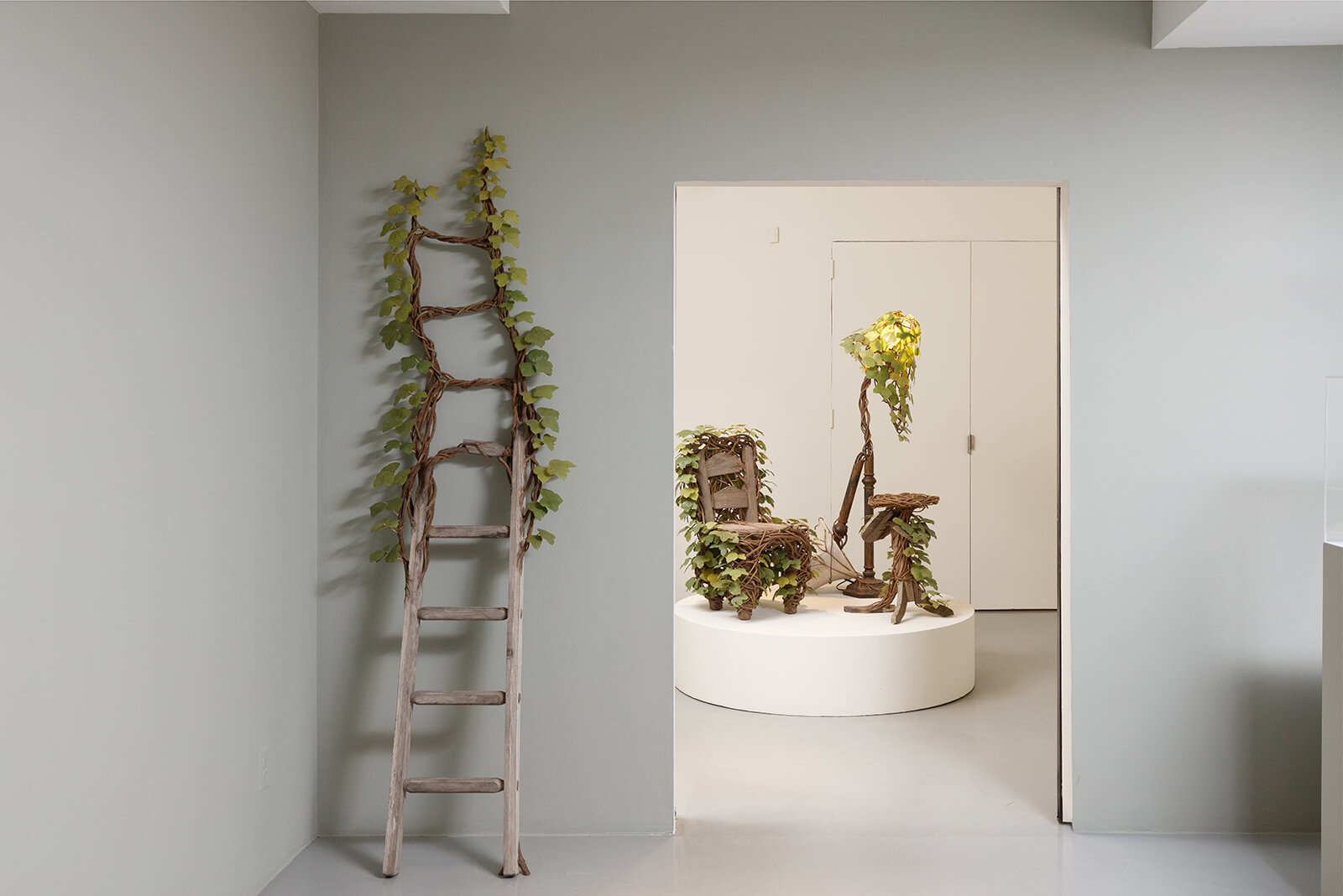
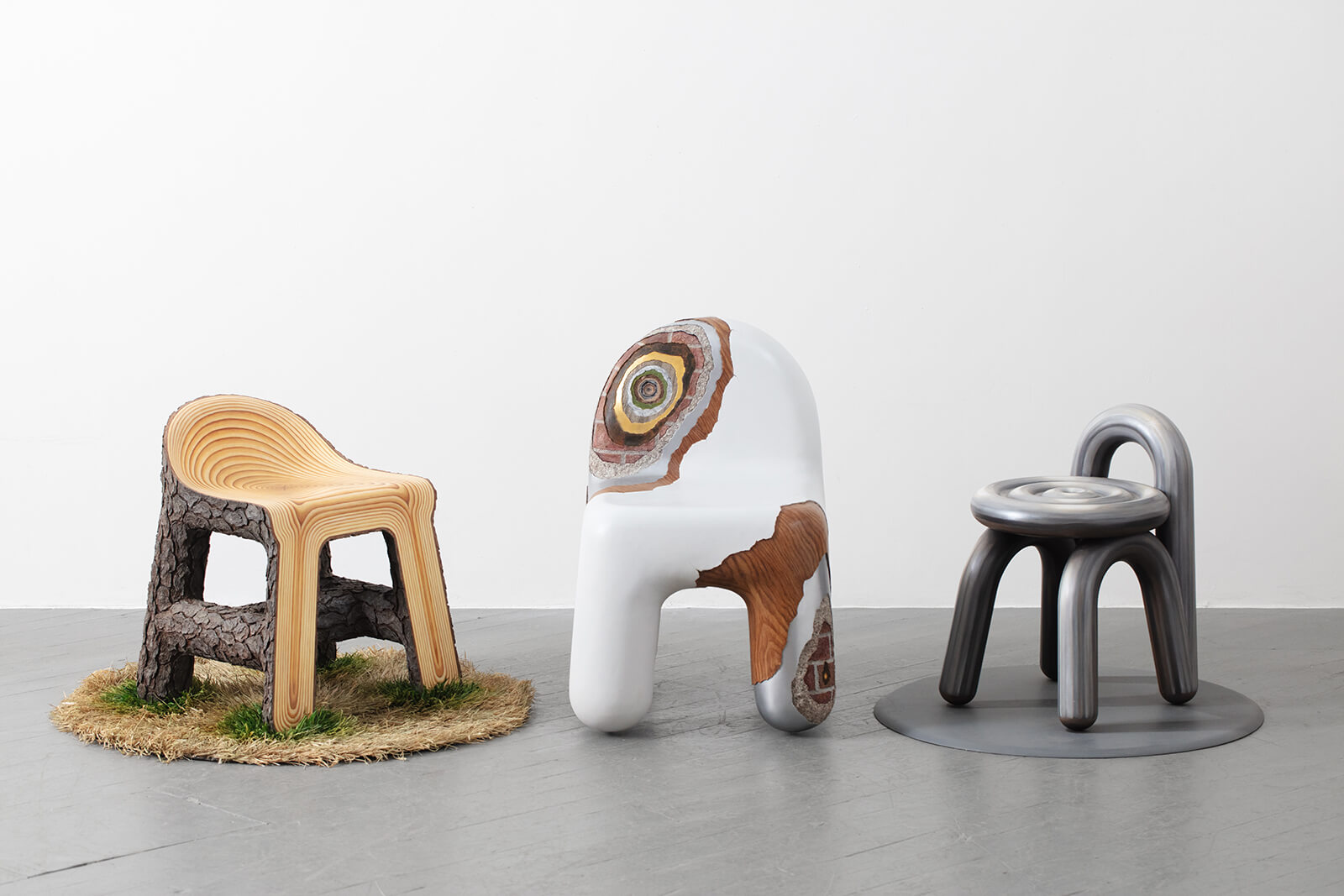
Throughout the exhibition, Lin employs mimetic techniques to replicate organic and natural materials, using trompe-l’œil (trick of the eye) strategies to challenge assumptions about what materials are and what they merely appear to be. “Someone recently described my approach as ‘using material as metaphor,’ which I think is pretty fitting,” Lin tells STIR.
True to this approach, she resists literal interpretations of abstract ideas. “I enjoy the allegorical imagery—spirals, caves, turtles, even stuff that may only make sense to me,” she says, likening the logic of her work to “the gag in Scooby-Doo where the characters unmask the villain to reveal another mask underneath, and another and so on.” Rather than dictating material choices, these references function as conceptual guides, allowing fiction and imitation to keep the work grounded while reality itself remains deliberately unstable.
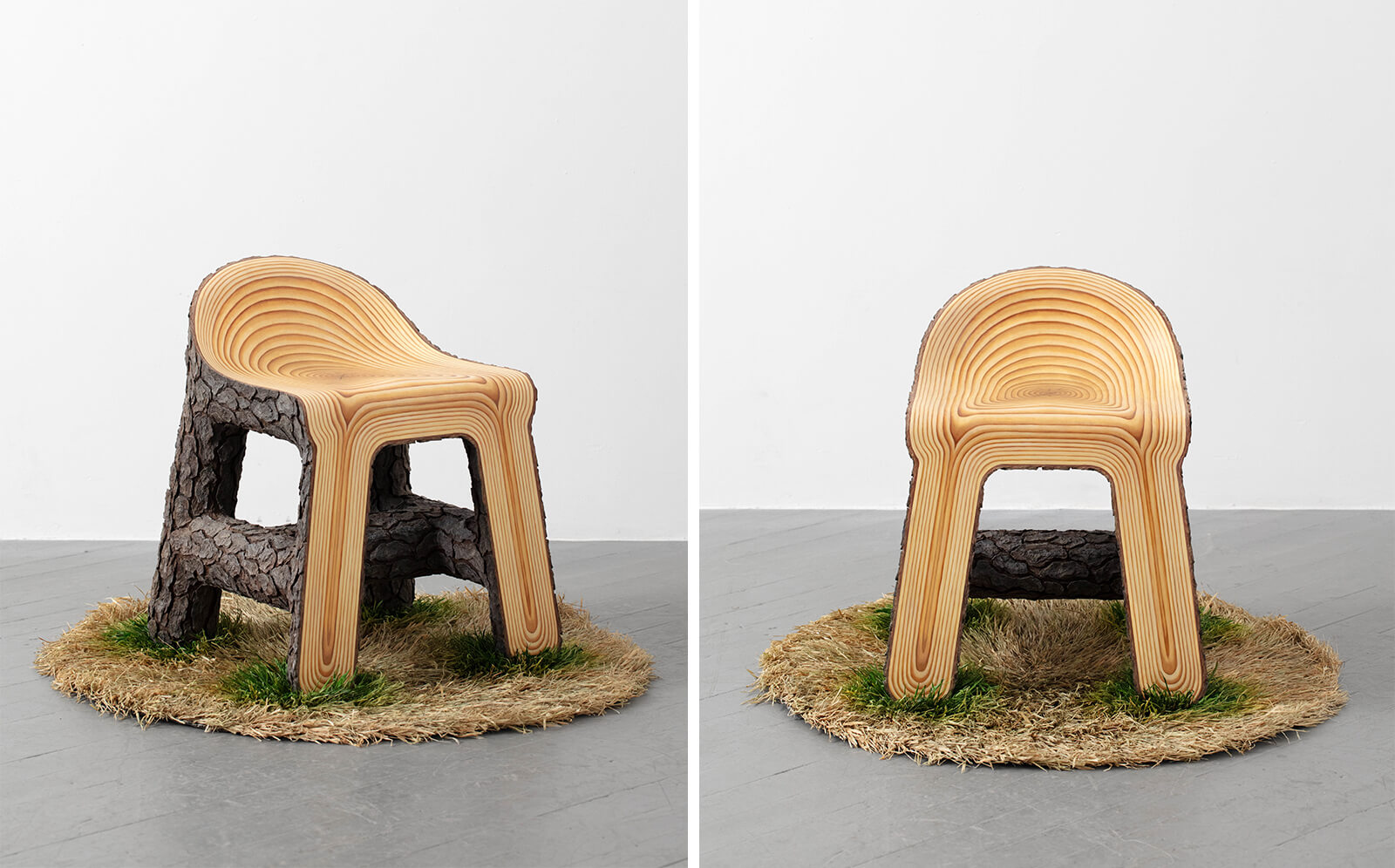
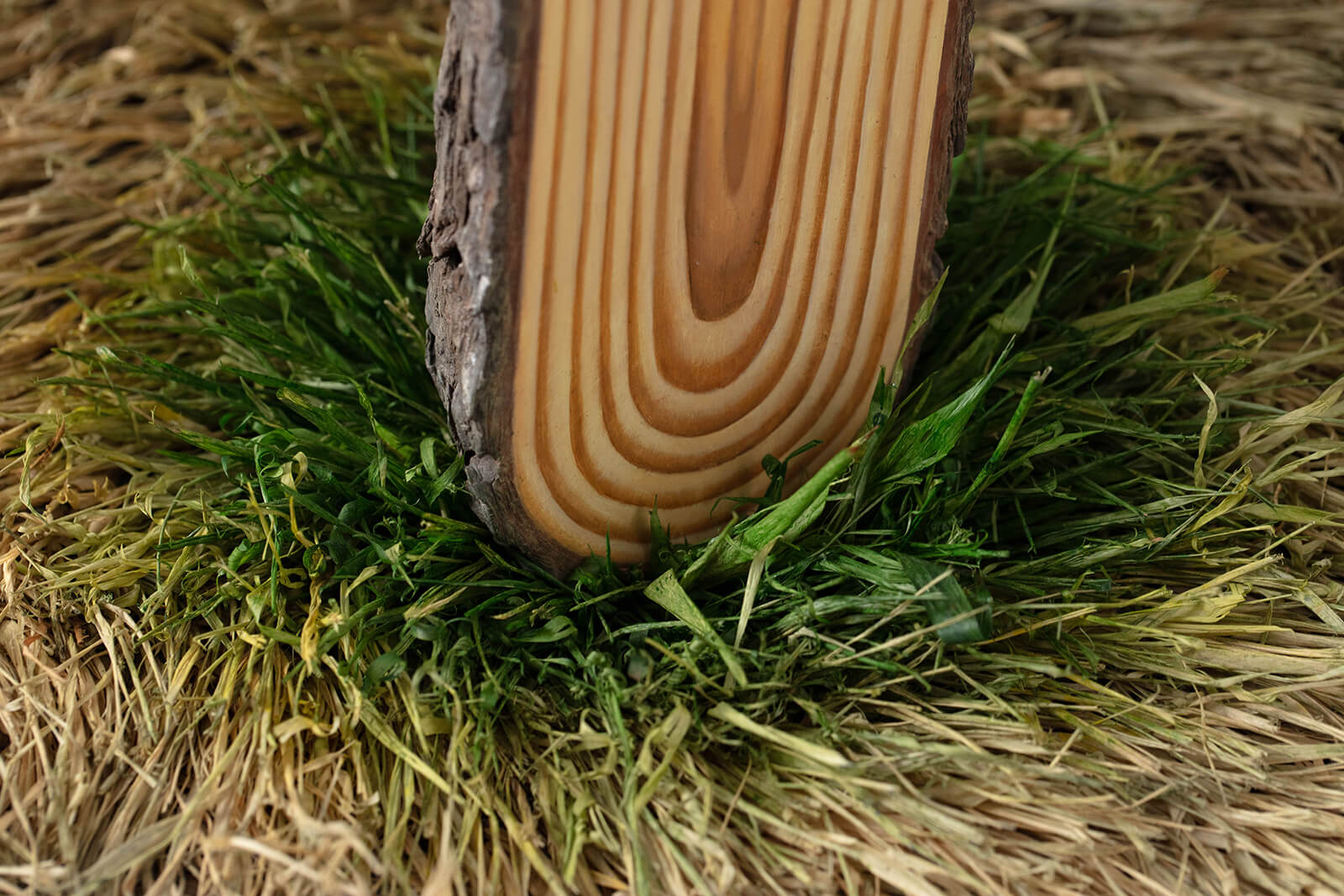
In her Fictive Matter series, Lin turns to imitation as a way to ‘bypass material limitation’ constructing surfaces that convincingly masquerade as other materials. For the Wood Chair—a low-back, saddle-seat—rather than working within the limitations of wood as a material, Lin constructs the likeness of it through surface, texture and context. The wood grain is oil-painted; its bark, modelled after pine, is sculpted in epoxy clay, with fissures carved directly into the seat. Surrounding it, a latch-hook rug made from raffia fibres and dyed in muted greys imitates grass.
Wood does not have to behave like wood, and nature does not need to be real to feel convincing. What holds the work together is not the authenticity of substance, but its ability to be persuasive enough to suspend doubt. “After I achieved purely artificial wood, I felt conflicted over the idea of dissecting real materials again. With each passing year, it feels like aspects of reality are crumbling around us. Are we, artists and designers, simply using materials as a means to an end toward a kind of escapist fantasy?” Lin muses in an official release.
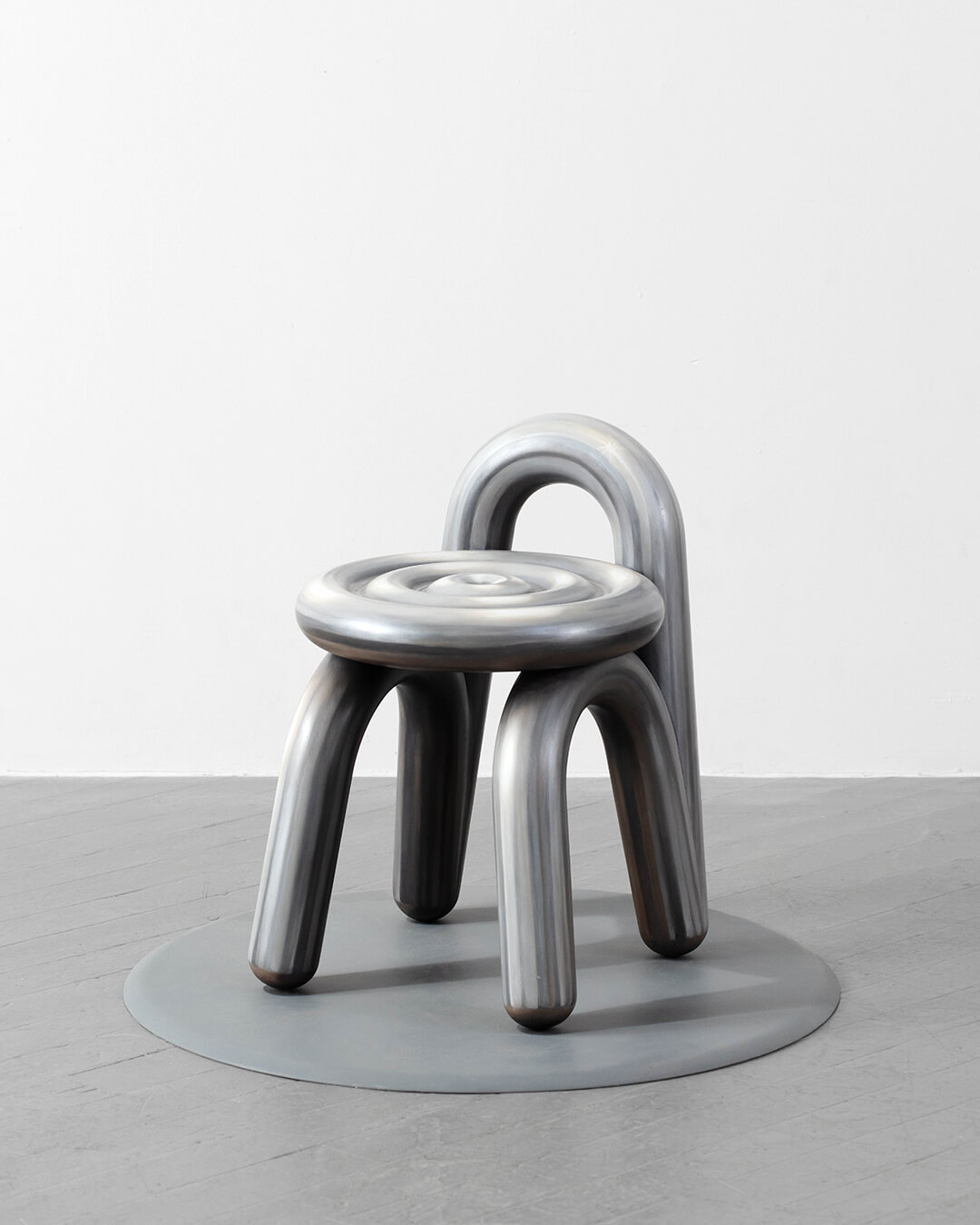
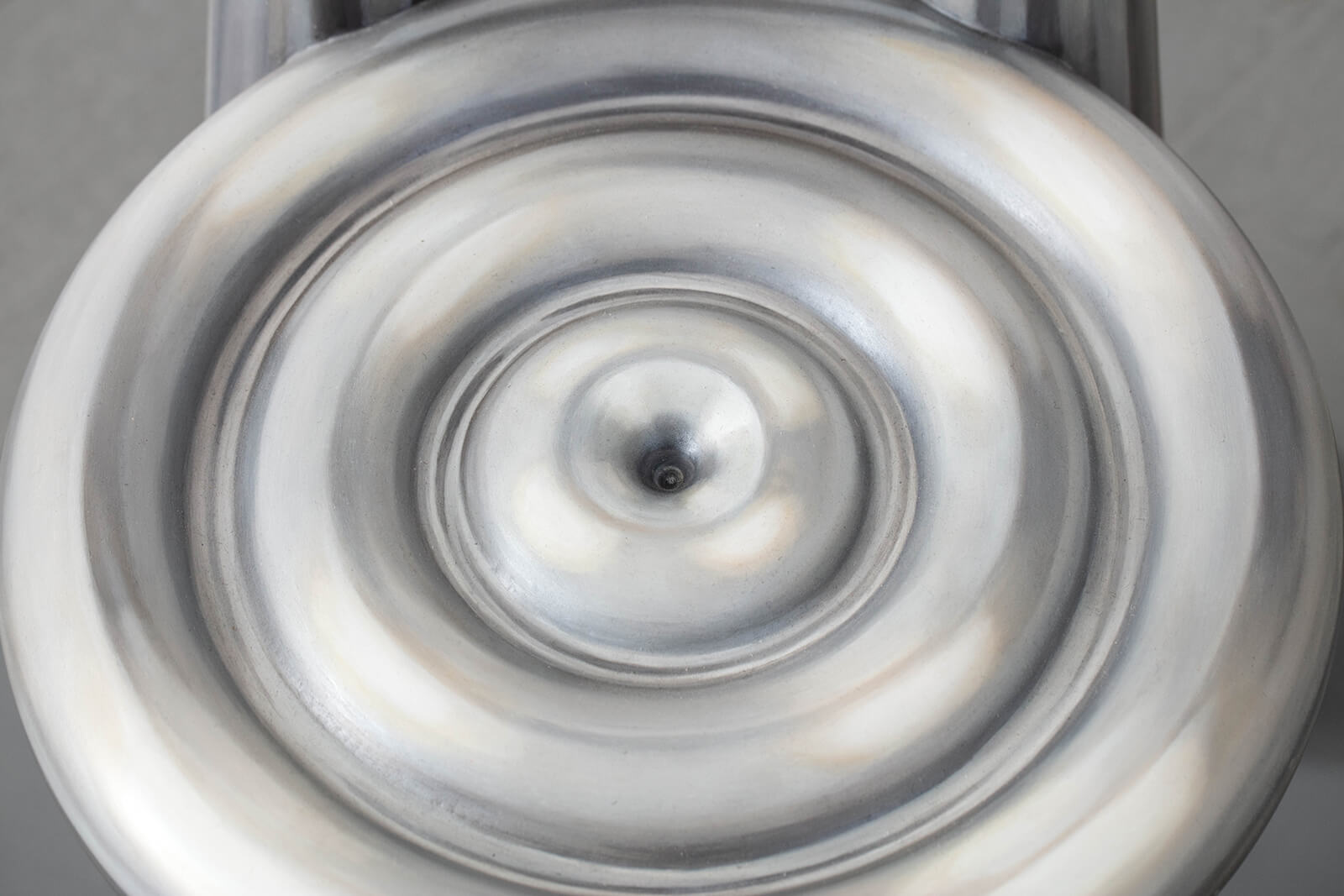
In her Metal Chair, Lin pushes this logic of imitation further. She begins by 3D-modelling a tubular form, which she then paints by hand with oil paint, a light glaze of metallic pigment and satin varnish to give it a steel-like appearance. Lin relies on digital renderings, close studies of reflection and the figurine-painting technique known as Non-Metallic Metals (NMM) as visual references, using them to translate light, shadow and sheen onto a non-metal surface.
From the outset, Lin accepts that absolute realism is unattainable—but was that the goal to begin with, she asks. Referencing Plato’s allegory of the cave, in which prisoners mistake shadows cast on a wall for reality itself, Fictive Matter embraces the image over the source. As Lin puts it, “Even when told the truth about the cave, they deny the real world in favour of the shadows. In these works, I also let go of the real to chase the unchanging, fantastical ideal in my mind.”
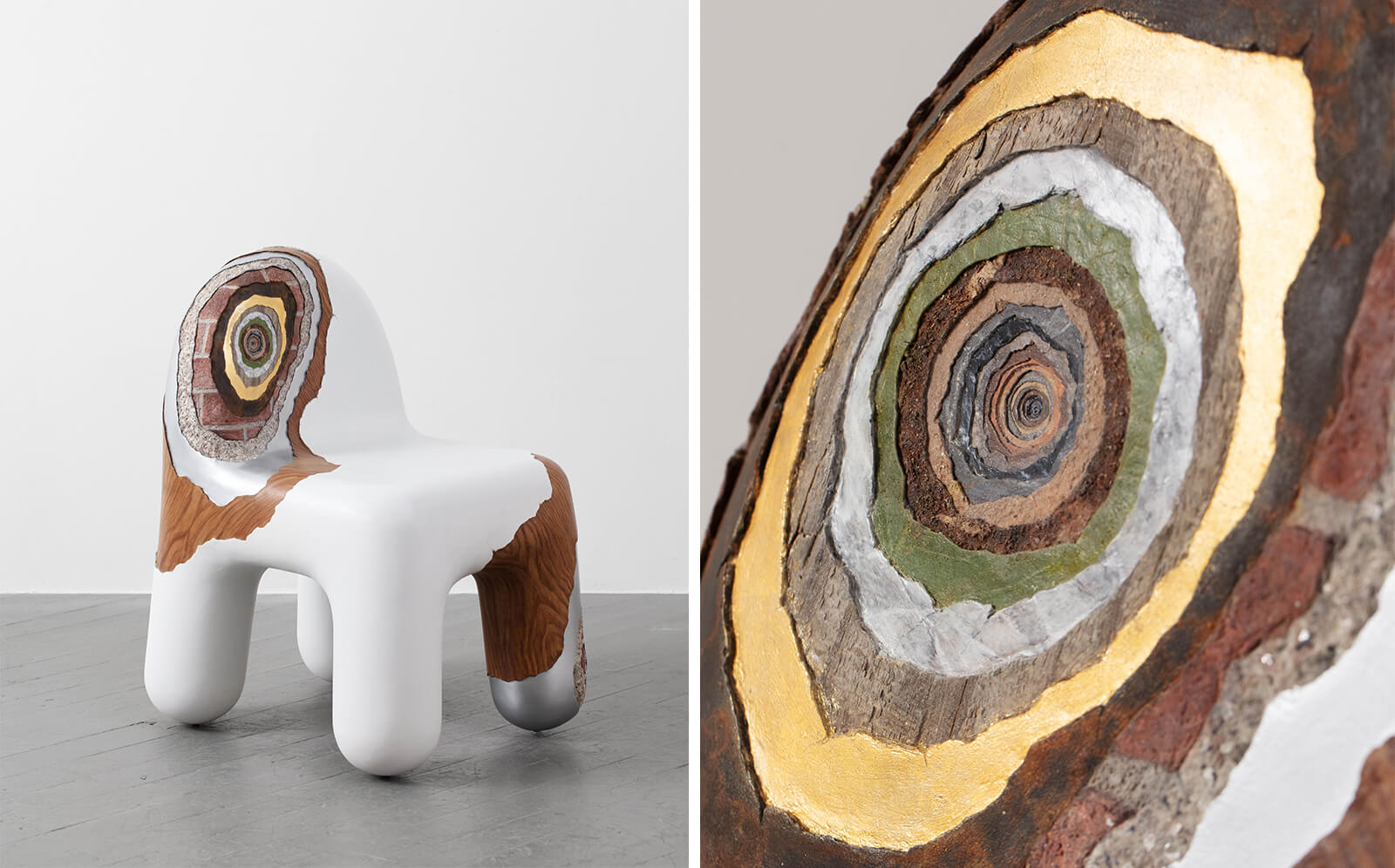
In the Surfaces All the Way Down chair, Lin draws inspiration from spirals in Japanese comic book writer Junji Ito’s horror graphic novel Uzumaki (2000), in which a town is consumed by escalating spiral-related supernatural events, revealing a cyclical, inescapable curse. She also engages with the philosophical problem of infinite regress, where each explanation rests on another, endlessly with no stable foundation—a concept famously illustrated by the myth of ‘turtles all the way down’—in which the Earth rests on the back of a giant turtle, which in turn stands on another turtle, and another, forming an endless stack.
In the chair, spirals of material wind through the form, each layer made with a different material—from wood to aluminium to granite to brick and so on—all folding into one another in repeating, concentric sequences. Each layer creates a sense of depth that is perpetually deferred, as the eye follows circles that fold into themselves endlessly—spiral within a spiral within a spiral.
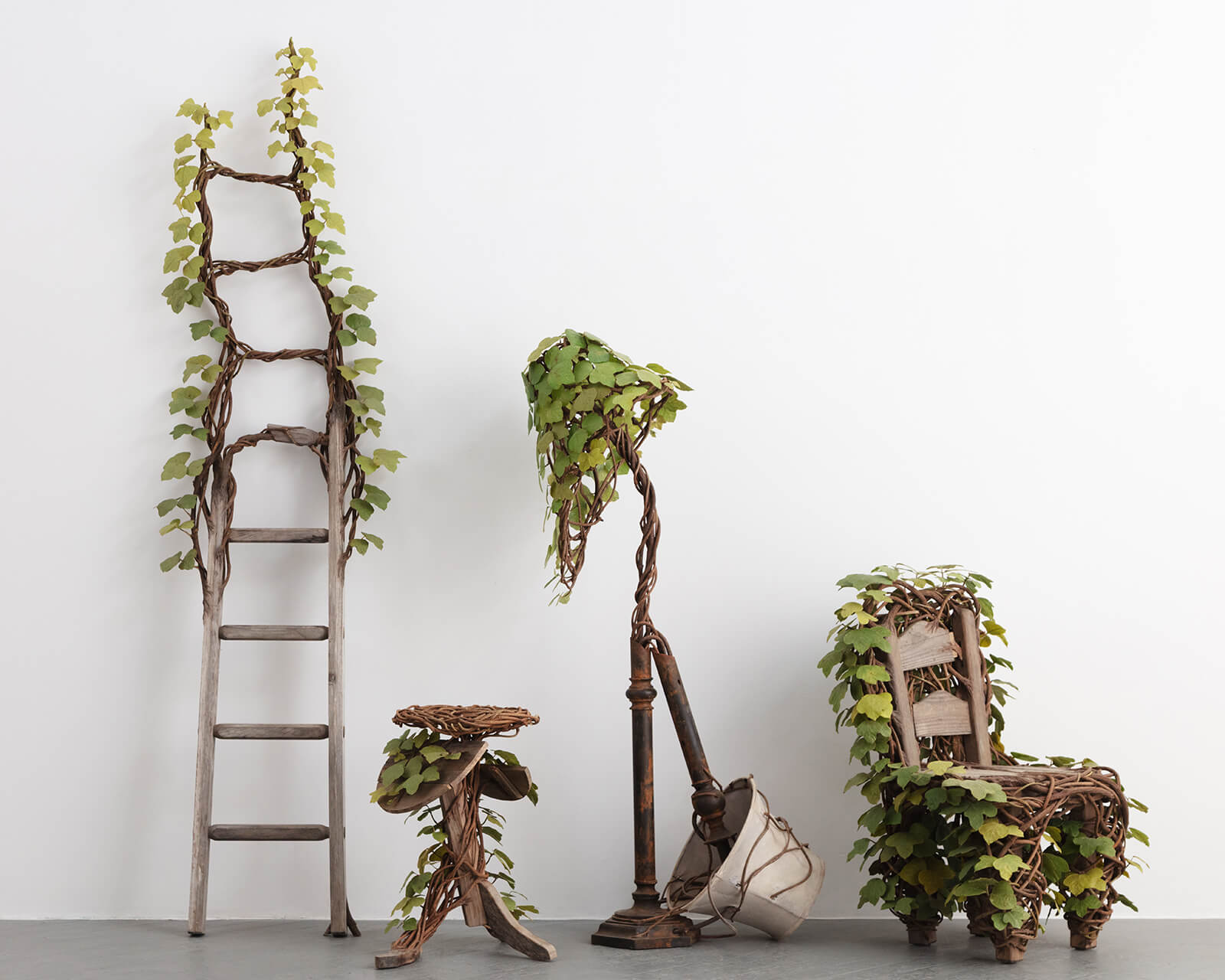
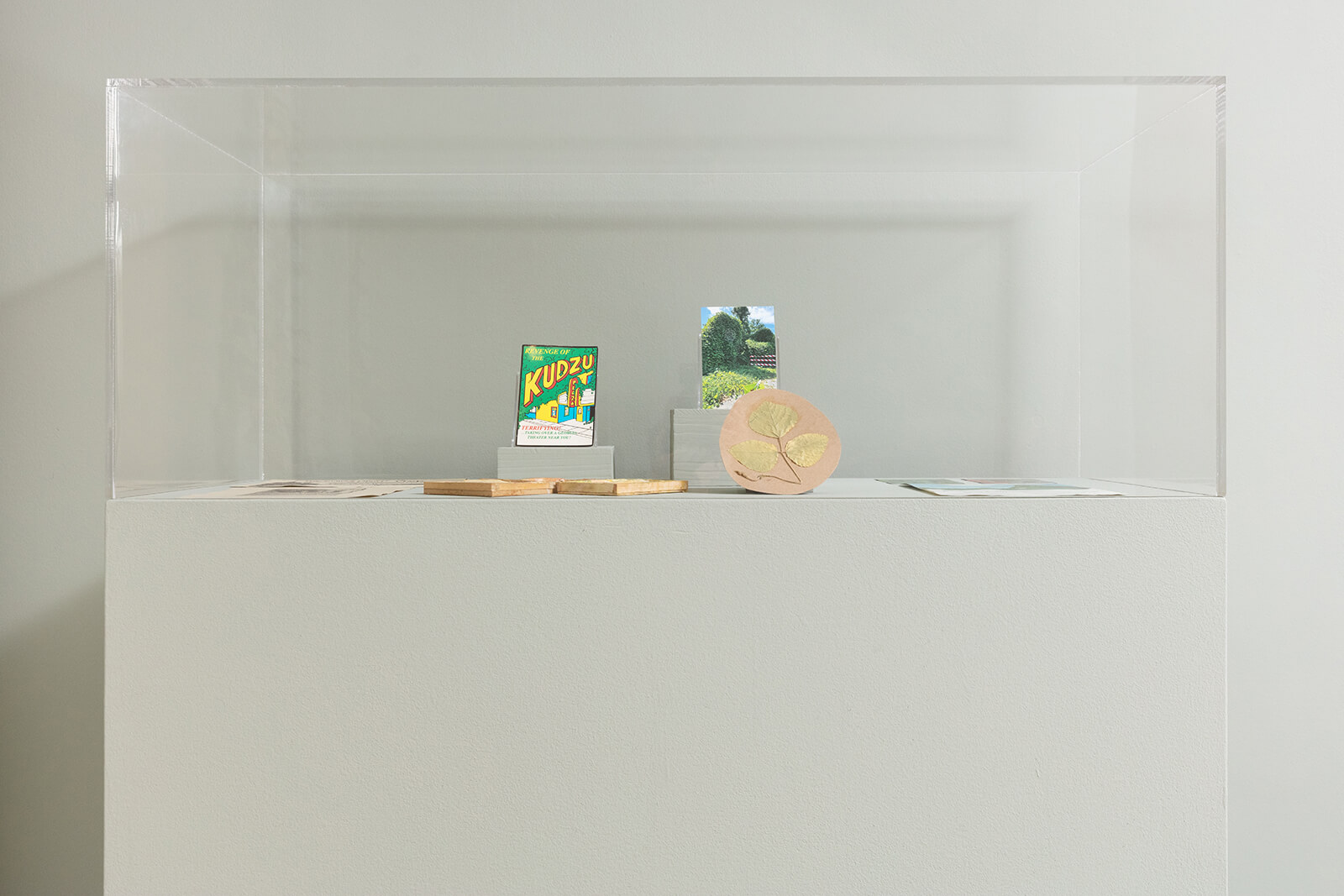
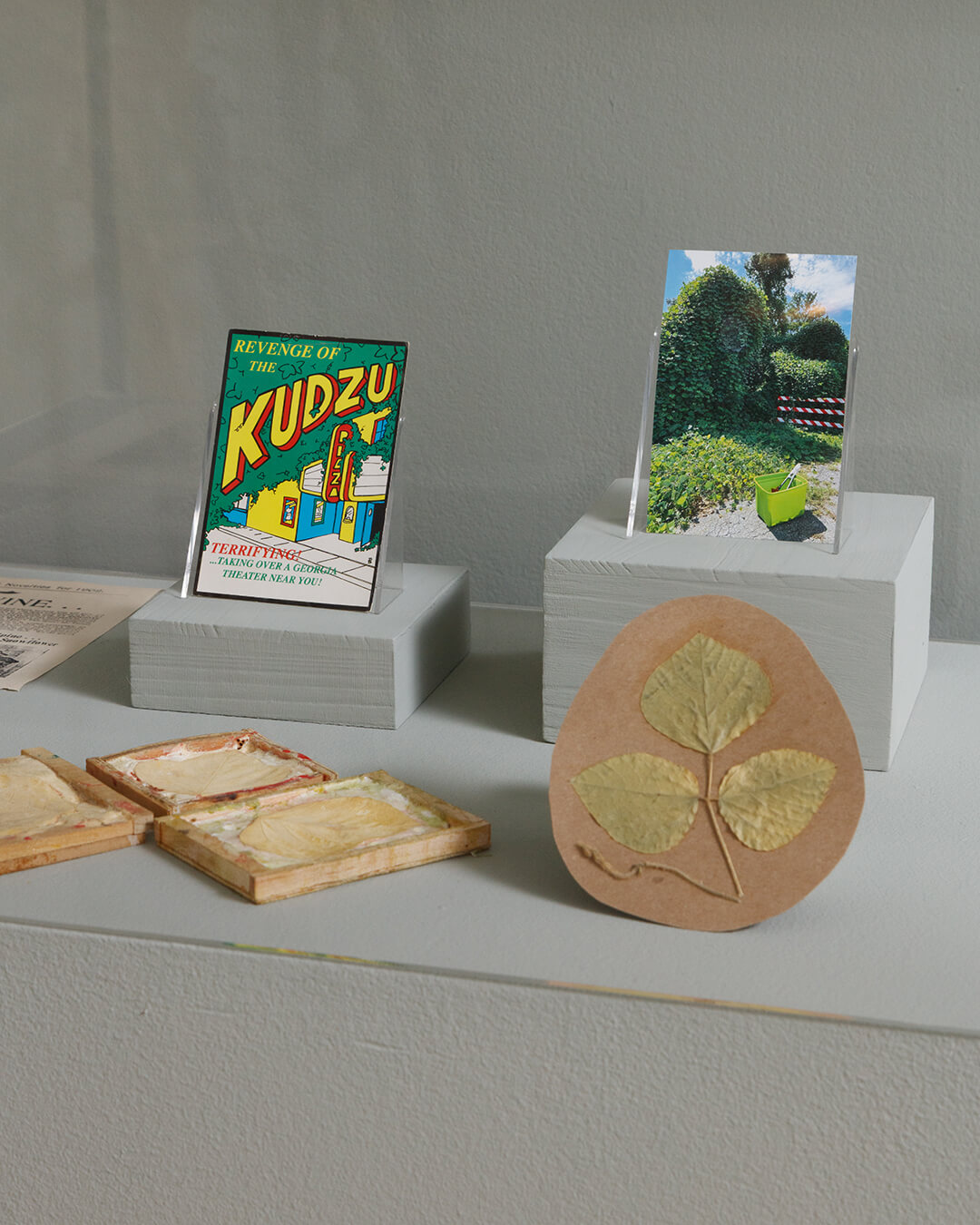
In her Kudzu Series, Lin explores the fast-growing, invasive species of vines that have come to cover large swathes of landscape in the American South. The imagery represents Lin’s most technically ambitious project to date, anchored in the cultural mythos of the kudzu vine. Famously nicknamed ‘the vine that ate the South’, it spreads aggressively in coiling tendrils, choking everything that comes in its path of sunlight. Introduced from Japan in the late 19th century, it arrived as an outsider and has since become an icon of the southern landscape in the United States—appearing in art, music and literature as both a symbol of excess and of resilience.
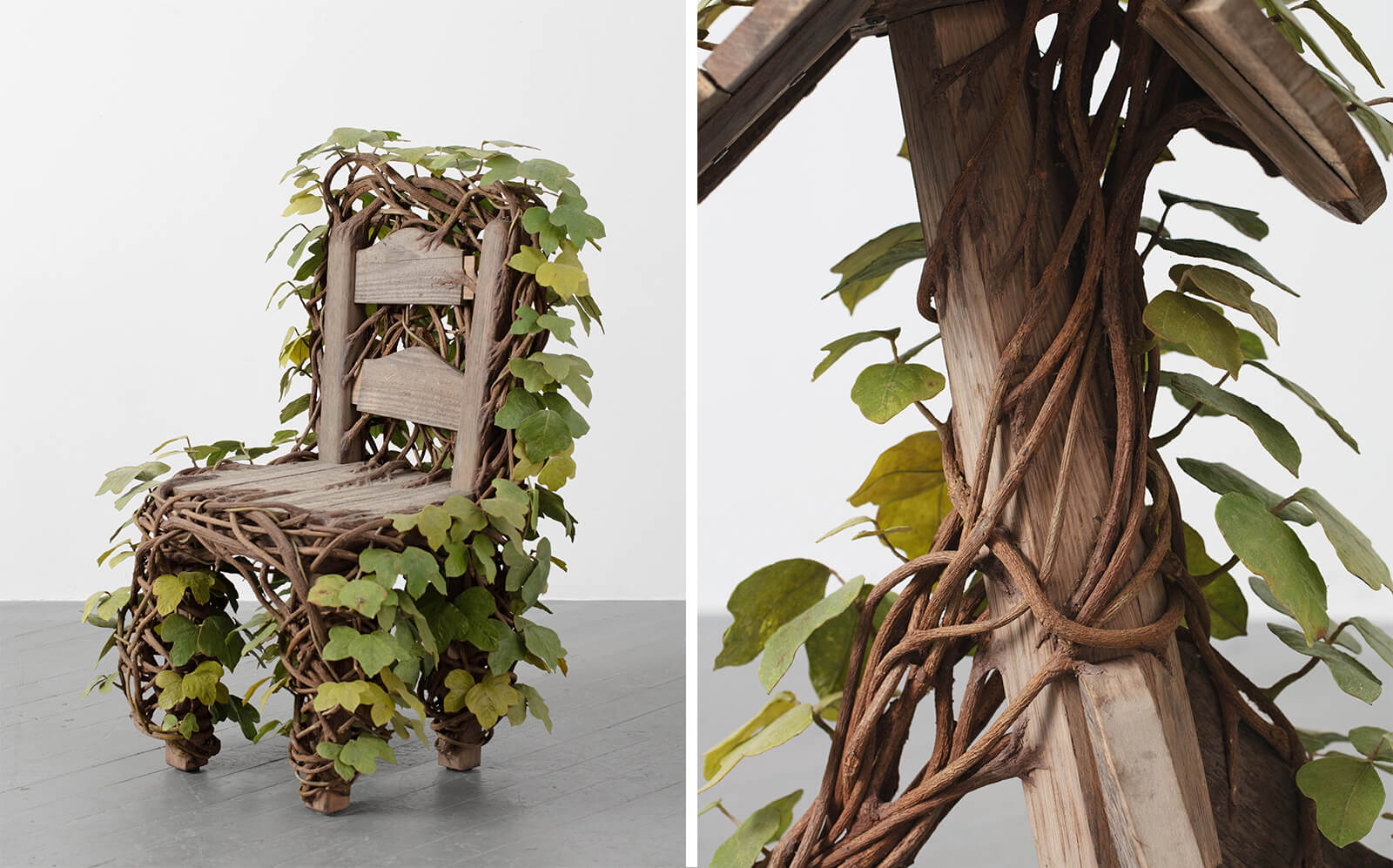
Growing up in Birmingham, Alabama, Lin encountered kudzu as an ordinary feature of the natural landscape. It was only through working with the plant directly that its deeper potential revealed itself to her. “The history of the kudzu vine is fascinating, but I didn’t fully grasp how it could take on any shape, both literally and metaphorically, until I began harvesting it myself and weaving it around my structures,” she tells STIR. “The vine’s physical properties opened up possibilities for adding storytelling details, like how the vine could ‘eat into’ the furniture, or begin to grow its own freestanding structure.”
I think the project shifted toward themes of resilience and adaptability, largely due to my evolving relationship with the materials. I was adapting to the materials, and they were adapting to me. – Joyce Lin
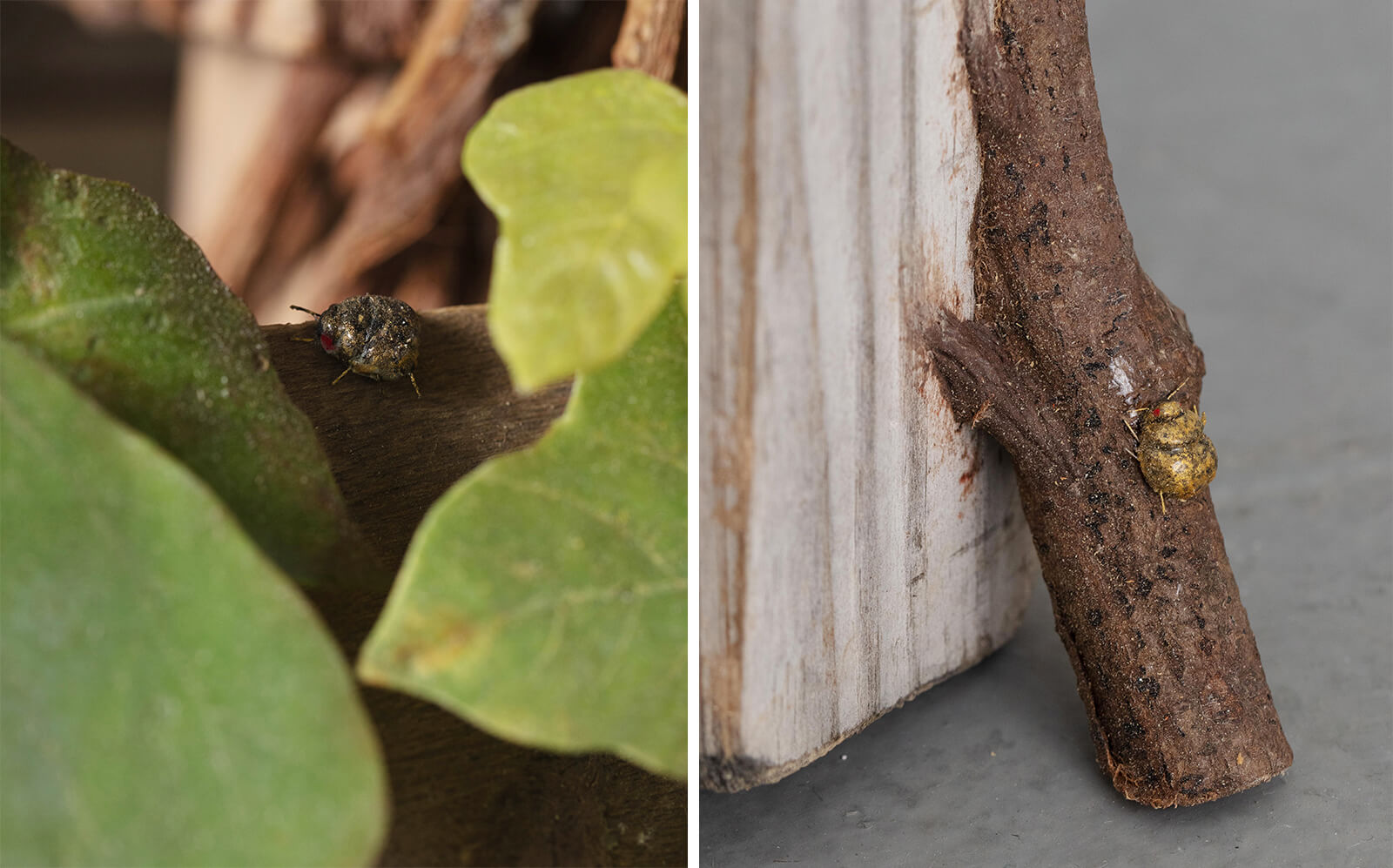
For the series, Lin harvested thick, woody vines from the Houston area and wove them around the furniture, incorporating concealed steel supports where necessary. She cast and hand-painted hundreds of leaves, embedding subtle imperfections and tiny resin kudzu bugs to create a microcosm that feels realistic. “Working so intimately with organic materials, watching them shrink and dry and lose colour, while emulating their appearance at the same time, made me more attuned to the transitions between life and death,” Lin adds.
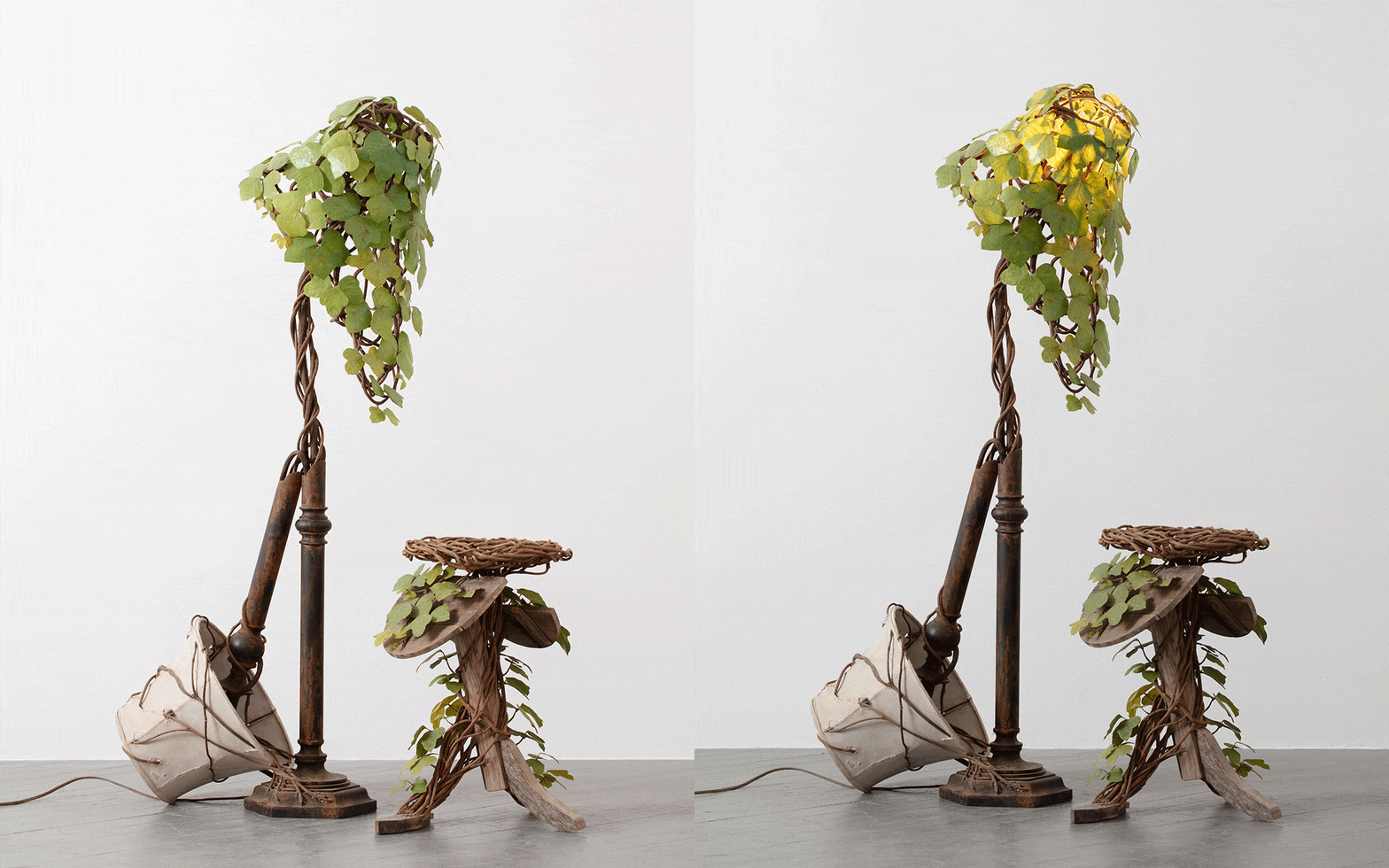
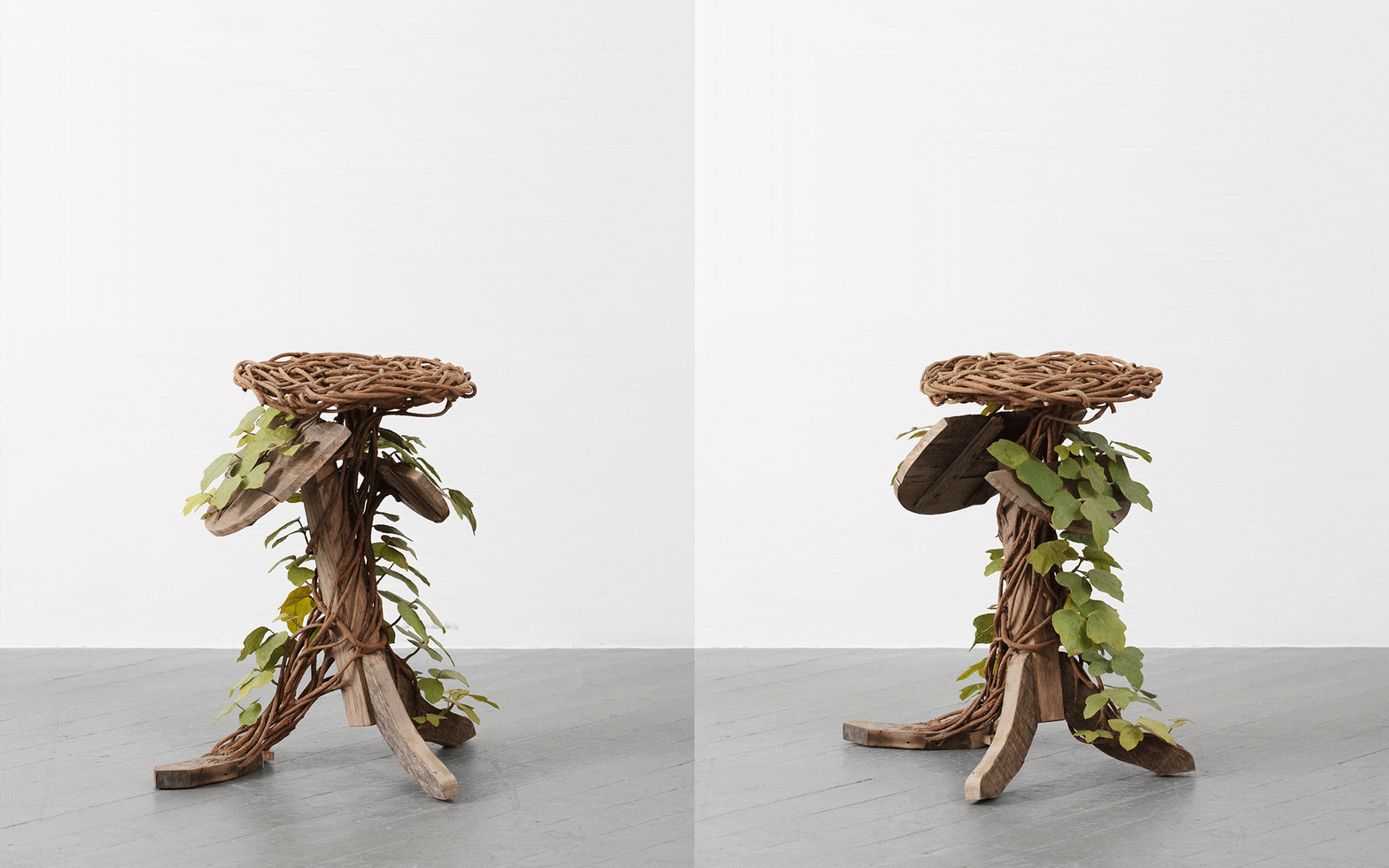
Neither fully natural nor entirely artificial, the works on display at Hypernatural occupy a space where reality feels stranger than fiction, inviting multiple readings; their meanings as entangled as the vines themselves. “I think viewers can find any interpretation they want in the work, which is perhaps the amorphous power of kudzu,” Lin shares with STIR. “But I hope they appreciate the nuances—that the plant is neither fully good nor bad, just like us.”
‘Hypernatural’ by Joyce Lin is on view from November 3, 2025 – January 9, 2026, at R & Company, New York.

by Pranjal Maheshwari Oct 23, 2026
Co-authored by Jareh Das, Chairman traces the British designer’s fixation on chairs as symbols of power and identity and as mediums of expression and community building.
by Mirra Lynn Oct 22, 2026
The curators behind Palestine Design Week 2026 reflect on its intent, considering how design holds memory, makes space for loss and imagines a future in Palestine.
by Chahna Tank Oct 22, 2026
STIR speaks with the Mumbai-based type designer about her practice, type walks and why she wants more people to have stronger opinions about Indian-script fonts.
by Jincy Iype Oct 15, 2026
STIR explores craft, material intelligence and people shaping Indian design through dialogues with Design Democracy’s co-founders and the curators of its special exhibitions.

make your fridays matter with a well-read weekend
Enter your details to sign in
Don’t have an account?
Sign upOr you can sign in with
a single account for all
STIR platforms
All your bookmarks will be available across all your devices.
Stay STIRred
Already have an account?
Sign inOr you can sign up with
Verification link sent to check your inbox or spam folder to complete sign up process
Tap on things that interests you.
Select the Conversation Category you would like to watch
Please enter your details and click submit.
Enter the 6-digit code sent at


Joyce Lin spotlights furniture design's Hypernatural dimension in a New York show
by Chahna Tank | Published on : Dec 22, 2025


 Sign in with Google
 Sign in with email
What do you think?