Architecture05 mins. read
Atelier Deshaus creates undulating terraces for Qintai Art Museum in Wuhan, China
by Jerry ElengicalApr 30, 2022



by Simran GandhiPublished on : Aug 26, 2024
Contemplated as a living fossil and a testament to the enduring power of nature, the ginkgo tree is a symbol of hope and longevity. From the serene temple gardens of China and Japan to the urban landscapes of today, ginkgo is revered for its resilience and timeless beauty. The tree serves as an inspiration for the Ginkgo Gallery, an art museum designed by Amsterdam and Shanghai-based MORE Architecture, nestled amidst a grove of ginkgo trees on an island in a manmade lake in Jiaxing, China. “We took the amazing colour of the ginkgo tree in fall as an inspiration in thinking about the colour and material palette for the building,” Daan Roggeveen, Founder of MORE Architecture tells STIR.


As visitors approach the Ginkgo Gallery, their journey begins with a symbolic crossing leading to the island over a curved bridge that seemingly allows them to walk on water. The island features a statue garden with a series of organic pathways providing space for outdoor exhibitions. Upon entering the art gallery, the spatial design unfolds in a way that "the courtyard and the covered gardens create subtle transitions between inside and outside," the design team shares. The building’s thoughtful orientation towards the waterfront and surrounding landscape design further maximises its connection with nature to augment a seamless extension of the island. “We tried to open the building up to the north side, so from the galleries there are uninterrupted views towards the water,” Roggeveen tells STIR. The gradual increase in the size and height of the exhibition spaces from south to north, coupled with east-west running ‘streets’ that bring in natural light, allows visitors to experience a dynamic and immersive journey.


Challenging the conventional museum design, Ginkgo Gallery merges two traditional typologies - the structured approach of a guided museum with the freedom of a free-flow plan. It probes the essence of the local Zhejiang village to conjure the experience of exploring a small town, with a variable network of fluid spaces. MORE Architecture crafted these adaptable spaces to include museum halls, an auditorium, a reading room and a workshop space in an arrangement that enhances the museum’s role as a vibrant community hub and encourages diverse interactions with art and culture.


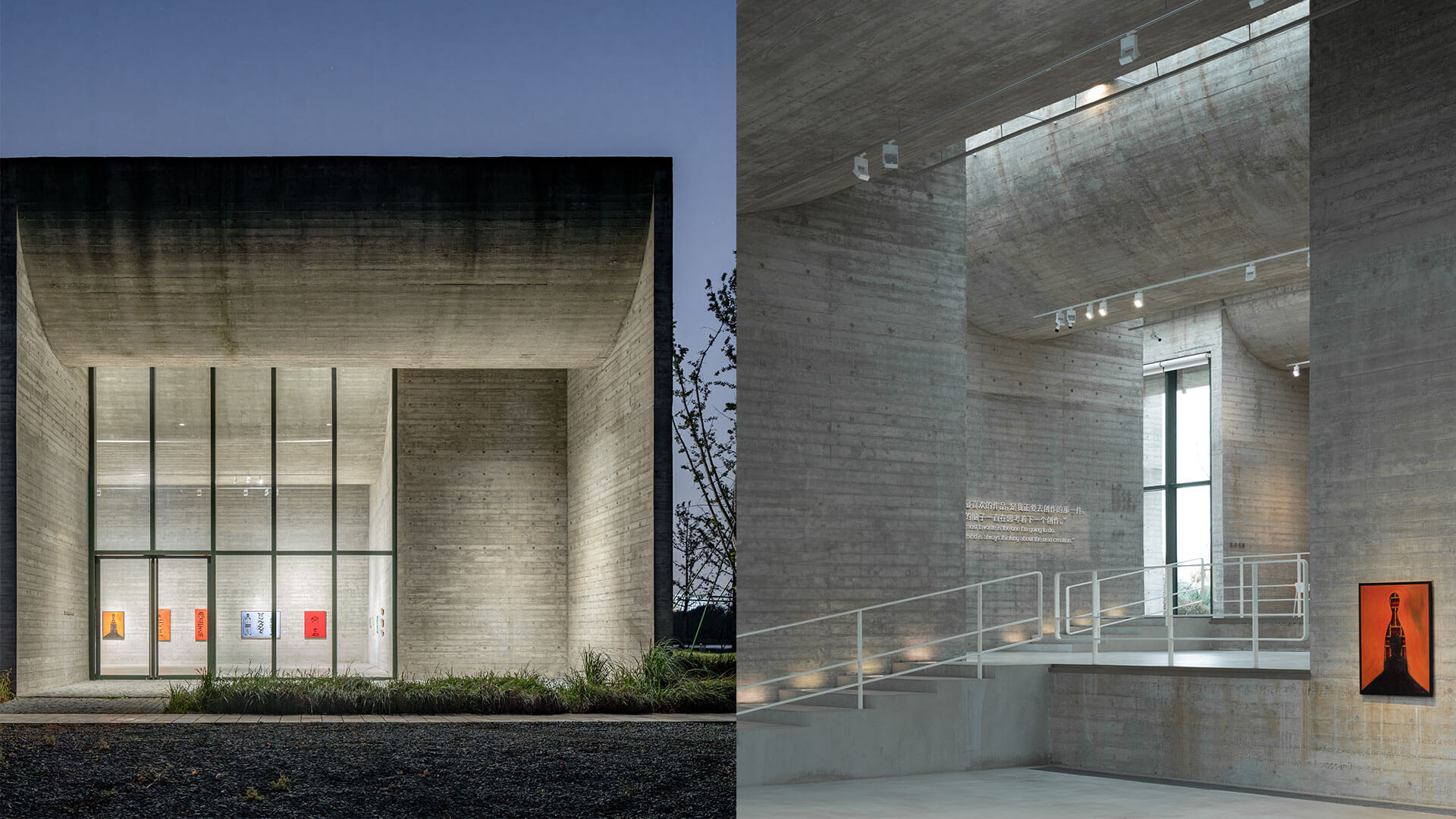
The design team restrained the materiality of the museum to in-situ concrete, with solid walls supporting the 17 metres of expansive curved slabs to achieve an austere façade design. “As opposed to the ‘museum as an icon’ phenomenon, we wanted to create a low-key, almost unassuming building with limited materials. Yet, we wanted the building to be robust and clear in its appearance,” Roggeveen comments on the choice of material for the building. “The concrete contrasts with its natural environment yet has a high tactility,” he continues. Demonstrating his commitment to sustainability, the Amsterdam-based architect minimised material diversity, transport movements, construction waste and packaging of material in his design.

The casting process of concrete architecture utilised scaffolding and rough wooden planks arranged horizontally, with the patterns left to the discretion of the construction workers. This low-tech method imbued the building’s surfaces with a rhythmic texture, where the imprint of the planks created shadow and depth. The raw concrete exterior is complemented by green aluminium mullions and warm beech accents in the interior, including customised furniture designs. Reflecting on a significant challenge faced during the low-tech casting method, Roggeveen shares, “We needed to be very precise with the position of MEP installations, everything had to be cast at once and we didn’t want to touch the walls afterwards.”

Ginkgo Gallery reflects the fusion of art and nature to create an immersive experience that transcends conventional museum design. It fulfils the client's vision of embedding art into public life, with a special emphasis on educating children in contemporary art. The brutalist architecture thus heralds a new paradigm in museum architecture, where the path into the building is as much a part of the experience as the art it houses.
Name: Ginkgo Gallery
Location: Jiaxing, China
Client: Di Yuan Art Gallery
Architect: MORE Architecture
Design Team: Daan Roggeveen (Design Lead), Robert Chen, Lina Peng, Pedro Martins, Emilio Wang, Mengyao Han, Anna Clement, Mae Szeto, Jeffrey Kuo
Structure/MEP/HVAC: 9LEON, Jiaxing
Contractor: Zhejiang Zhongcheng Construction Engineering Group
Façade: Shanghai Meite curtain wall Co Ltd
Surface Area: 2500 sqm
Year of Completion: 2024

by Pranjal Maheshwari Oct 19, 2026
The Mumbai-based architects integrate courtyards, mesh screens and north light trusses to create a dining space that doubles up as a community hub at SR University, Warangal.
by Mrinmayee Bhoot Oct 17, 2026
The Rotterdam-based institute centres the Indian Ocean as a network for exploring material histories and transnational links shaping coastal cultures, positing them as future models.
by Pranjal Maheshwari Oct 16, 2026
At the 2026 Stirling Prize ceremony, Mary Duggan with RUFF Architects, MAKER Architecten and Nakshabid Architects were felicitated for proffering quality housing and social equity.
by Mrinmayee Bhoot Oct 12, 2026
The new Centre for Contemporary Arts, fostering public engagement with art in Uzbekistan, is housed in a tram depot refurbished by the French studio, emulating local craftsmanship.

make your fridays matter with a well-read weekend
Enter your details to sign in
Don’t have an account?
Sign upOr you can sign in with
a single account for all
STIR platforms
All your bookmarks will be available across all your devices.
Stay STIRred
Already have an account?
Sign inOr you can sign up with
Verification link sent to check your inbox or spam folder to complete sign up process
Tap on things that interests you.
Select the Conversation Category you would like to watch
Please enter your details and click submit.
Enter the 6-digit code sent at


MORE Architecture's brutalist museum in Jiaxing embodies the grit of ginkgo trees
by Simran Gandhi | Published on : Aug 26, 2024


 Sign in with Google
 Sign in with email
What do you think?