Art09 mins. read
Skin of Dreams sees Shezad Dawood at his multimedia, multipassionate best
by Srishti OjhaSep 15, 2026



by Zohra KhanPublished on : May 12, 2026
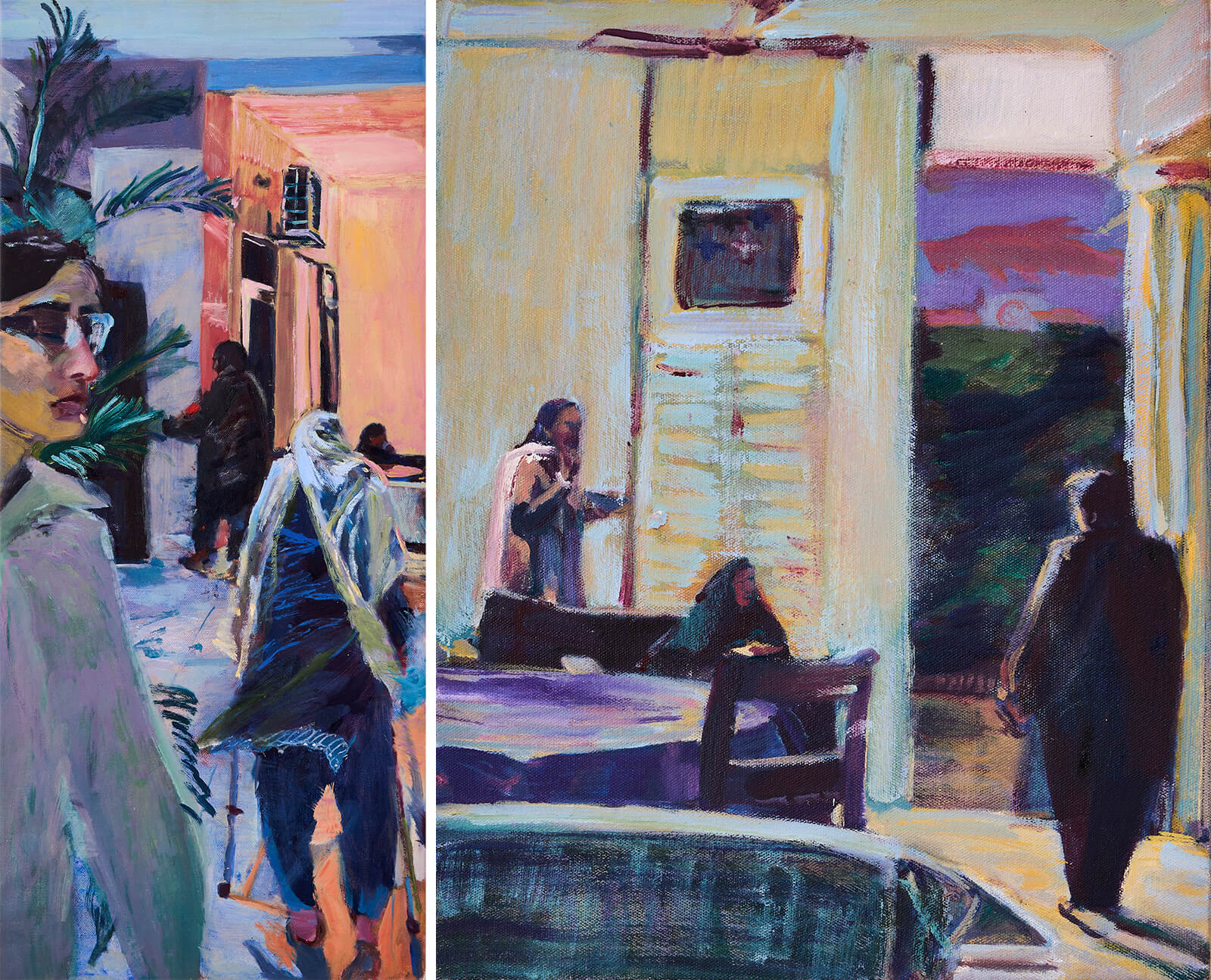
What is the version of home you remember when life carries you elsewhere? And what happens when the home is unmistakably South Asian—dense with the choreography of a joint family, in which hierarchy quietly dictates movement, speech and performances? A visit to the gallery Pristine Contemporary in Delhi to see Lahore-born, London-based artist Irum Rahat’s solo exhibition resonated on a lot of fronts. It offered a closer look at the dynamics of a Muslim South Asian household—one that felt uncannily familiar to me. The paintings carried the emotional weight of rooms I have known all my life: of a home that equally liberated and unsettled my worldview, where women didn’t know what rest meant, where silence signalled both comfort and restraint. Ye Kab ki Baat hai?, which translates to ‘When did this happen?’ brings together 16 paintings of familial environments drawn from the artist’s memory and imagination of her life at her Lahore home and what she left behind when she moved abroad for higher studies. Languid everyday scenes capture vignettes of definitive spaces from an indefinite past. Rooms recur, morph and reappear, and the effect is hauntingly tender: a meditation on how spaces endure inside us long after we have left them.
In a conversation with Rahat, we discuss her evolving series, the slipperiness of memory and what it means to navigate life and art as a South Asian artist living away from home.
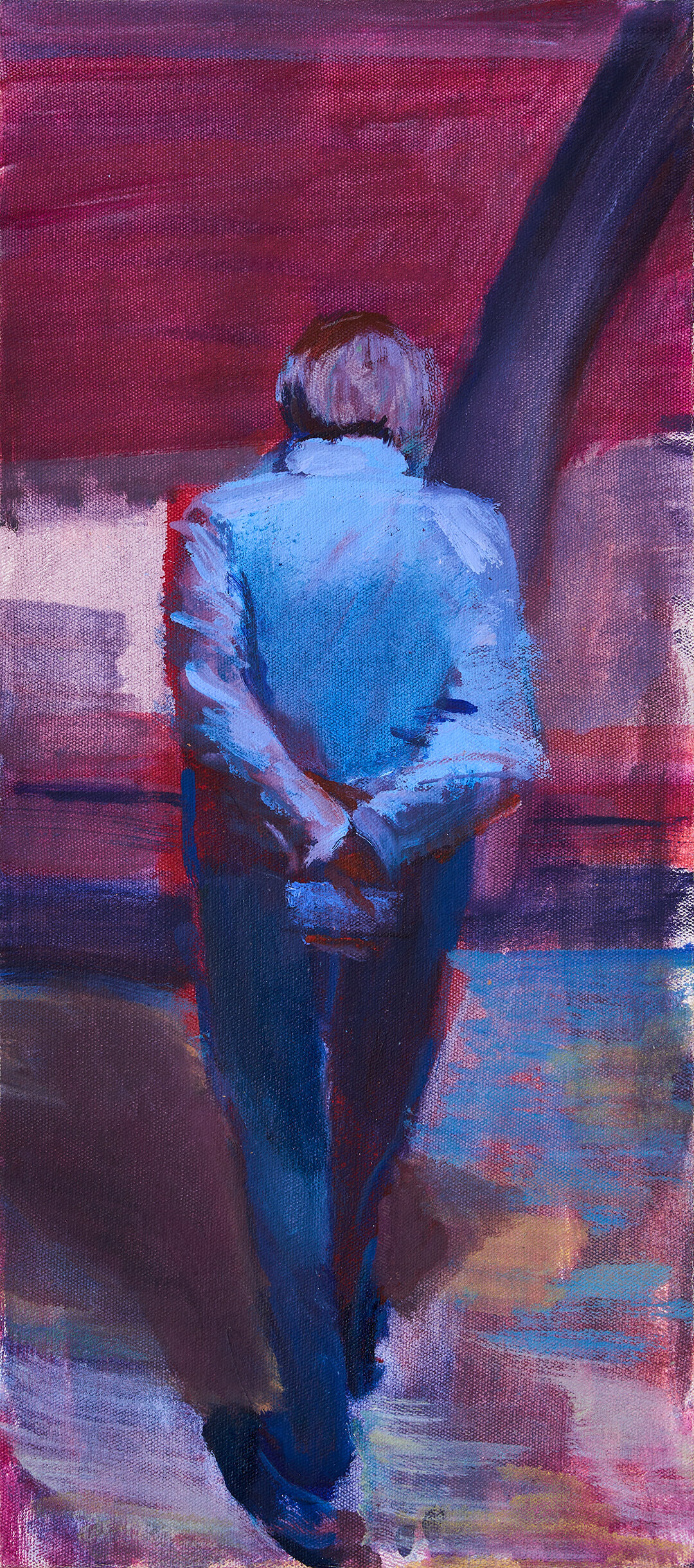
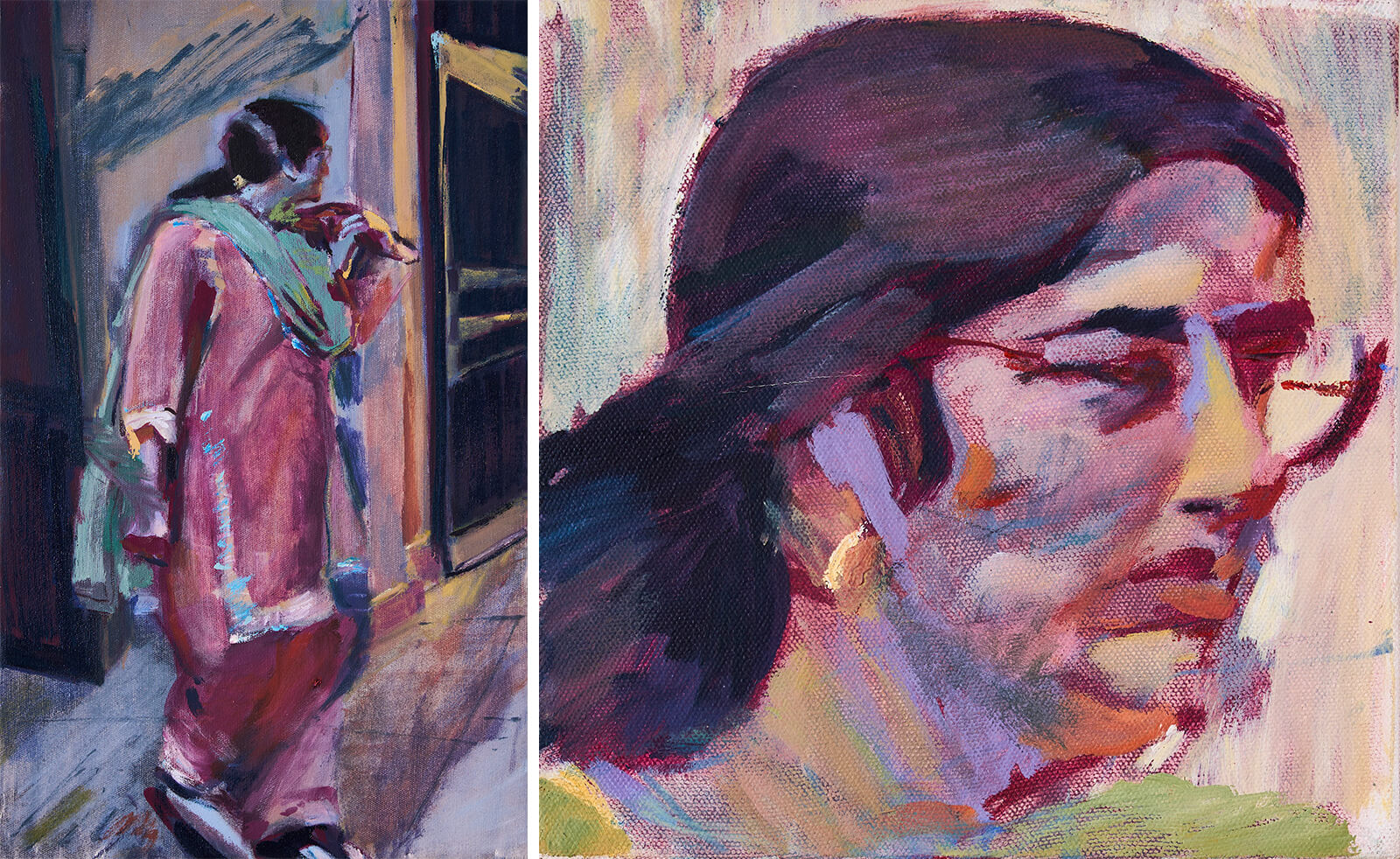
Zohra Khan: The first painting that caught my eye was the figure of your father, walking with his hands clasped behind his back. It stirred an immediate memory of my own father, hours before his cancer diagnosis. We were heading to the hospital, I was walking a few steps behind him, and in one instant, I caught the frailty settling into his legs and the slight droop of his figure, as though his body already knew something the rest of us did not. I lost him in 2018, but that image remains painfully fresh.
Irum Rahat: I am so sorry to hear that. These are, of course, dynamics because everyone has a particular relationship with their parents, good or bad. Because these are genre paintings, they are very much drawn from the life I live and have lived. And increasingly so, I think I've become braver about including more and more characters in the work, and I wanted that to be enunciated in the title too. Originally, I thought of naming it Man Walking, but then I thought, I want it to be known that this is a fatherly figure. And if people can put it together that it's my father, even better. Abbu is what I've called him growing up, which is why I named it Abbu, Walking.
Zohra: Now that I’m married and have moved away from home, I find myself paying closer attention to things I once only registered in passing—like the elaborate recipes my phupho (paternal aunt) shares on our family WhatsApp group, often just minutes after a phone call. What used to feel like background noise of everyday life has become something I now hold onto with unexpected care. There’s this idea that distance somehow brings you closer to home. Has that been your experience too?
Irum: I do think that, unfortunately, distance does make the heart grow fonder. Moving abroad specifically, it's a well-known phenomenon that your identity becomes heightened when you're away from what makes so much of it. That fondness grew when I moved for my master's. You start caring about the recipes. And then, when so much of the work spoke of home, you delve deeper, you become more intentional about everything that construtes home for you. Maybe age has something to do with it, too, but definitely moving away brings you closer home.
Zohra: Is there a story to why you chose to name the show, Yeh Kab Ki Baat Hai??
Irum: This body of work explores how I am thinking of home from memory and imagination, and what lies in between. Because it is a space I'm so familiar with, when I recall a certain memory of a certain space in my home, I frame it differently every time. When I first sat down with the concept, every time I opened my sketchbook, I would add a different detail about a particular space I wanted to paint, of an outdoor-indoor subliminal corner of my home. I thought it was a great starting point because that's exactly how it feels; you're in between realities. The title came from the fact that every time I revisited the same memory, it came with a different detail, a different person, a different outfit, different lighting. I'd ask myself: when did this happen exactly? I noticed the memory didn't follow a linear pattern; everything came in at once. Maybe I confused days; maybe even years. I also punctuated the series with some daytime pieces, the more indoor, reddish works you saw in the show. And in revisiting those memories, I returned to my diary, where I keep notes of random things people around me say. Funnily enough, the phrase Ye Kab ki Baat Hai? (When did this happen?) is something one of my family members says quite often and I felt it fit really well with the concept I was exploring.
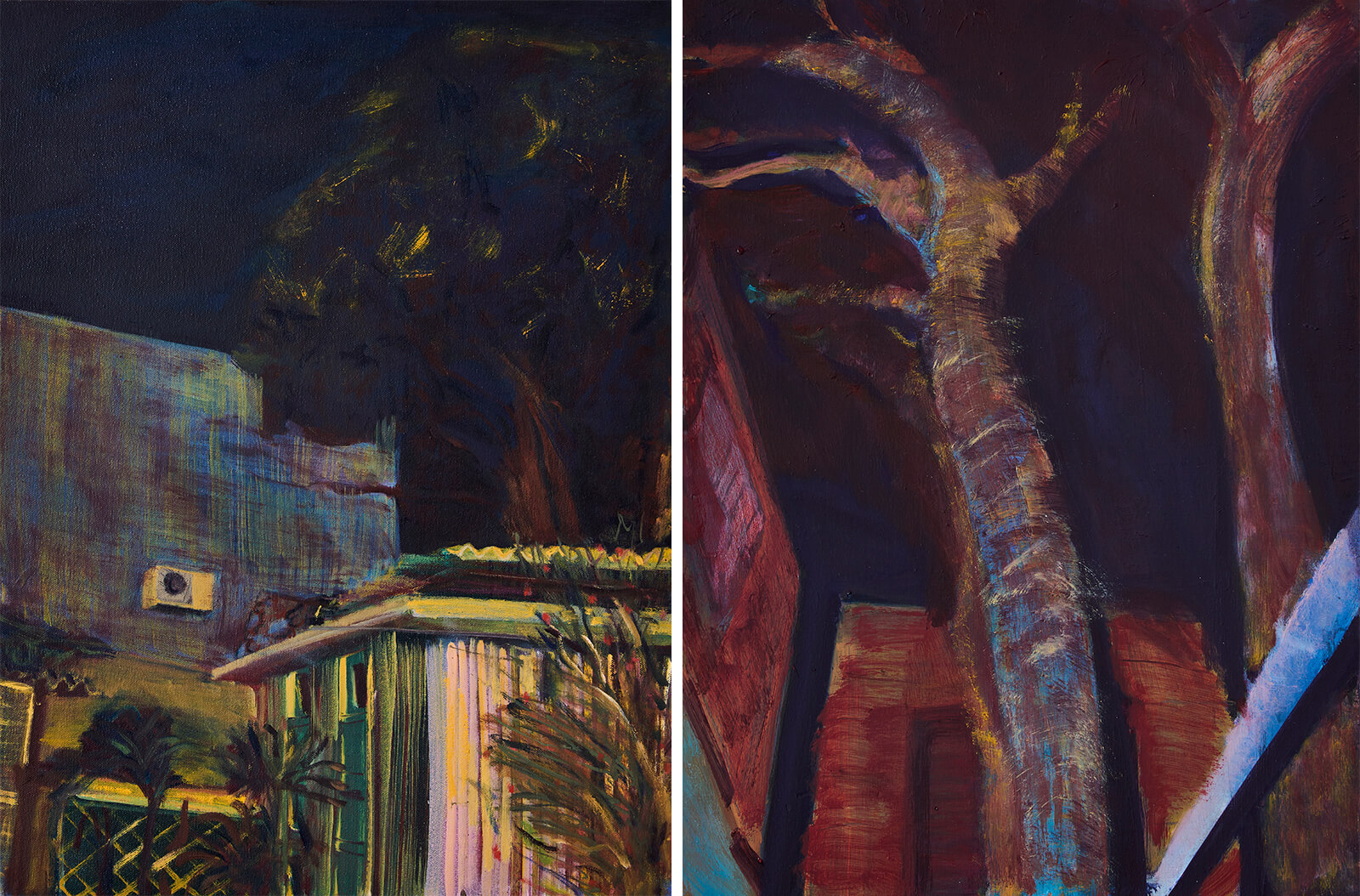
Zohra: Most of the paintings unfold at night, and I found myself deeply relating to that. In so many South Asian households, nighttime carries its own emotional texture—conversations stretch longer, routines soften, people become more vulnerable, more themselves. Growing up in Delhi, I’ve felt that same shift within my own home: the day belonged to structure and performance, but the night allowed other kinds of intimacies to surface. What was life like for you in Lahore, especially within the rhythms of home after dark?
Irum: In reference to what you said, with the nocturnal paintings, it was very similar and still is. Once the work was done, there was a ritual; everyone would come home, and we would have dinner together. Dinner was a big thing growing up. It was important that everybody show up, which is why nighttime was buzzier. The nocturnal scenes also capture a specific walk we used to take around the house after dinner when that energy from the dinner table spills outdoors. That ritual is very much a part of my memory. And I think that's what a lot of memory is, these compartmentalised rituals that I saw growing up, which I even try to recreate to some extent now, building my own life abroad.
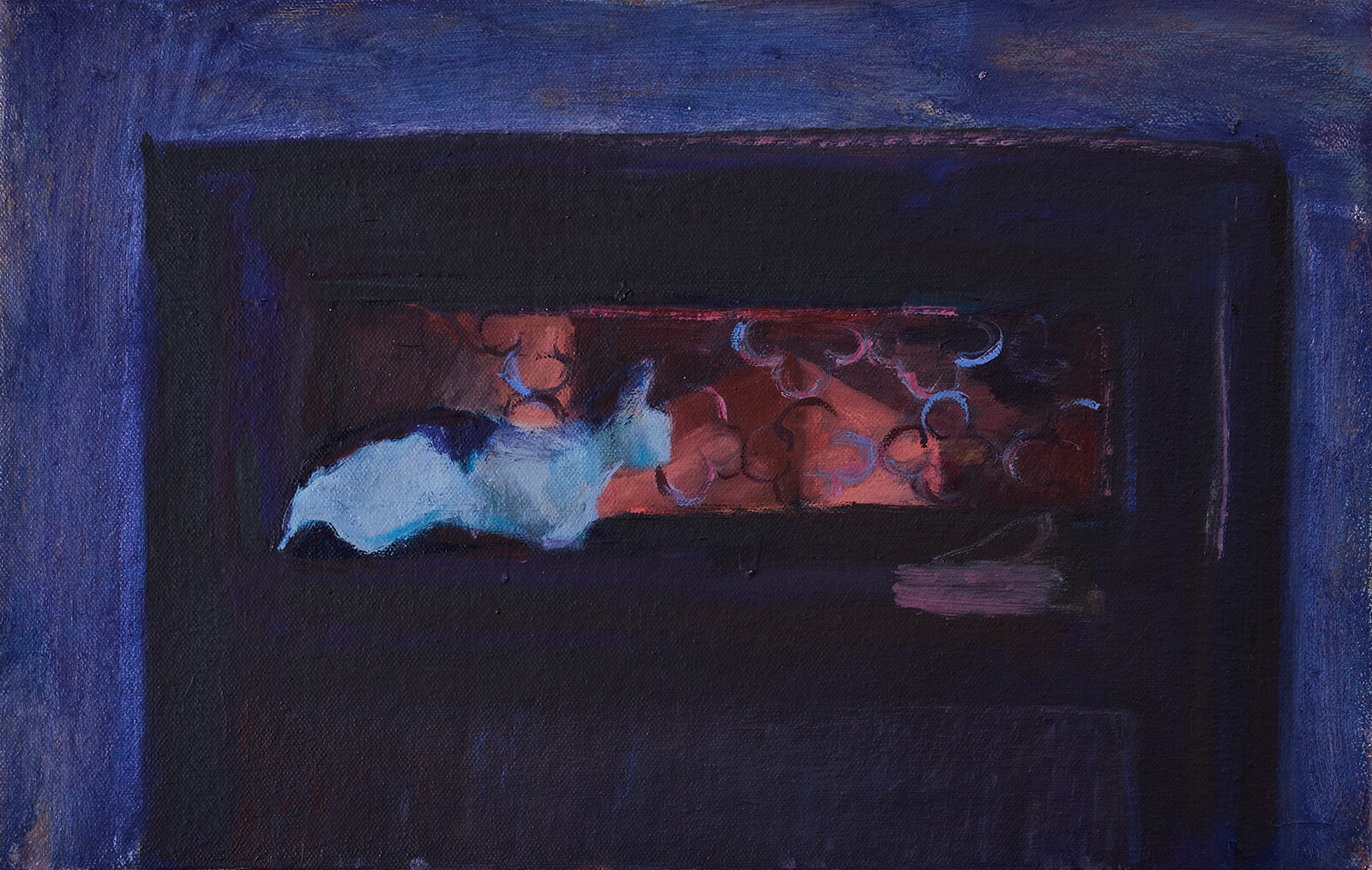
Growing up was quite family-oriented, and the emphasis was always that people around you matter. I think the work glimpses into that, too. I'll also say that I try, at least in my work, to give space to what is considered unimportant as well. For example, alongside the nocturnal scenes with people, I've also painted more overlooked scenes, such as the cat painting, capturing neglected corners you don't even notice. And the daytime scenes where women are simply doing what they need to do; sometimes that's work, sometimes it’s not. I try increasingly to make those works, as a continuous series, because I think it's important too. For so long in South Asia, we have very easily dismissed anything and everything a woman does. To counter that, I try to give those moments space in the work. Even if they're just lounging, we're going to give that a sense of permanence in the painting, because god knows they can't lounge forever.
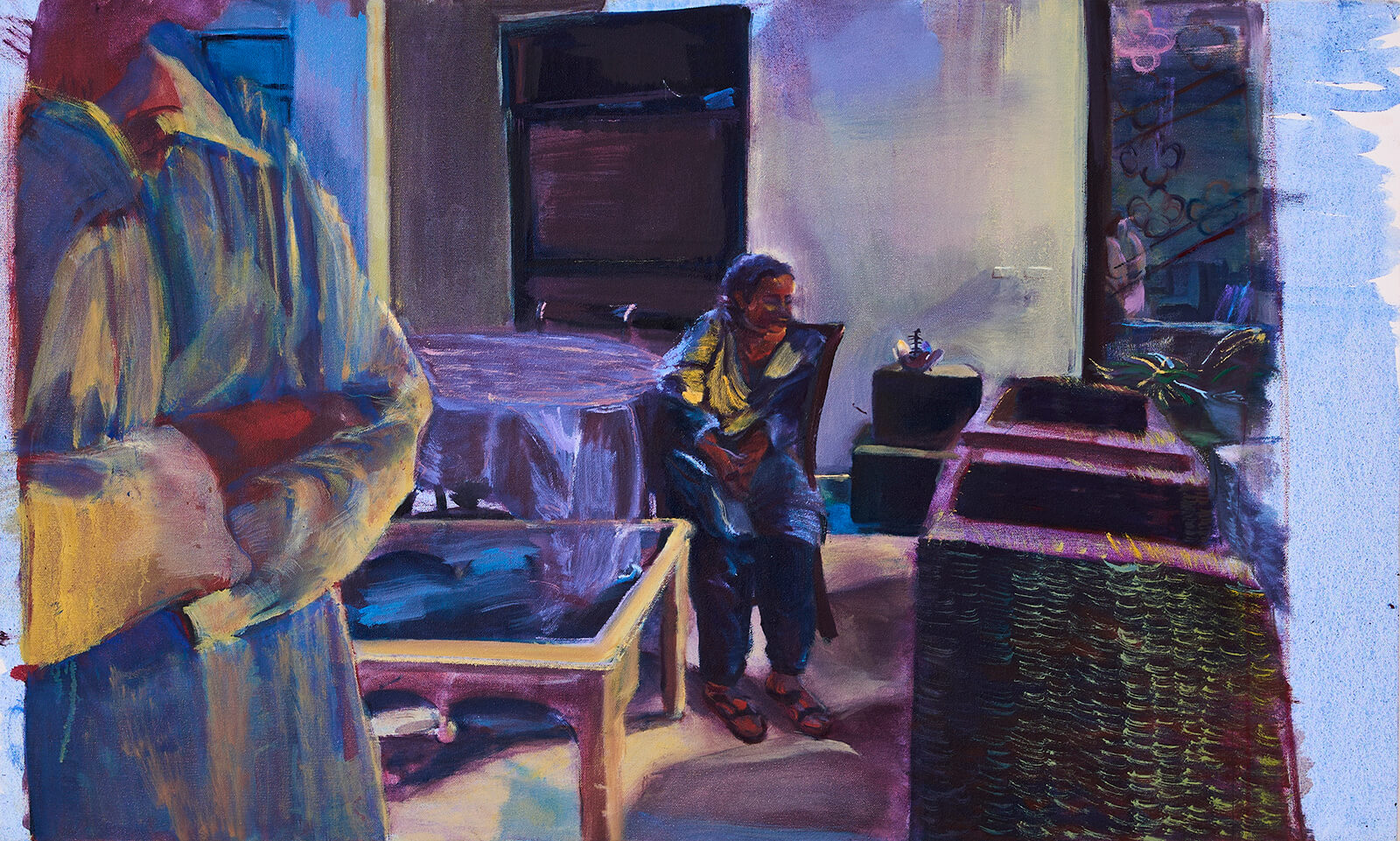
Zohra: There's one painting in particular—a woman seated on a chair—that stands out. It feels like dinner is over, and she has slipped into a quiet moment for herself.
Irum: Women are always preoccupied with the thought, ‘what now?’, ‘what's next?’, ‘does anyone need anything?’ There's this constant anxiety that doesn’t let them sit still, even if they want to, which is also why showing these slower moments, without that restlessness, feels important. I think it undoes a lot of the performativity that women have had to keep up, which we see in European paintings too, where there's a certain kind of woman required to inhabit the canvas. I try to undo that a little bit.
Zohra: There are multiple figures in the scenes, but the people aren't really in conversation with one another. Many share the same space, but they seem to be on their own.
Irum: Yes, I think that's intentional. Even in how I've shown the figures, there is a certain disconnect, and that disconnection exists within the figures themselves, too. They're very much with each other, and yet everyone is also self-possessed, focused on the periphery of their own self. Blinders on, but also blinders off, because you can see that so much else is going on around them. I think the nocturnal setting enhances that quality too. There's something almost romantic about that in our culture, and it’s true that nighttime is when your guard comes down, your performance fades. It's just human nature.
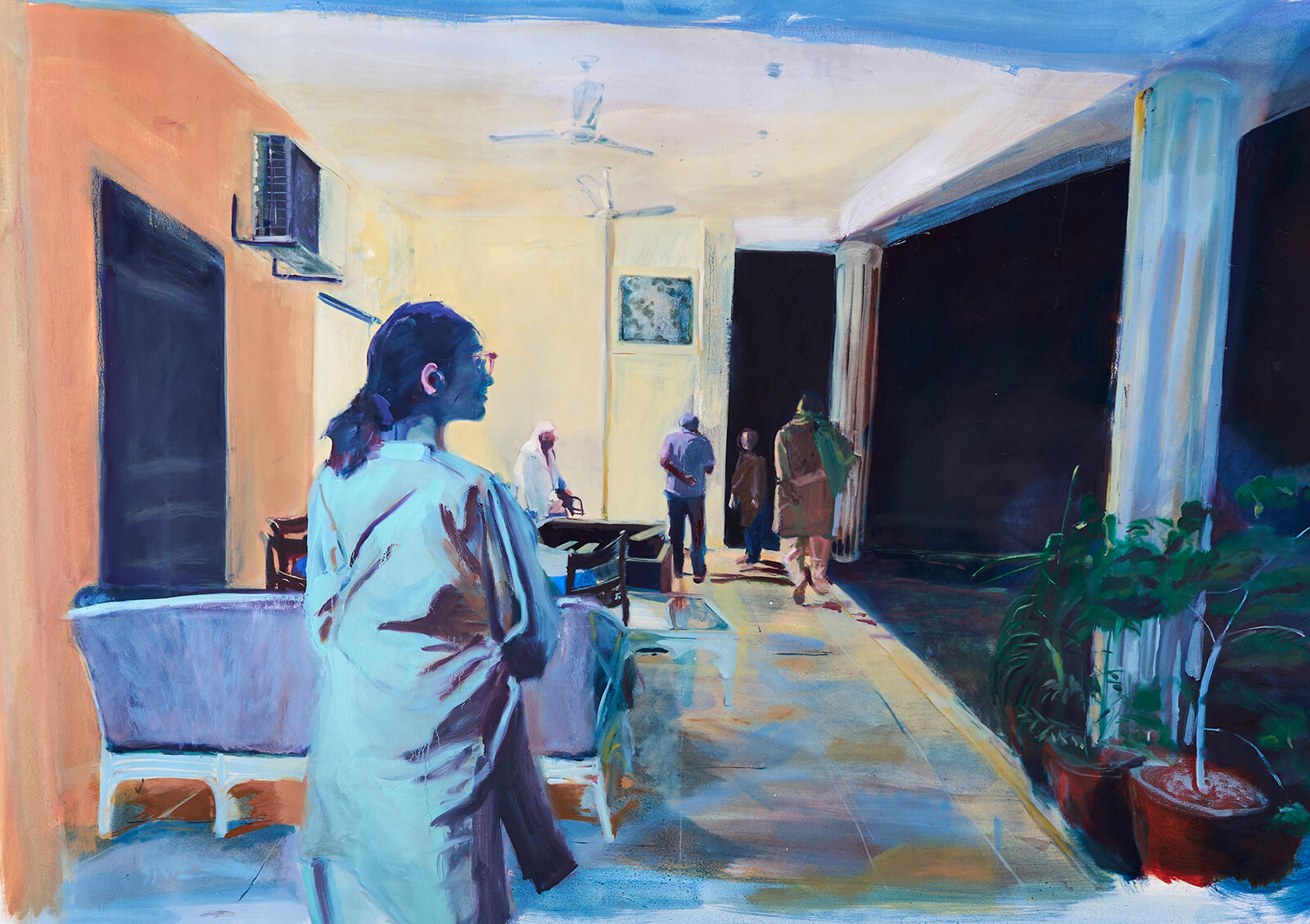
Zohra: Speaking of gaze, there's one that feels intentional: a figure looming in the corner, either looking into the scene, sometimes almost out of it. Is this to enhance the cinematic aspect of the work? Why did you decide to bring that figure in? I was told it's you.
Irum: It's not me, but I do use that figure as an extension of myself. It's my sister. I've used her motif before in my work as an extension of my own gaze, or my placement within a space in relation to the other characters. It's just easier; I know her best, so it's almost second nature, second skin. She's become this recurring motif in my work: on the periphery of things, but not really within. And I think that enhances exactly what I was saying earlier; you're in it, you're connected and immersed, but you're also self-possessed, within your own bubble. The work then stops being just about one character or multiple characters; it becomes about the space and everything happening within it, which is also why it was important for me to leave some works without figurative characters at all, because the space holds memory too.
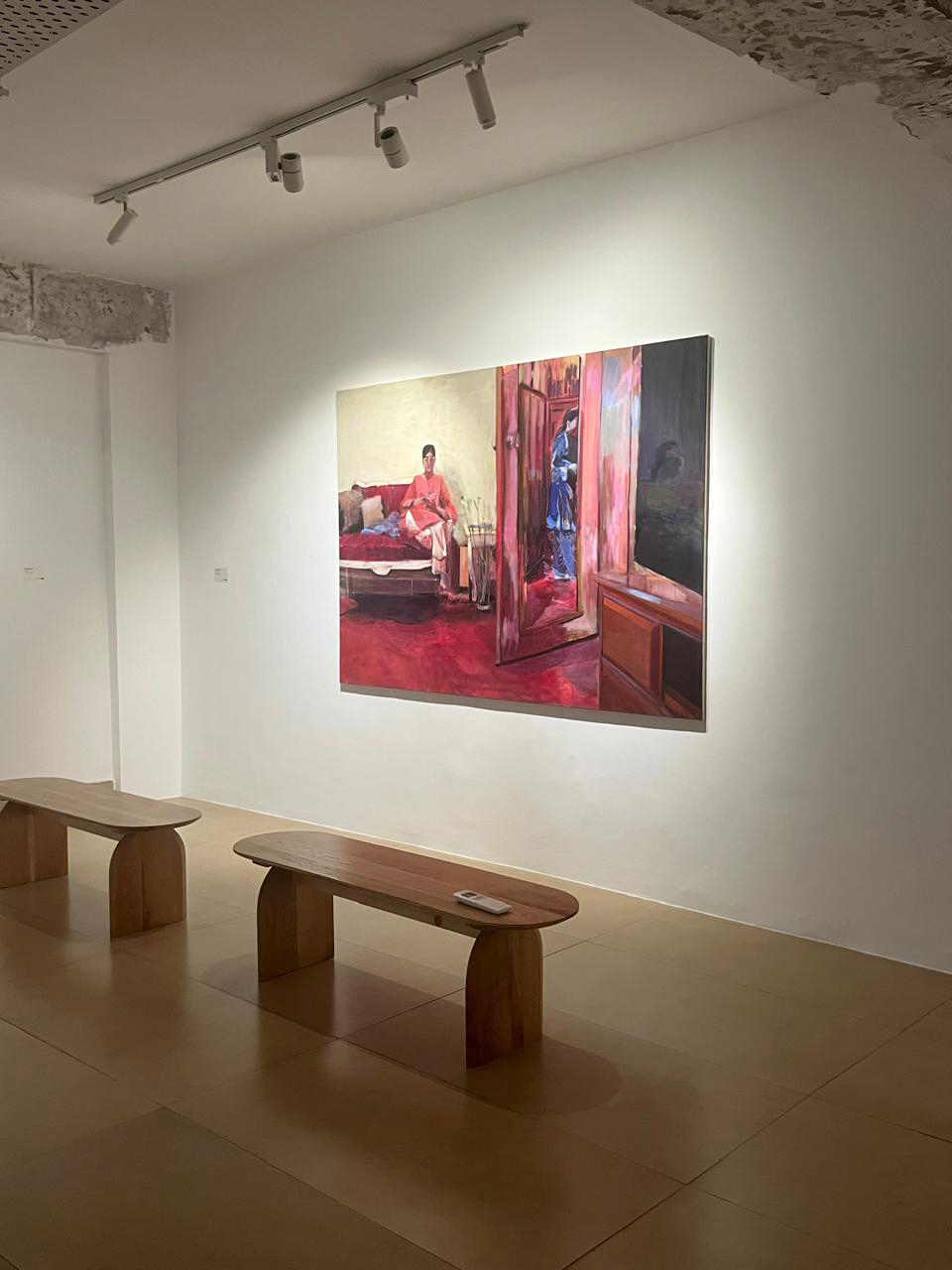
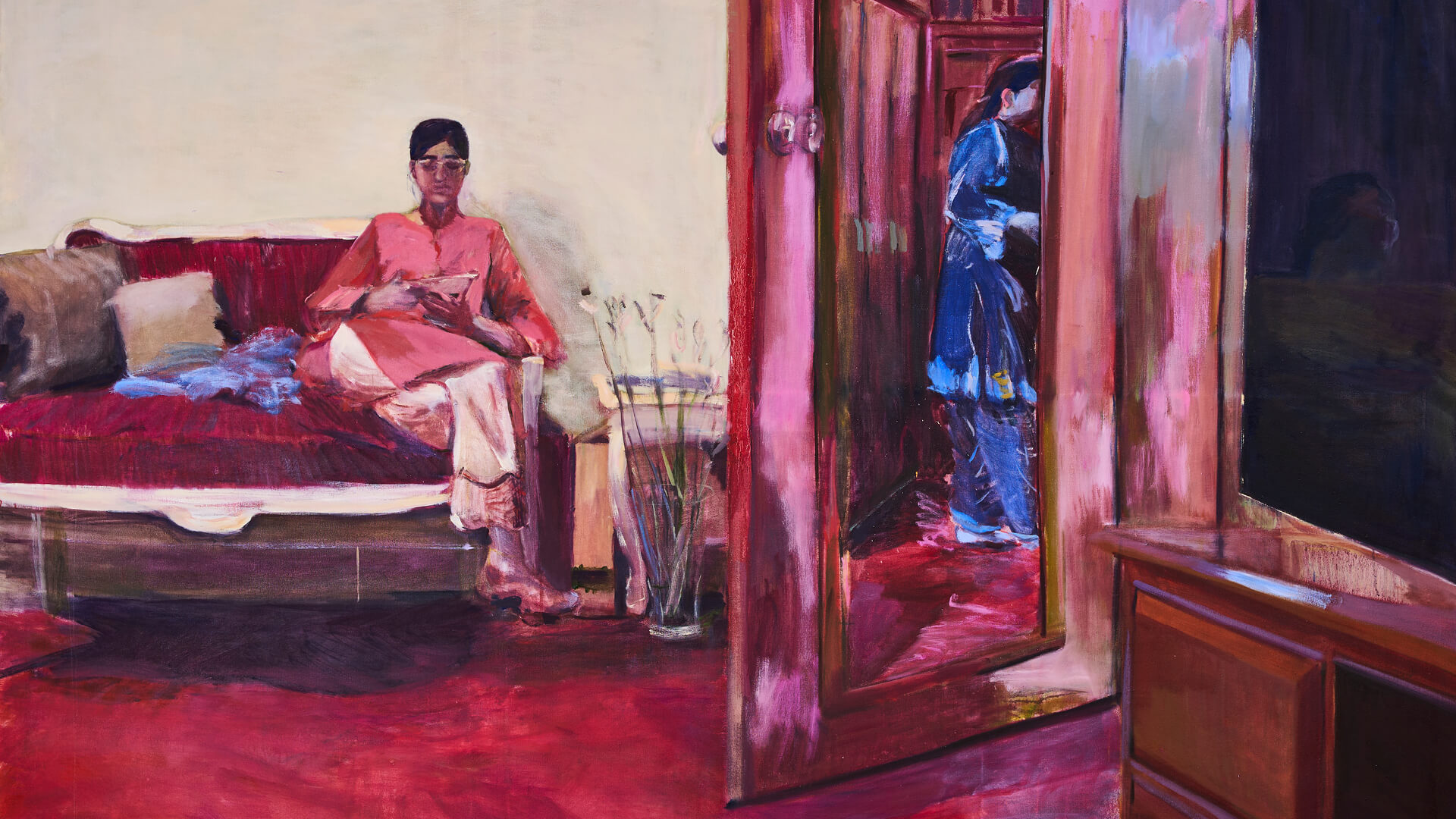
Zohra: The central painting, Offline—the one also featured on the posters, with its striking red, almost theatrical foreground—stays with me. Could you speak more about your thinking behind it?
Irum: In my view, there are really two main works in this show, which is why they used multiple images for the poster. One is Offline. The other is the nocturnal scene on paper, the nighttime work with the looming figure on the left, looking inward or away from the other characters. I chose these two as the centring pieces because one is nocturnal and one is daytime, one is outdoors and one is indoors; they're opposites. One is a lot more active in terms of its energy and relational dynamics. The other, the daytime one, is far more restful. I think that's a good culmination of my concept of women at rest, or them at least attempting rest. There's a woman you see immediately: sitting on the couch, eating something, but still removed from the onlooker. Then, if you notice on the right, there's a reflection on the TV screen, and further right, another woman doing something, cut off by the door. It alludes to what's happening around her, which is why I said ‘attempting rest’, because there's always some engagement looming around the corner. I think it's important that these women take up that space, because growing up, this wasn't considered work; it was just something that had to be done, not important enough to be classified as such. The discourse around this has changed a great deal in recent years, though there's still more to change. I wanted my paintings to become that space, specifically for these women, or for any woman who can relate, to simply exist within the work without the pressure of performance.
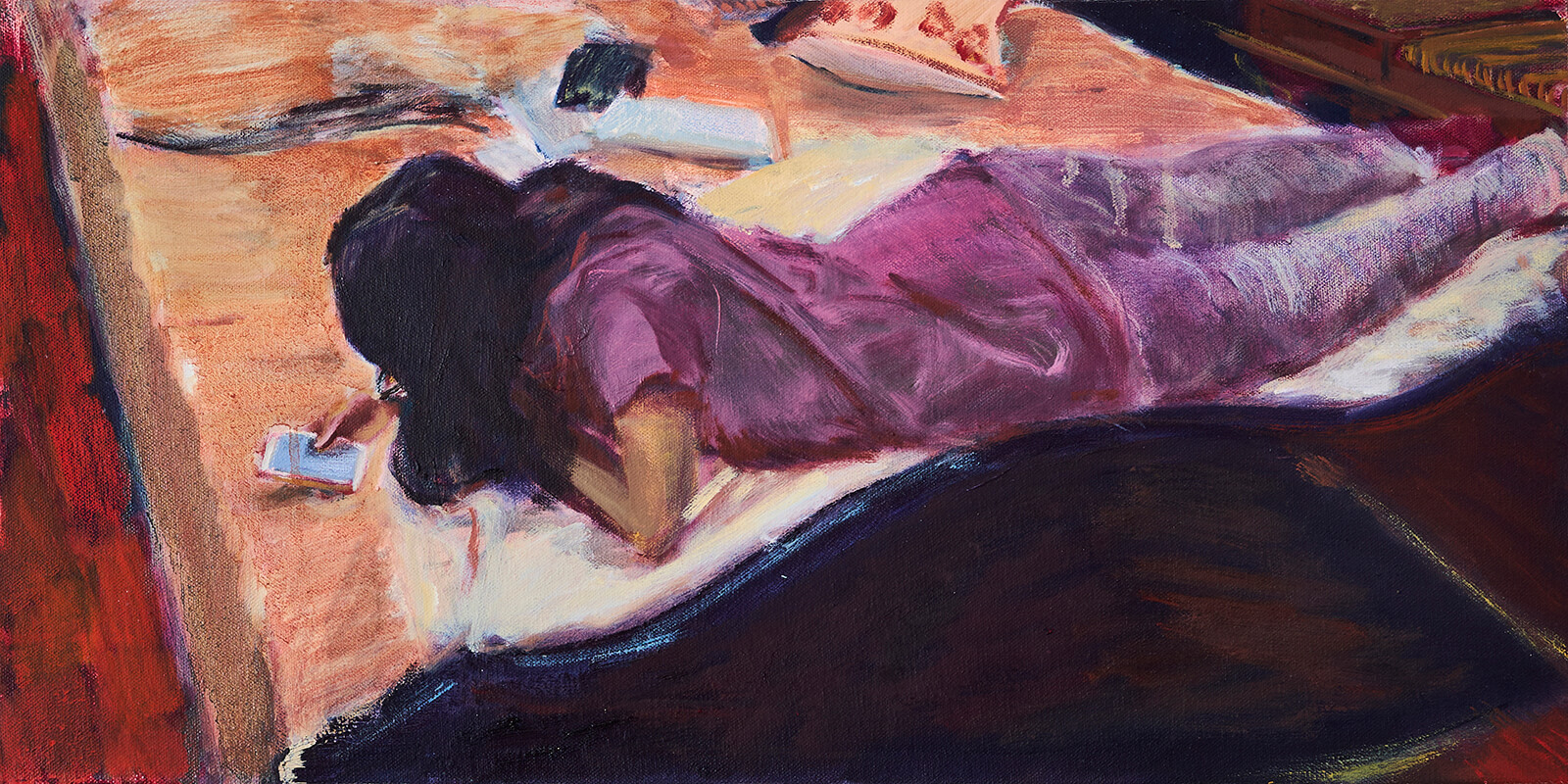
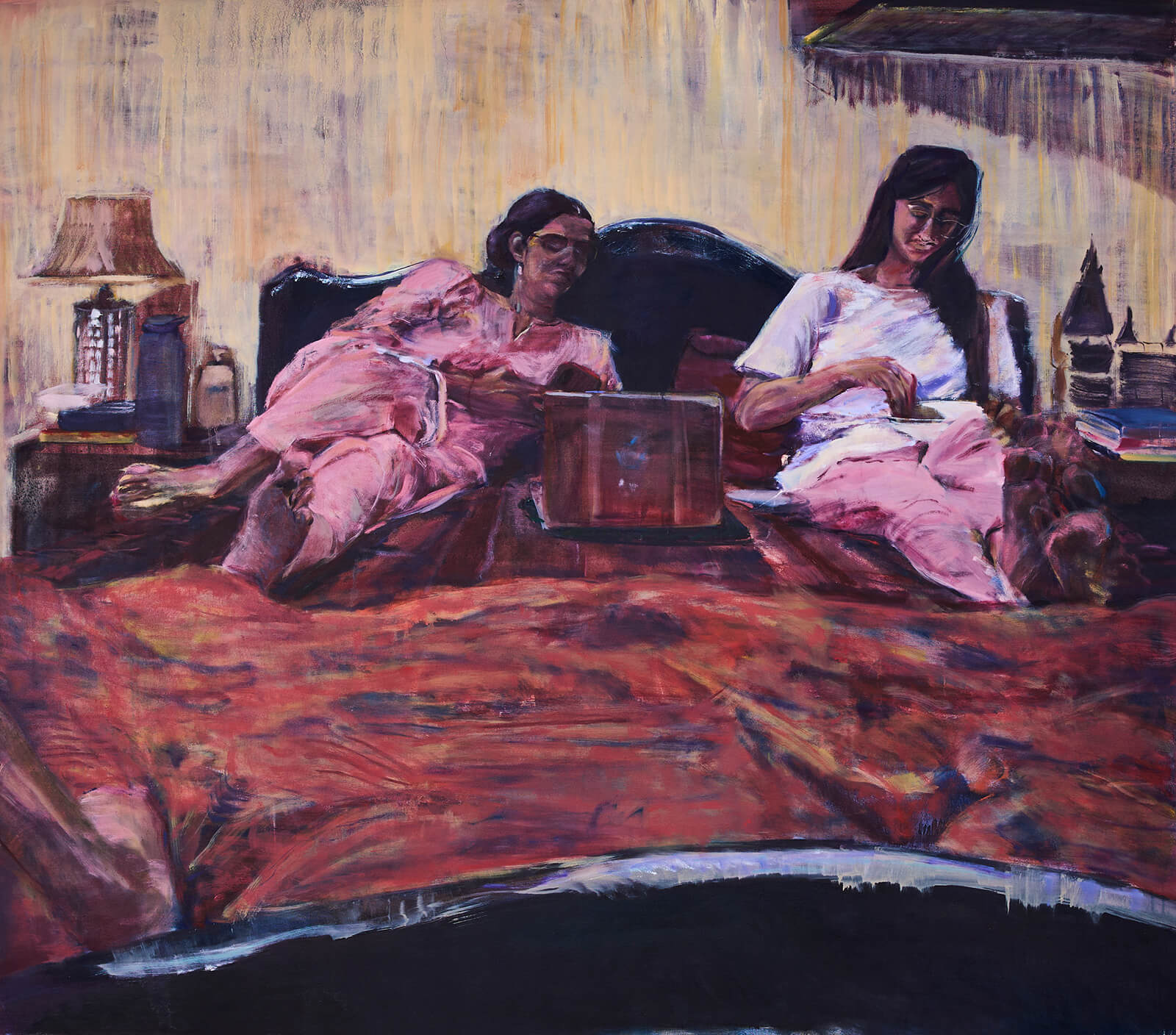
Zohra: You’ve previously described painting these moments as a form of quiet resistance. While your earlier work often explored labour and the overlooked architecture of domestic space, this series feels more immediate and contemporary, turning toward the intimate rhythms of everyday life—lounging in bed, scrolling through Instagram, sitting alone in thought. Could you talk about how your focus has shifted in this body of work, and what new themes you’ve been trying to hold compared to your earlier paintings?
Irum: During my MA, once a white woman asked me: "Why are you painting a woman and a cat in a brown house? Who cares?" And I said: "I care, because it's my story to tell." There's so much to say about European painting, what's considered important and what can be shown in oil, but that's exactly it. You don't get to decide anymore what's important. I get to decide it, because the brush is in my hand. That sense of resistance plays into everything, into colour, into what I choose to show and how much of it, in titles. For me, Abbu Walking was important as it's not just some man; it's my father, and it matters that his character embodies that space in writing too. Maybe that is also a form of resistance.
In this newer body of work, there's a lot more emphasis on what I'm able to remember of home, and also on what my imagination of home has become, because when you're living away, you do build a slightly more romantic version of it. The effort to remember, to imagine, to ask: ‘Is this a memory or is this imagination?’ ‘Did I live this, or did my father tell me this is what he did growing up?’ All of that coming together is what makes this body of work different, and hopefully a little more mature.
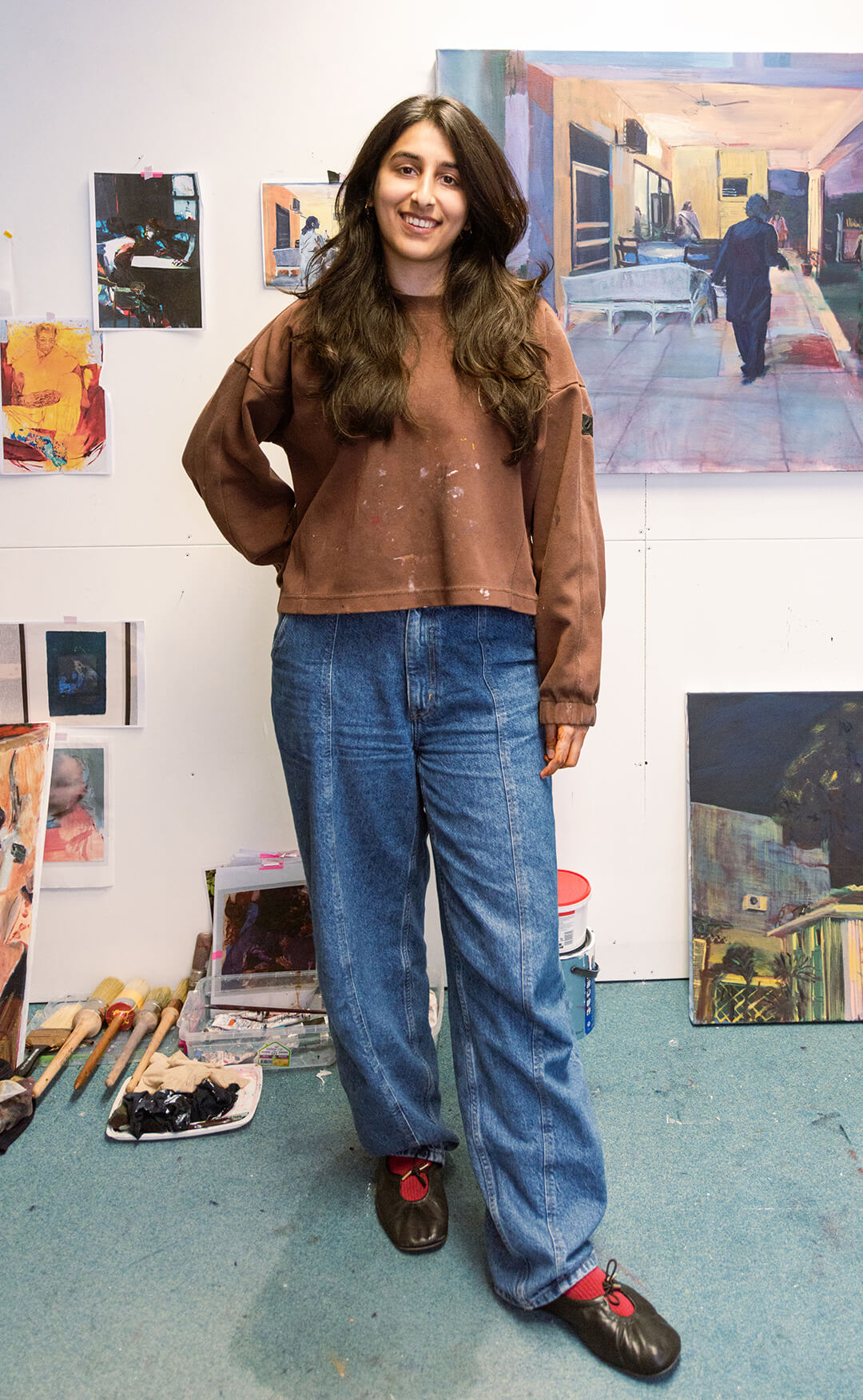
Zohra: Do you think in the future you'd want to move away from familiarity and explore more unfamiliar terrains?
Irum: For most artists, the overarching themes remain the same; it's the visual language that grows and evolves. So I think I'll be doing this for a while. But let's see; you never know where a certain memory takes you.
Zohra: What do you hope your work holds: for South Asian Muslim women, for women more broadly and for the art you are creating itself?
Irum: The most important thing would be for them to feel seen, for artists and audiences alike, to feel that you get to decide what's important enough to have space on a canvas. And then hopefully, the work travels, it goes places. For it to have that permanence is what matters the most, so that it is given the weight that ordinary life does not give it.
'Yeh Kab Ki Baat Hai?: Irum Rahat' is on view from April 23 – May 16, 2026, at Pristine Contemporary in Delhi.

by Srishti Ojha Oct 21, 2026
Increasingly, artists, filmmakers and activists are turning to VR to create more personal, tangible accounts of the climate emergency and its impact on vulnerable communities.
by Mirra Lynn Oct 20, 2026
The Indian artist paints the old wadas of central Pune, capturing the traces of everyday life that cling to these structures, battered by time but unbowed.
by Anmol Ahuja Oct 15, 2026
How do heaps of souvenirs and relics with racist Aboriginal motifs and features become art? MCA Sydney’s winter showcase—the artist’s largest to date—beckons a possibility.
by Vandana Kalra Oct 14, 2026
With his latest exhibition as a point of departure, the modernist discusses his decades-long practice, the spontaneity of drawing and the social responsibility of artists.

make your fridays matter with a well-read weekend
Enter your details to sign in
Don’t have an account?
Sign upOr you can sign in with
a single account for all
STIR platforms
All your bookmarks will be available across all your devices.
Stay STIRred
Already have an account?
Sign inOr you can sign up with
Verification link sent to check your inbox or spam folder to complete sign up process
Tap on things that interests you.
Select the Conversation Category you would like to watch
Please enter your details and click submit.
Enter the 6-digit code sent at


Irum Rahat on calling home and her tender meditation on South Asian familiality
by Zohra Khan | Published on : May 12, 2026


 Sign in with Google
 Sign in with email
What do you think?