Art12 mins. read
KNMA's The Meeting Ground brings diverse art histories into conversation
by Vandana KalraAug 17, 2026



by Deeksha NathPublished on : Nov 17, 2025
The Royal Academy of Arts’ (RA) latest exhibition, A Story of South Asian Art: Mrinalini Mukherjee and Her Circle, on view from October 31, 2025 – February 24, 2026, attempts an ambitious task: to narrate a history of postcolonial modernism in India through the intertwined lives and works of sculptor Mrinalini Mukherjee (1949 – 2015) and her artistic milieu. Bringing together prints, hemp, bronze and ceramic sculptures by Mukherjee alongside paintings, prints and sculptures by her parents Benode Behari and Leela Mukherjee, her teachers and mentors K.G. Subramanyan, Jagdish Swaminathan, Gulammohammed Sheikh, and her close friend Nilima Sheikh, the exhibition aims to trace a lineage of ideas and aesthetic exchanges across generations.
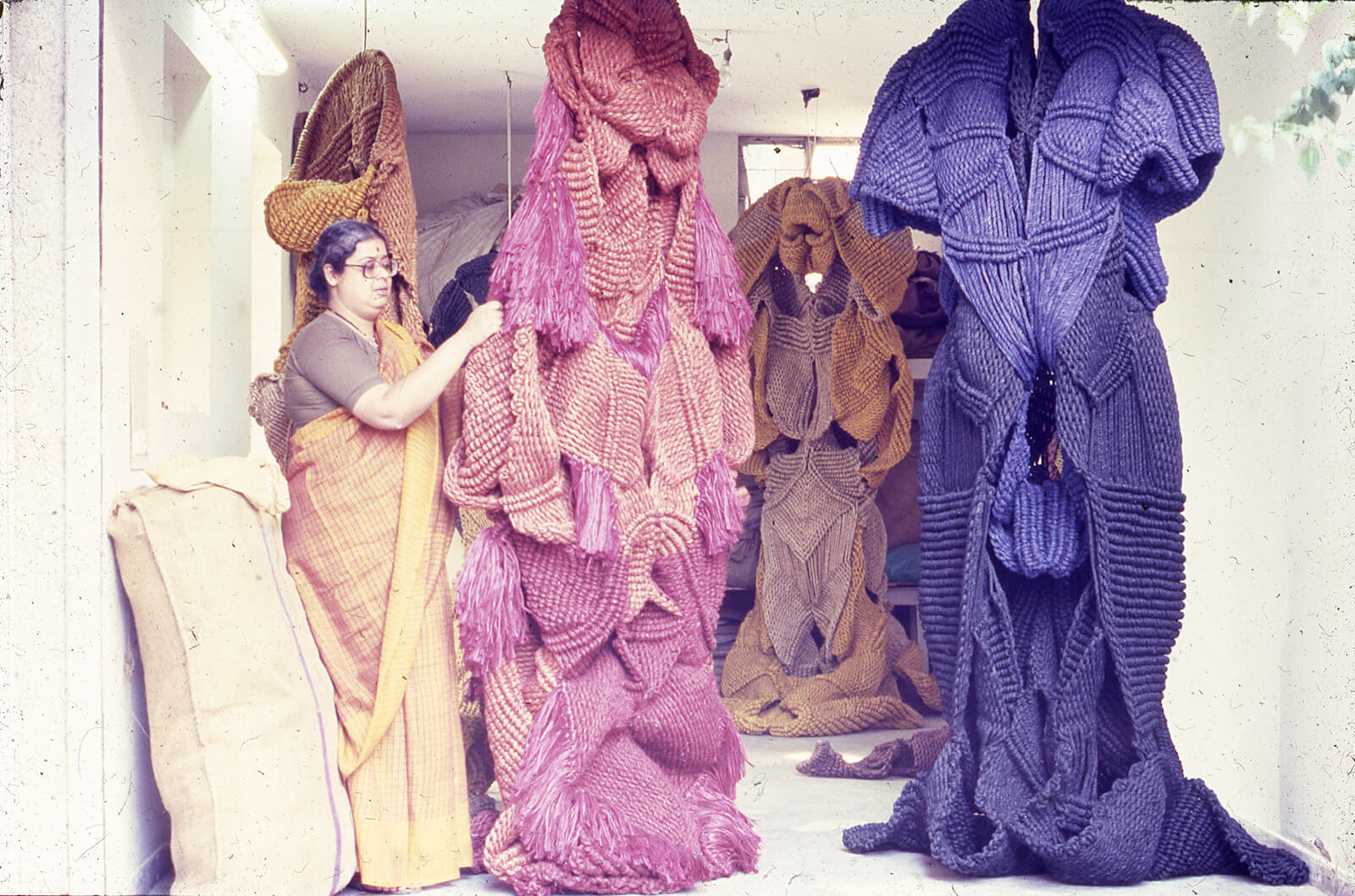
This curatorial framework, devised by RA’s Tarini Malik, situates Mukherjee within two seminal art institutions that shaped twentieth-century Indian art: Kala Bhavan in Santiniketan, founded in 1919 by Rabindranath Tagore, and the Faculty of Fine Arts in Vadodara (Baroda), established in 1950 by Markand Bhatt. The two schools—Santiniketan’s nature-inspired contextual modernism and Baroda’s experimental engagement with living traditions as well as a broad reading of world art history—form the intellectual and pedagogical backbone of the exhibition. Mukherjee’s life and practice moved fluidly between them: born in Mumbai, raised in Santiniketan, trained in Vadodara under Subramanyan and Gulammohammed Sheikh, and later working for decades in Delhi’s Garhi Studios.
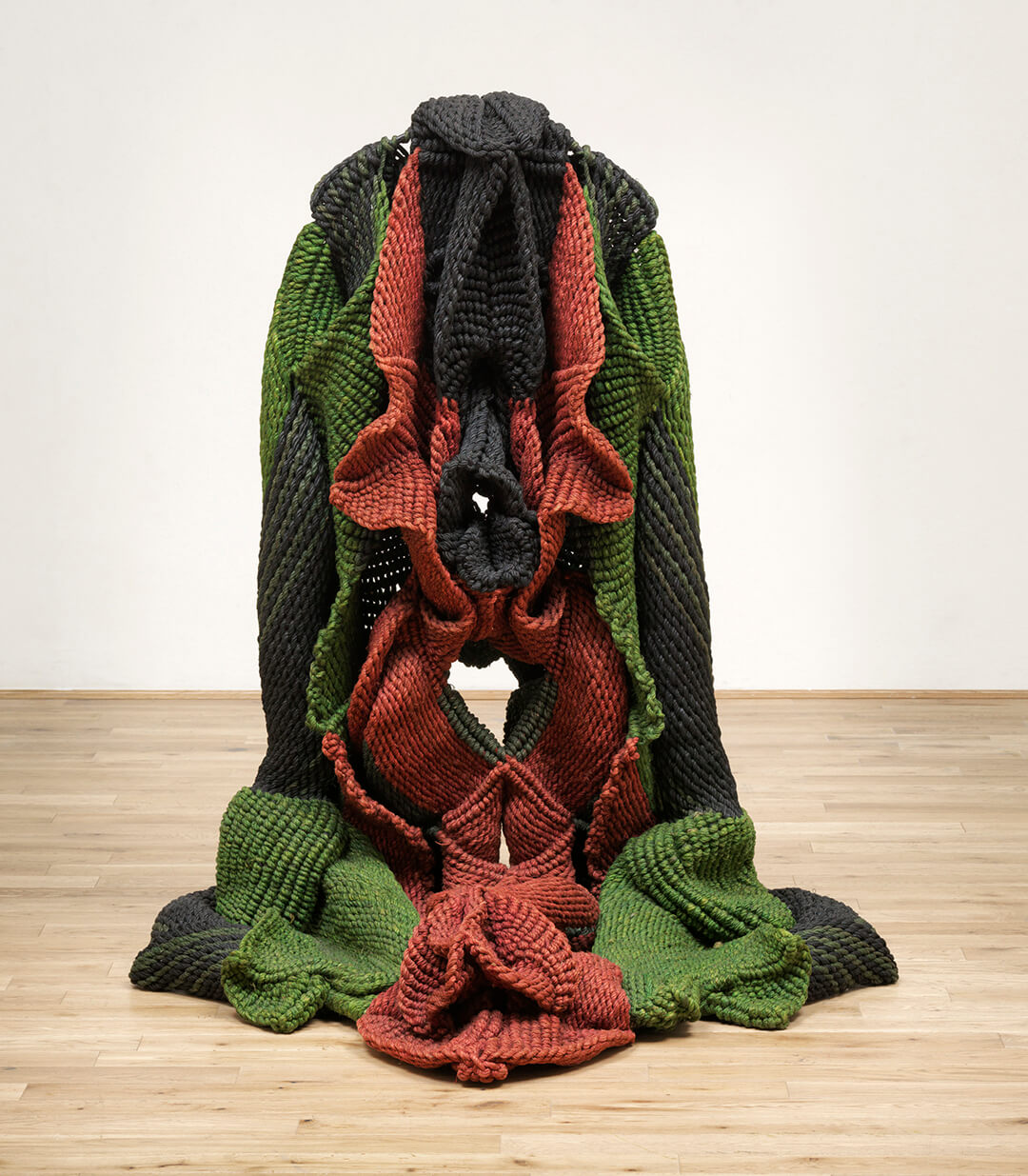
Mukherjee’s work, particularly her celebrated hemp sculptures, embodies this layered inheritance. Drawing from Santiniketan’s humanistic ethos, Baroda’s material explorations and her own fascination with organic form, she forged a practice that is both rooted and radical. Working with hand-knotted fibres, she redefined what sculpture could be. This choice was not merely formal; it carried feminist and decolonial resonances, asserting the tactile, the handmade, and the traditionally ‘feminine’ as sites of modern artistic power. Her organic, hybrid forms embody both rootedness in Indian aesthetic philosophies and a radical challenge to hierarchies between art and craft, masculinity and femininity, nature and culture.
The RA’s exhibition, however, only partly communicates the coherence of this artistic evolution. The selection and sequencing of works do not make clear the conceptual or chronological trajectory that links her drawings, prints, fibre, ceramic and bronze sculptures. Without this connective narrative, viewers encounter a series of impressive objects placed rather deliberately alongside her mentors and peers, rather than an unfolding practice shaped by distinct pedagogical and cultural contexts. As a result, the exhibition conveys the magnitude of Mukherjee’s achievement but only partially realises its curatorial aim, to reveal the continuity and intellectual depth underlying her material transformations.
Displayed across three rooms, the show is purportedly organised in a chronological and thematic order. In the first gallery, Benode Behari’s lyrical 1950s landscapes, muted, introspective and suffused with the influence of East Asian brushwork, converse with Leela Mukherjee’s totemic figurative sculptures, dating from 1950 to 1989. Between them hangs Landscape XVIII (2010), a stunning rectangular bronze relief by their daughter, its earthy patina and compressed surface echoing the rhythms of both her parents’ works. Yet beyond this generational juxtaposition, curatorial links remain elusive. Without stronger interpretive framing, the thematic threads of influence and divergence feel more associative than analytical.
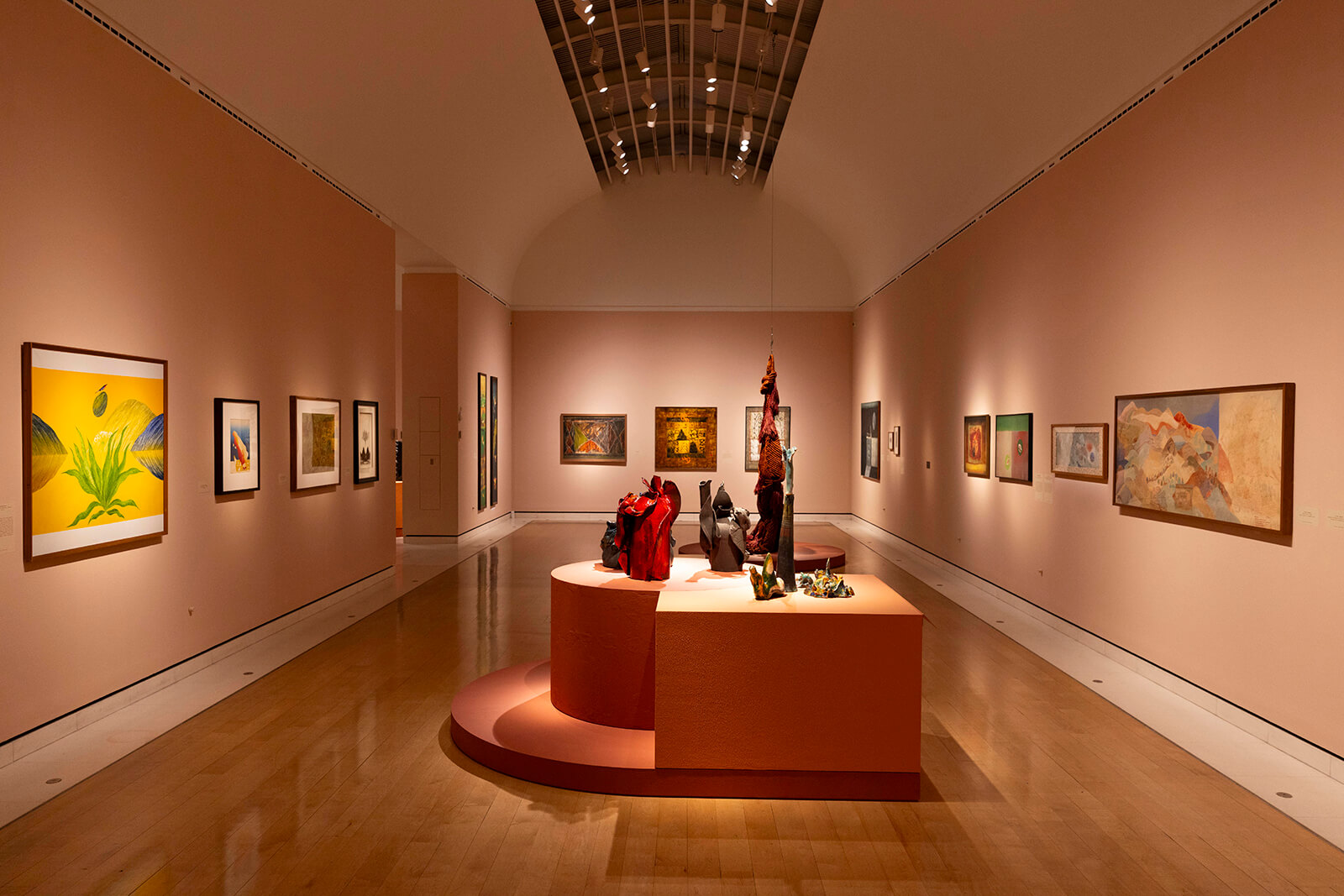
The second and third rooms mix works by Mukherjee’s mentors and peers: Subramanyan’s figurative paintings, Swaminathan’s geometric abstractions, Gulammohammed Sheikh’s paintings and ceramics, and Nilima Sheikh’s painted worlds of myth and memory. While the premise of ‘her circle’ is conceptually rich, the display lacks narrative rhythm, due to an unclear understanding of the histories of the Santiniketan and Baroda schools and the importance of the contributions made by the artists in shaping the legacies of the subcontinent.
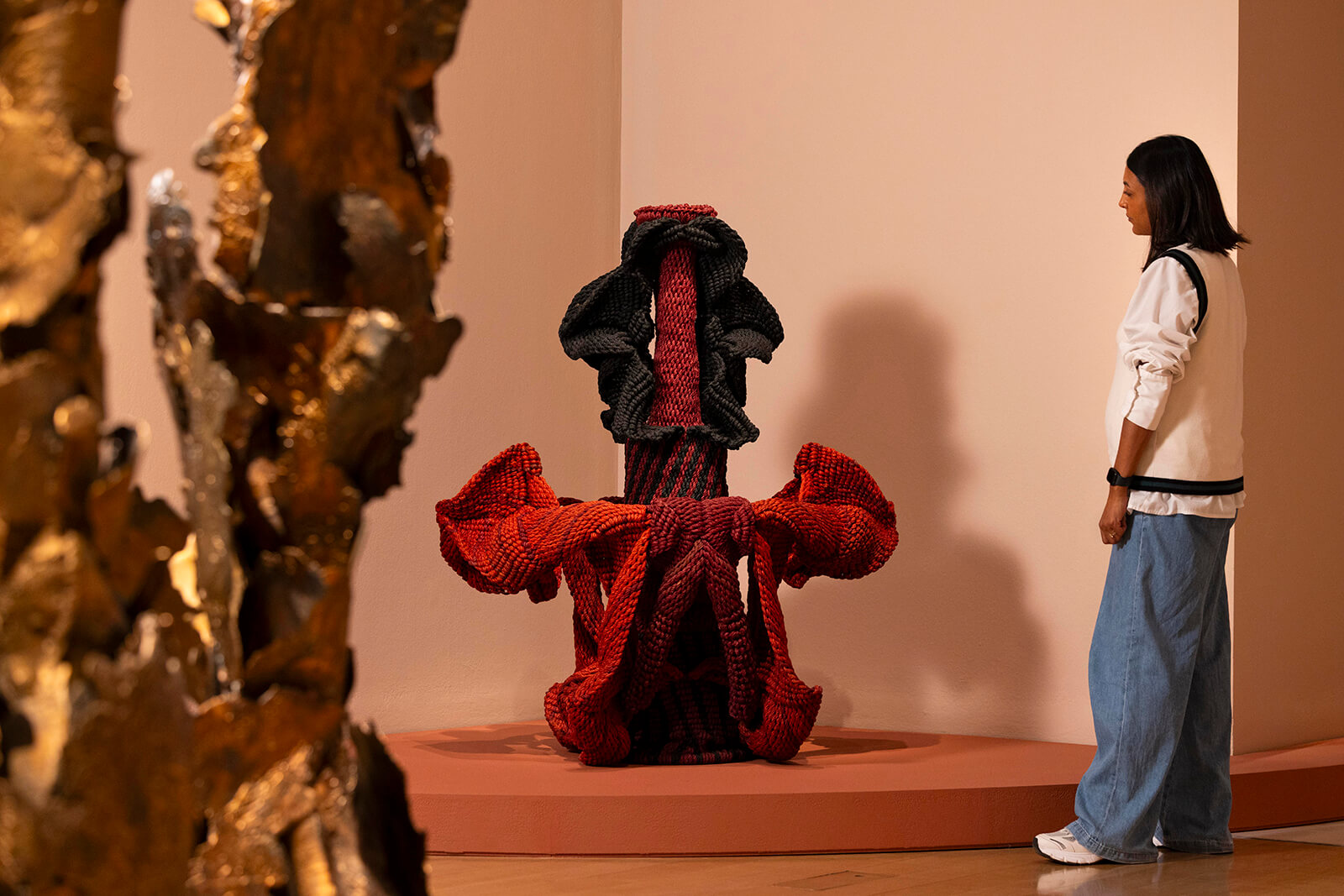
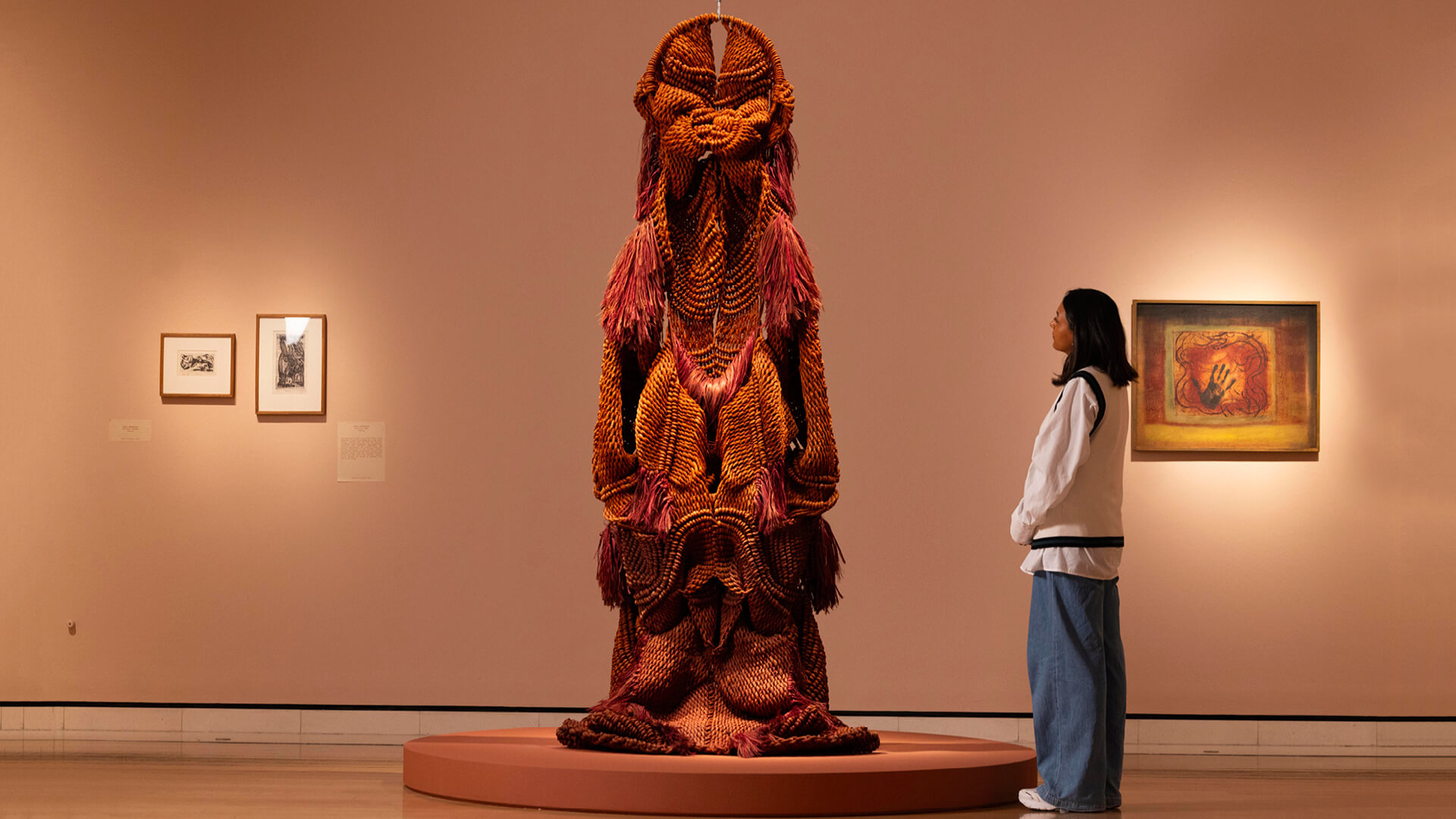
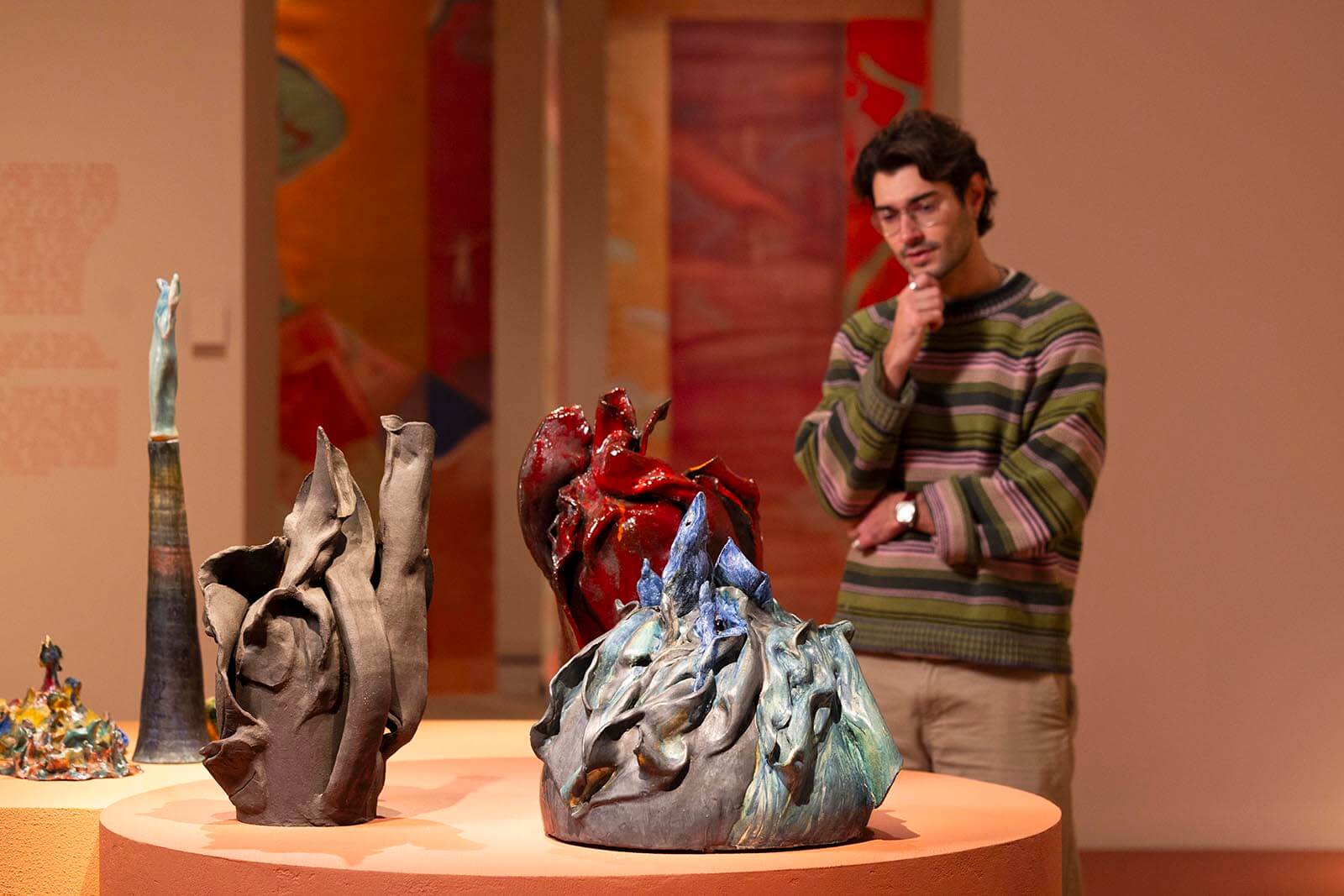
Nonetheless, individual works offer moments of revelation. Night Bloom II (1999 – 2000), one of six glazed terracotta sculptures made during a residency in the Netherlands, is a quiet triumph. It resembles a cross-legged seated figure, yet its layered slabs of clay suggest petals or folds of fabric. Mukherjee’s mastery of ambiguity, between body and plant, flesh and clay, is on full display. Similarly, the monumental Pakshi (1985), a red-hued hemp sculpture suspended from the ceiling, commands the exhibition. Its avian form radiates both erotic energy and sacred presence, the only hemp work that visitors can circumambulate. Here, the exhibition achieves the transcendence it seeks, as Pakshi converses dramatically with Gulammohammed Sheikh’s vertical scrolls Hunted and Simurgh and the Paris (2018 – 24), Swaminathan’s Tribal Motifs (1982) and The Temple (1965) and Leela Mukherjee’s etched vignettes of dancers and animals.
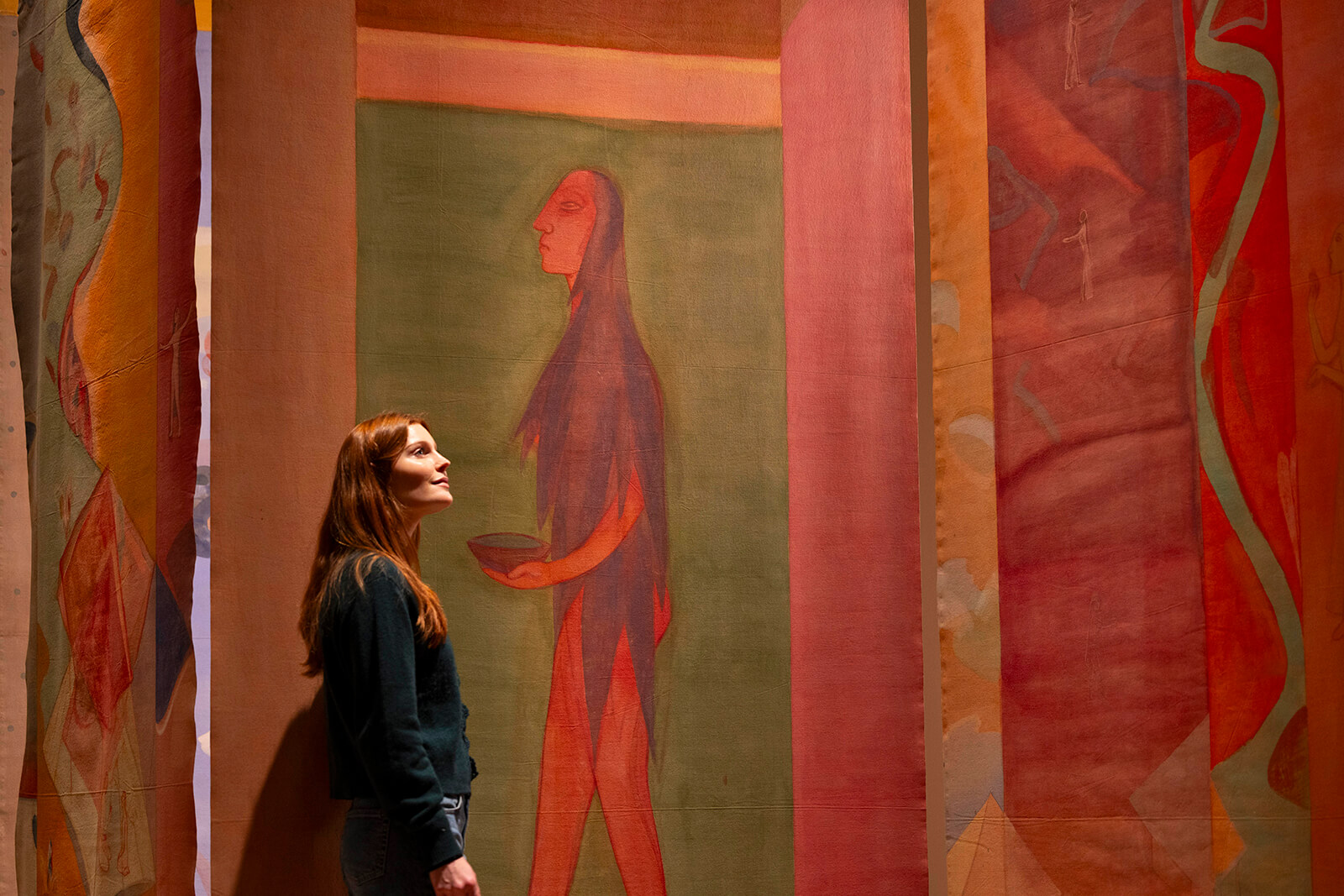
The third room also displays Nilima Sheikh’s suspended scrolls Songscape (1995), her first in what has become an internationally celebrated innovation in her practice. Hemmed in by other works, by Subramanyan and Gulammohammed Sheikh as well as her own, it sits alongside Mukherjee’s sculptures, which are placed to one side. Overcrowded, certainly, it nevertheless provides a moment to reflect on the intertwined intellectual and pedagogical overlaps that produced distinctive and influential artistic legacies in South Asia.
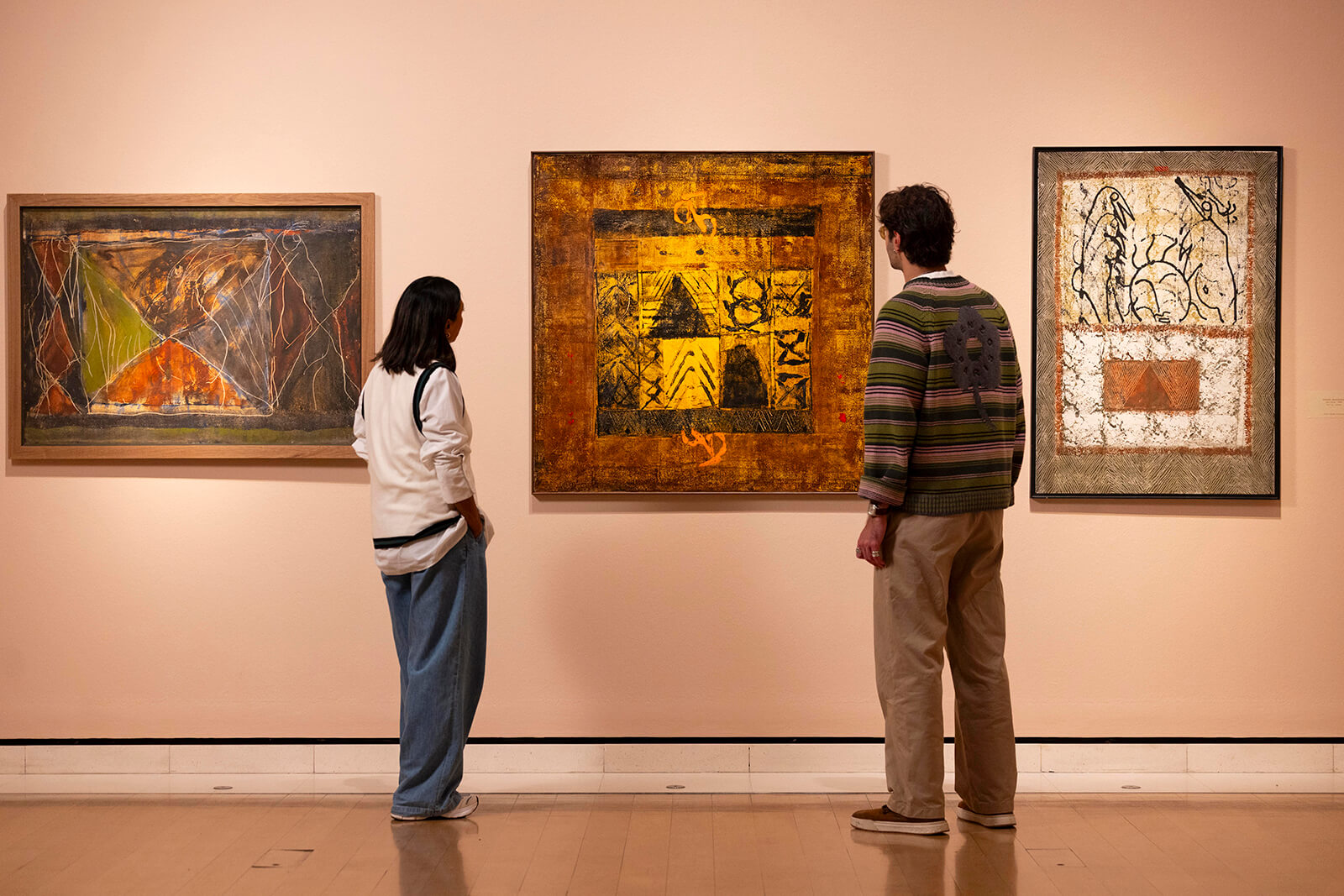
Despite its uneven curatorial execution, A Story of South Asian Art succeeds in foregrounding a narrative often marginalised in global modernist histories. By situating Mukherjee not as an isolated genius but as a node in a web of intellectual and emotional exchange, it challenges the Eurocentric notion of modernism as singular and linear. The exhibition insists instead on the plural, intergenerational and dialogic character of Indian modern art, rooted in pedagogical institutions, collective practice and friendships. These were spaces where teachers and students, artists and cultural practitioners collaborated, debated and redefined the boundaries between art, craft and design. Such convivial processes were sustained by a shared investment in reimagining modernity from within local contexts.
If the show occasionally feels overdetermined by its thesis and confusing in its display, the works themselves resist containment. They speak in the language of materials—hemp, bronze, clay, pigment and paper—of transformation, memory and sensual vitality. Mukherjee’s circle was indeed a constellation of visionaries, and this exhibition, despite its flaws, offers a rare chance to encounter their intertwined legacies in one space.
‘A Story of South Asian Art: Mrinalini Mukherjee and Her Circle’ is on view from October 31, 2025 – February 24, 2026, at the Royal Academy of Arts, London.
The views and opinions expressed here are those of the author(s) and do not necessarily reflect the official position of STIR or its editors.

by Srishti Ojha Oct 21, 2026
Increasingly, artists, filmmakers and activists are turning to VR to create more personal, tangible accounts of the climate emergency and its impact on vulnerable communities.
by Mirra Lynn Oct 20, 2026
The Indian artist paints the old wadas of central Pune, capturing the traces of everyday life that cling to these structures, battered by time but unbowed.
by Anmol Ahuja Oct 15, 2026
How do heaps of souvenirs and relics with racist Aboriginal motifs and features become art? MCA Sydney’s winter showcase—the artist’s largest to date—beckons a possibility.
by Vandana Kalra Oct 14, 2026
With his latest exhibition as a point of departure, the modernist discusses his decades-long practice, the spontaneity of drawing and the social responsibility of artists.

make your fridays matter with a well-read weekend
Enter your details to sign in
Don’t have an account?
Sign upOr you can sign in with
a single account for all
STIR platforms
All your bookmarks will be available across all your devices.
Stay STIRred
Already have an account?
Sign inOr you can sign up with
Verification link sent to check your inbox or spam folder to complete sign up process
Tap on things that interests you.
Select the Conversation Category you would like to watch
Please enter your details and click submit.
Enter the 6-digit code sent at


Contextual modernisms: Mrinalini Mukherjee and Her Circle
by Deeksha Nath | Published on : Nov 17, 2025


 Sign in with Google
 Sign in with email
What do you think?