Architecture08 mins. read
The Lumen Learning Centre seeks an architecture of "unbearable lightness"
by Mrinmayee BhootSep 04, 2024



by Mrinmayee BhootPublished on : Nov 29, 2025
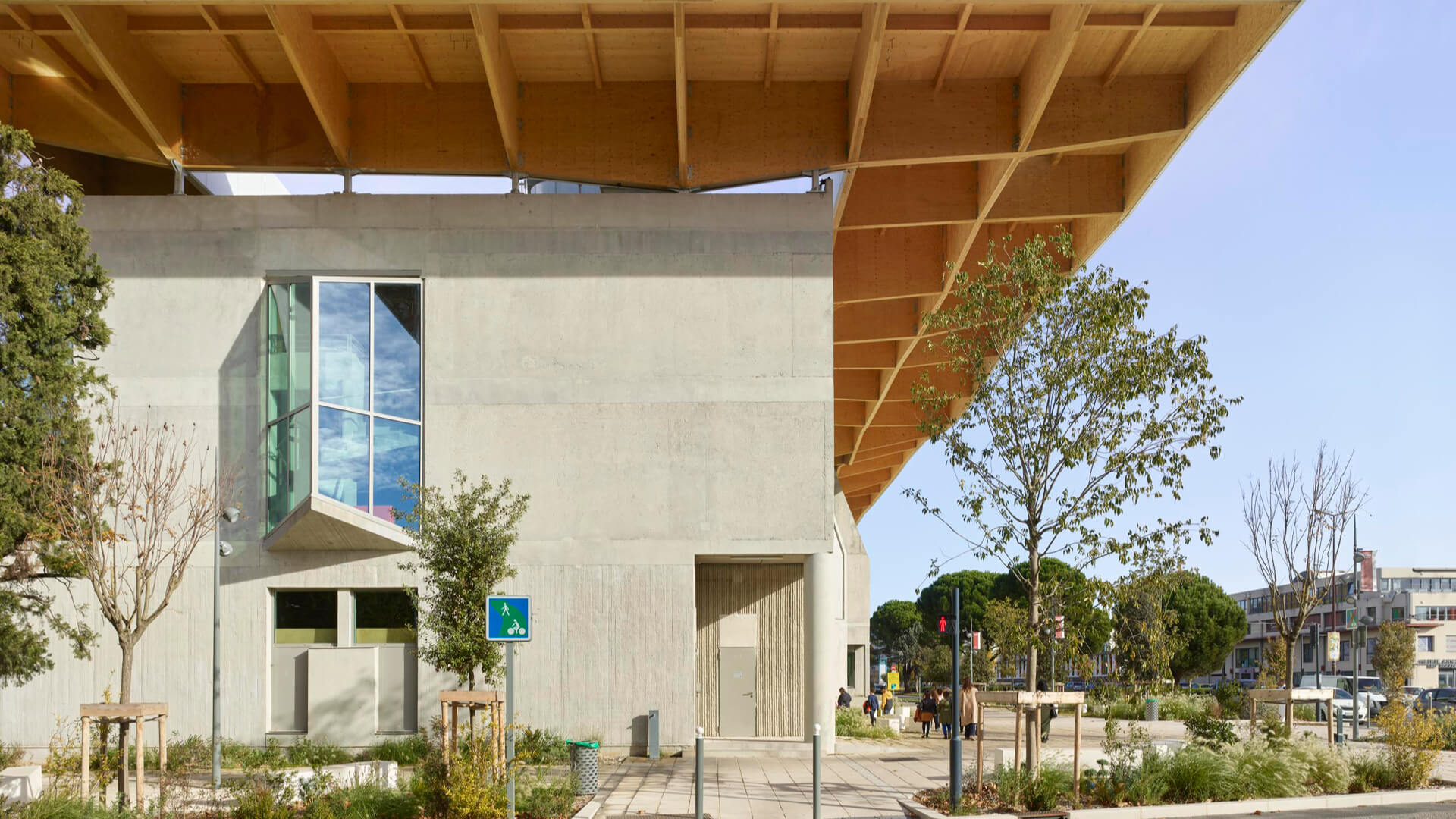
Already distinct in its robust exposed concrete form, the Madeleine Renaud and Jean-Louis Barrault Library is now adorned with a floating timber roof as part of its larger refurbishment. Teeming with new life, the public library was renovated by Paris-based architecture studio Jakob+MacFarlane. While the original 1985 design by architects Jacques Prunis and Béatrice Douine deferred to an en vogue brutalist visual language with hefty concrete blocks defining its form, in recent years the public facility had fallen out of use—prey to the vagaries of nature—located in a district encountering similar malaise. The new intervention by the French architects revitalises the space, redefining the library as a cultural node and vital part of Avignon's urban renewal. As the design team elaborates in a press release, the renovation of the library is part of a larger scheme, namely France’s Nouveau Programme National de Renouvellement Urbain (NPNRU), with the building now connected more directly to the city centre via a new tramway line.
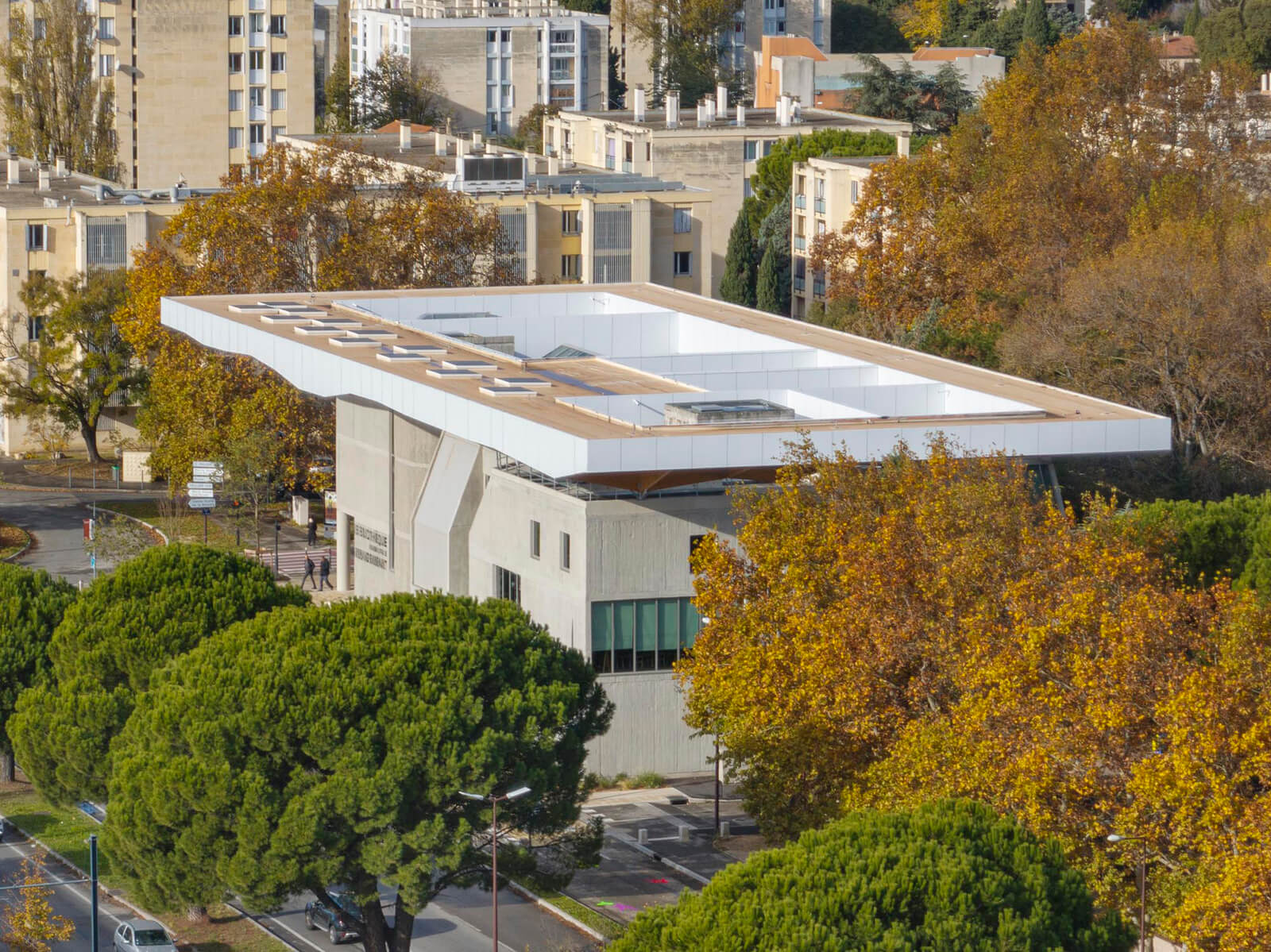
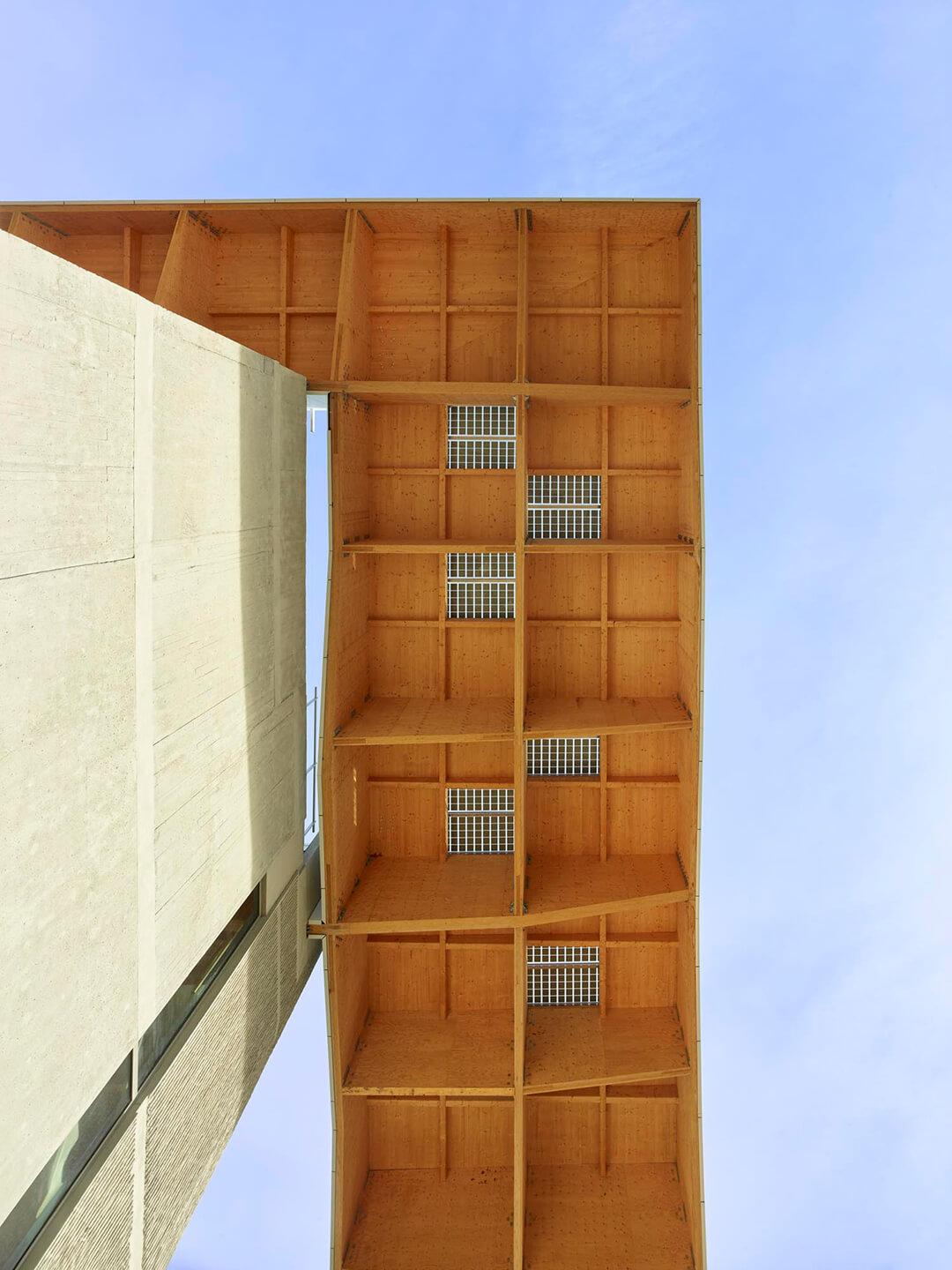
The project is positioned as a symbol for the revitalisation of the French city by Jakob+MacFarlane, and a crucial symbol of this rebirth for the architects has been the canopy. This light structure, constructed from cross-laminated timber, announces a new life for the brutalist architecture of the library, meant to mimic the canopy of a tree. "We knew we needed to create a symbol of new life in a fairly [depleted] urban context...We had to enable a strong external presence, which led to the idea of a floating element that would act as both an urban signal and a new presence on the site," the team notes in conversation with STIR.
This ‘new presence’, the Canopy—as the designers have dubbed it—is particularly sculptural as an architectural addition and counters the heaviness of the original structure. Rather cannily, the architects have also mirrored the angularity of the building's facade in the floating roof, exaggerating these angles to add a sense of movement to the otherwise staid block. "As we worked with the site and with the themes of knowledge and rebirth, the metaphor of a tree emerged quite clearly," the design team explains.
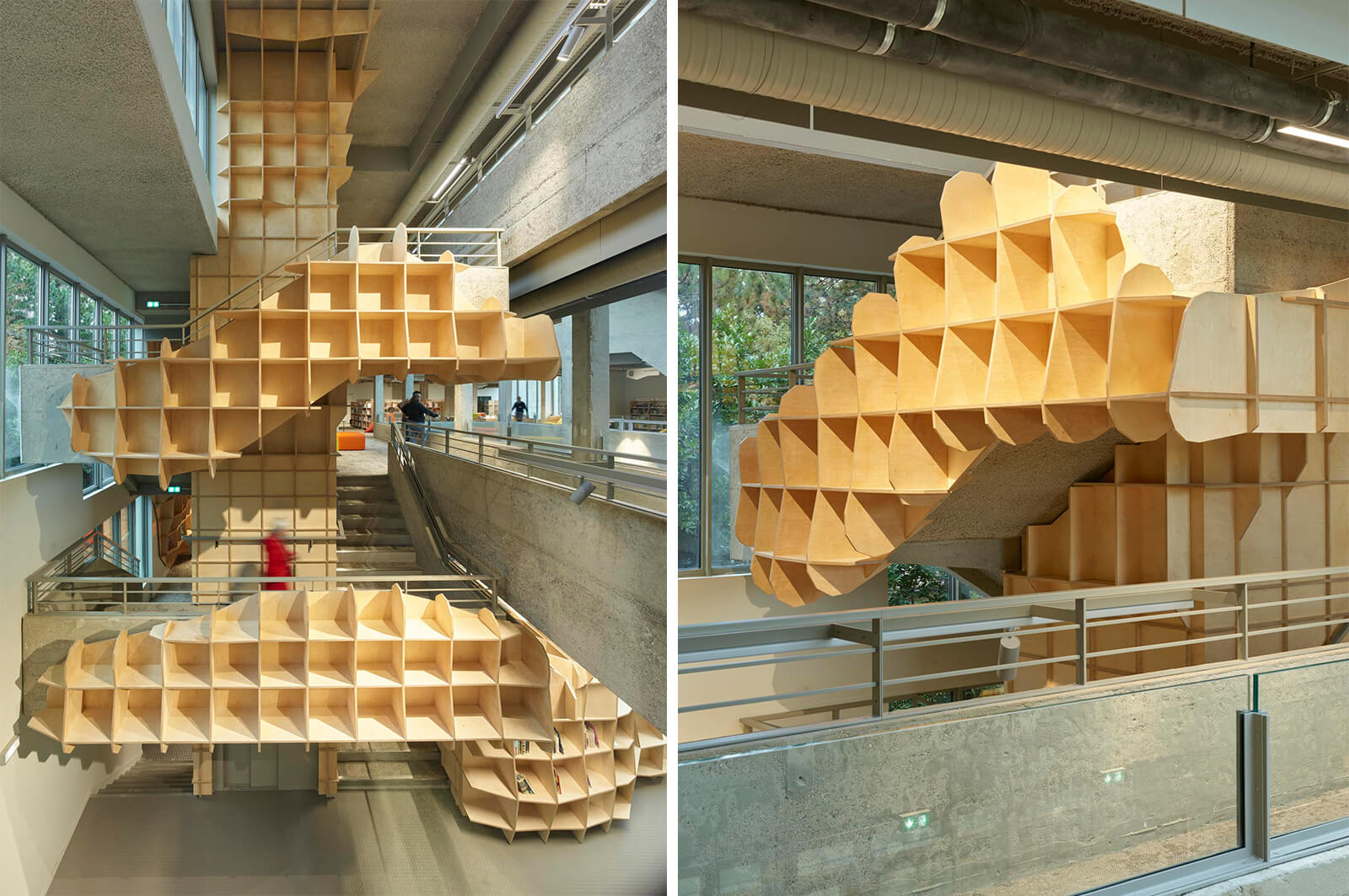
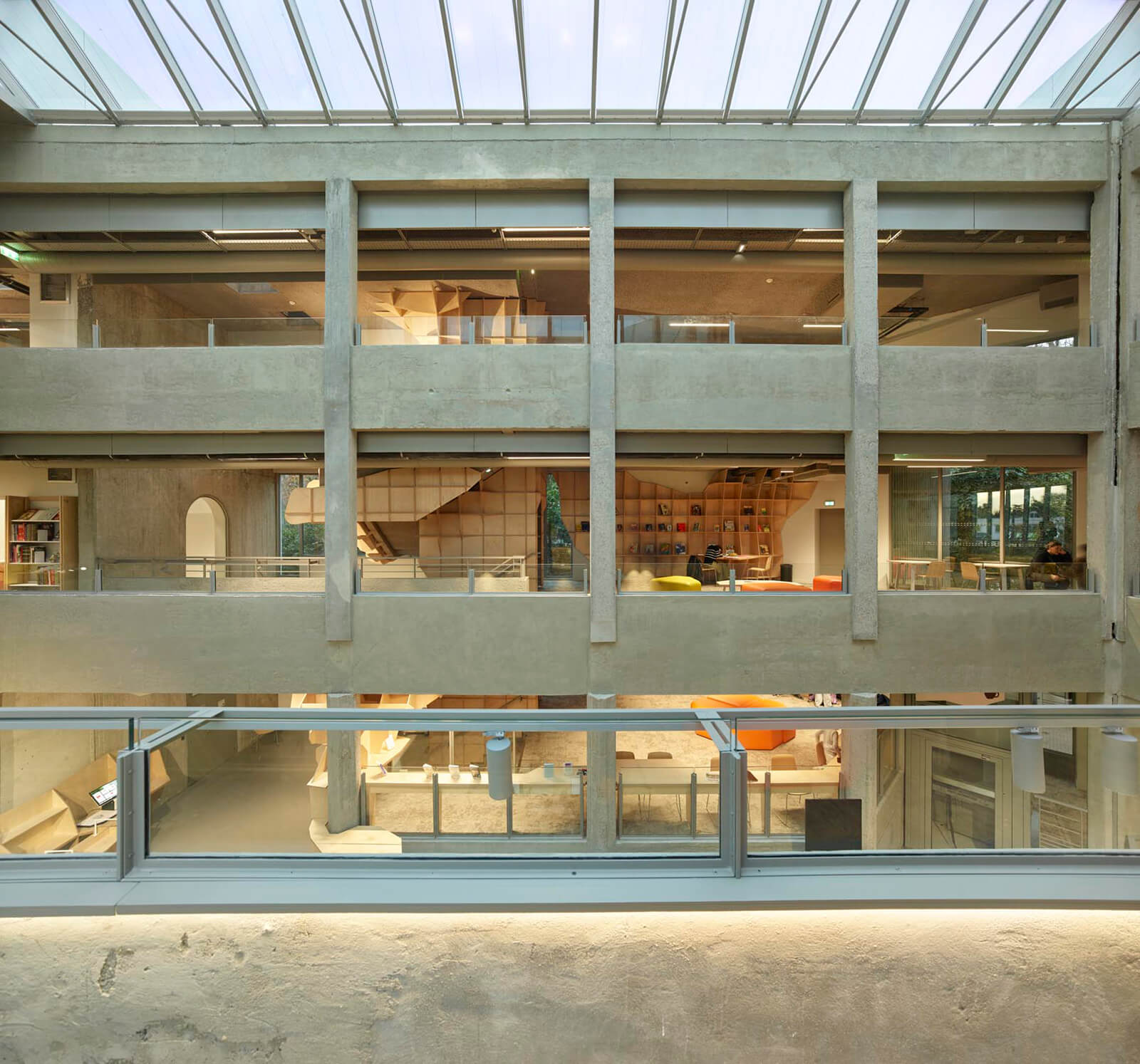
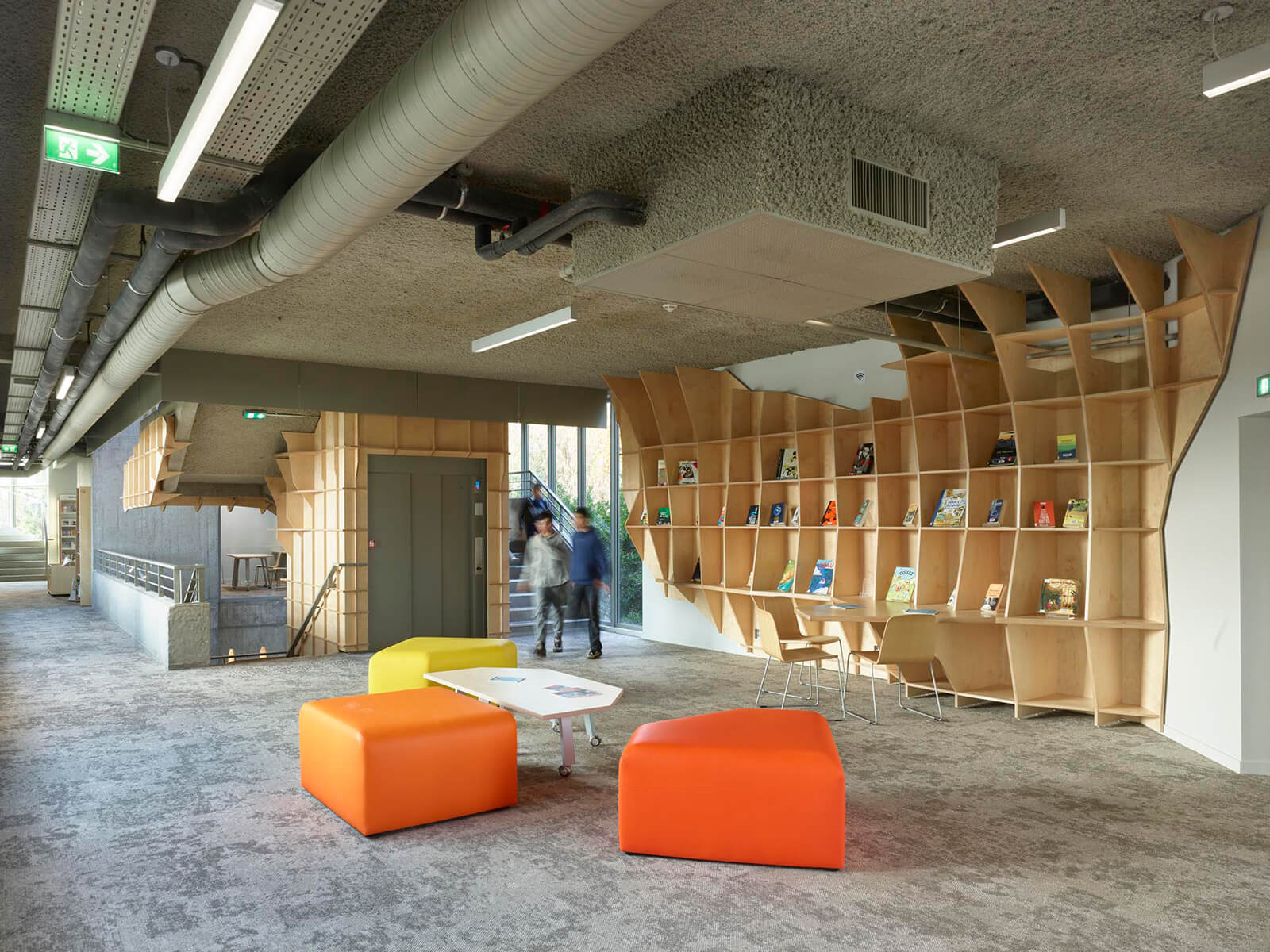
While the new roof metamorphoses into the tree's canopy, an existing central staircase that was preserved by the architects becomes the tree trunk. As one enters the library, one encounters this custom timber framework, snaking around the staircase. Its grid-like modular design with repeating segments replicates the dynamic design of the canopy. The jagged, rhythmically arranged modules create nooks that double as shelves within the atrium space, and on the ground level, settle down to act as the reception desk. The atrium space, once dingy and closed off, now features a central light well that bathes the interiors in natural light, delineating reading zones. Similarly, the designers have created bespoke furniture for the project, meant to be flexible and reconfigurable for different purposes. The colourful designs by themselves inject a new life into the interiors.
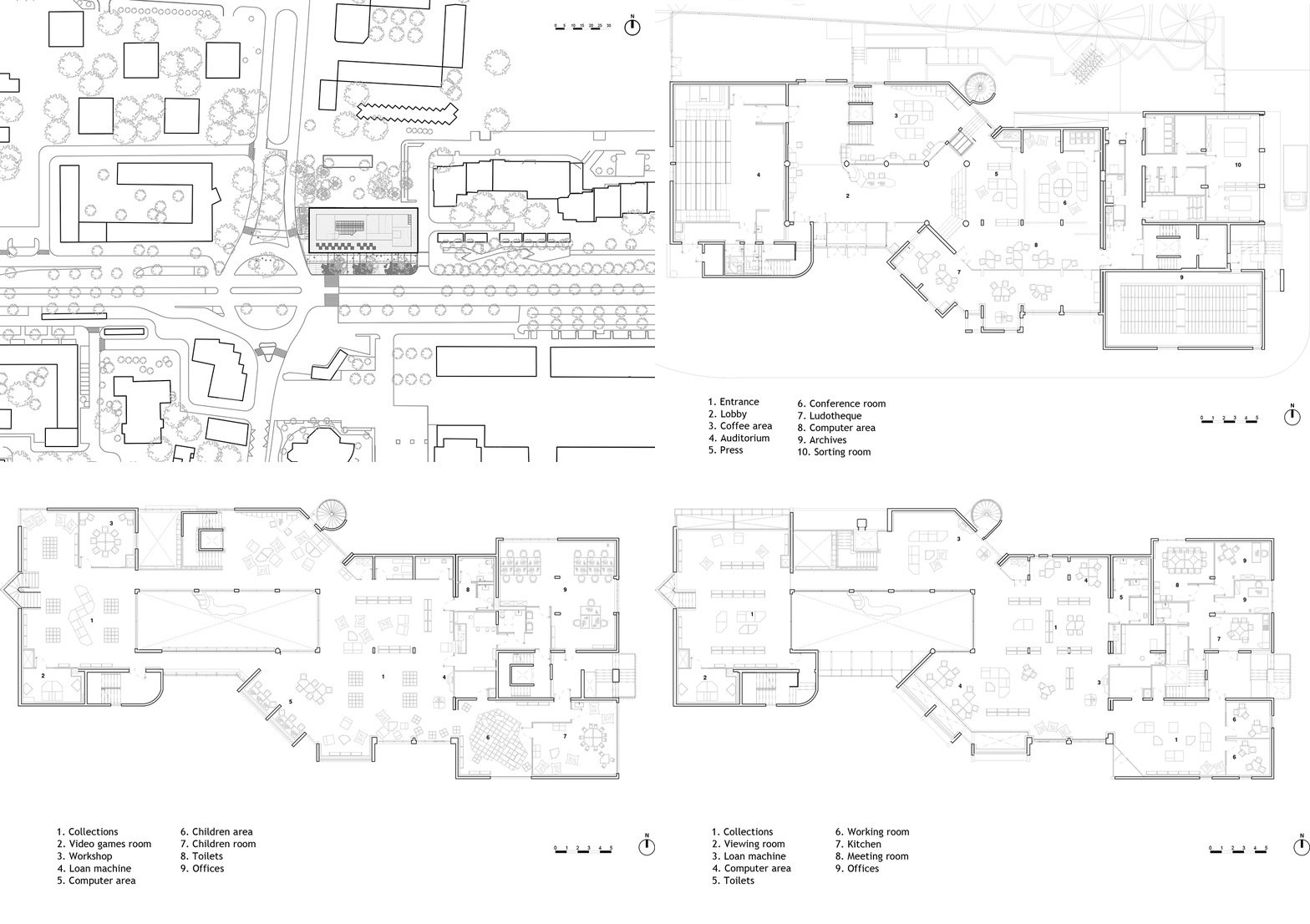
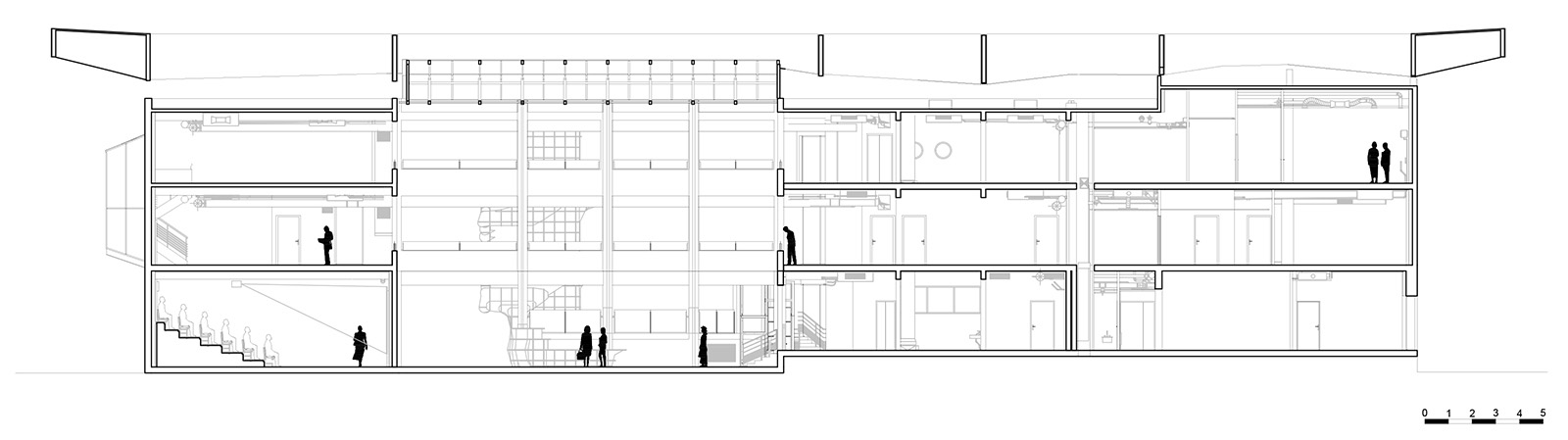
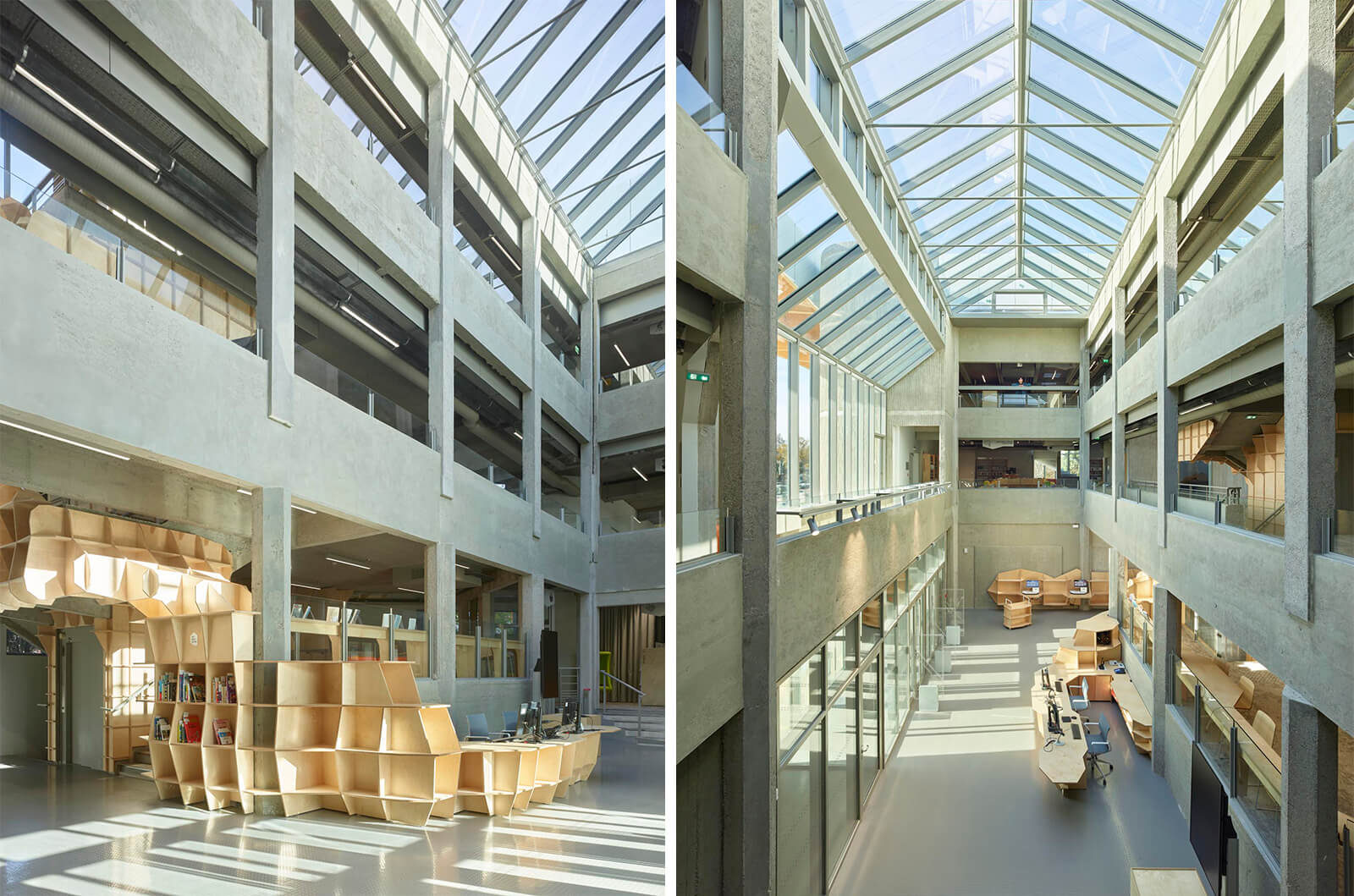
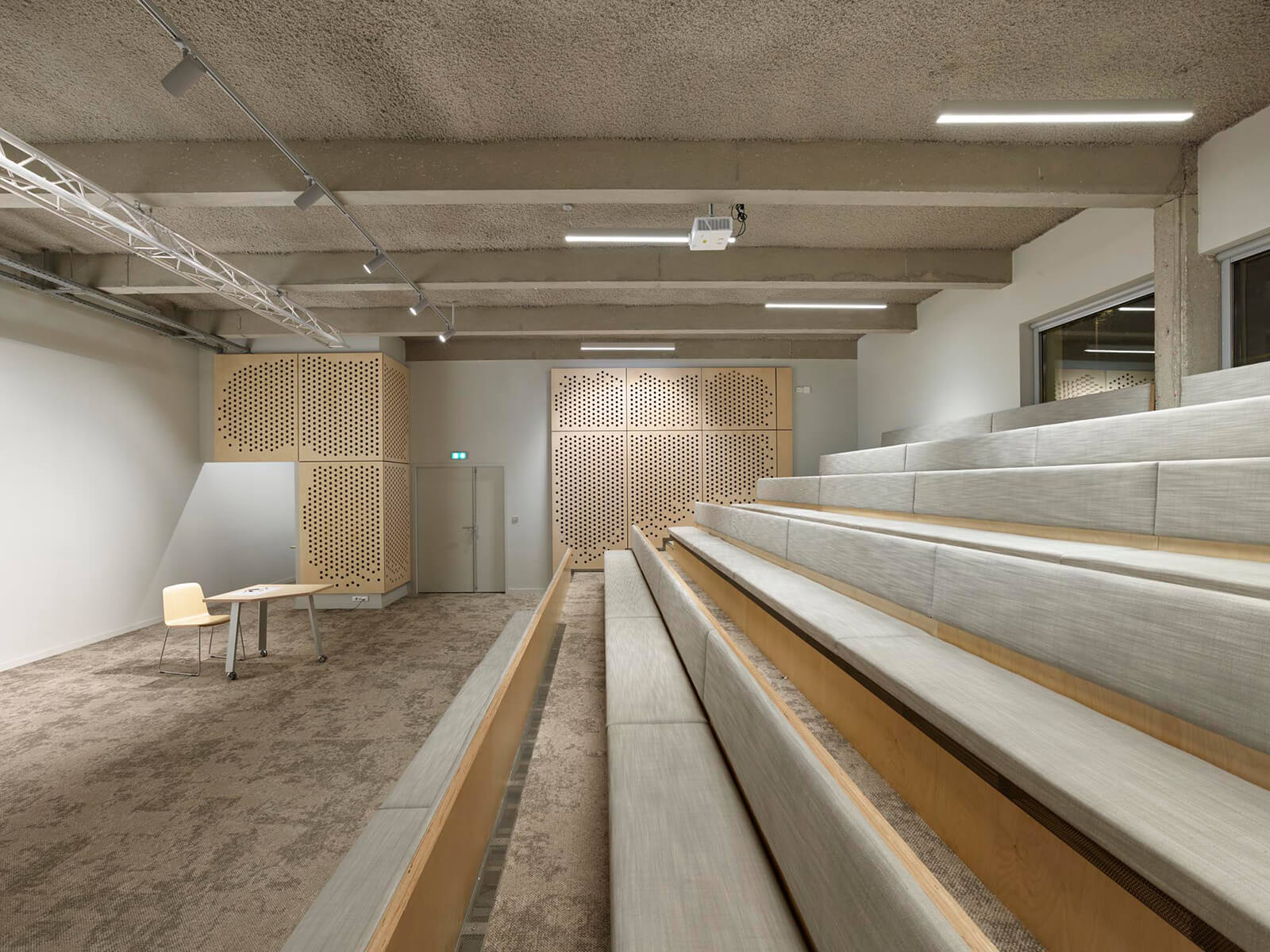
Apart from the main structural and supplementary interventions—that act as lively inserts into the library design—other gestures by the team were carried out to emphasise a sense of openness and accessibility. "We removed internal partitions, left the concrete structure as open as we could and used the library furniture to create ‘secondary’ alcoves. This gives a sense of openness and belonging, with the central atrium reinforcing the feeling of one total space by providing visual connections across all levels," they note. Emphasising the library’s new role as a cultural hub, Jakob+MacFarlane have reconfigured the existing auditorium on the ground level so it opens outward to the street, extending its function to serve as an accessible public space, accommodating events like exhibitions. "There is a notion of double programming, uniting the city’s needs with the library’s needs, which we found contemporary because it makes the library part of the city, not an isolated program," the designers underscore.
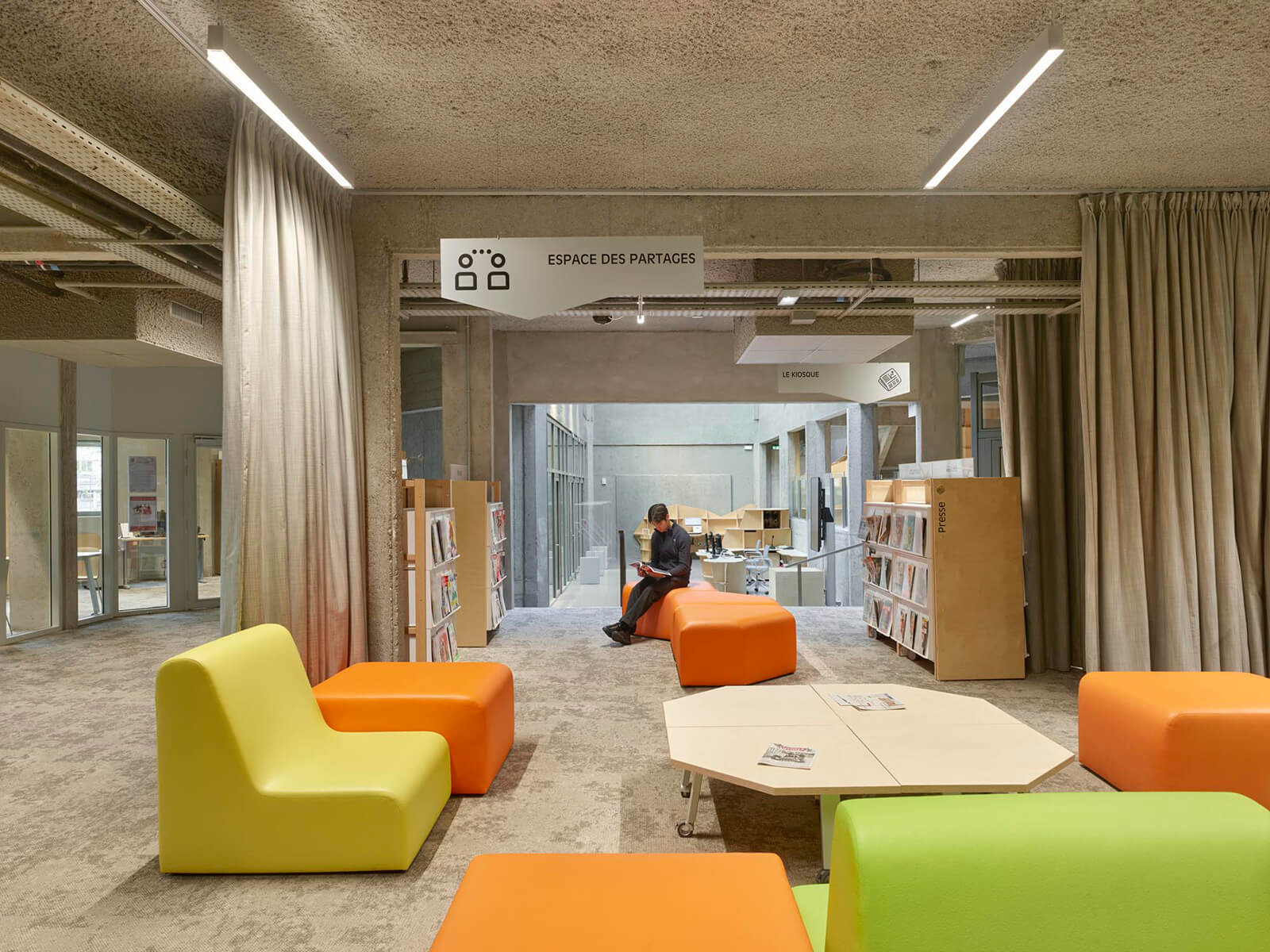
Circumventing the idea of libraries as closed-off spaces or unchanging repositories of knowledge, Jakob+MacFarlane’s vision for the refurbishment emphasises the public nature of the cultural architecture. Of late, libraries are being conceived of as cultural nodes not only for learning but also as spaces for local communities to gather, relax and socialise. The project, entering a new life in a distinctly new time, asserts its rebirth, simultaneously inviting one in.
Name: The Canopy
Location: Avignon, France
Architect: Jakob + Macfarlane
Engineers: TPF Ingénierie (concrete structure, HVAC); Gustave Ingénieur du Bois (wood structure) Cabinet Conseil Vincent Hédont (CCVH) (acoustical)
Contractors: SDR (Demolition); Neotravaux (Structural work); SN POULINGUE (Wood timber frame); Alpha Group (Waterproofing); SMAB (windows, curtain walls); Indigo (concrete facade restoration); Masfer (concrete facade restoration); D3A (plaster); Bareau (wood furniture); SPP (ground); Touranche (electricity); BRES (painter); Selmac (HVAC); Ermhes, Paca Ascenseur Services (lift); Bruynzeel (compactus shelving); Denis Papin Collectivité (shelves furniture); Silvera (general furniture)
Area: 2,500 sq m

by Pranjal Maheshwari Oct 19, 2026
The Mumbai-based architects integrate courtyards, mesh screens and north light trusses to create a dining space that doubles up as a community hub at SR University, Warangal.
by Mrinmayee Bhoot Oct 17, 2026
The Rotterdam-based institute centres the Indian Ocean as a network for exploring material histories and transnational links shaping coastal cultures, positing them as future models.
by Pranjal Maheshwari Oct 16, 2026
At the 2026 Stirling Prize ceremony, Mary Duggan with RUFF Architects, MAKER Architecten and Nakshabid Architects were felicitated for proffering quality housing and social equity.
by Mrinmayee Bhoot Oct 12, 2026
The new Centre for Contemporary Arts, fostering public engagement with art in Uzbekistan, is housed in a tram depot refurbished by the French studio, emulating local craftsmanship.

make your fridays matter with a well-read weekend
Enter your details to sign in
Don’t have an account?
Sign upOr you can sign in with
a single account for all
STIR platforms
All your bookmarks will be available across all your devices.
Stay STIRred
Already have an account?
Sign inOr you can sign up with
Verification link sent to check your inbox or spam folder to complete sign up process
Tap on things that interests you.
Select the Conversation Category you would like to watch
Please enter your details and click submit.
Enter the 6-digit code sent at


Jakob+MacFarlane’s renovation of Avignon library gathers locals under The Canopy
by Mrinmayee Bhoot | Published on : Nov 29, 2025


 Sign in with Google
 Sign in with email
What do you think?