Architecture15 mins. read
PK_iNCEPTiON on championing freedom of learning through architecture in rural India
by Pranjal MaheshwariSep 10, 2026



by Jincy IypePublished on : Mar 16, 2026
Architecture often begins with a boundary: a line, a sketch, a wall to contain, a roof to shelter, a boundary to demarcate and yet, some of the most compelling modern architectural thinking revolves around dissolving that certainty. The notion of ‘porosity’, a condition of spaces remaining open to flows of air, light, movement and social exchange, to the very idea of what spaces hold or remit, has long animated discussions on architecture and urbanism. In their 1925 essay, Naples, Walter Benjamin and Asja Lacis famously described the city as a porous entity, where everyday life permeates the built instead of remaining sealed from it.
Applied to the architecture of educational institutions, such porosity takes on particular significance. Schools, after all, are frequently reduced to functional containers: corridors lined with classrooms and other, mostly enclosed spaces designed primarily for efficiency. But it’s understood that learning environments demand more—spaces that nurture curiosity, enable interaction, fun and community building while remaining attuned to climate and in veneration of landscape, expounding encounters which help make sense of the world beyond the classroom.
In tropical contexts especially, architecture that embraces openness—resisting enclosures and allowing flora, breeze, rain and shade to structure experience—often proves more potent and responsive than buildings that end up isolating themselves from their surroundings. Such an approach also echoes ideas of biomorphic architecture, where the built form borrows its intelligence from organic structures, recalling experiments by figures such as Antoni Gaudí, whose structures translated the logic of trees, bones and shells into architecture. At the campus of the Shiv Nadar School in Chennai, India, conceived by Vastushilpa Sangath, these ideas coalesce into a quietly radical proposition: a school conceived as a porous landscape of learning and congregating beneath a single protective canopy.
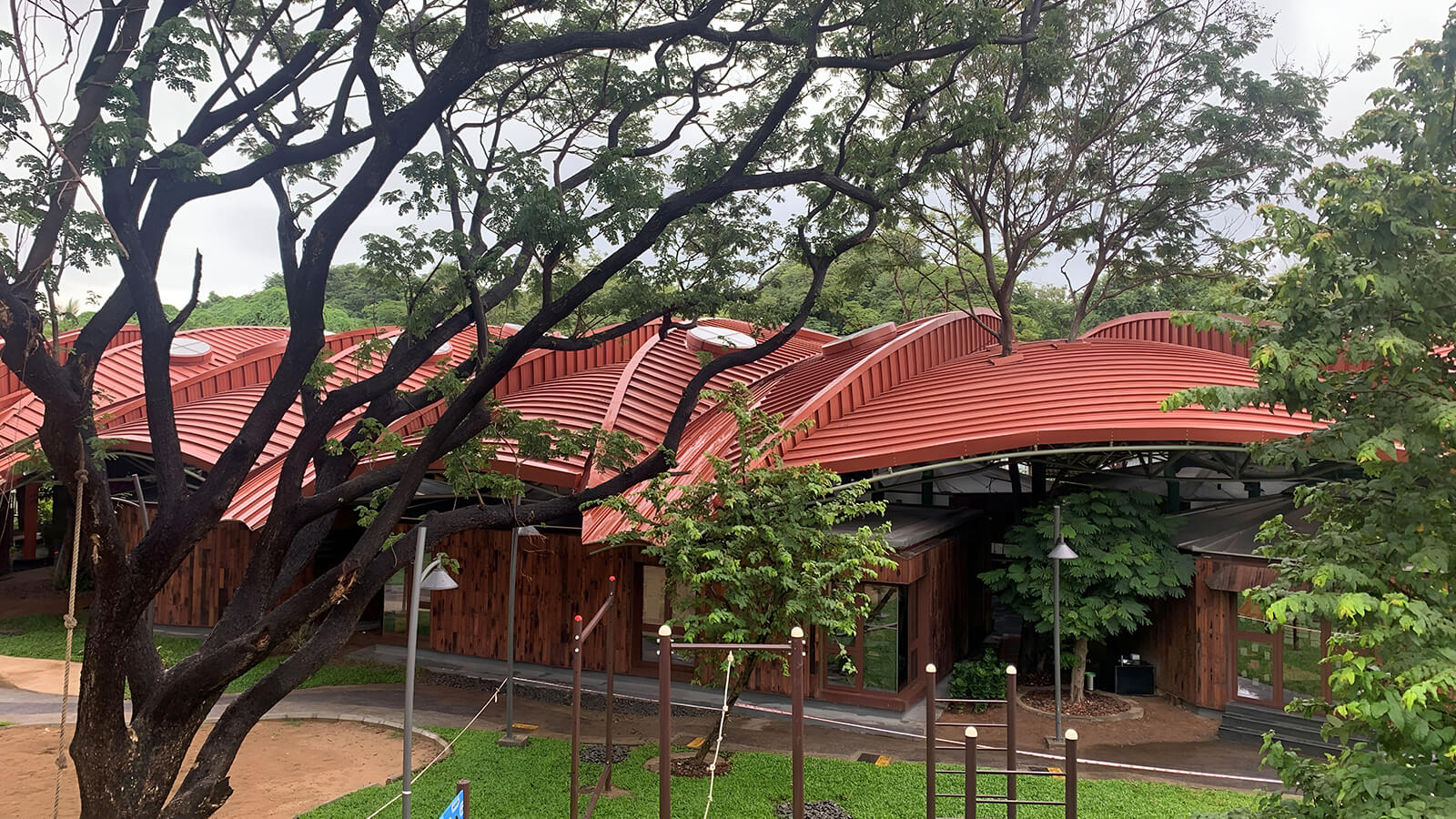
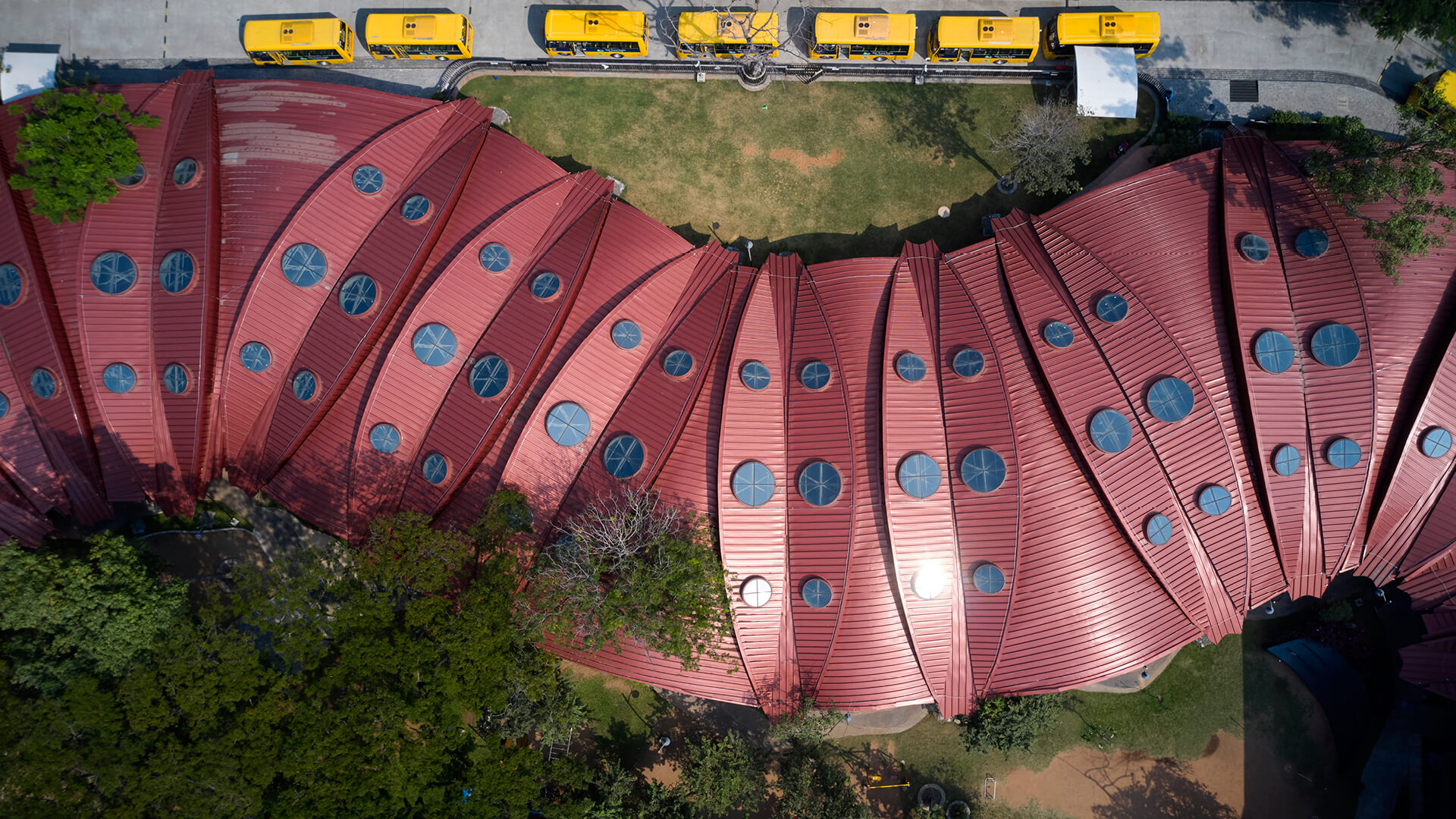
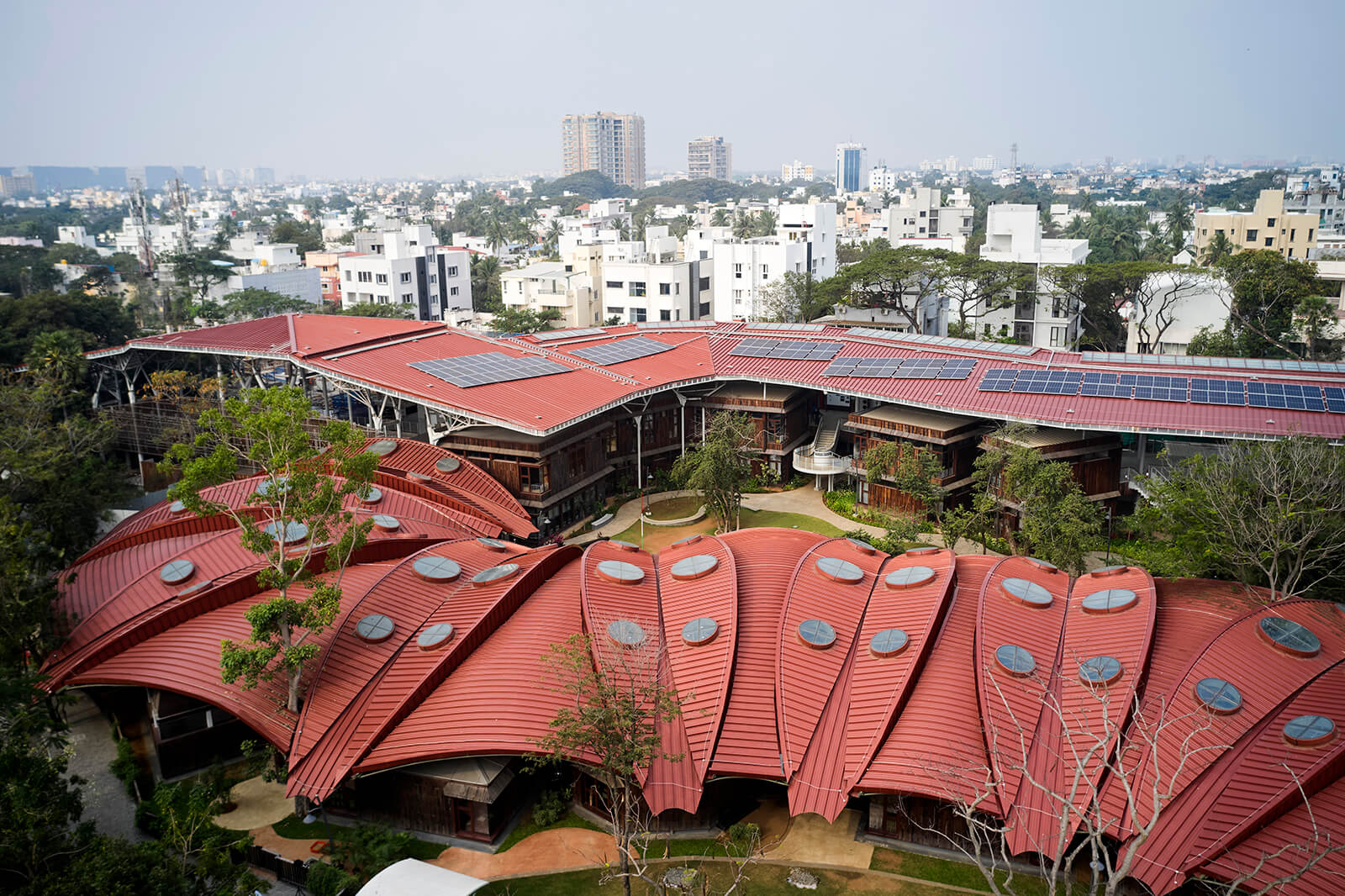
Instead of a singular institutional volume, this campus unfolds as an assemblage of learning spaces. As the Gujarat-based firm’s principal architect, Rajeev Kathpalia explains, the design begins with a direct response to Chennai’s climate, which receives rain for nearly eight months of the year, sometimes unexpectedly. The Indian architect tells STIR how, as a result, the school was conceived beneath a single expansive canopy—"a 26-metre-wide parasol shaped like a banana leaf"—that allows the campus to remain open and airy while protected from the frequent monsoon.

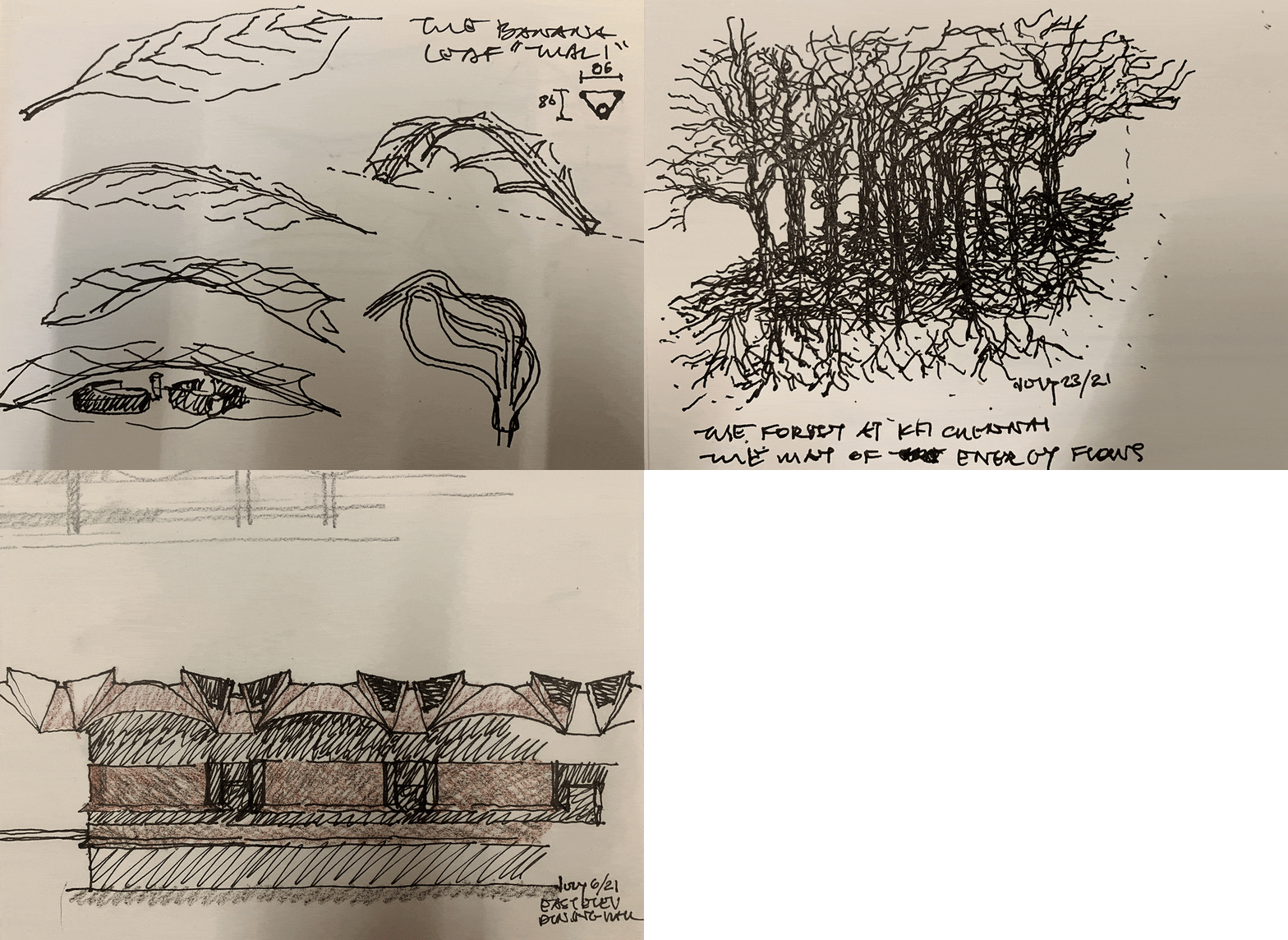
Both symbolic and efficacious, the educational architecture’s central design gesture—its biomorphic roof—draws from an everyday object deeply embedded in South Indian culture. “In much of South India, the banana leaf carries a quiet cultural resonance,” he explains. “It is associated with nourishment, hospitality and everyday ritual, appearing most visibly as the surface on which food is served during traditional meals. Its form is both simple and intelligent: broad, light and naturally shaped to collect and shed water. This quality offered not only a symbolic reference but also a climactic strategy.”

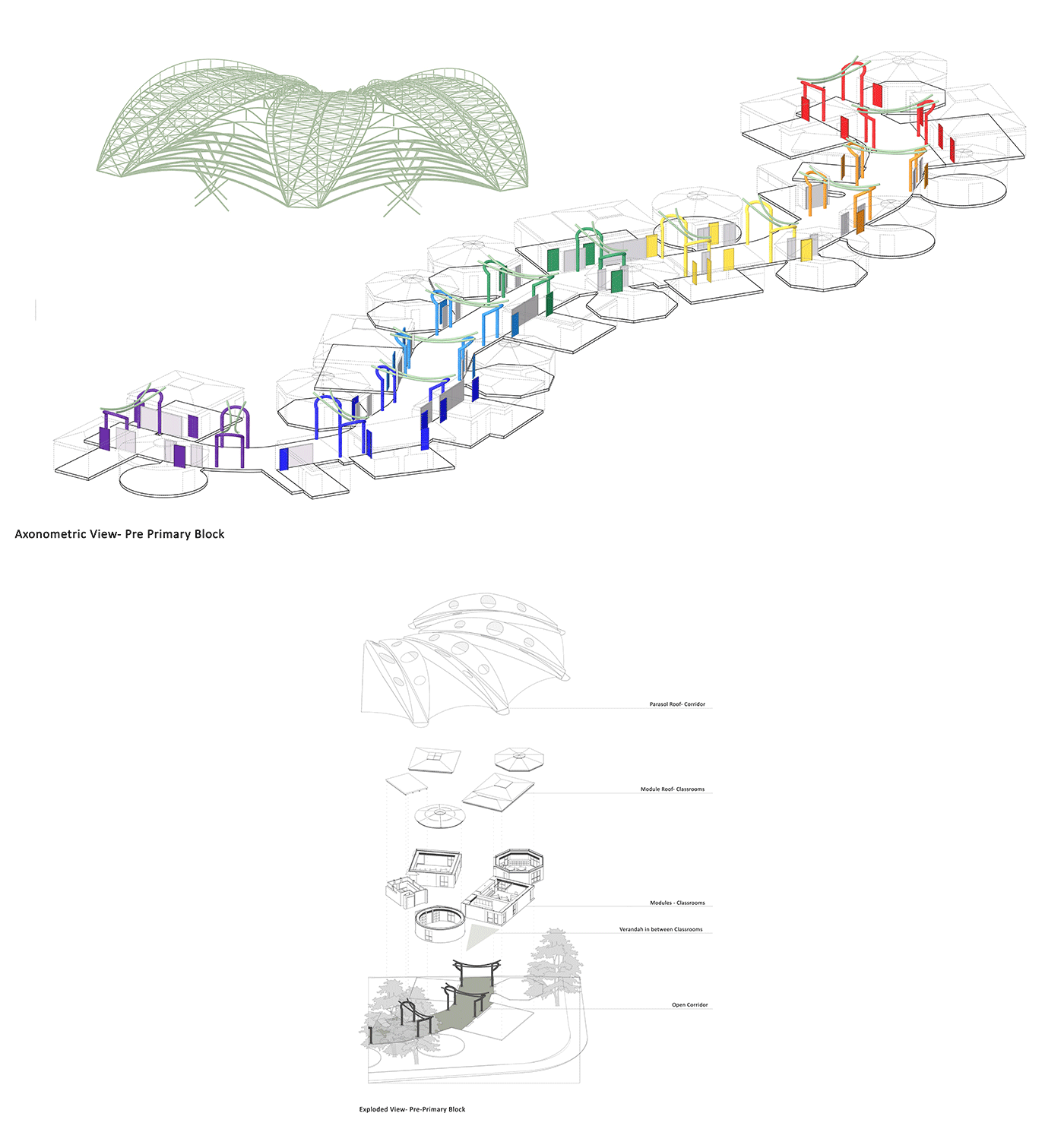
Translated into the school’s architecture, the leaf becomes a bright, expansive roof gathering diverse school functions beneath a single span while allowing air, natural light and movement to flow freely in the spaces below. The metaphor extends further into Indian culture, as Kathpalia conveys: “The spatial organisation is reminiscent of a Chettinad thali—the traditional Indian meal in which a variety of dishes are arranged together on a single plate. Under the large canopy, the school functions in much the same way. Each space retains its individuality while remaining part of a larger whole.”
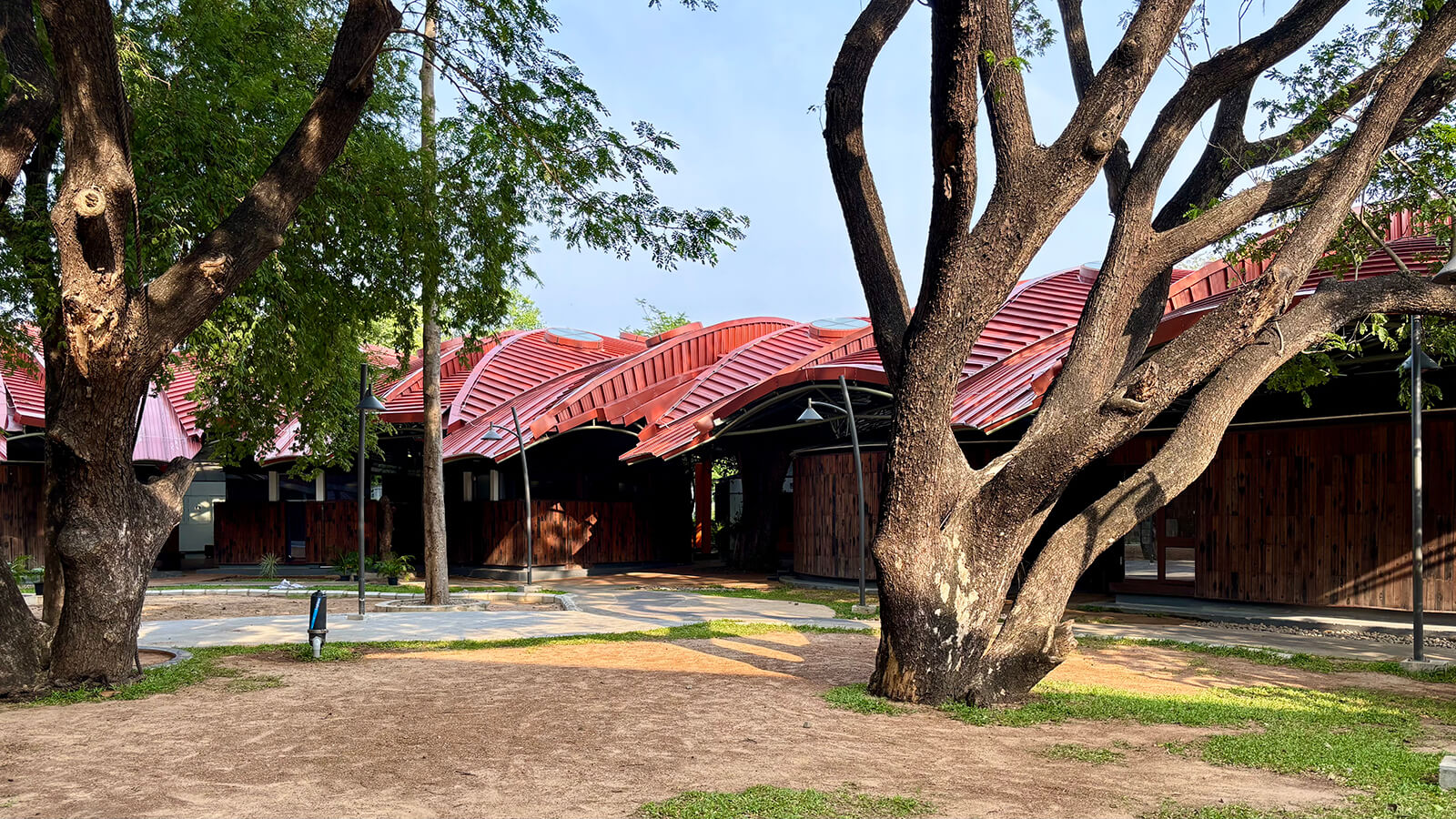
This conceptual framework allows the school to operate as a fluid landscape. Instead of straight-lined corridors and sealed classrooms, the Shiv Nadar School is organised into clusters of small buildings sharing classrooms, communal learning areas, gathering spaces and informal zones of play loosely distributed underneath the parasol. Circulation happens through shaded edges and open walkways that function like extended verandahs. “Classrooms become quiet bowls of concentration, courtyards offer places of gathering and play, while shaded edges create zones of pause and interaction where learning extends beyond the formal boundaries of the classroom,” Kathpalia reiterates.

Apart from being a formal flourish and shaping movement and social interaction, the roof also acts as the project’s primary environmental device. Its wide span provides continuous shade while its gently sloping surface channels monsoon rain away from occupied areas. “During the frequent monsoon showers, rain striking the canopy becomes an audible presence, reminding occupants of the climate that shapes the architecture. Yet the spaces beneath remain comfortable and usable, allowing the daily life of the school to continue uninterrupted,” the architect elaborates.
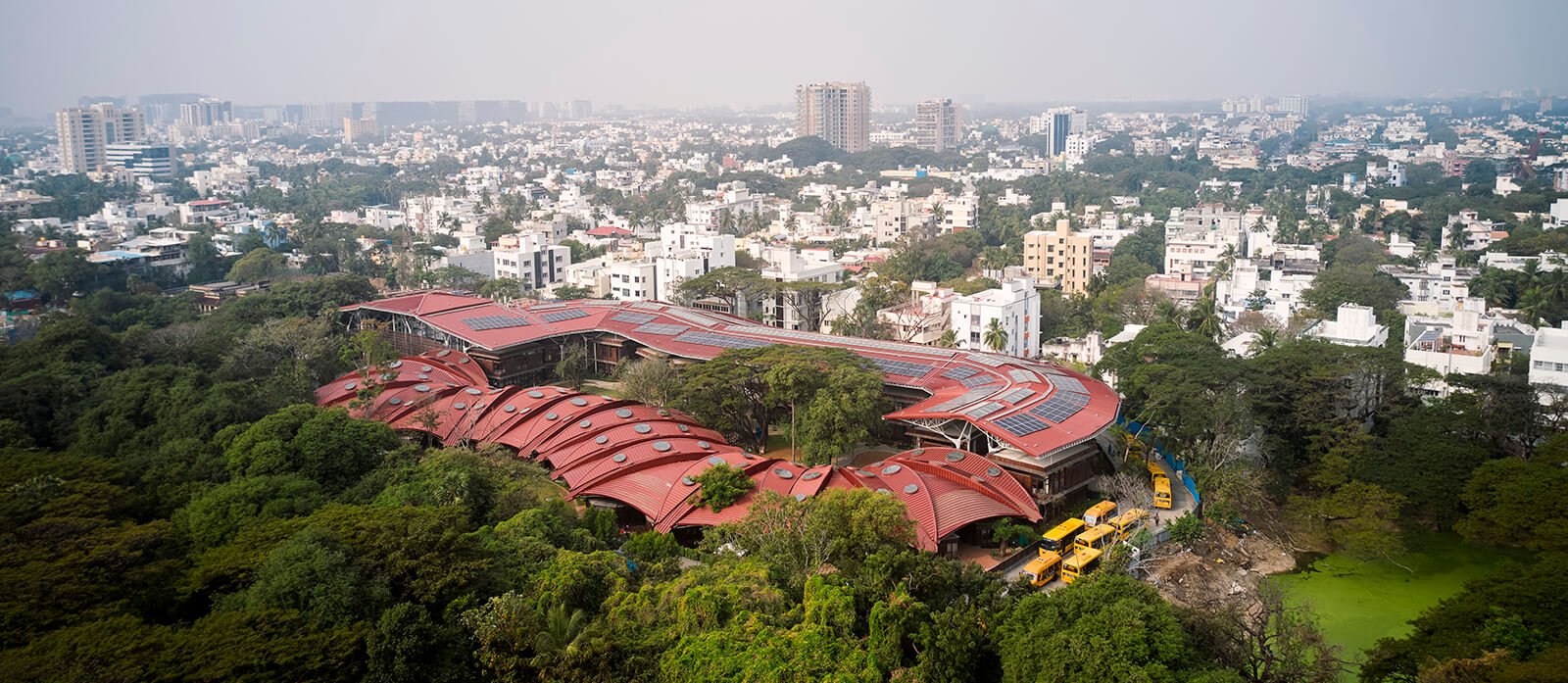
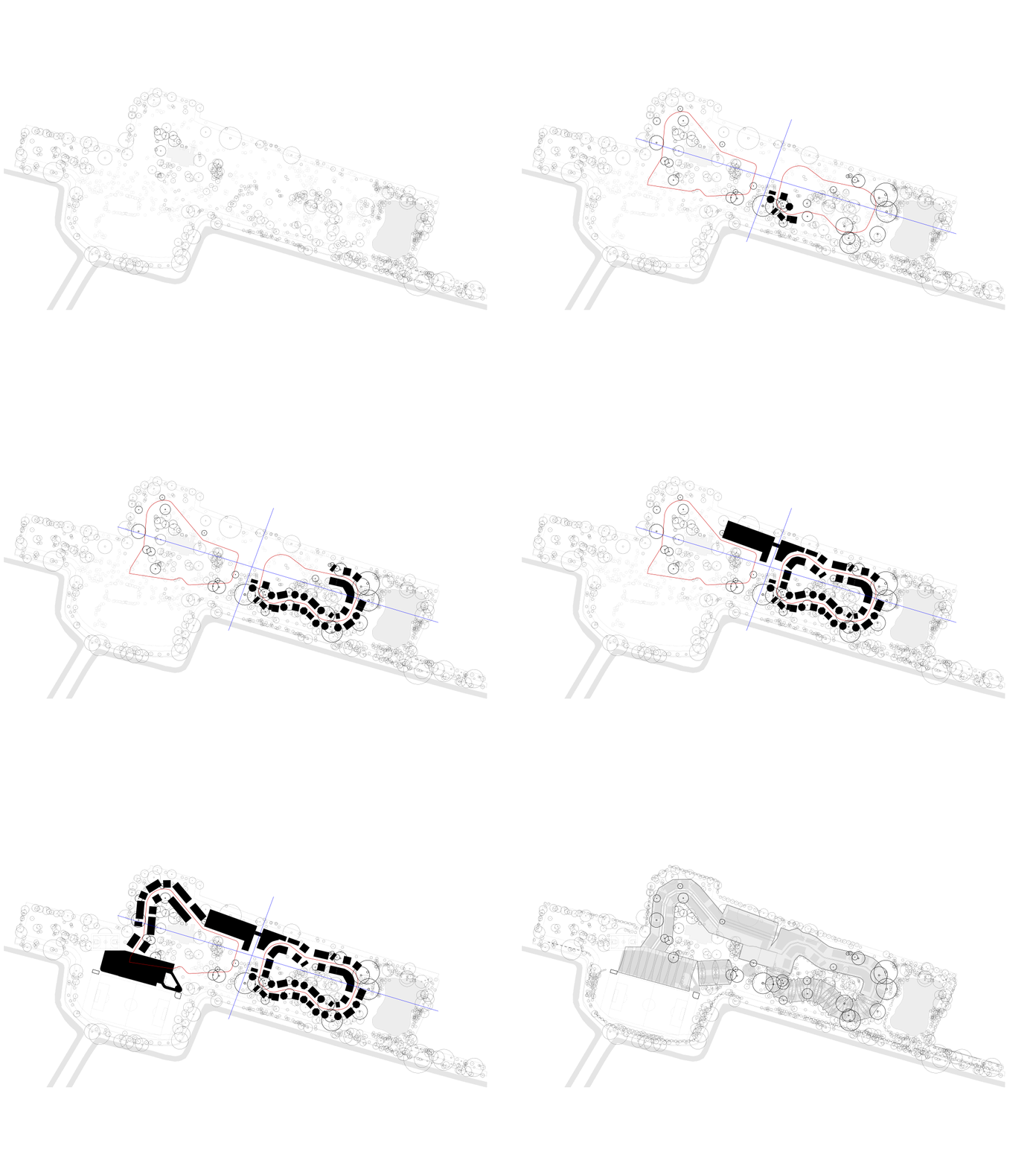
The campus is organised along a looping circulation system that threads carefully between existing trees identified for preservation based on their age, nativity, medicinal value and ecological significance. Rather than clearing the site to establish a tabula rasa, the plan adapts itself to the landscape, allowing the school to settle within an already living terrain. As the architects note, “our first design decision after surveying the trees thoroughly was to draw a looping path that wove through the significant trees. This loop became the organisational diagram for the project.” Classrooms were consequently fragmented into smaller blocks, each shifted and rotated to accommodate the existing vegetation while preserving as much of the site’s canopy as possible. An older structure on the site was also retained and retrofitted, now housing the senior school library.
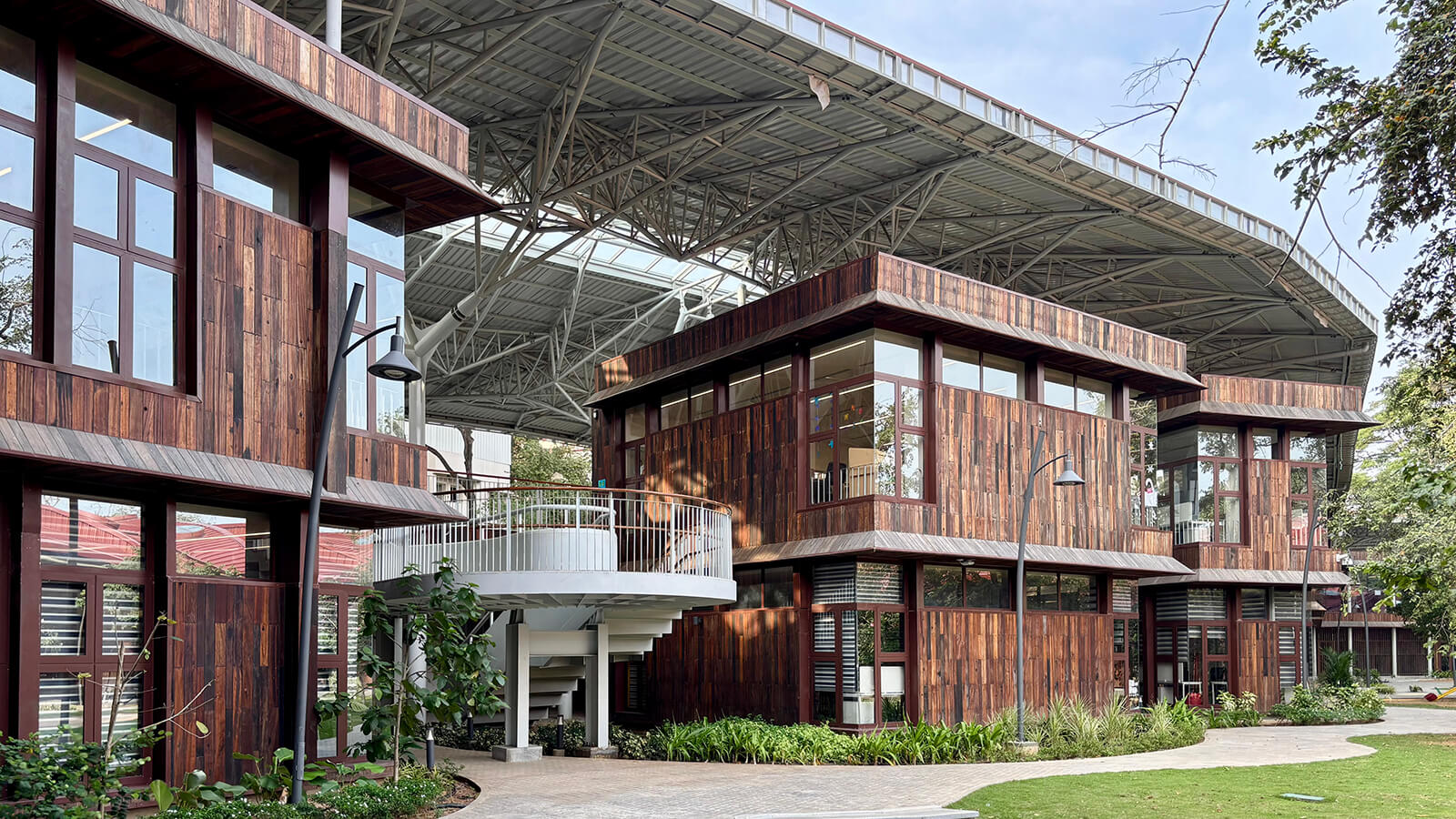
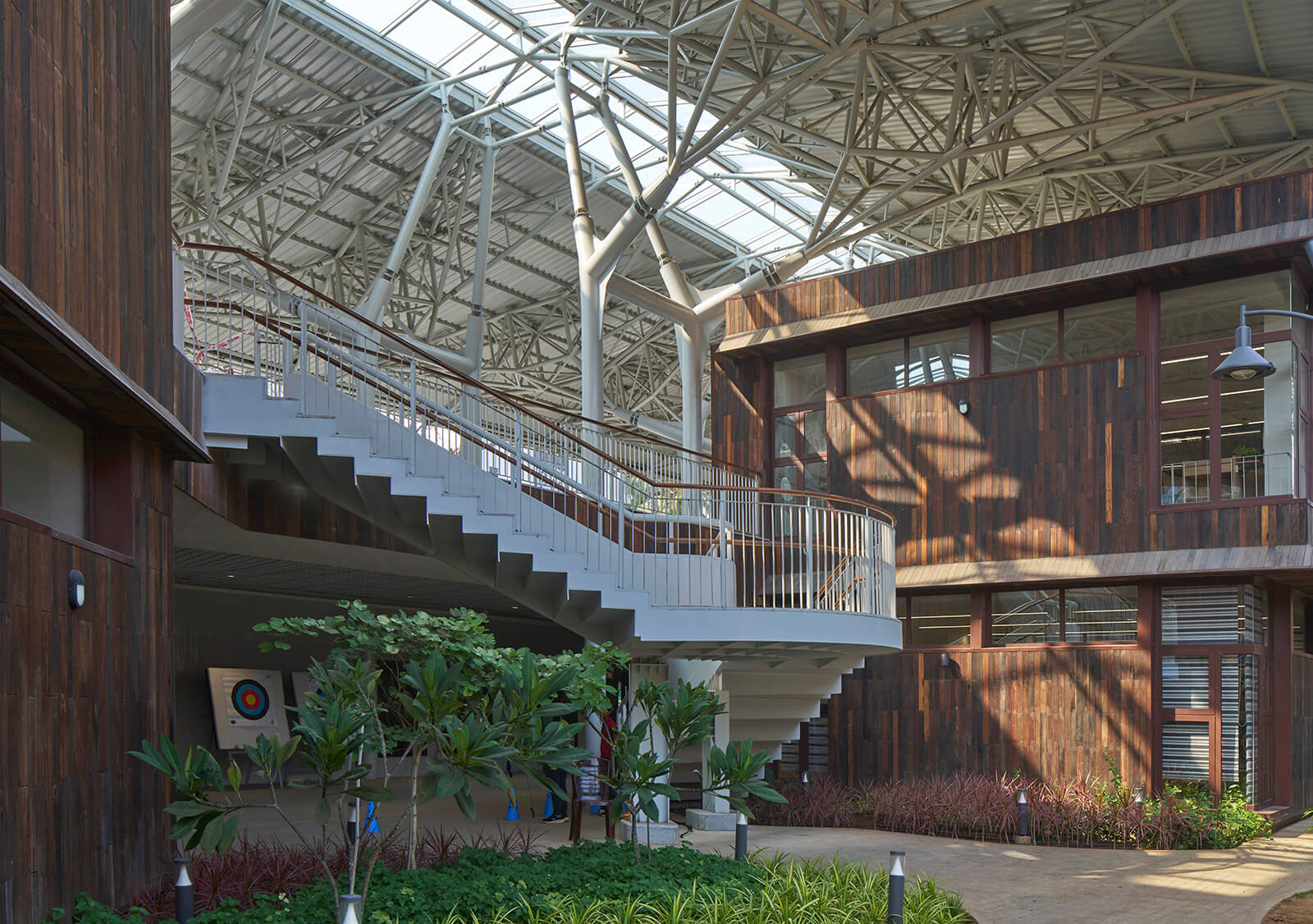
This porous layout preserves natural movement corridors for breeze, birds, insects and small animals, enabling the campus to function as part of the region’s larger ecological network. Construction methodologies were likewise calibrated to minimise disturbance: prefabricated structural components were assembled on site, while building services were consolidated within combined foundation-and-trench systems that allow future adaptability while protecting sensitive tree root zones.
Moreover, the verandah, one of the most enduring spatial devices in Indian architecture, becomes the organising principle here. Students, therefore, move between courtyards, play areas and classrooms through spaces that remain visually and climatically connected to the landscape at all times. “To us, the verandah also embodies a certain idea of freedom and the potential of liminal spaces in education,” the firm shares.
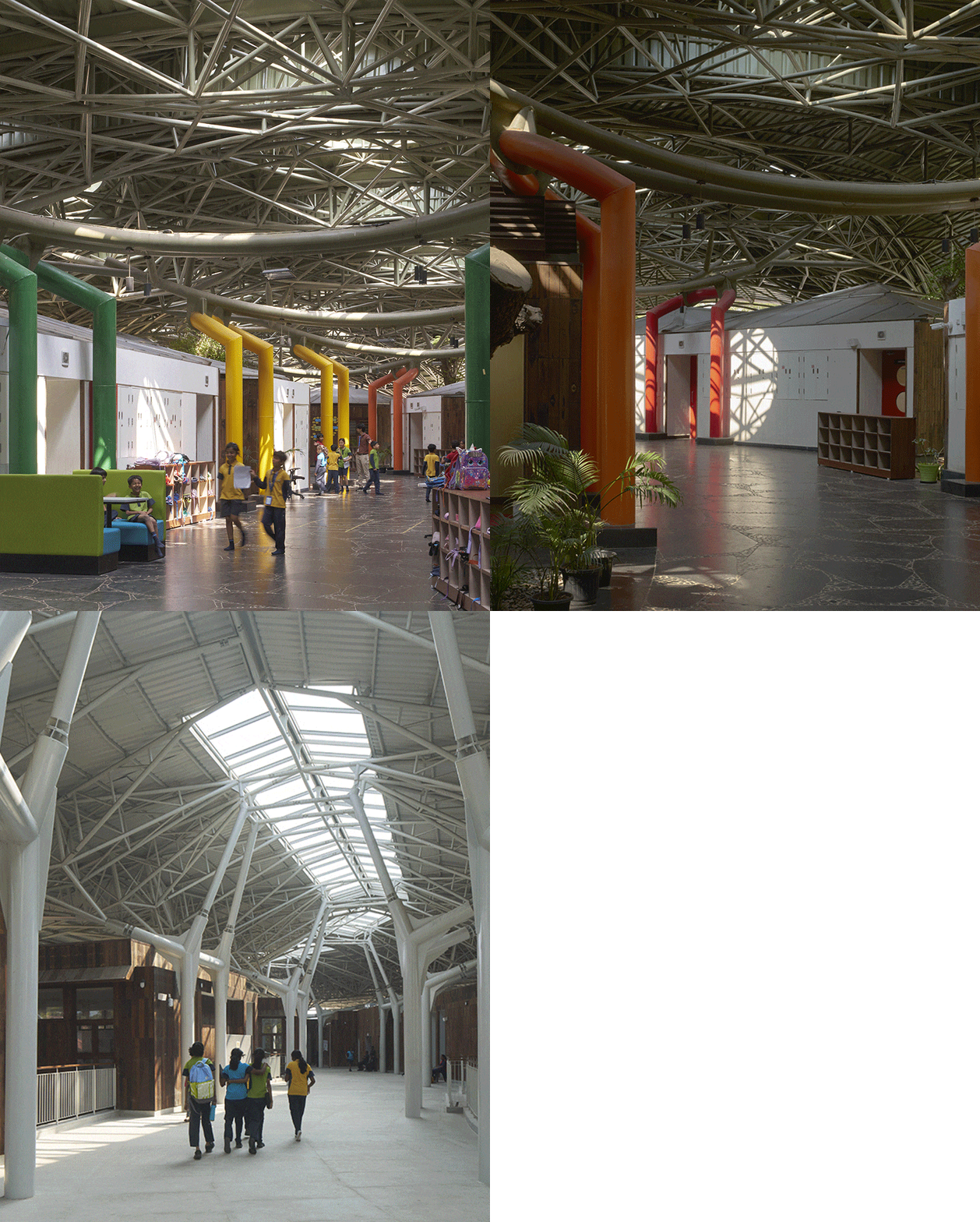
Climate-responsive design strategies underpin the project’s environmental performance. Deep overhangs temper solar exposure, while natural ventilation allows air to circulate freely through the largely open plan. The campus also engages directly with the site’s hydrological systems. An existing lake (largely absent from official revenue maps but critical to the area’s water ecology) is being restored as both a reservoir and an extended learning landscape for the school.
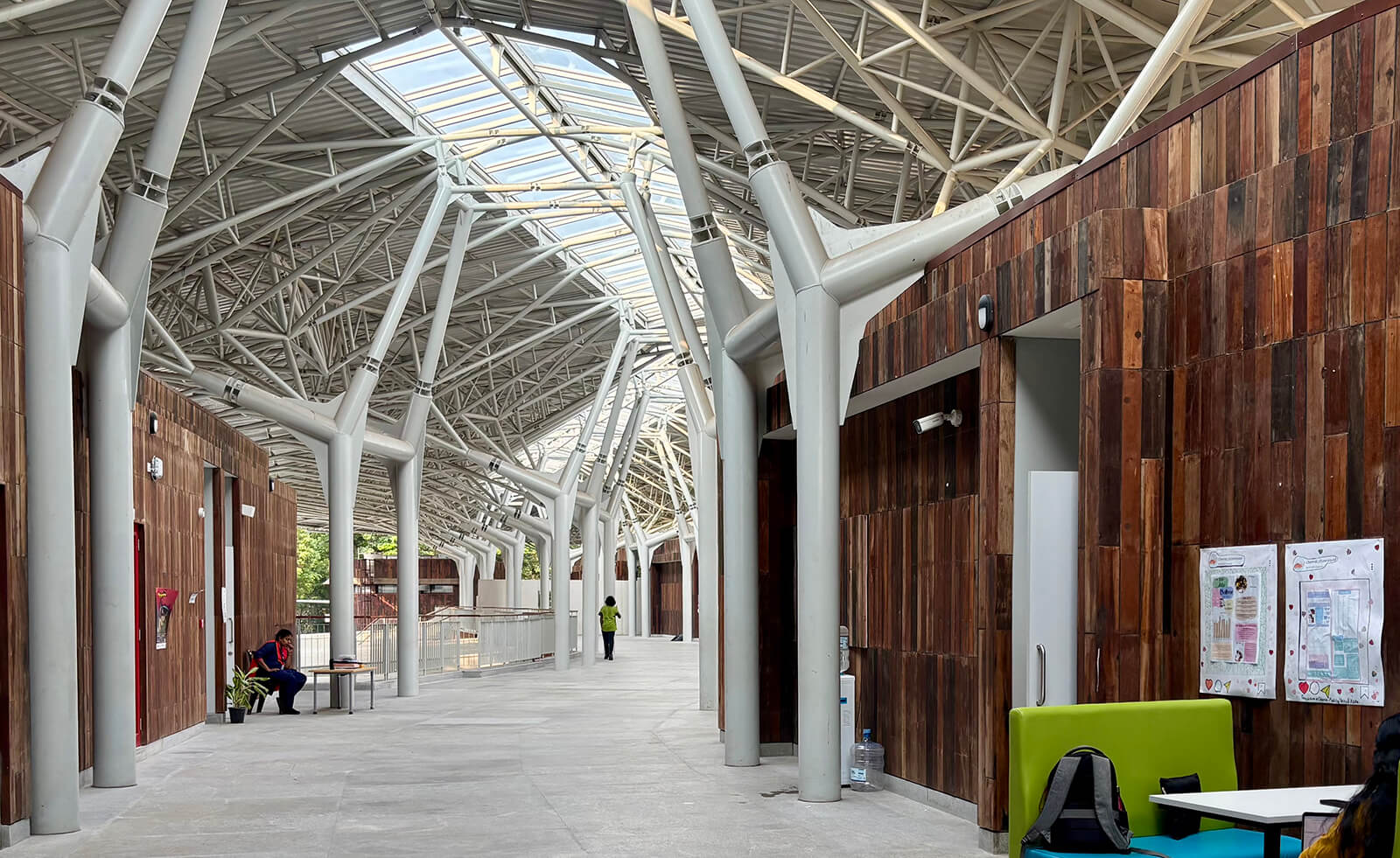
Material choices further reinforce the project’s emphasis on circularity and regional economies. Locally sourced grey granite forms a durable base while reducing embodied energy through proximity and regional craftsmanship. A secondary timber skin made from reclaimed decking wood salvaged from dismantled ships introduces both insulation and tactile richness to the façade. Solar panels integrated within the roof structure generate roughly one-third of the campus’ energy demand, while a hybrid ventilation system combines mechanical cooling with natural airflow to optimise indoor comfort.

The low-rise educational building further reflects Vastushilpa Sangath’s long-standing interest in architecture as a framework for community, culture and everyday life. This is an architecture that subtly shapes behaviour while adhering to occupant comfort. Movement is exploratory rather than regimented; the boundaries between classroom and landscape remain organic.

“The project positions architecture as an active pedagogical tool, one that reiterates the importance of porosity in our lives,” the project’s press release notes. The statement resonates beyond the building’s physical openness. Porosity here becomes a cultural stance—an architecture that invites exchange rather than enclosure. Protected beneath a leaf-like canopy yet open to air, rain and movement, the school’s design demonstrates how educational spaces might move beyond institutional conventions. In doing so, it suggests that learning, like architecture, thrives best when boundaries remain permeable.
Name: Shiv Nadar School
Location: Chennai, Tamil Nadu, India
Typology: School (Educational institute)
Architect: Vastushilpa Sangath
Design Team: Rajeev Kathpalia (principal architect); Rajesh Suthar (project lead); Vijay Patel (design director); Rahul Venugopal, Drashti Bhavsar, Lipi Maun, Gunja Rupareliya (architects)
Collaborators: Manjunath & Co. and V.R Shah Engineers (structure consultant); Beyond Green and RaA - Ravikumar and Associates (landscape consultant); Jhaveri Associates (MEPF consultant); Larsen and Toubro (contractor)
Area: 40,453 sqm (gross built area)
Year of Completion: 2025

by Pranjal Maheshwari Oct 24, 2026
A consortium of Copenhagen’s 3XN, Toronto’s B+H Architects and Shenzhen’s Zhubo Design has designed the museum to mimic the surrounding riverscape, topped with a public park.
by Pranjal Maheshwari Oct 19, 2026
The Mumbai-based architects integrate courtyards, mesh screens and north light trusses to create a dining space that doubles up as a community hub at SR University, Warangal.
by Mrinmayee Bhoot Oct 17, 2026
The Rotterdam-based institute centres the Indian Ocean as a network for exploring material histories and transnational links shaping coastal cultures, positing them as future models.
by Pranjal Maheshwari Oct 16, 2026
At the 2026 Stirling Prize ceremony, Mary Duggan with RUFF Architects, MAKER Architecten and Nakshabid Architects were felicitated for proffering quality housing and social equity.

make your fridays matter with a well-read weekend
Enter your details to sign in
Don’t have an account?
Sign upOr you can sign in with
a single account for all
STIR platforms
All your bookmarks will be available across all your devices.
Stay STIRred
Already have an account?
Sign inOr you can sign up with
Verification link sent to check your inbox or spam folder to complete sign up process
Tap on things that interests you.
Select the Conversation Category you would like to watch
Please enter your details and click submit.
Enter the 6-digit code sent at


The Shiv Nadar School by Vastushilpa Sangath positions porosity as pedagogy
by Jincy Iype | Published on : Mar 16, 2026


 Sign in with Google
 Sign in with email
What do you think?