Art08 mins. read
India Art Fair 2026 and more in Delhi: The STIR list of must-see exhibitions
by Srishti OjhaFeb 04, 2026



by Avani Tandon VieiraPublished on : Jan 16, 2026
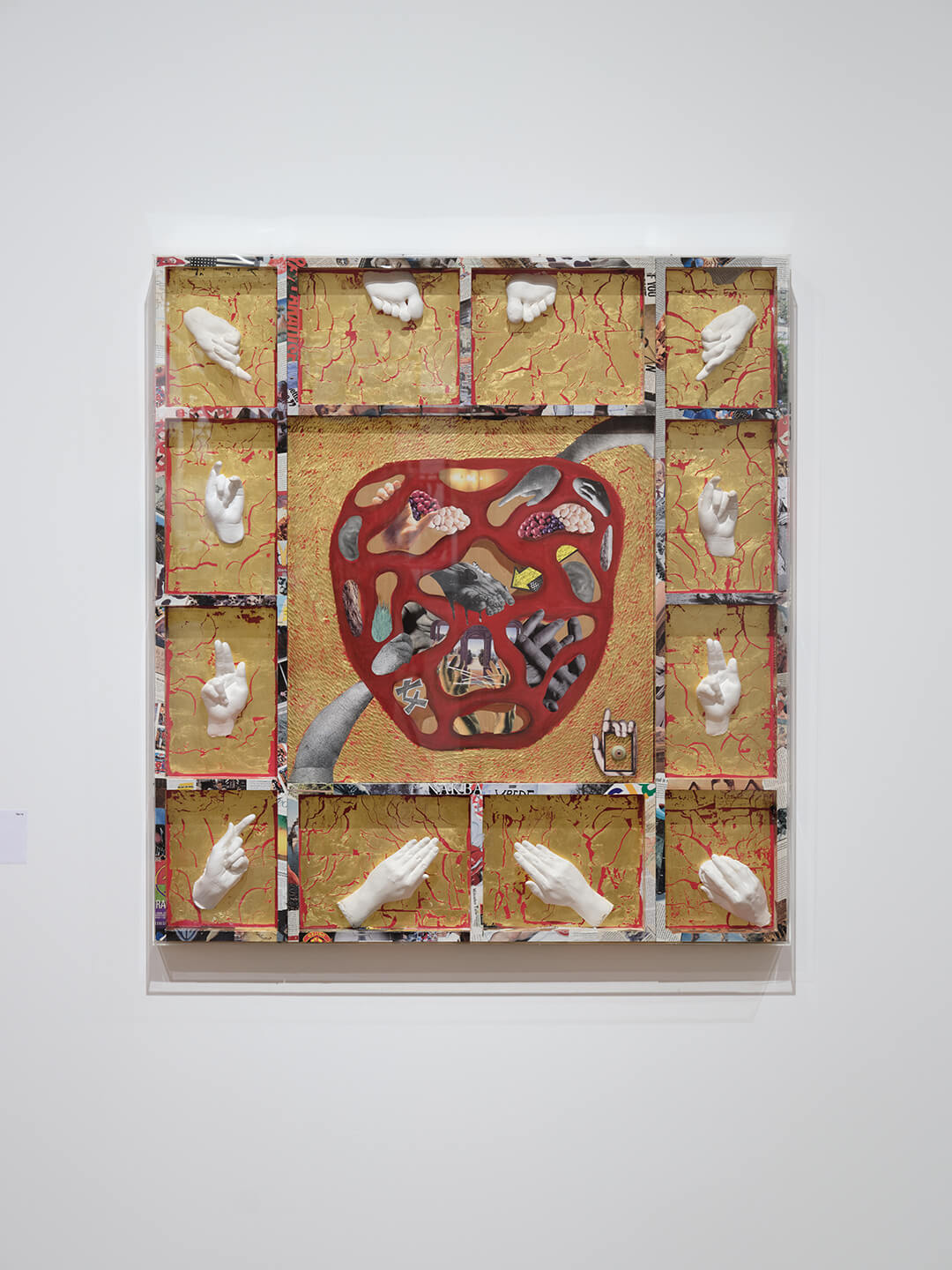
Against a backdrop of gold and red, a profusion of gestures. Plaster casts of hands point, hold objects and make sign language handforms. Each is positioned in a separate cube, together framing a central chamber in which more hands – this time collaged – reach into and through a porous, heart-like form. On the borders of the wooden structure, layers of print: advertisements, the artist’s name, the word NAKBA. Text and images, bodies and symbols. This is Tabe Mitsuko’s Sign Language (1996/2010), a multimedia work that explores modalities of communication in search of a radical, more-than-verbal language. Tabe (1933 – 2024) was a multimedia artist and key member of the Japanese avant-garde. A year after her passing, her artistic vision, anchored in social consciousness, serves as the foundation of For a Placard at the National Museum of Art, Osaka.
For a Placard takes its title from Tabe’s 1961 text by the same name, in which the artist calls for a “placard that absorbs the energies of the masses” – a new physical form that can more fully capture the vitality of people’s movements. Responding to this exhortation, the exhibition, curated by Shoji Sachiko, assembles the work of seven Japanese artists who share, per its wall text, a focus on ‘themes of human life and dignity’. In this endeavour, the placard is interpreted loosely as a “metaphor for acts of appearing, expressing, and resisting” that may appear as “an object, a gesture, a narrative or a quietly held personal statement”, Shoji tells STIR. Treating the iconic object less as an instrument and more as a rhetorical framework, the exhibition asks what it may mean not just to reflect, but to perform politics in the creative realm. The plasticity of this frame enables the construction of solidarities across generations, sites and even species, producing a portrait of the Japanese political sphere as diffuse and malleable.

For a Placard ’s perspectival breadth is evident from its earliest gestures. Presented in an antechamber leading into the main exhibition space is Sasaoka Yuriko’s Working Animals (2024-2025), in which nine animatronic figures, constructed from recycled textiles and bejewelled screens, perform a child-like song. Sonically joyous but lyrically disquieting, the song’s refrain – “Love me, love me please/ Teach me, labour, Teach me, labour” – is addressed from the non-human to the human and positions the two in a paternalistic, even exploitative, dynamic. Sasaoka’s sculptures are modelled after labouring animals – such as the Soviet stray Laika – who were made to suffer for human progress, extending the role of protesting subject, and the possibility of collective action, to the animal world.
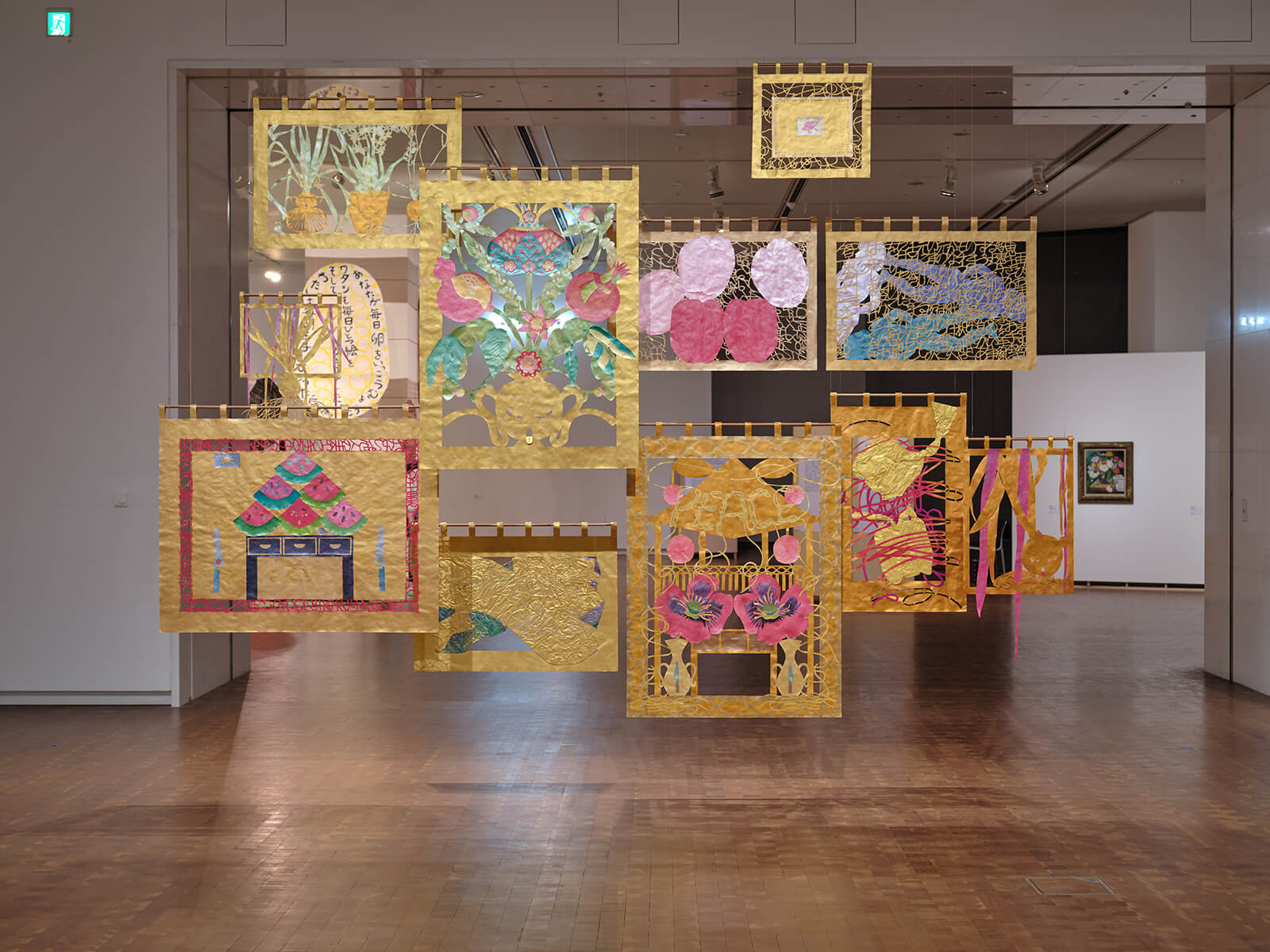
Elsewhere in the exhibition, similar fictional dialogues are initiated with human interlocutors. Tanizawa Sawako’s A Bright New Path Unfolding Before Me, an installation of large-scale paper hangings, is imagined as a conversation between female artists from distinct temporal and geographic backgrounds. Tanizawa’s site-specific work was inspired by four predecessors – early 20th-century Japanese painter Takamura Chieko, 18th-century British collage artist Mary Delaney, appliqué artist Miyawaki Ayako and Chinese paper-cutting artist Ku Shulan – and draws on shared motifs, techniques and experiences. The set of eleven paper cuts presents scenes of the home in burnished tones and intricate detail – fruit piled high on a ceremonial table, root vegetables, flower vases, potted plants – elevating the domestic to the ornamental. The artist’s choice of ‘contemporaries’ further recognises the intersections of identity, subject and material, attending to the medium of paper, and the bodies that deploy it, in light of their exclusion from the artistic and political mainstream.
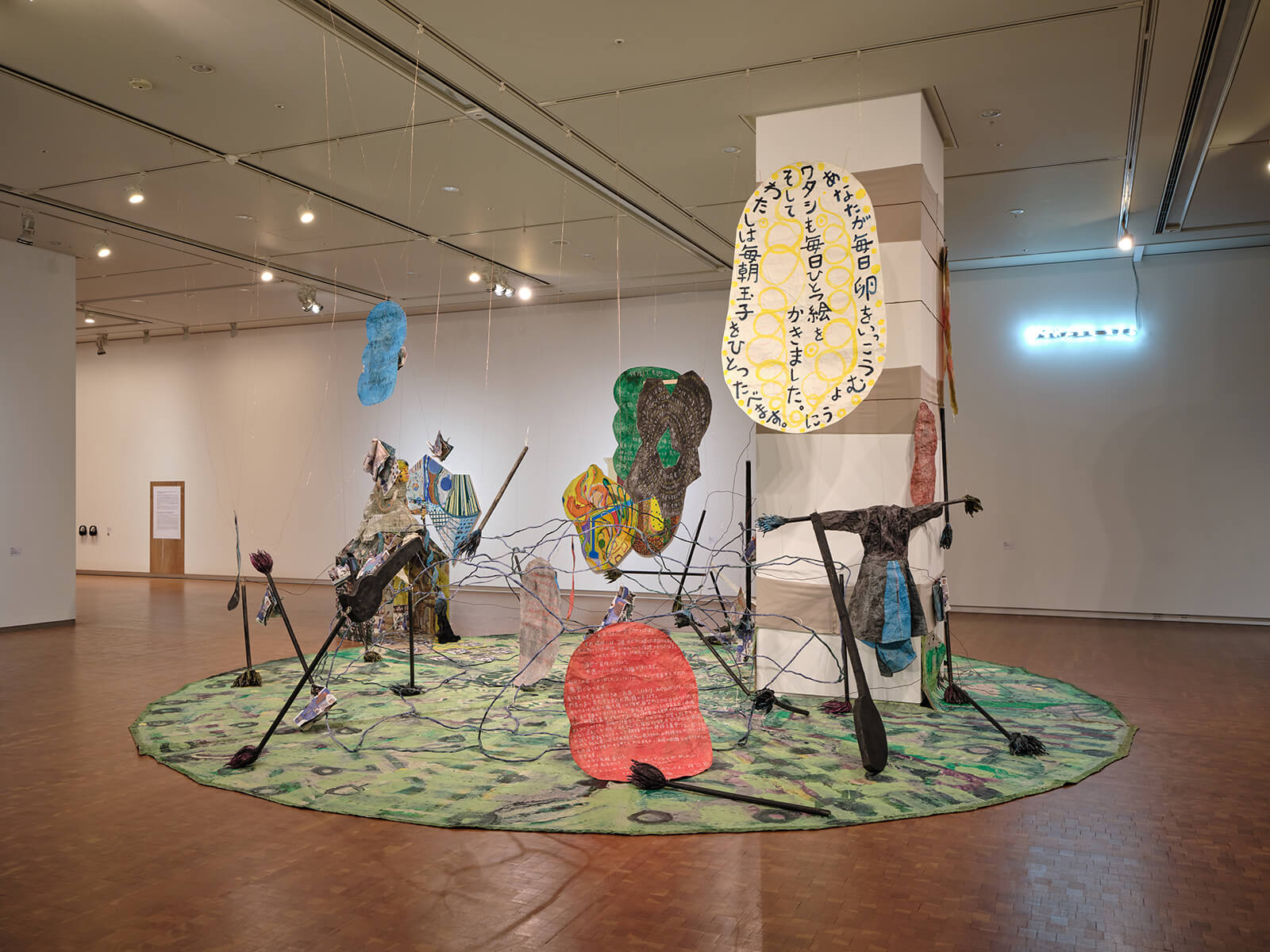
Given the profound tangibility of its titular form, materiality is predictably centred in For a Placard. As with Tanizawa’s work, Ushijima Tomoko’s Hitori Demo Tai: Even One Person Can Be a Team, also developed for the exhibition, presents a dreamscape in washi paper and konnyaku paste: oversized brooms, candles and brushes suspended alongside panels of text, a paper house and aluminium polyhedra. In contrast with Tanizawa’s more obviously polyvocal work, Ushijima’s piece seems to present a more solitary intervention: a domestic scene occupied by the titular single individual. And yet, the artist’s choice of materials – which were produced locally for bomb making during World War II – suggests a similar attention to the politics of paper, not just as surface but also as a tool.

Reflecting Tabe’s dissatisfaction with existing modalities of protest, For a Placard’s engagements serve as both explorations and critiques, gesturing to its inadequacies as a resistant object. In what is perhaps the exhibition’s most direct engagement with the placard’s known form, Iiyama Yuki’s Work shop: You can write anything on this card (2023), the hyper visible medium is deployed in service of the socially invisible. Working with people with disabilities at Kazenoneco, a temporary workplace program, Iiyama invites participants to express feelings that have been denied space or voice. Colourful boards of varying sizes document their responses – from explanations of symptoms to frustrations with the dynamic of patient and caregiver. Across these articulations, much space is taken up by the impossibility of expression – messages referencing forced silence or the failures of familial empathy –suggesting that the act of putting words on paper may be both valuable and inadequate. In another series of works by Tanizawa, titled small voice, attention shifts to the material precarity of the form. Viewers are presented with miniature placards in wafer-thin ceramic, each inscribed with a different message. ‘NO’ reads one emphatically. ‘my voice’ reads another in Japanese. Tanizawa’s small objects are staged in various states of disintegration, so that their fragility almost supersedes their rhetorical impact. The viewer must look closely and carefully if they hope to hear what the ‘placards’ are saying. Perhaps a small voice can only claim a small space.
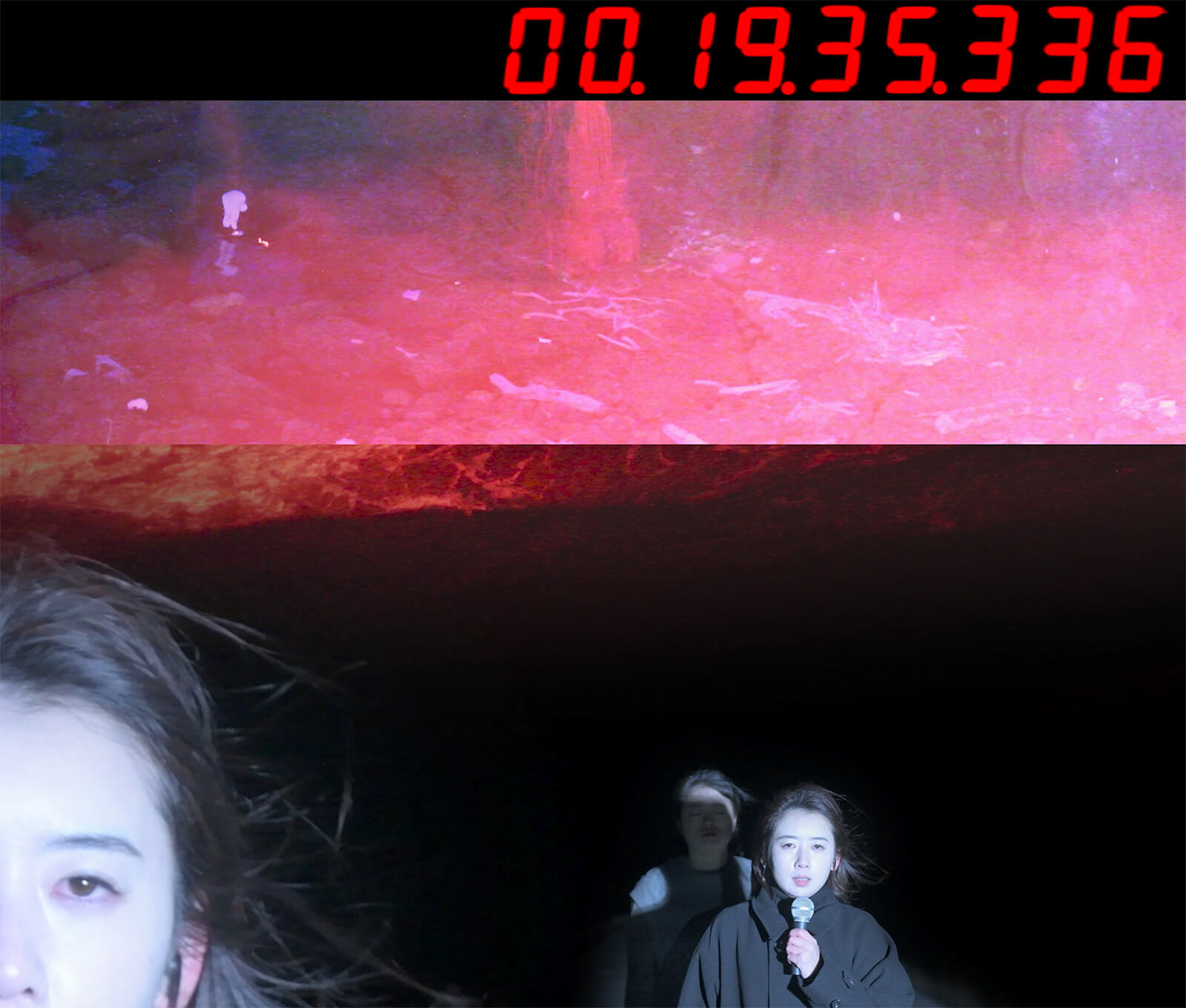
In a semi-partitioned space across from Tanizawa’s miniature placards is a work that retains their narrative thrust but inverts their scale – Shiga Lieko’s video installation When the Wind Blows. Shiga’s work is concerned with inequities of place, made manifest in the aftermath of natural disasters. Considering material and human losses in the Tohoku region after the 2011 earthquake, the single-channel work addresses the political foundations of regional suffering. In a pitch-black night, starkly illuminated figures walk towards the camera. In the lead is a woman with a microphone who narrates the region’s history of resource extraction and top-down reconstruction. Visibly battered by the elements, the strange procession serves as a visual and sonic reflection of Tohoku’s marginalisation, extending the temporal limits of disaster to include everyday forms of exploitation.
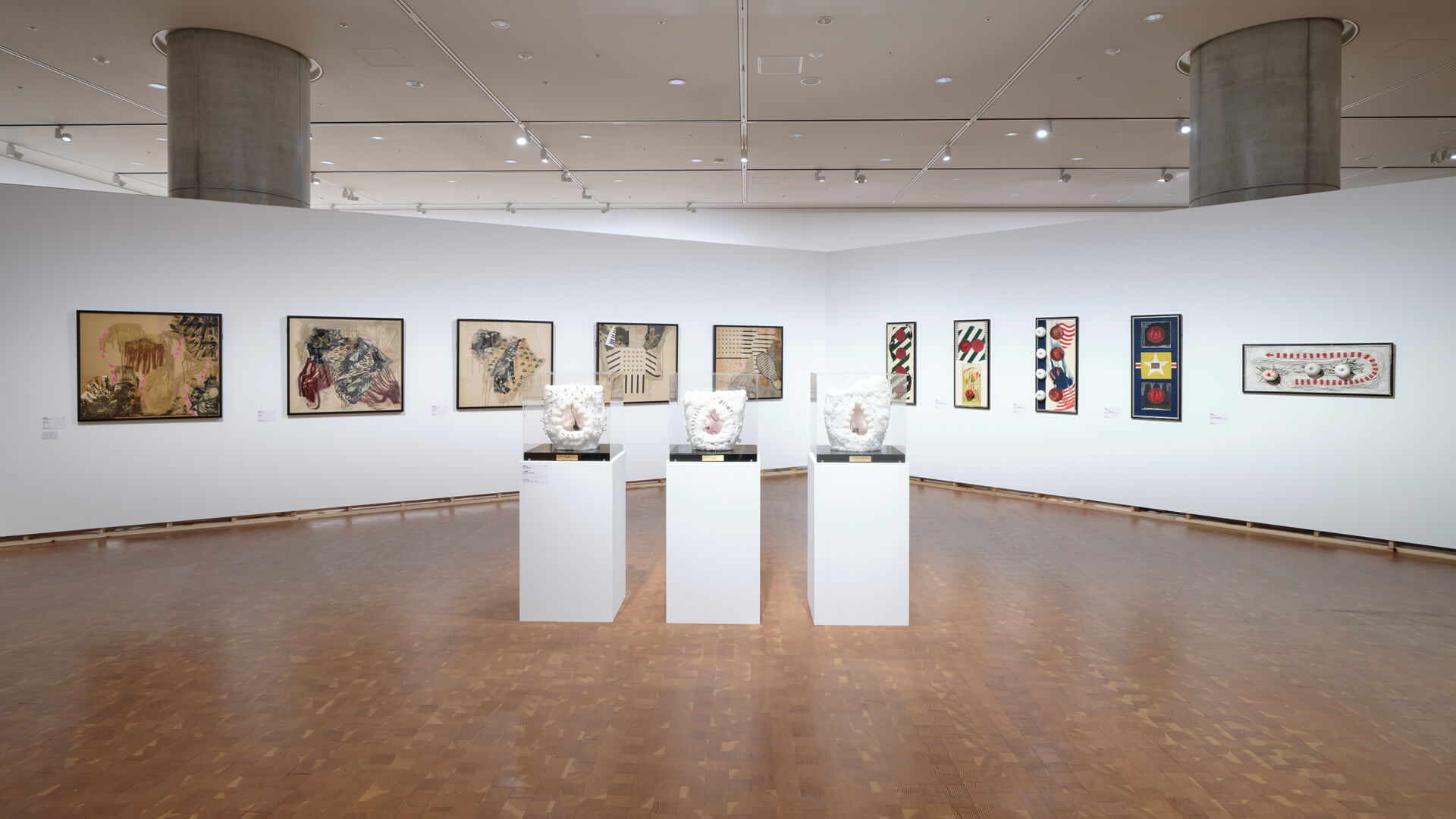
Where Shiga’s work recognises the unevenness internal to the nation, Tabe’s Placards, presented inthe exhibition’s opening section, considers its transnational echoes. The five-panel work, like her later Sign Language, relies on collage as an aggregative technology, bringing together images of black musicians with hand-torn material on the U.S. – Japan peace treaty, mannequin hair and lipstick marks. The result is a series of visually dense works that gesture at broad, international solidarities, evocative of protest in their improvisatory nature and visual grammar.
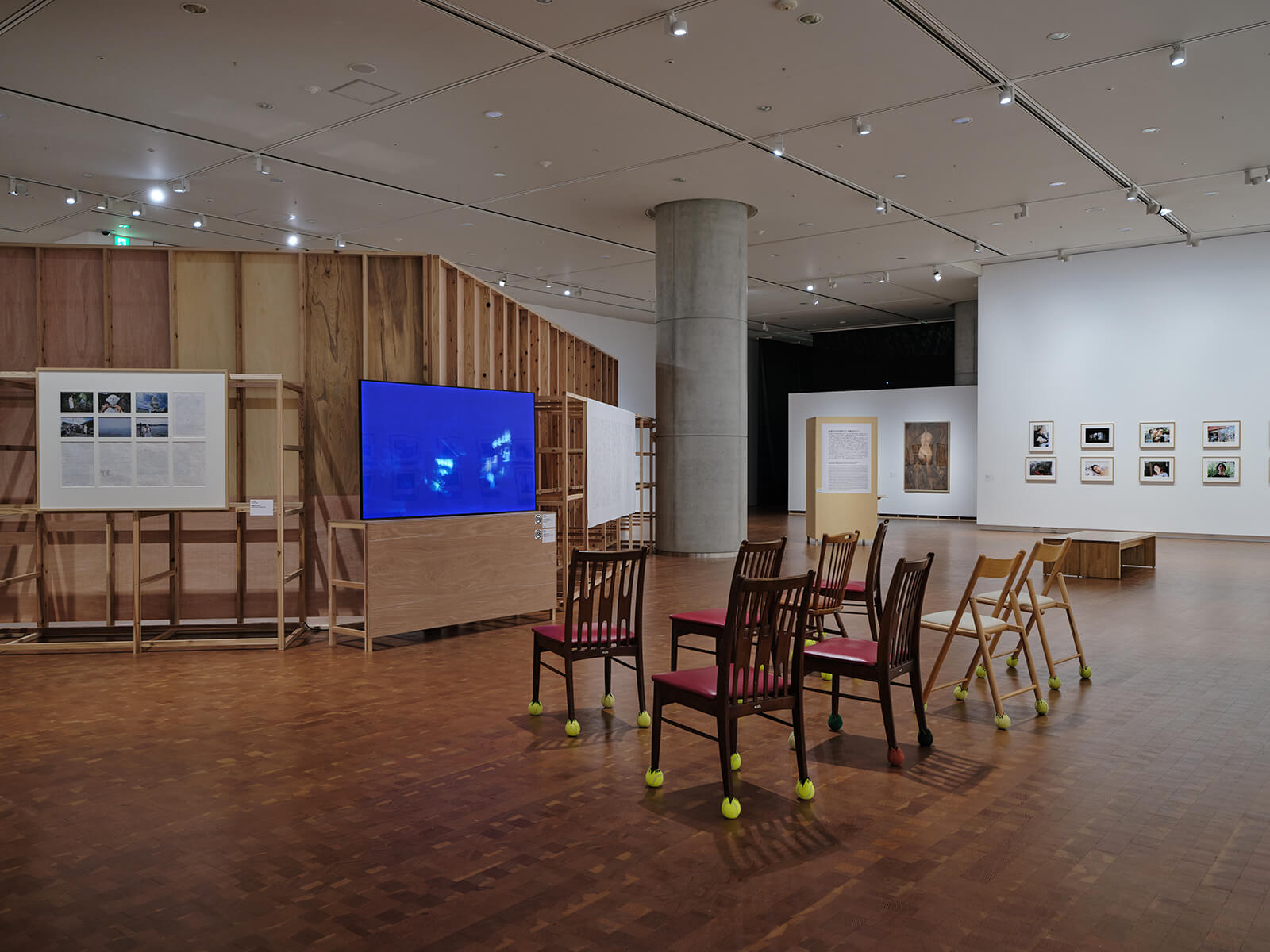
A comfort with mixed registers is central to both the works in For a Placard and the curatorial vision behind it. Artists and works are permitted, even encouraged, to mingle, each voice presented in several movements, across sections that thematically and spatially overlap. Explaining this choice, Shoji expresses a hope for the “frictions, echoes and quiet correspondences between adjacent works [to] allow the exhibition to unfold as a shared field” – one that permits both resonance and interference. Just as a protest site can be overwhelmingly, and liberatingly, plural, the exhibition actively chooses commonality as its organising principle, making it possible to uncover new, if not always legible, solidarities between artists, works and concerns.
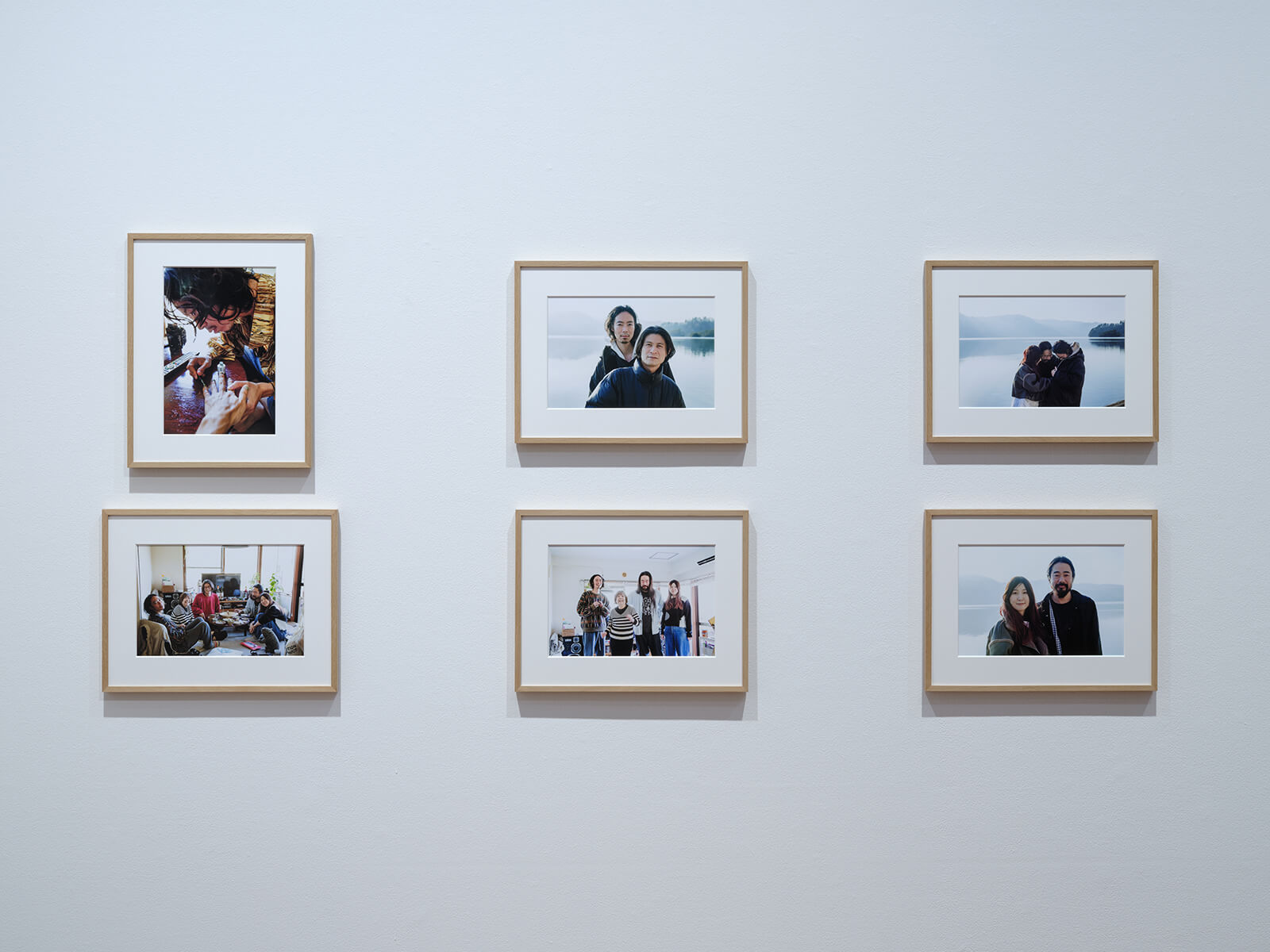
Significantly for an effort that is premised on outward gestures, much of For a Placard is invested in the intimate. Lining the walls of the exhibition’s first chamber is Kanagawa Shingo’s A Bright Room, a set of 38 photographs taken when the artist was living communally with a couple of artist friends. Depicting scenes of domestic life that are superficially unremarkable, the work uses irregular forms of association to query the unspoken rules of habitation. In one photograph, the three sit on the floor in the nude, smiling at the camera in the manner of an ordinary family photograph. In another, directly below it, they are photographed together again, this time outside and fully clothed. Looking to the home, Kanagawa’s work reduces activism to its most basic units, examining the forms of kinship through which politics is enacted.
As in A Bright Room, many of the works in For a Placard precipitate a reckoning with discomfort, whether prompted by what is being said or by who is doing the saying. Simultaneously, their visual strategies – the exaggerated levity of Sasaoka’s animals, the vividness of Tanizawa’s papercuts – perform a mediatory function, softening the hard contours of causes that might not be treated as generously outside the confines of the exhibition hall. In his now seminal meditation on the link between art and reality, philosopher Herbert Marcuse warns of art’s tendency to “[arrest] that which is in motion… [making] it an object among other objects”. Within the rarefied environment of a national museum, it is difficult to deny this possibility. That For a Placard is able to make a valuable effort, despite it is because it seeks, as Shoji puts it, to place artists, subjects, visitors and the institution “on a relatively flat plane”, recognising a shared “responsibility to resist invisibility” at a time when such gestures remain uncommon in Japanese art institutions. There is value in this dream: to meet on common ground in search of a shared language, holding a card, or a microphone or some newer, more vital form, like Tabe would have wanted.
‘For a Placard’ is on view from November 1, 2025 – February 15, 2026, at The National Museum of Art, Osaka.
The views and opinions expressed here are those of the author(s) and do not necessarily reflect the official position of STIR or its editors.
by Srishti Ojha Oct 21, 2026
Increasingly, artists, filmmakers and activists are turning to VR to create more personal, tangible accounts of the climate emergency and its impact on vulnerable communities.
by Mirra Lynn Oct 20, 2026
The Indian artist paints the old wadas of central Pune, capturing the traces of everyday life that cling to these structures, battered by time but unbowed.
by Anmol Ahuja Oct 15, 2026
How do heaps of souvenirs and relics with racist Aboriginal motifs and features become art? MCA Sydney’s winter showcase—the artist’s largest to date—beckons a possibility.
by Vandana Kalra Oct 14, 2026
With his latest exhibition as a point of departure, the modernist discusses his decades-long practice, the spontaneity of drawing and the social responsibility of artists.

make your fridays matter with a well-read weekend
Enter your details to sign in
Don’t have an account?
Sign upOr you can sign in with
a single account for all
STIR platforms
All your bookmarks will be available across all your devices.
Stay STIRred
Already have an account?
Sign inOr you can sign up with
Verification link sent to check your inbox or spam folder to complete sign up process
Tap on things that interests you.
Select the Conversation Category you would like to watch
Please enter your details and click submit.
Enter the 6-digit code sent at


In Osaka, the placard is an object of resistance and a rhetorical framework
by Avani Tandon Vieira | Published on : Jan 16, 2026


 Sign in with Google
 Sign in with email
What do you think?