Art08 mins. read
A group exhibition traces the complex history of colonial-era plantations
by Srishti OjhaJul 04, 2025



by Srishti OjhaPublished on : Oct 09, 2026
When you imagine a post-apocalyptic society, what do you picture? A return to the ways of old, to neo-primitiveness after the fall of civilisation as we know it, of renewed connection to the Earth despite the loss of millennia of progress? Or perhaps you picture the opposite—a futuristic techno-world where humans must share their dominance of the planet with machines, algorithms and intelligences of their own creation? South African artist Pierre Fouché sees both, and to him, these two speculative worlds are not as disconnected as they might initially seem. They are united by an unexpectedly common denominator, a revolutionary technology and technique that is rarely thought of as such—thread.
The harvesting and spinning of natural fibres into thread, the skilled transformation of that thread into textiles, lace and other utilitarian and decorative fabrics, is both an ancient art and the bedrock of modern scientific thinking and technology. The systems that govern pattern-making and textile construction—over/under, thread/no thread—are the foundations for binary code and therefore computing as a whole. This system of knowledge, and its centrality to the past, present and future of the human story, is at the heart of The Townsfolk Whisper Your Name in Hushed Tones, Fouché’s solo exhibition at WHATIFTHEWORLD gallery in Cape Town, South Africa.
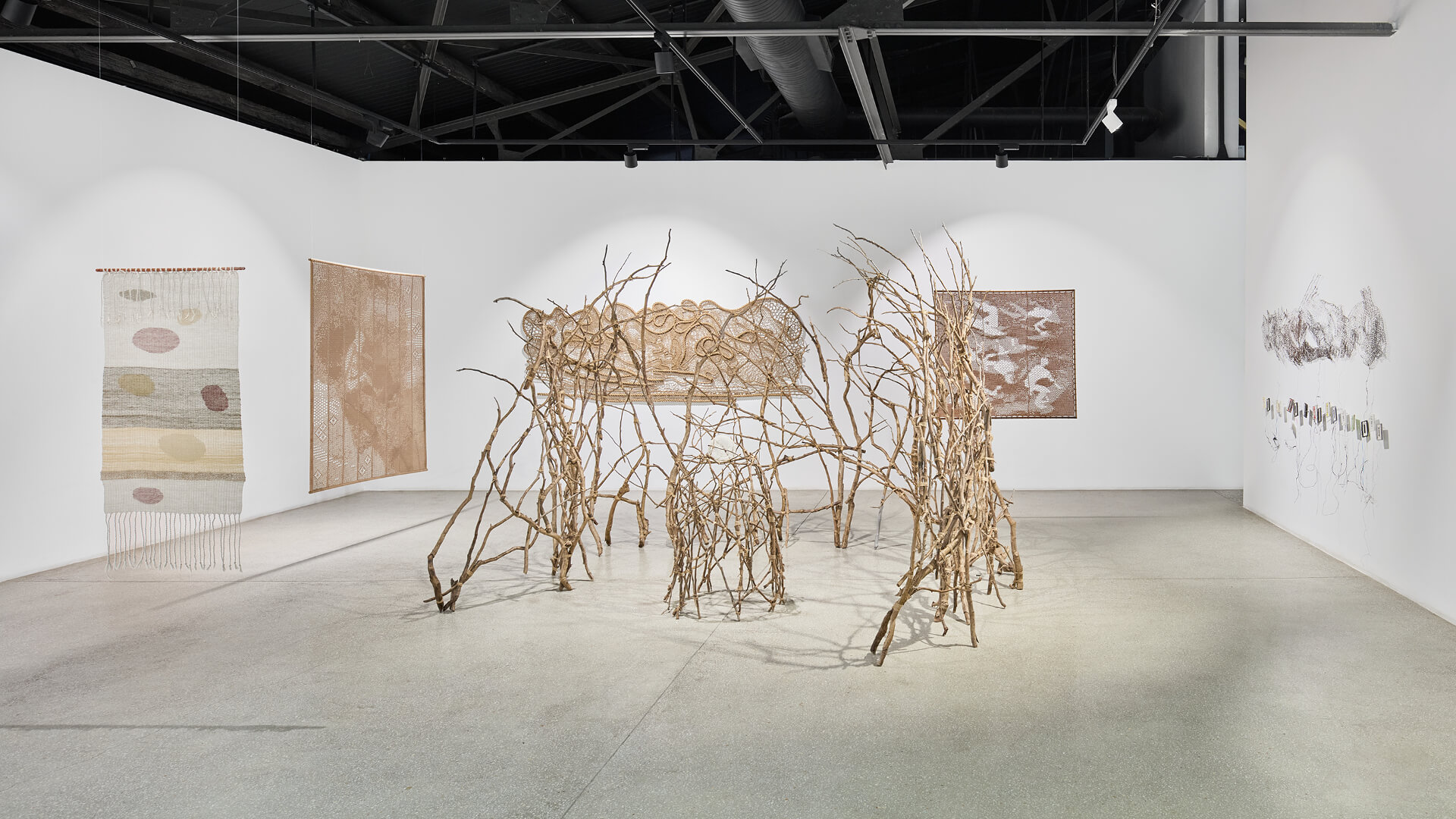
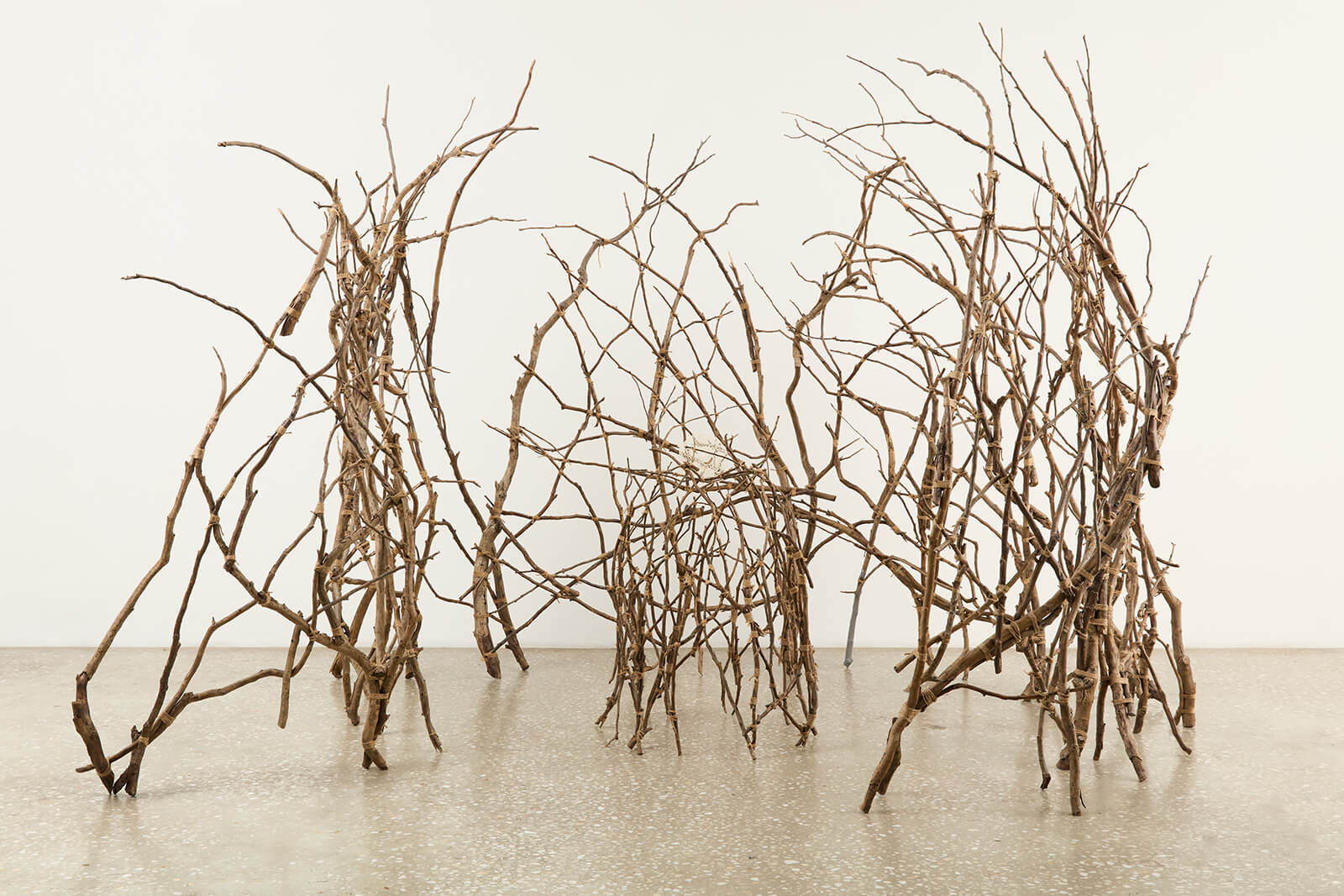
The exhibition consists of two rooms, beginning with The Village. The textile artist imagines a post-apocalyptic society that constructs itself around the only remaining artefacts from a bygone Earth—a bobbin lace instruction manual and a few surfing magazines. A large, central installation made of Eucalyptus branches linked together with jute in a lace-like formation creates the kind of sacred gathering space that comes to mind when one imagines protohistoric life. It is surrounded by a series of diverse works made predominantly from natural materials like—Linen, Cotton and Karakul (a kind of sheep, whose wool the artist spun into yarn himself).
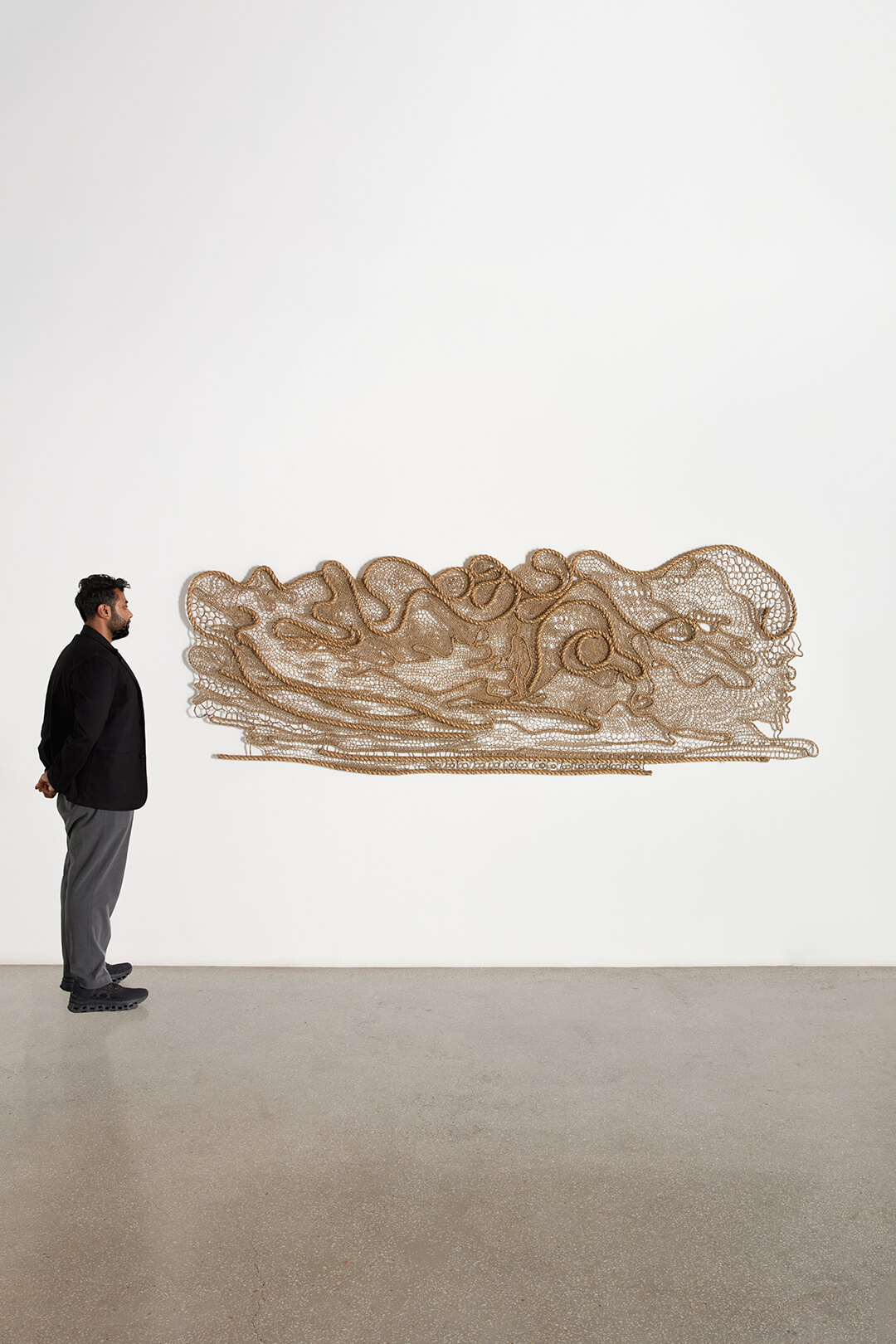
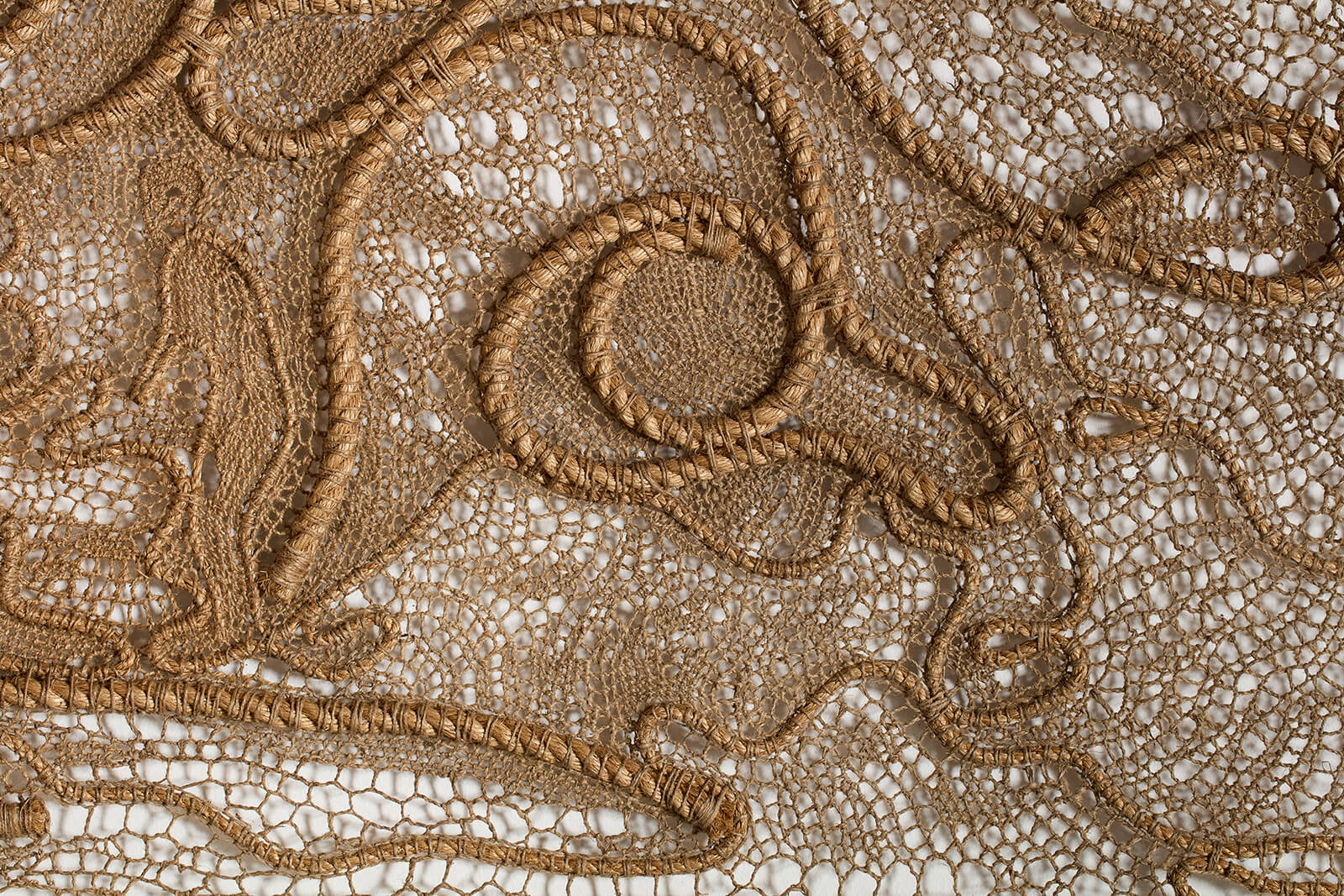
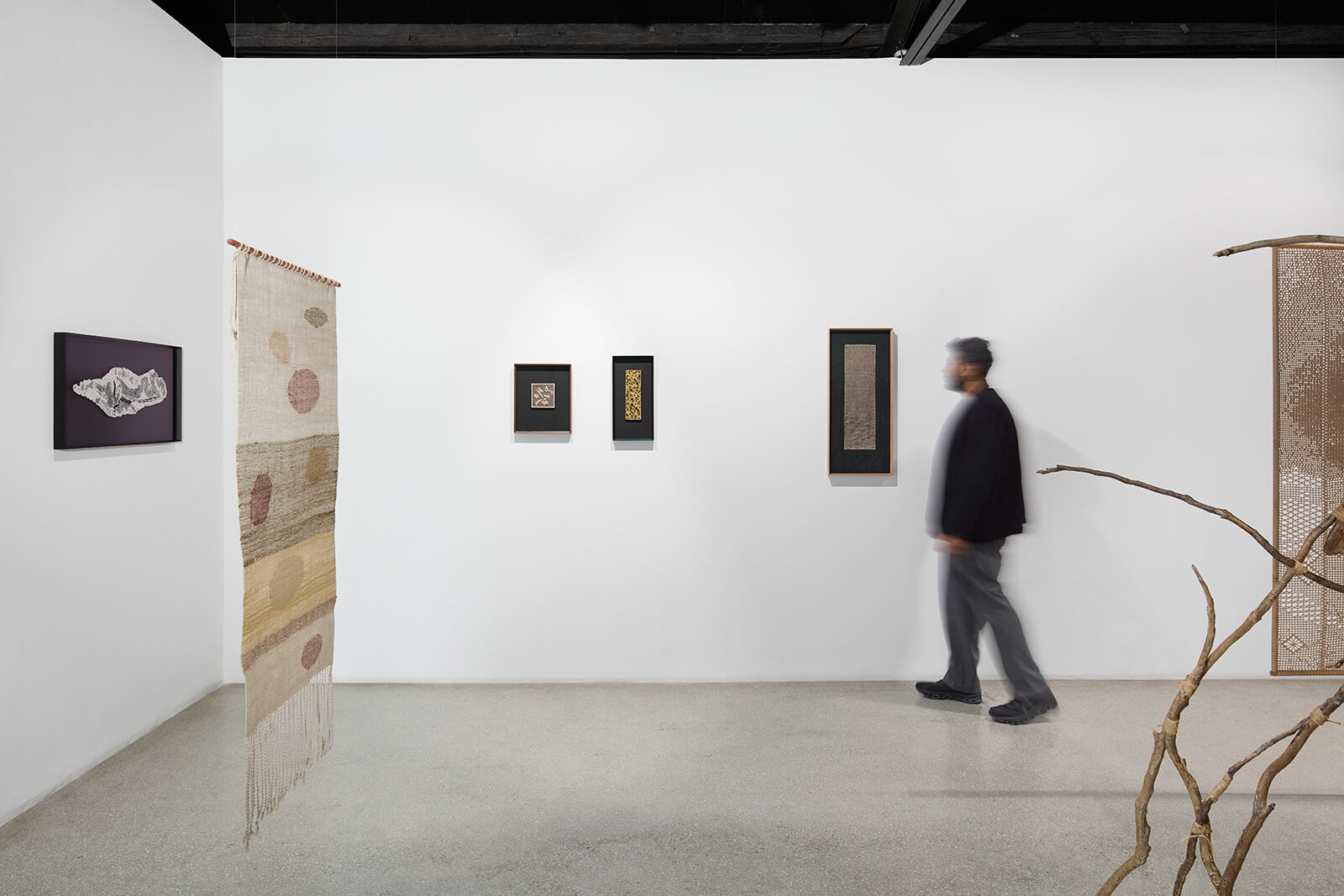
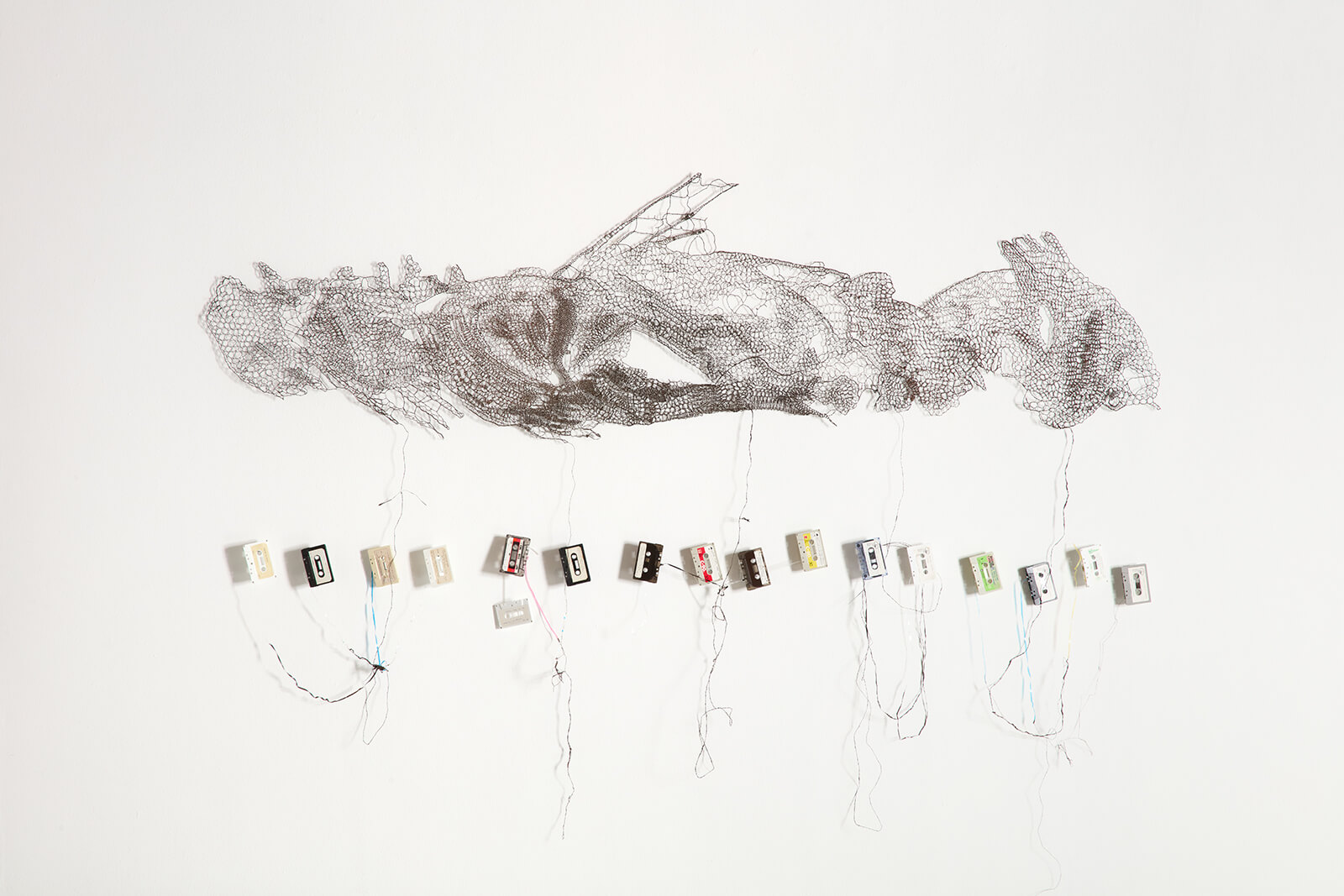
Hanging installations, tapestries, smaller framed fabric artworks and larger wall-based works show the diversity of textile art. They are thick or thin, complex or simple, lacy or sturdy, organised or organic, each changing with their fibre and pattern. One work, Privy to Mysteries (2024), uses audio tape from cassettes of religious sermons to create bobbin lace in a visual metaphor for the human need for connection, construction and meaning-making (echoed in textile installations like Creation Myth I (2025) and II (2026). These works demonstrate the deeply human tendency to work with one’s hands to make complex, distinct objects out of something as simple as thread.
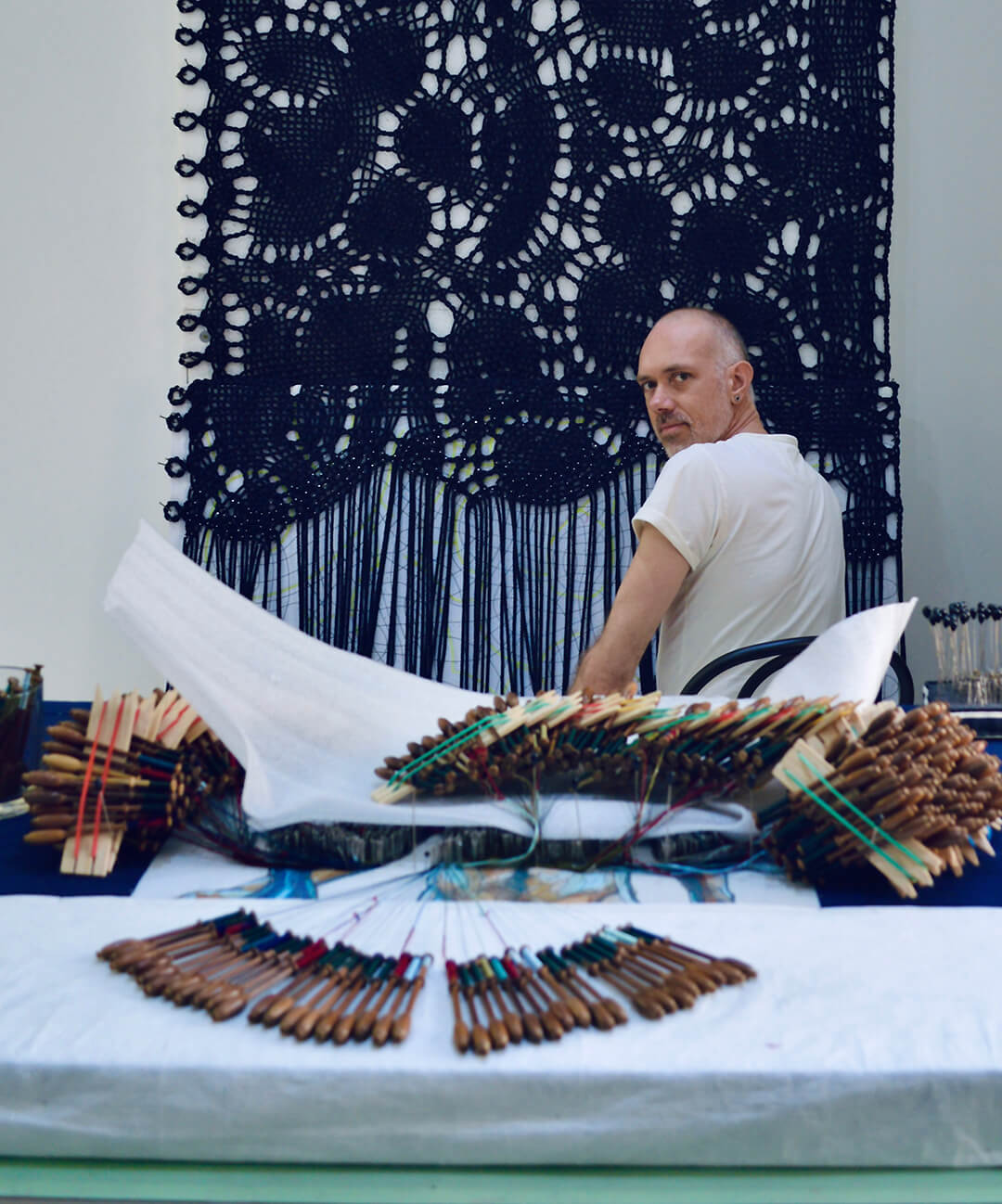
Fouché spoke to STIR about his artistic journey and how it resulted in his decades-long engagement with textiles, saying, “I trained as a sculptor, and my early work was all about pixelated assemblages: building up images out of discrete units. I watched my grandmother working on a needlepoint tapestry one day, and it hit me: she was doing exactly the same thing I was, just with thread instead of objects. The gestalt of digital imagery and needlepoint tapestry is basically the same problem. I asked her to show me how it worked, and I completely fell in love with working with thread. Needlepoint gave way to crochet pretty quickly, and that was really my gateway drug into lacemaking properly.” He continues, talking about more recent forays into surfing and his love for science fiction.
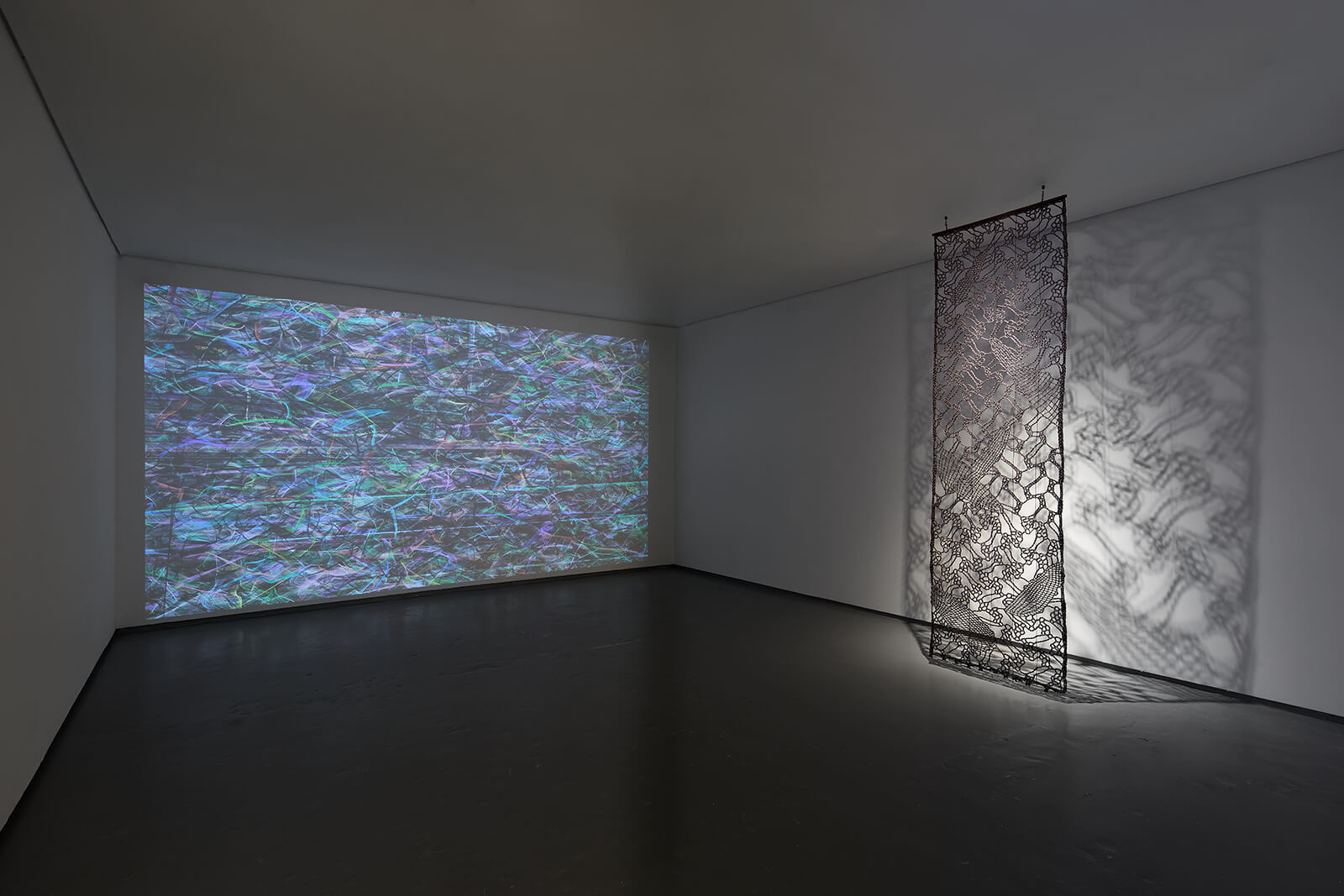
This contemporary and speculative aspect of his practice becomes evident in the second room of the exhibition, The End of Time. Here, he says, “Authorship shifts outwards.” Each piece engages with technology in different ways. Ancient and hypermodern technologies meet in a full-circle moment in works like the towering Silent Weave (2026), which was created using an algorithmically generated pattern
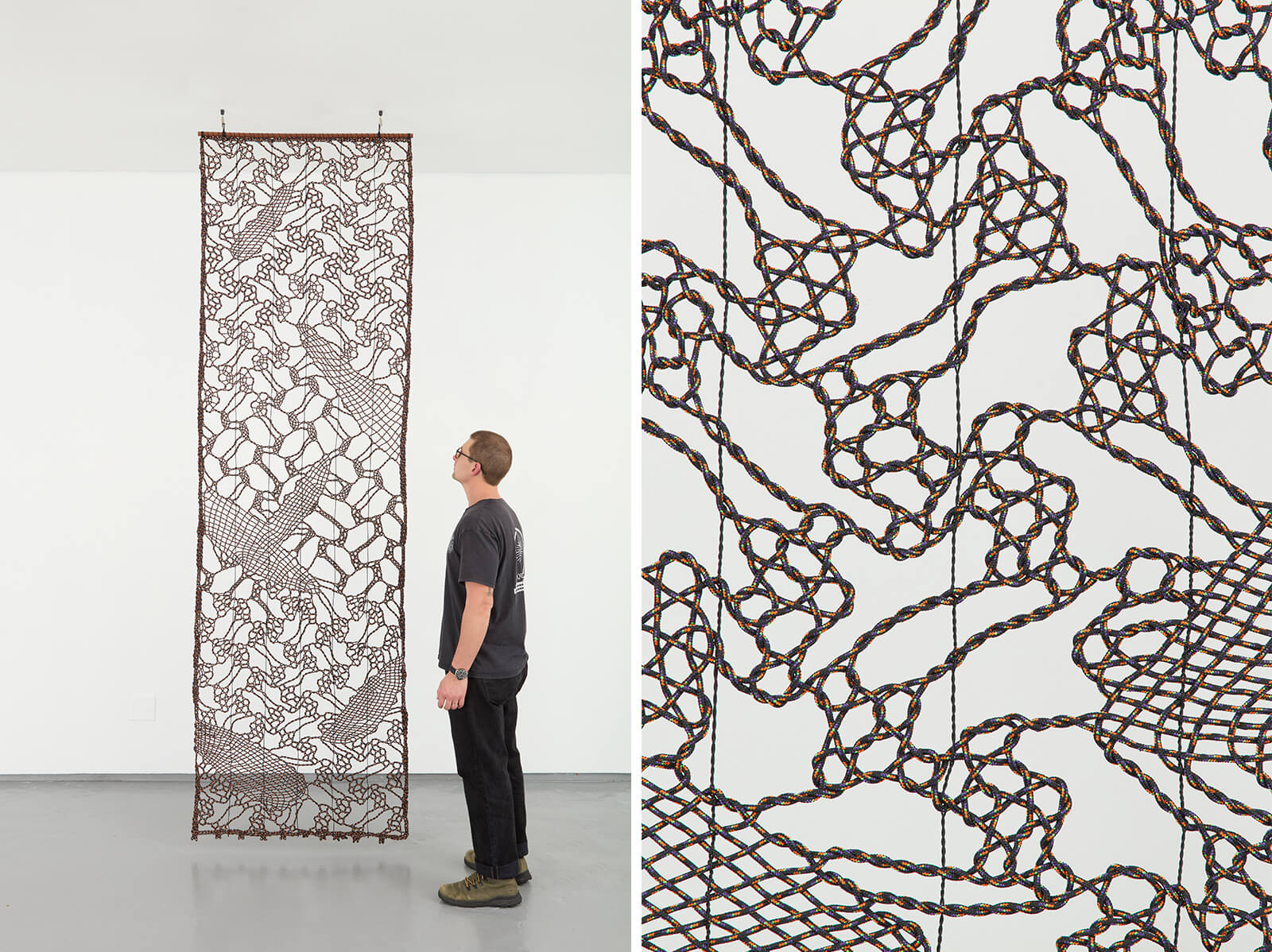
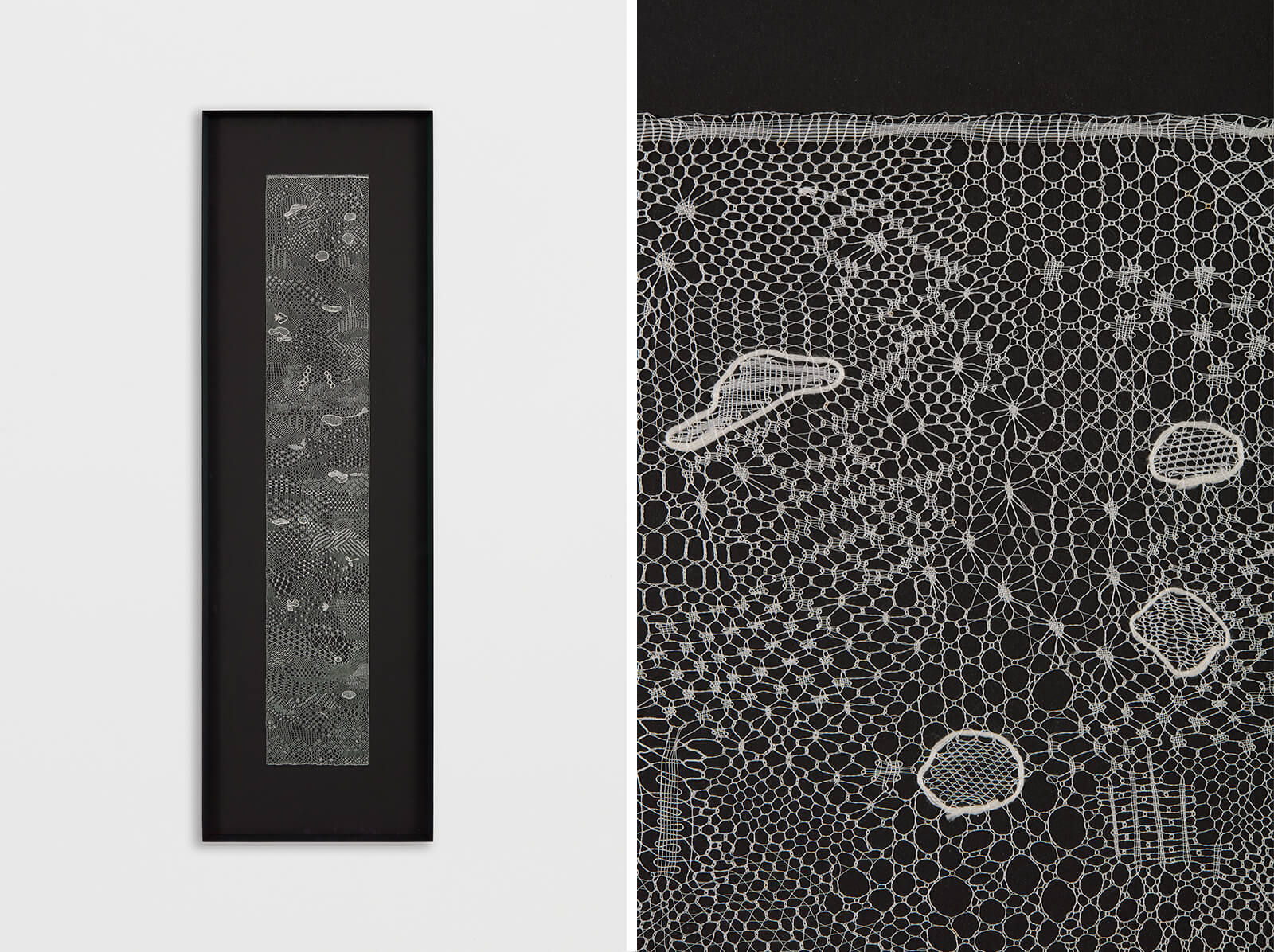
Meanwhile, Drift (2023 – 26), by Fouché as part of his meditation practice without a pattern, explores the ‘algorithms’ at work in human consciousness. The end result seems to fall more in line with fluid dynamics than the Cartesian geometry that structures human perception. Drift II , meanwhile, is a collaboration between Fouché and a Large Language Model projected in the room. To complement this exploration of an alien consciousness, Fouché selects what he considers an equally alien fabric for the room—silk. The insect-woven fibres (rather than plant or mammalian fibres) seem to embody the same unfamiliarity and distance from humanity that these algorithmic authors do.
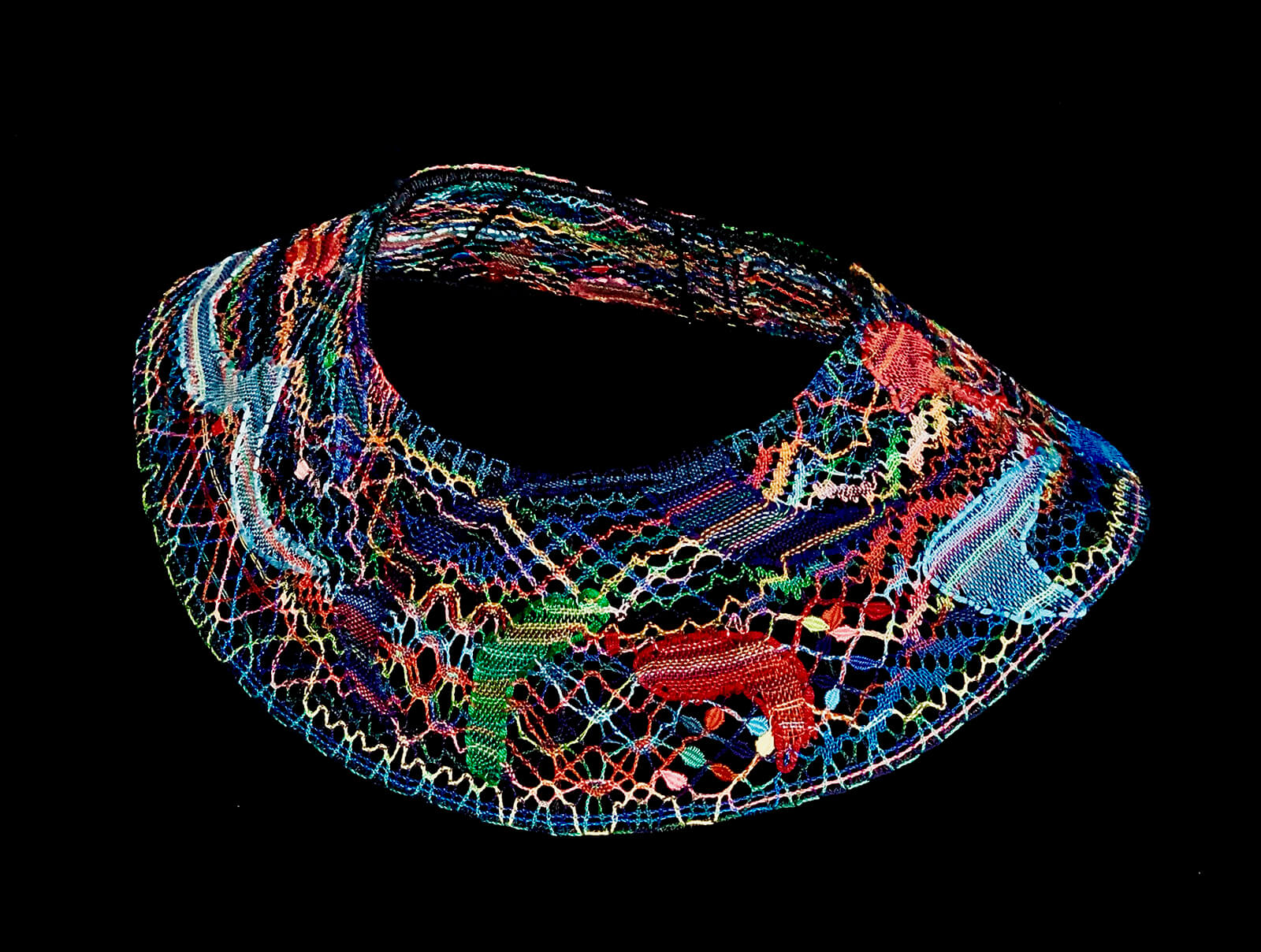
Interface (2023), references the programming term for a shared boundary where disparate parts of a computational system exchange information. The multicoloured thread reveals the paths of the thread within the lace, representing the numerous creative and technical choices at work in the piece and the computational nature of lacemaking. It resembles the kind of woven collars that would not look out of place on the civilisation of The Village, alluding to the idea of exchange and sharing between technology and humanity.
In contrasting these two timelines, Fouché does not seek to set up a binary between the past and future, between what is human and earthly and what is algorithmic and technological. “What interested me wasn't the contrast between ‘primitive’ and advanced so much as this: in both futures, consciousness will delight in pattern, and develop craft/technologies that utilise and delight in it as much as finding practical problem-solving applications for it,” said Fouché.
There are more similarities across both rooms than there are differences, all the more striking for the different timelines Fouché constructs within them. Throughout his work, in this exhibition and his oeuvre more broadly, Fouché has had an interest in time, linearity and playing within its seeming confines. He explains, “I think artists are trained to be painfully aware of the weight of art history: this immense burden of human cultural expression sitting on our overconfident shoulders…You start seeing everything as part of the same long chain of ebbs and flows. I think artists hold onto that chain because they realise every step of our evolution is significant: it speaks volumes about who we are. That's why defunct technologies always end up becoming art media, whether cassette tapes or hand-weaving, bobbin lacemaking; they remind us of our astonishing ingenuity and our frightening ignorance, often in the same object.”
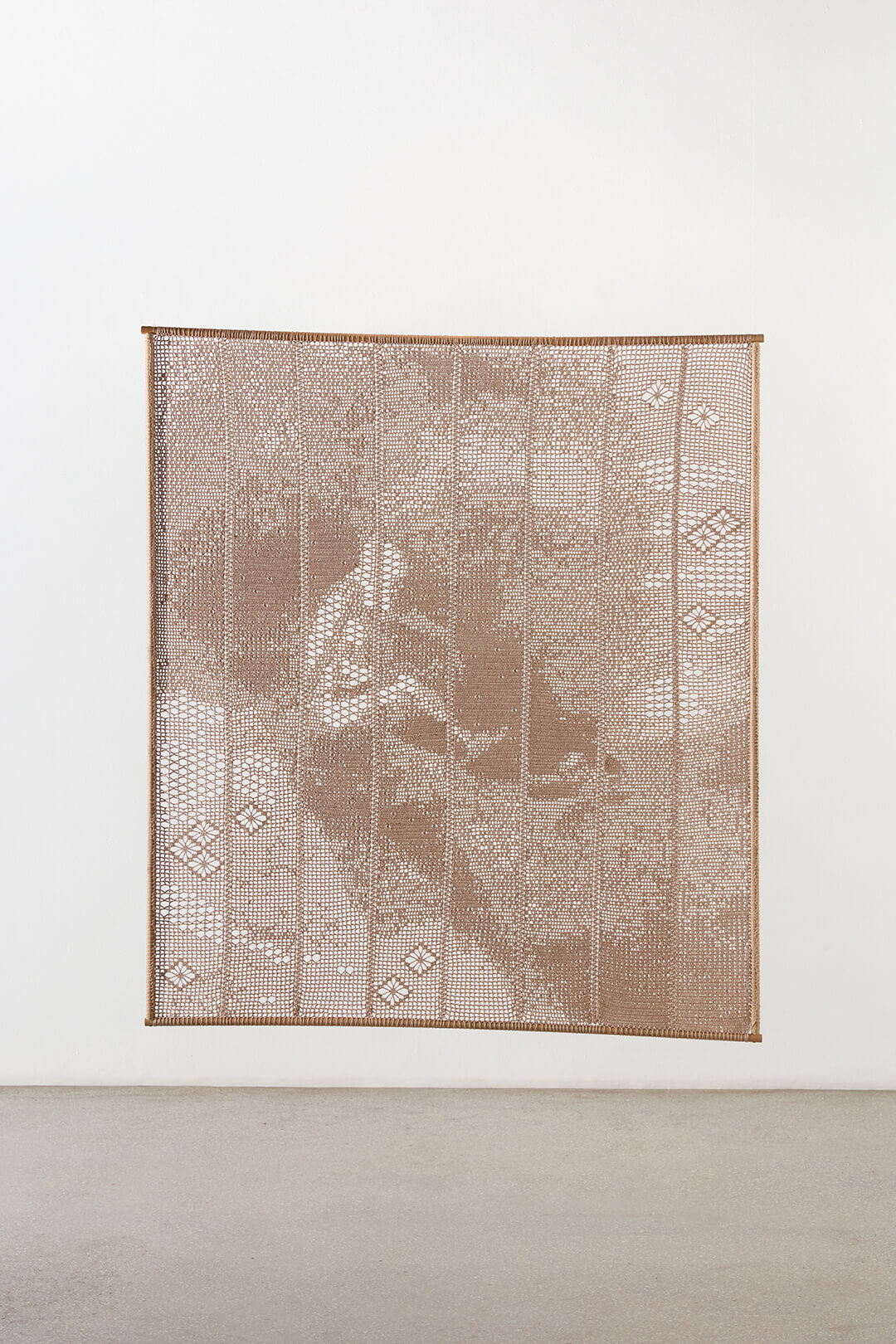
While the titles of both rooms have to do with this continuum of time, evolution and development, the exhibition’s title stands out, revealing the political and social stakes of a show that is not interested in creating hierarchies between the past and future or humanity and technology. It was inspired by the name of a simple Tunisian rug motif, The Disorderly Man at the Assembly, found in a book alongside patterns with more expected names like ‘Sparrows’, ‘Grapes’, etc. Fouché explains its significance to his work and the exhibition, saying, “That a small pattern should carry the name of a feared social role told me something: this symbol is universal. Every community has its troublemaker, its dissident, the person pushing against consensus.”
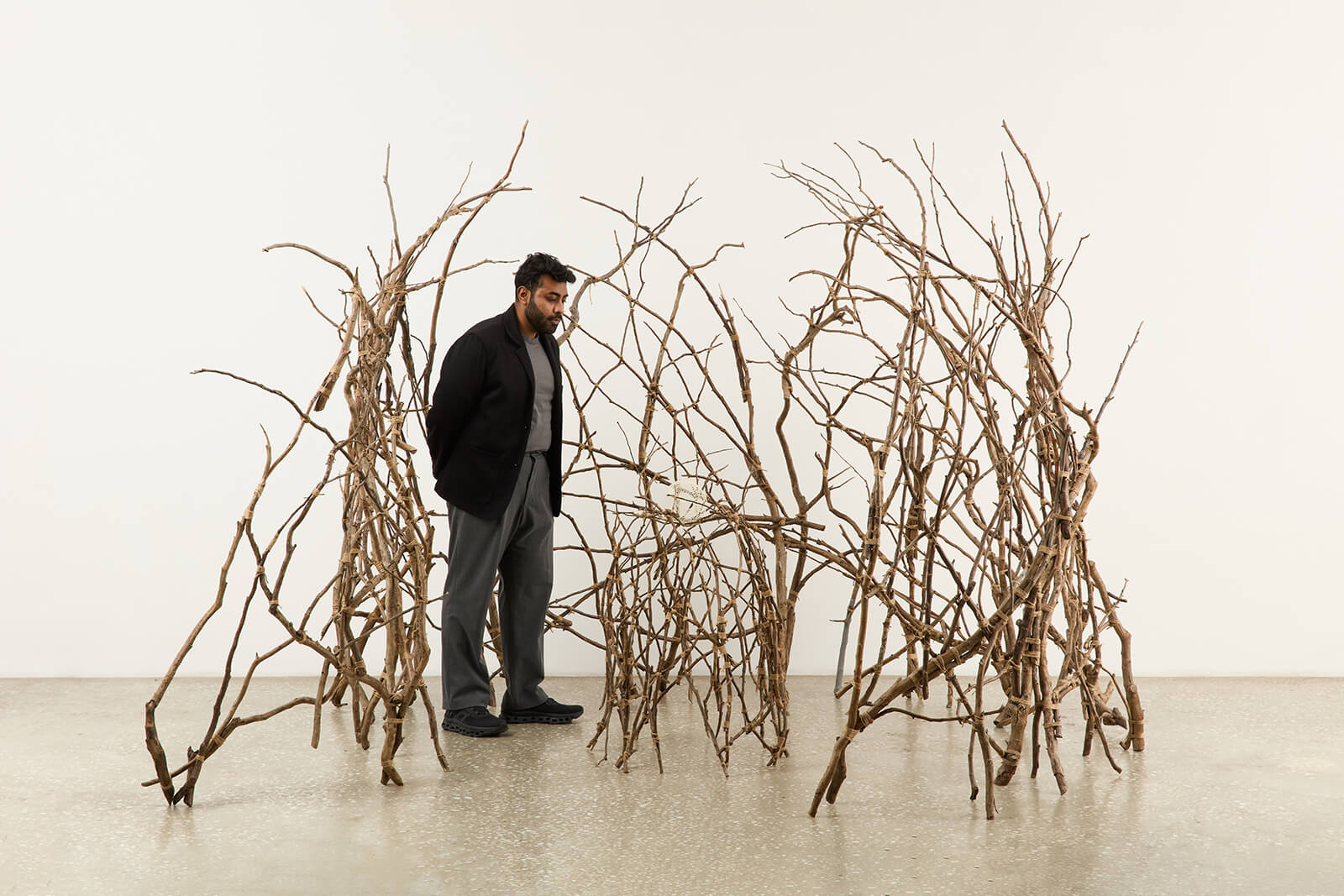
He refers to the central, branching installation of The Village, which he named for this rug motif, adding, “It sets the tone for the whole show, titled The Townsfolk Whisper Your Name in Hushed Tones, where I'm asking every viewer to locate themselves in that scene, but as the one being discussed. The outsider. The shaman. The countercultural surfer. The artist. The queer person...perhaps even the misunderstood AI, quietly generating patterns no one asked for. What connects all of them is that they are being watched and talked about before they are being understood, which is the position queerness has always occupied in relation to the gaze. Seen first, known later (if at all).”
While weaving and lacemaking lay the foundation for the system of binary code that structures our society, both technologically and socially, Fouché wants to draw the viewer’s eyes to the excesses and lacunae that lie outside of it. A system that does not allow for outsiders, randomness, non-conformity, inutility and spontaneity risks becoming ossified as an unintended result of its strict self-imposed order and heterogeneity. Fouché’s work creates an interface between seeming extremes of art—traditional (textile art) and experimental (AI and algorithmic art)—thus collapsing the boundary between them. The Townsfolk Whisper Your Name in Hushed Tones asks us to put ourselves in the uncomfortable, whispered-about position outside binaries and beneath hierarchies to find similarity, connection and meaning where there appears, at first glance, only difference and opposition.
‘The Townsfolk Whisper Your Name in Hushed Tones’ will be on view from September 5 – October 10, 2026, at WHATIFTHEWORLD in Cape Town, South Africa.

by Srishti Ojha Oct 27, 2026
The 13th Gyeonggi Ceramics Biennale in South Korea showcases global ceramics, from ancient traditions to contemporary experimentation
by Srishti Ojha Oct 26, 2026
The Taiwan-based artist shares his opinion on exhibition rituals, protests and his search for ‘fragmented beauty’.
by Srishti Ojha Oct 21, 2026
Increasingly, artists, filmmakers and activists are turning to VR to create more personal, tangible accounts of the climate emergency and its impact on vulnerable communities.
by Mirra Lynn Oct 20, 2026
The Indian artist paints the old wadas of central Pune, capturing the traces of everyday life that cling to these structures, battered by time but unbowed.

make your fridays matter with a well-read weekend
Enter your details to sign in
Don’t have an account?
Sign upOr you can sign in with
a single account for all
STIR platforms
All your bookmarks will be available across all your devices.
Stay STIRred
Already have an account?
Sign inOr you can sign up with
Verification link sent to check your inbox or spam folder to complete sign up process
Tap on things that interests you.
Select the Conversation Category you would like to watch
Please enter your details and click submit.
Enter the 6-digit code sent at


Artist Pierre Fouché is constructing and dismantling binaries with bobbin lace
by Srishti Ojha | Published on : Oct 09, 2026


 Sign in with Google
 Sign in with email
What do you think?