Architecture12 mins. read
On planetary speculation as shared cultural infrastructure: Liam Young's In Other Worlds
by Bansari Paghdar, Anmol AhujaMay 28, 2026




by Mrinmayee BhootPublished on : Nov 07, 2025
To speak of Ursula K. Le Guin's work, conventionally deemed to belong to science fiction’s murky realms, but unclassifiable at best, is to inhabit worlds that feel familiar and strange all at once. While reading her, one gets the distinct feeling that Le Guin knows the world she’s writing about intimately, that perhaps its strange terrains have existed for millennia, waiting to be eventually discovered by the author. This sense of corporeality is evident, especially because of the maps that often accompanied her fiction, allowing readers to dwell in and traverse unknown lands. Drawing maps was a central practice for Le Guin’s writing process, with cartography becoming a tool for her to imagine—or rather discover alongside her characters—other realms, as much as these became a structure that held the tale to follow. Maps often appear alongside her writing—as guides, as vanguards to new possibilities, acting as talismans, memories of what has been or what will one day be. It's these worlds within worlds, and worlds outside the realm of sterile reality that are at the centre of The Word for World: The Maps of Ursula K. Le Guin, an exhibition currently on view at the Architectural Association (AA), London.
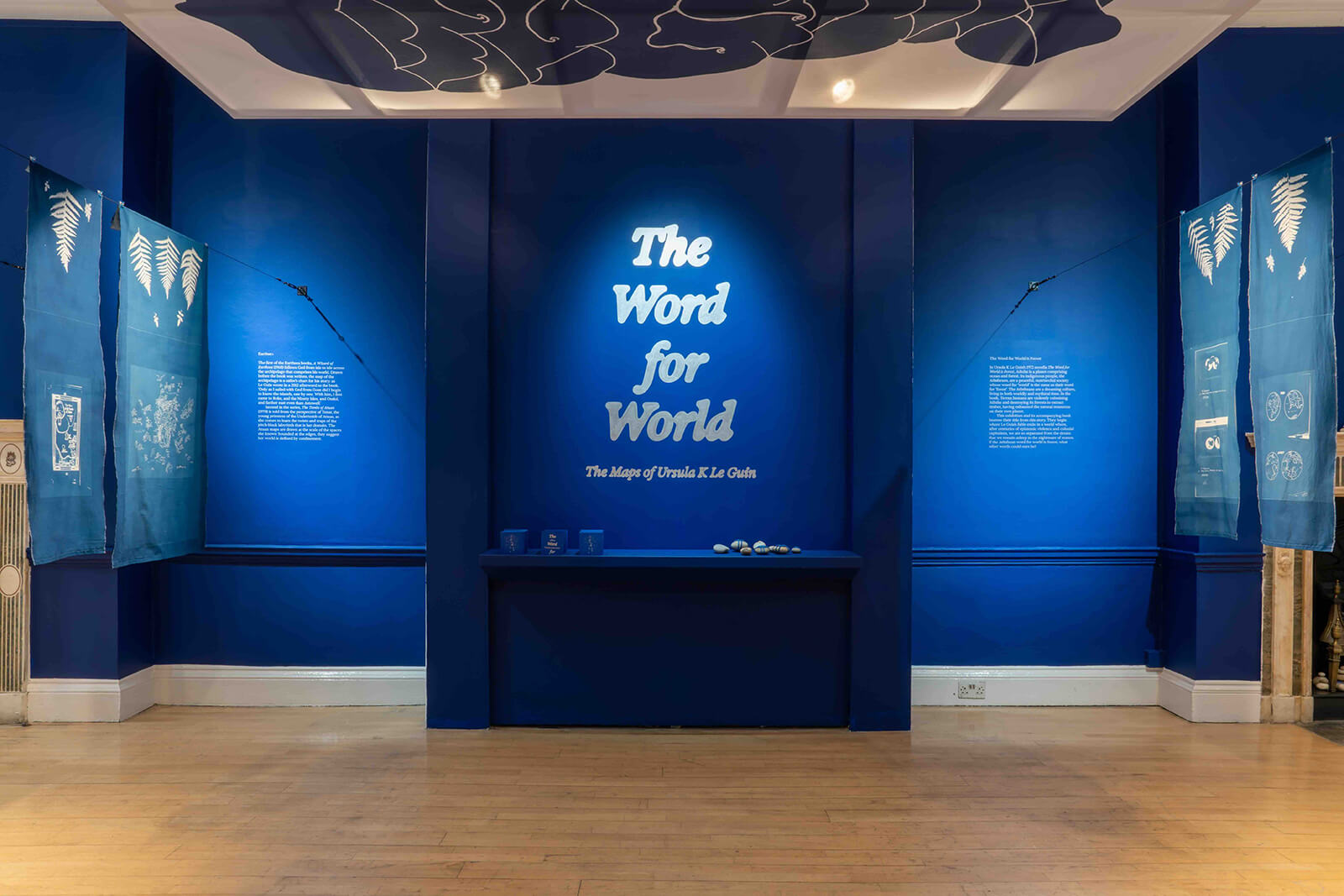

Taking its name from her 1972 novel, The Word for World is Forest, the exhibition presents previously unpublished maps by the author; activating the shimmering in-between spaces of document and object, of map and world, weaving together stories, drawings and charms. An eponymously titled book accompanies the showcase (which remains open to the public from October 10 – December 6, 2025), edited by So Mayer and Sarah Shin and co-published by Spiral House and AA Publications. This volume brings together a diverse range of contributors, including Le Guin’s son Theo Downes-Le Guin; professor of anthropology Marilyn Strathern; writers David Naimon, Canisia Lubrin, Daniel Heath Justice; poets Bhanu Kapil and Nisha Ramayya; Italian philosopher Federico Campagna; London-based design collective Standard Deviation; and activist community The Restoring Shoshone Ancestral Foods Gathering Group, charting the relevance of maps and mapping to Le Guin's view of the human world, that shaped her other worlds.


For Le Guin, maps were not simply records of fictional architectures and universes; they were instrumental to her stories because they demonstrated the profound connections between territory and communities for her characters. They underscored the idea that the world “does not in fact belong to us at all”. Often, more than human entities take precedence in Le Guin’s maps. Directions are determined by the flow of water, which seems to be everywhere in her drawings, whether in the waters that surround the archipelagos in the Earthsea novels or the sinuous rivers that slash through the rolling terrain in Always Coming Home (1985). Apart from the attention Le Guin pays to how the landscape is shaped, it's also fascinating to consider the notes she writes in the margins, especially in the maps reproduced in the volume by Spiral House.
As the editors note in the introduction, to read these is to understand how Le Guin spatialised time, using cartography to chart not only terrain but seasonal shifts and planetary alignments. This is especially pertinent in the maps she created for novels such as The Dispossessed (1974) and Always Coming Home, where the map is anything but a fixed entity. Subverting the settler-colonial notion of the map as a register of human discovery, the maps of her future anthropological study of the Kesh people operate as markers of memory, noting places in relation to where one currently is. In some ways, the book’s outline feels akin to the narrative structure of Always Coming Home—unwieldy and pluralistic—featuring recipes, poetry, personal reflections and essays. Similar to Le Guin’s speculative fiction, it asks readers to suspend disbelief in the cold, hard fact of maps as simply documentary proof of a rational world, as paradigms of a prescriptive form of knowledge, or representative of hegemonic order.


Instead, in relying on the idea of fiction as true—as Le Guin insisted all her life—the book conspires in dreams, myths and other times, rejecting Euclidean reason. As Mayer and Shin underscore in the introduction to the text, it “begins from where her fable [Word for World] ends: in a world in which a new kind of singing and a new kind of death have already come into being”. Referencing Le Guin’s ‘fable’, written in indignation at the US’ incursion into Vietnam, the story speaks to being deeply in harmony with one’s landscape by depicting the lives of the Athshean peoples. After all, their world is defined by—is, in fact—wilderness itself. Warning against capitalism’s disregard for indigenous knowledge systems and their profound relationships to natural habitats, by alluding to Le Guin’s wor(l)ds, the editors ask readers: “If the Athshean word for world is forest, what other words could ours be?”
To return to the invocation of Le Guin’s fable championing indigenous ecological activism with the book and exhibition’s title, one might consider the particular corporeality of the phrase ‘word for world’. It imbricates that which is immaterial into the creation of the material. Words hold worlds, and hence hold sway over our interactions with our surroundings. For Le Guin, as for the countless thinkers she has since inspired (including Donna Haraway and Anna Tsing), we are bound up in knotty entanglements with each other, always being woven into the ecologies that surround us. We are always more than human.
In this regard, the essays by Downes-Le Guin, The Geography of Imagination and Naimon, Mapping the Inland Sea: Landlines and Waterways, highlight the vitality of place to the writer. While Downes-Le Guin writes about his mother’s conviction in her maps as forms of realism, knitting together writerly rituals, stories and the places Le Guin lived in; Naimon dwells on how these relationships informed the writer’s engagement with feminism, anarchism and Taoism, invoking the lessons of water. He writes, “Perhaps to model oneself and one’s inner and outer maps on water is […] not to make a mark on a map or on history, but to recognise water as the ultimate mapmaker [and] to sinter oneself into a landscape and skyscape so immense and alive it could swallow you – and it does – like a dragon.”


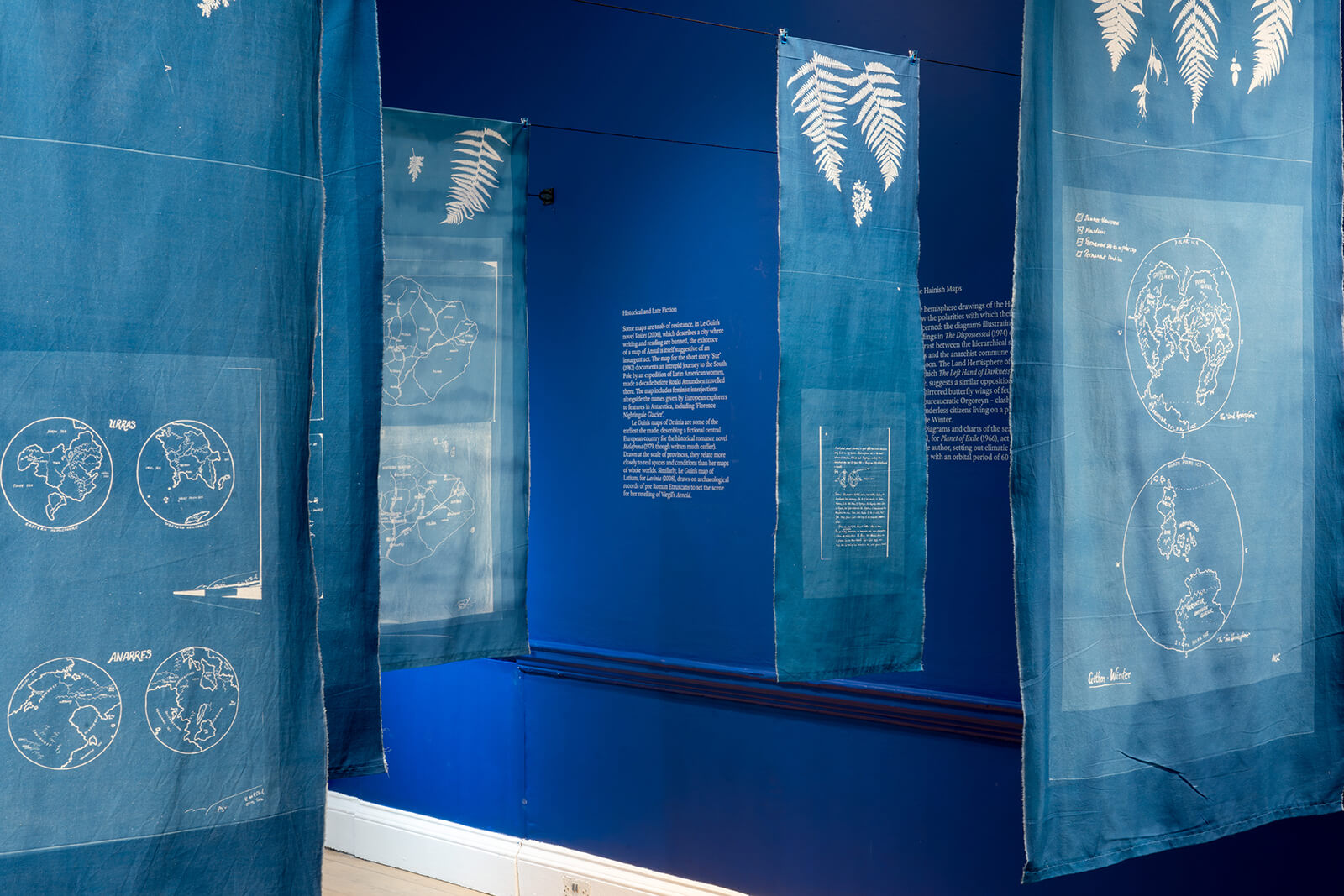
If, on the other hand, worlds hold words, and maps are treated as talismans of memory, it's fruitful here to consider the map as a carrier bag—as Le Guin has pointed out—that which gathers. In Standard Deviation’s contribution to the text, where they reproduce an experimental non-Euclidean architectural plan of the exhibition room at the AA, they note, “One day, the goddess [...] went to consult the oracle book in the seed library that contained all the seeds in the world. Opening the book, she found rows and rows of seeds.” Le Guin’s maps are meant to be seeds, to nurture life.
“On the maps drawn by men, there is an immense white area, terra incognita, where most women live. That country is all yours to explore, to inhabit, to describe,” Le Guin pronounced in a 1982 commencement speech at Bryn Mawr College. It’s with this notion, of an opening out of what has so far been guarded, held back and ordered stringently, that I consider the exhibition that displays her drawings and paintings at the AA. The exhibition design charts a path non-linearly through the maps, asking for chance encounters and improper juxtapositions between the different fictions. The warm, brilliant blue of the cyanotype textile installations calls again, to my mind, vast expanses of water and its capacity to endure. One could argue that removing the maps from the contexts of the stories they are meant to tell reduces them to mere spectacle, severing them from the ideas they hold. However, we could also read them as an invitation to be curious about the terra incognita they don’t reveal.
In all this, one might at this point be wondering, what or how any of this matters to the moralistic member of society, who has nothing whatsoever to do with fantasy. He, like the worldly men who worship at the altar of rationality, care about buildings and the ways in which one achieves mastery over the other. In response to this admonishment, I urge you to look again. What is architecture if not a blueprint of a possible world? What is a blueprint if not an alternative reality that exists within the blank white spaces of paper? In denying this fertile fact, we deny the freedom of play; we move away from the ‘lunatic fringes’. To know Le Guin is to walk the landscapes she traces and retraces in her maps, and by extension, the worlds she makes and remakes. It is to believe beyond all reckoning in the insistent reality of the unknowable, for that is where hope resides. In the shadows, the dragons are still waiting. They exist at the margins of the real; to draw a map is to draw them out.

by Pranjal Maheshwari Oct 19, 2026
The Mumbai-based architects integrate courtyards, mesh screens and north light trusses to create a dining space that doubles up as a community hub at SR University, Warangal.
by Mrinmayee Bhoot Oct 17, 2026
The Rotterdam-based institute centres the Indian Ocean as a network for exploring material histories and transnational links shaping coastal cultures, positing them as future models.
by Pranjal Maheshwari Oct 16, 2026
At the 2026 Stirling Prize ceremony, Mary Duggan with RUFF Architects, MAKER Architecten and Nakshabid Architects were felicitated for proffering quality housing and social equity.
by Mrinmayee Bhoot Oct 12, 2026
The new Centre for Contemporary Arts, fostering public engagement with art in Uzbekistan, is housed in a tram depot refurbished by the French studio, emulating local craftsmanship.

make your fridays matter with a well-read weekend
Enter your details to sign in
Don’t have an account?
Sign upOr you can sign in with
a single account for all
STIR platforms
All your bookmarks will be available across all your devices.
Stay STIRred
Already have an account?
Sign inOr you can sign up with
Verification link sent to check your inbox or spam folder to complete sign up process
Tap on things that interests you.
Select the Conversation Category you would like to watch
Please enter your details and click submit.
Enter the 6-digit code sent at


Ursula K. Le Guin’s words and worlds, to hold people, landscapes and dragons
by Mrinmayee Bhoot | Published on : Nov 07, 2025


 Sign in with Google
 Sign in with email
What do you think?