Architecture10 mins. read
ADFF:STIR Mumbai 2026 promises a radical vision connecting cinema, space and city
by Jincy IypeDec 15, 2025




by Chahna TankPublished on : Nov 21, 2025
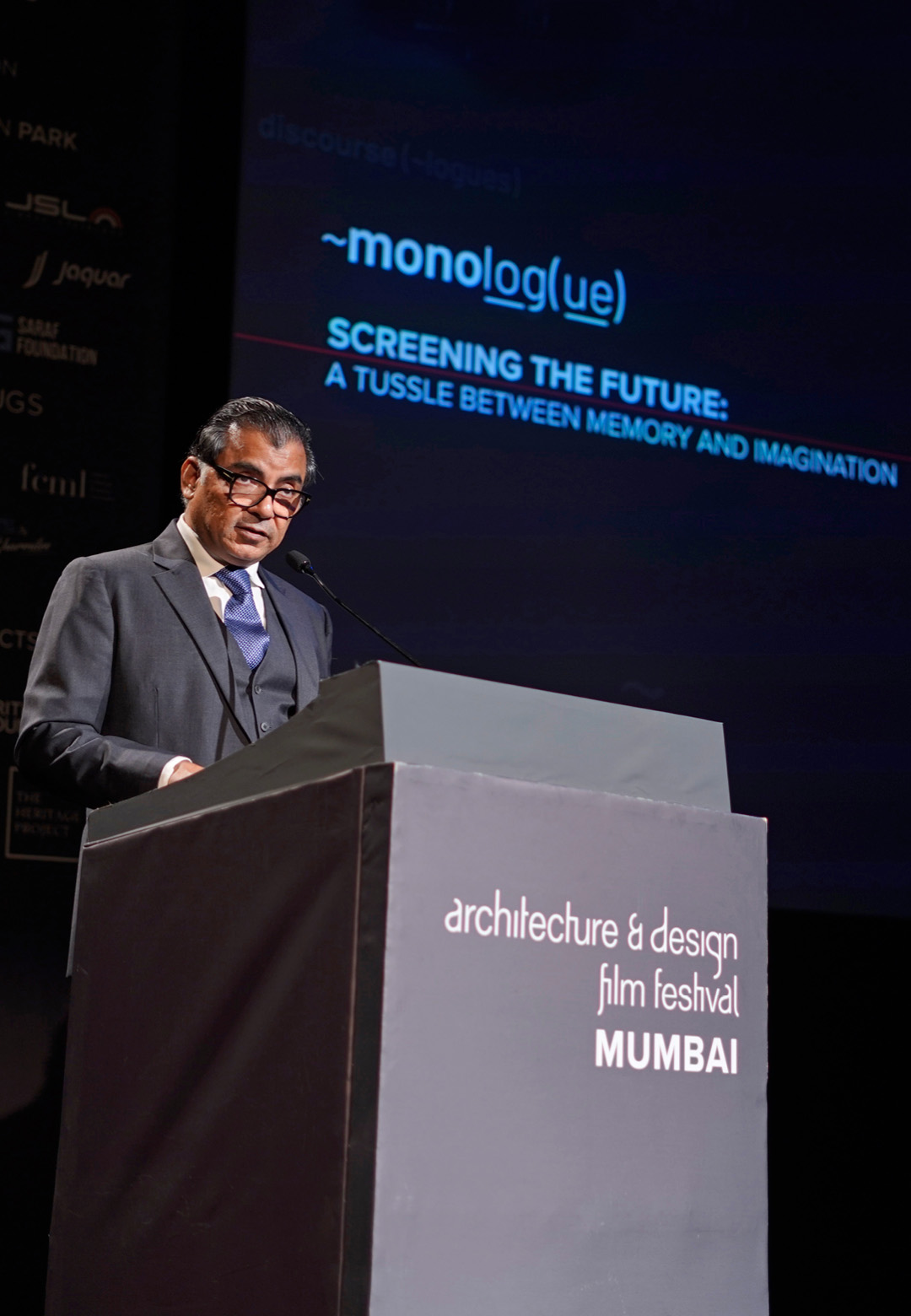
What do we talk about when we talk about the future? We think of it as if it's an untouched landscape; perhaps, a territory still forming somewhere just out of sight. But the future rarely arrives as a clean break; it gathers quietly from the debris of memory, never free of the past. “I think there is no future—only iterative re-imaginations of the past,” says poet, actor, storyteller and director Danish Husain, opening his ~monolog(ue) session at ADFF:STIR Mumbai 2025. As part of the architecture festival’s curated talks programme, ~log(ue), Husain spoke on Screening the Future: A Tussle between Memory and Imagination, at the National Centre for the Performing Arts’ (NCPA) Experimental Theatre in Mumbai. In the session, Husain delivered a meditation on future and our role in imagining it; moving fluidly between architecture, cinema and literature, lacing his talk with verses of poetry.
Before turning to the future, Husain leads the audience into the past, to the bylanes of 1970s Delhi—an Indian city of boundless contrasts. Majestic monuments, with their smooth domes and graceful arches, rose from the earth, dominating the skyline, their beauty unmatched by the modern architecture around them. Only the British-era buildings, disciplined and grand, seemed to hold their own against these relics of a storied past. In comparison, the post-independence government offices, with their straight lines, sharp edges and rigid symmetry, felt cold, almost hostile. By the early 1990s, architecture transformed again. “The mecca had shifted to Manhattan,” he proclaims. Glass towers and steel skyscrapers rose, reflecting the ideals of profit, efficiency and modernism. Ornamentation was abandoned, supplanted by clean lines and functional spaces. The city’s landscape reflected a world driven by neoliberalism, where beauty was measured by utility and elegance had little place.
Just as architecture shifted, so did literature, Husain continues. The ornate prose of the past gave way to lean, stark storytelling. Heroes were no longer princes wandering through arches and colonnades; they became revolutionaries, navigating crowded streets and ugly neighbourhoods. Poetry and cinema followed the same logic. Film embraced realism. Theatre, too, reimagined space. Sets could be built and deconstructed; lighting, shadows and the actor’s movement became integral to the audience’s experience. It revealed the other dimensionality of the world Husain was beginning to understand—how physical spaces acquire meaning through the memories we attach to them. “Suddenly, a room, a house, a promenade, a bend in the street, a turn at the corner acquires a fluorescent glow when looked through the night vision of our memories' lens; it's the tug at the heart that makes a physical space personal,” he mused.
To create is, and remains, our indescribable quest from cradle to grave. It is our process to confirm and disrupt simultaneously. Future is one of the many possibilities that we create in our present. – Danish Husain
Underlying all creation—architecture, design, literature, cinema—is an existential urge; “our attempt to replace the disruption we experience at birth,” Husain says. “Somehow, whatever the world can offer, whatever worlds we can create, it never returns us to the peace we felt in the mother's womb. Thus, life is constantly elsewhere for us. There is this knowing urge to have more, to build more, to create more than what we are offered, to find newer meanings, to imbue everything with a different meaning, and if still not content, then create newer meaning.” For Husain, this urgency translates into a clear responsibility for artists. Their work, he argues, must push back against the easy assumptions of their time. It requires noticing what most people overlook, identifying the small fractures where the truth becomes visible and drawing attention to them.
Stories, then, must not merely mirror the world but chronicle its churn. Yet the most crucial question remains: what stories will we tell? “In a world where environment and ecosystems are collapsing, a genocide is being live-streamed, capital is consolidating, income inequality gaps are rising, tech is constantly hacking our minds, freedom of expression is utopia, where most of the mainstream media is controlled by a few and governments are effectively deploying surveillance technology for their authoritarian purposes—what kind of stories do you think will emerge from this world,” Husain asks the audience. Will they be propaganda, nostalgic myths, dystopias or glimpses of hope?
Life, Husain reflects, towards the end of his session, is a rare and unearned gift—‘a lucky coupon’, as he puts it—offered by nature to its temporary guests. The responsibility of that guesthood undergirds all acts of creation: to leave the world better—if not better, then at least no worse—than we found it.
With ADFF:STIR Mumbai geared to return to the National Centre for the Performing Arts in 2026, we look back to key conversations from the ~log(ue) programme and highlights from the 2025 edition. Stay tuned for more throwbacks and exciting updates to be released in the coming weeks.

by Pranjal Maheshwari Oct 19, 2026
The Mumbai-based architects integrate courtyards, mesh screens and north light trusses to create a dining space that doubles up as a community hub at SR University, Warangal.
by Mrinmayee Bhoot Oct 17, 2026
The Rotterdam-based institute centres the Indian Ocean as a network for exploring material histories and transnational links shaping coastal cultures, positing them as future models.
by Pranjal Maheshwari Oct 16, 2026
At the 2026 Stirling Prize ceremony, Mary Duggan with RUFF Architects, MAKER Architecten and Nakshabid Architects were felicitated for proffering quality housing and social equity.
by Mrinmayee Bhoot Oct 12, 2026
The new Centre for Contemporary Arts, fostering public engagement with art in Uzbekistan, is housed in a tram depot refurbished by the French studio, emulating local craftsmanship.

make your fridays matter with a well-read weekend
Enter your details to sign in
Don’t have an account?
Sign upOr you can sign in with
a single account for all
STIR platforms
All your bookmarks will be available across all your devices.
Stay STIRred
Already have an account?
Sign inOr you can sign up with
Verification link sent to check your inbox or spam folder to complete sign up process
Tap on things that interests you.
Select the Conversation Category you would like to watch
Please enter your details and click submit.
Enter the 6-digit code sent at


Danish Husain on how stories shape the future at ADFF:STIR Mumbai 2025
by Chahna Tank | Published on : Nov 21, 2025


 Sign in with Google
 Sign in with email
What do you think?