Architecture07 mins. read
Transcribing the maximum city with Jaquar Pavilion Park at ADFF:STIR Mumbai 2026
by Jincy IypeDec 24, 2025



by Jincy IypePublished on : Jan 06, 2026
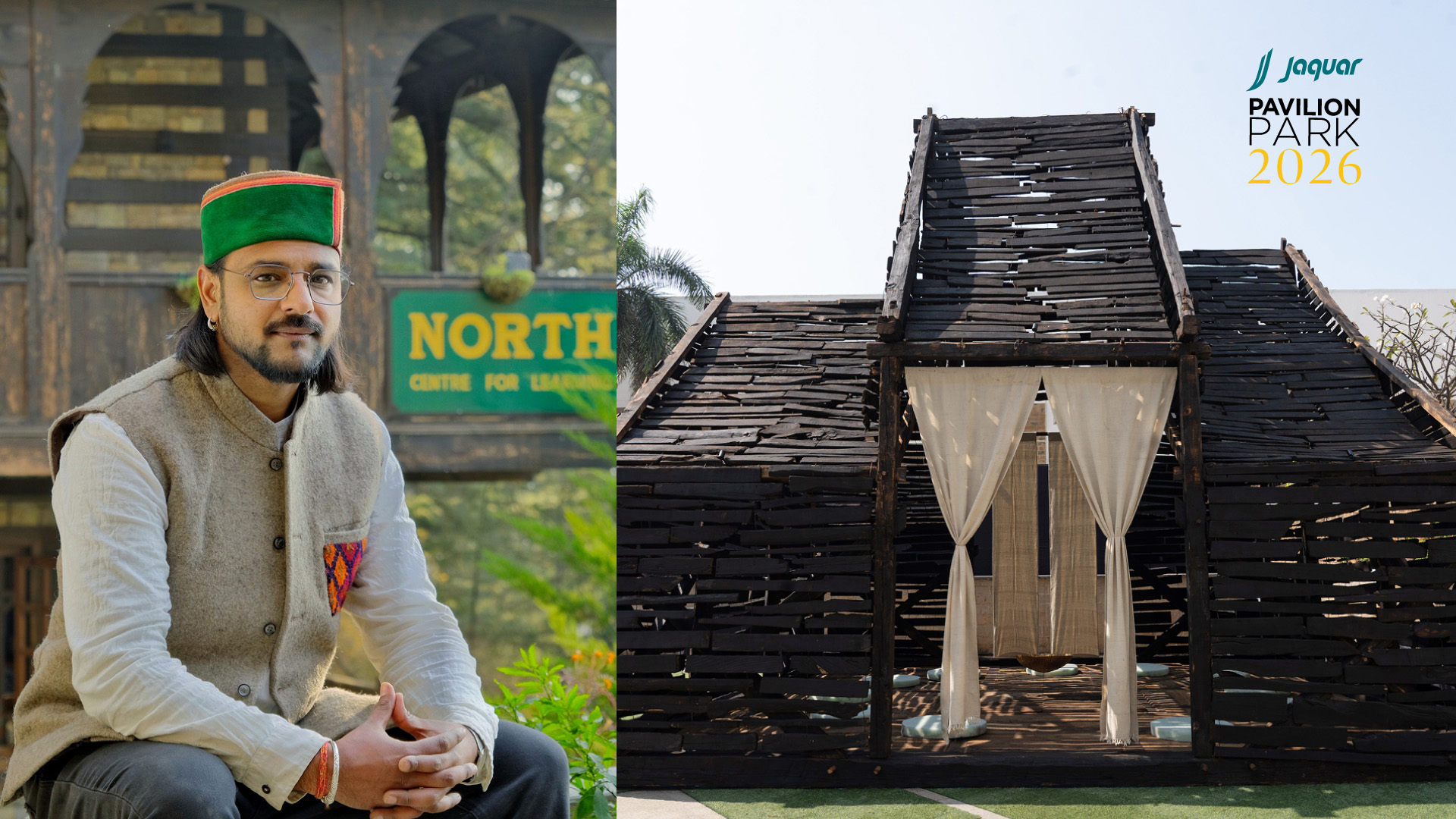
Many who migrate to Mumbai often relay how it behaves like a screenplay without a singular ending and an obscene amount of cameos. People, sound, colour, light and labour assemble and dissolve in an unbroken choreography, each day rehearsing the city anew. Within this relentless flux, the Jaquar Pavilion Park at ADFF:STIR Mumbai 2026 positions architecture as an event, an unfolding sequence shaped by movement, encounter and time. It is within this frame that the Mountain Transcripts pavilion, designed by Rahul Bhushan, director and founder of the Himalayan collective NORTH, arrives as a deliberate counter-rhythm.
Responding to Aric Chen’s curatorial theme for the festival and to Bernard Tschumi’s Manhattan Transcripts—theoretical propositions and speculations executed through drawings that understood architecture through narrative, action and cinematic notation—Mountain Transcripts asks what happens when this lens is turned towards a city like Mumbai, and applied and answered from elsewhere. “As seen in cinema and as seen by us every day we wake, the mountains have always been dramatic,” reflects Bhushan, a Himachali eco-architect, entrepreneur and educator. “Their essence is not only cinematic, but almost otherworldly.” The pavilion carries this diaphanous energy from the Himalayas into Mumbai’s density, as a studied contrast.
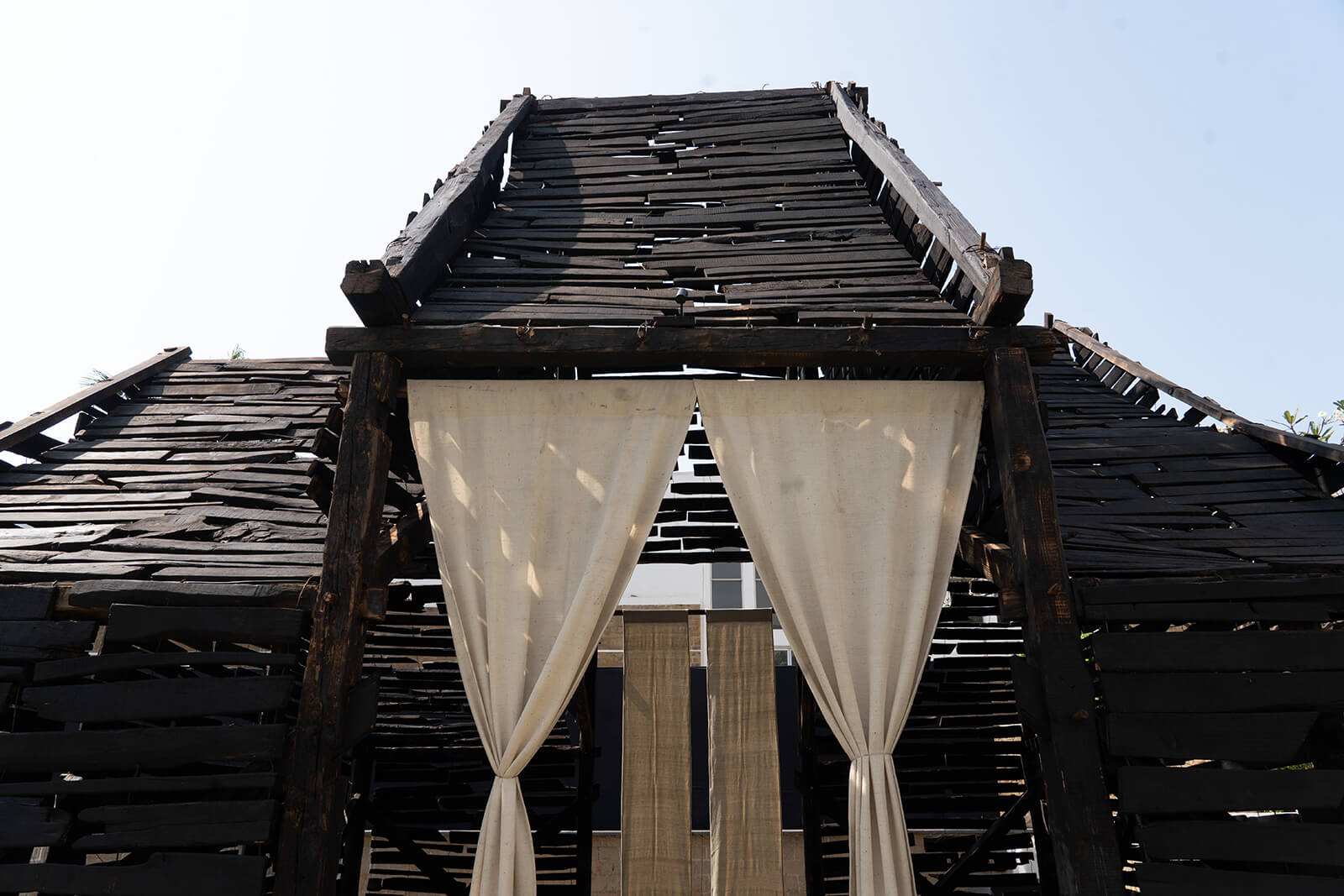
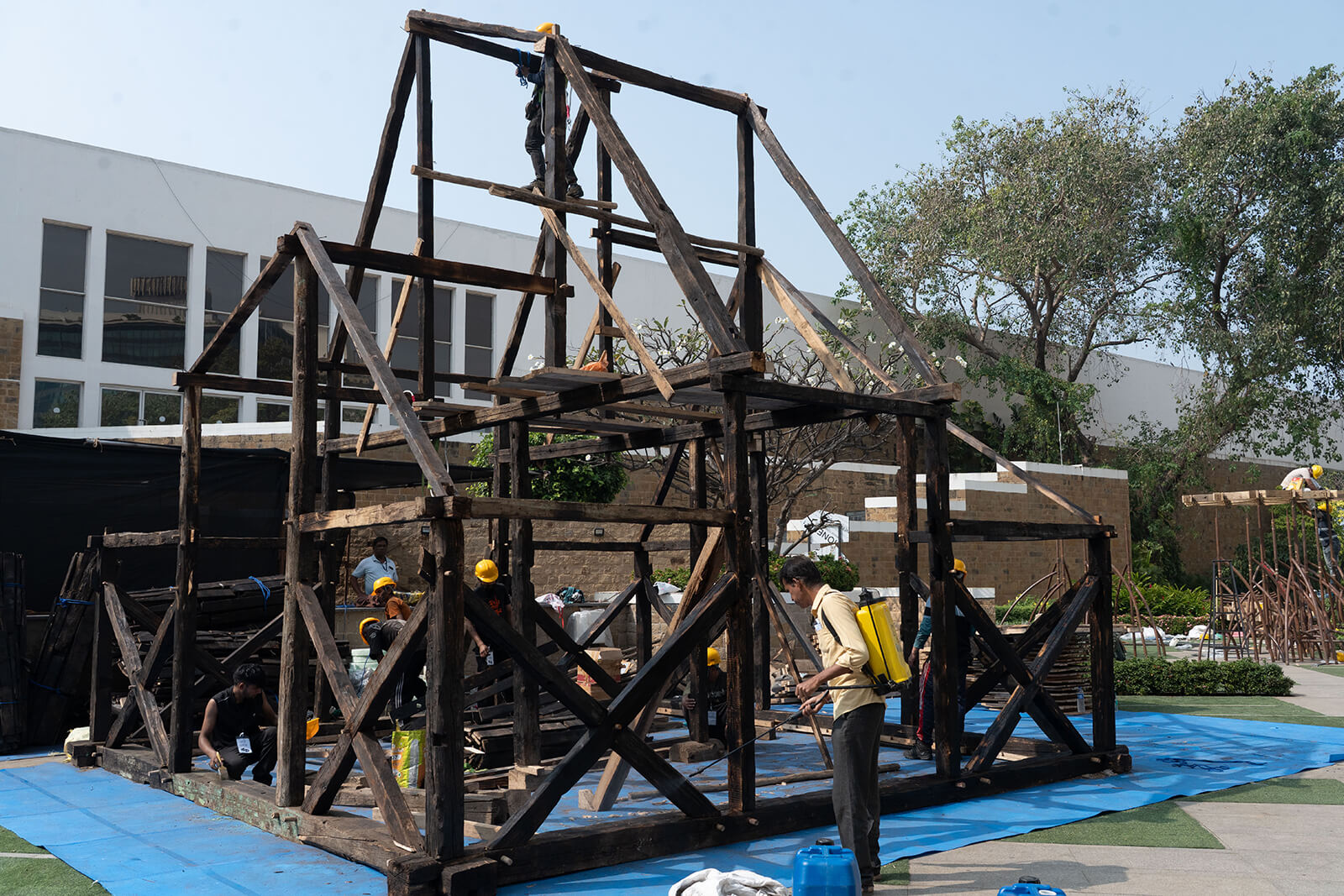
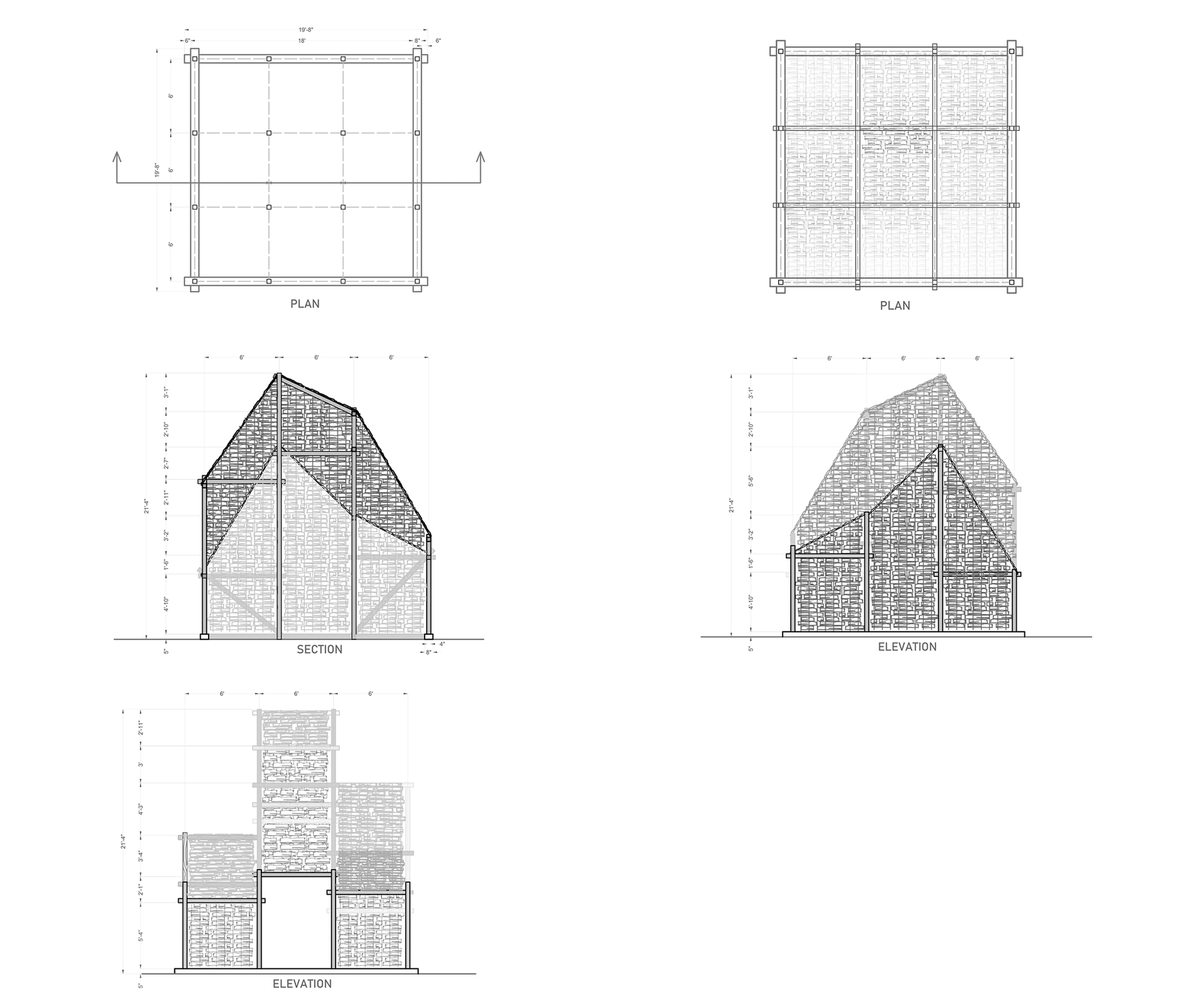
Installed on the lawns of the National Centre for Performing Arts (NCPA) as part of the Jaquar Pavilion Park curated by Aric Chen, director of the Zaha Hadid Foundation, the structure is set to rise like a sentinel, ‘striking and protective’ during the design festival running from January 9 – 11, 2026. Its proportions recall layered pagoda roofs and high-altitude shrines of Himachal Pradesh, while its tall timber members ascend like a forest of spires. Built entirely through nail-less timber joinery, the pavilion design employs ancestral wooden pins and locking keys, using the same systems that have held Kathkuni houses and mountain temples together for centuries in this North Indian state. No bolts, no iron. As the Indian architect notes, this is not nostalgia but continuity: a material intelligence that strengthens with time.
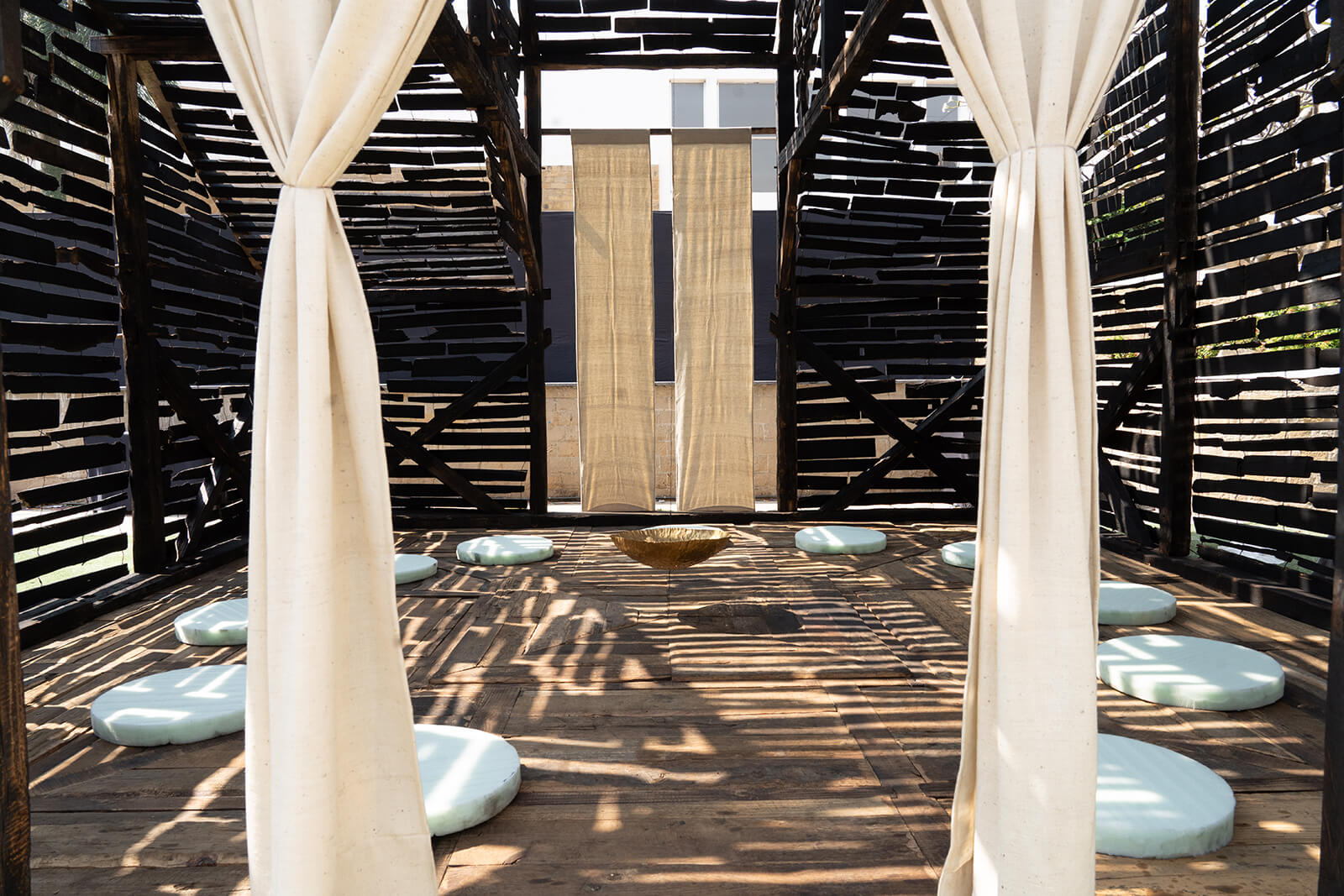
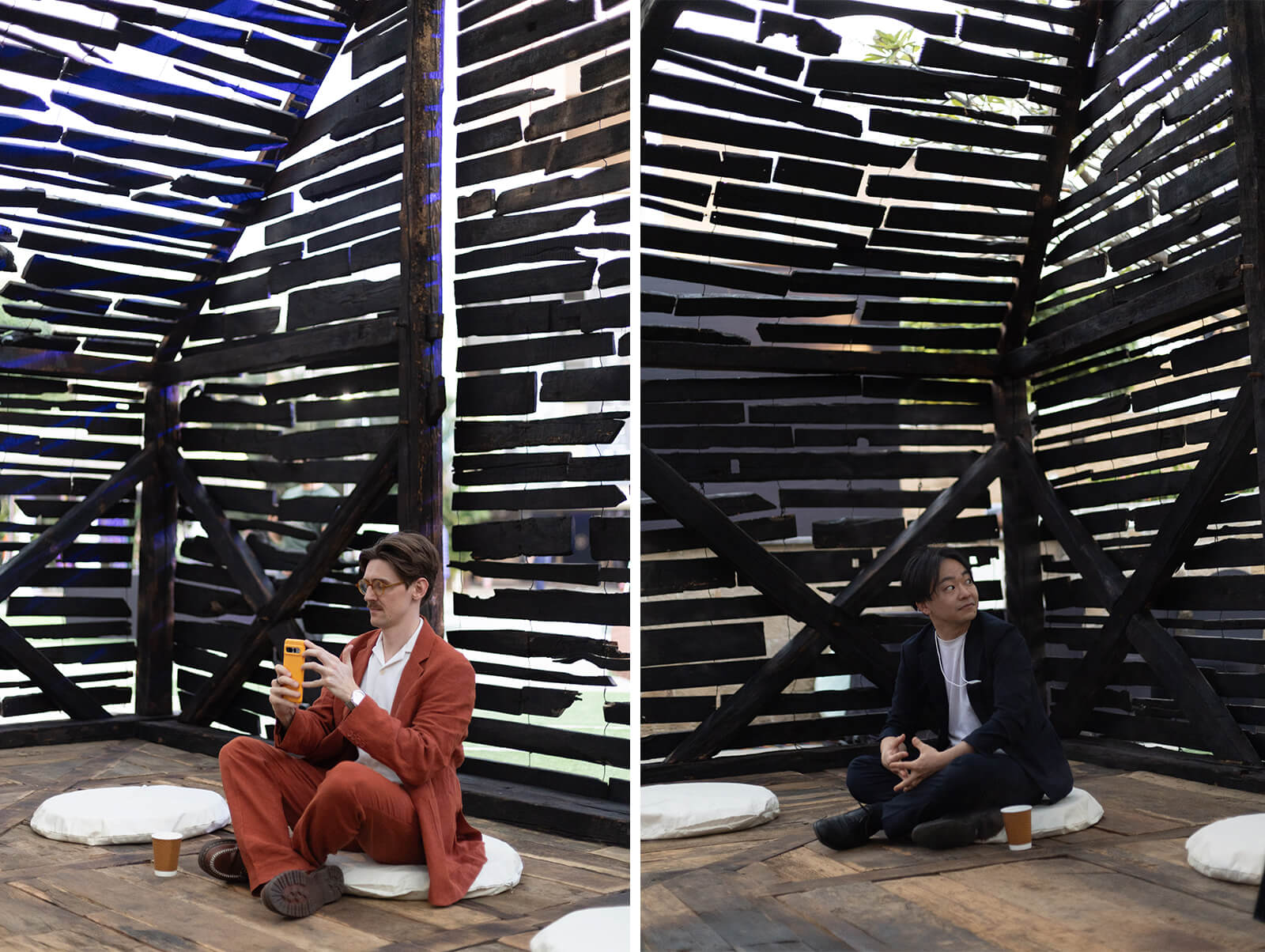
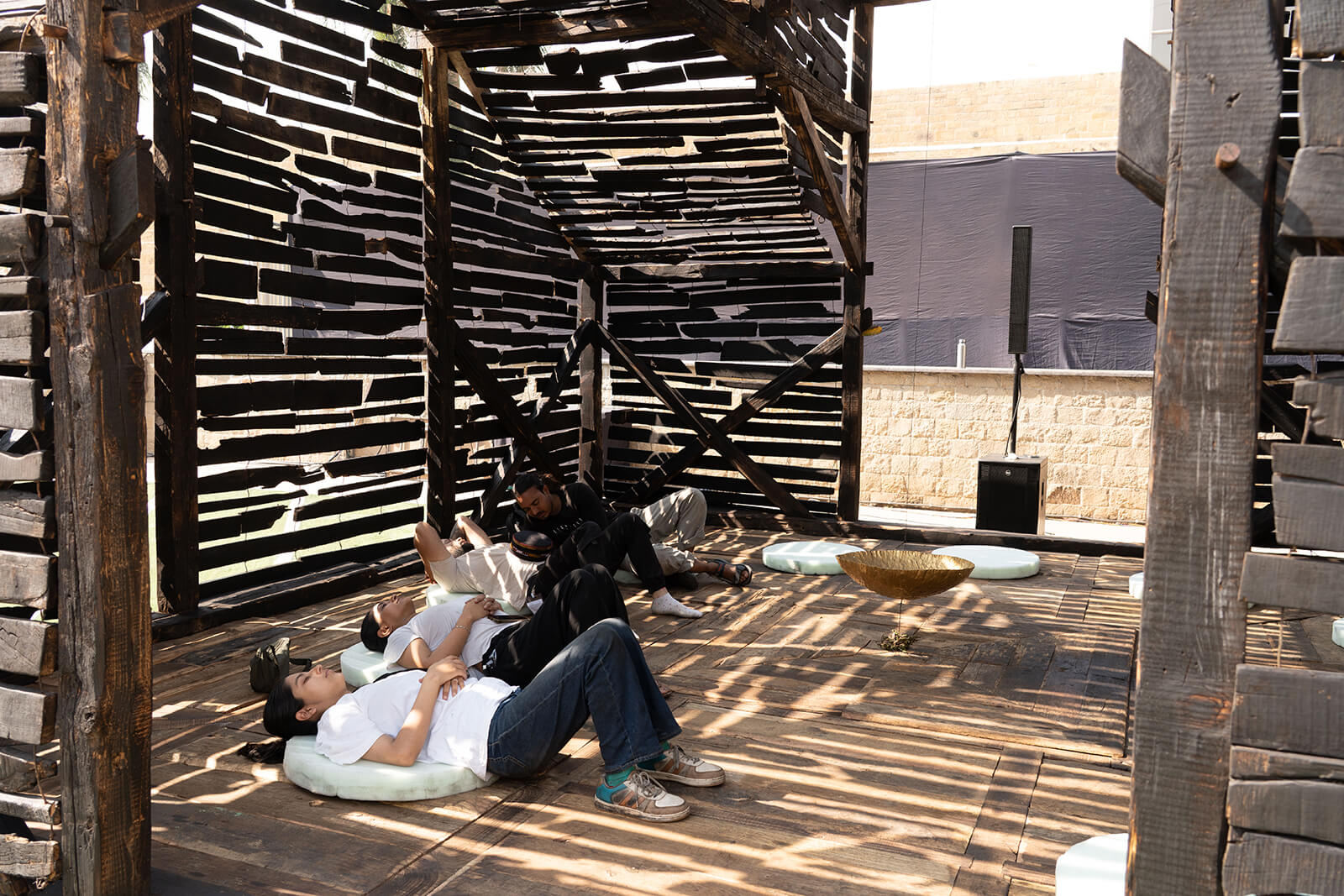
Encircling the timber construction is a woven canopy made from reclaimed timber off-cuts (which have been given new life by charring), transforming construction waste into a porous skin. Part fabric, part forest, the canopy filters light and casts shifting shadows across the ground. Throughout daytime, the pavilion breathes with the movement of the sun and, by night, it glows like a lantern, its patterns projected outward onto the lawns. Light itself becomes a script, constantly rewritten, placing visitors simultaneously as actors and audience.
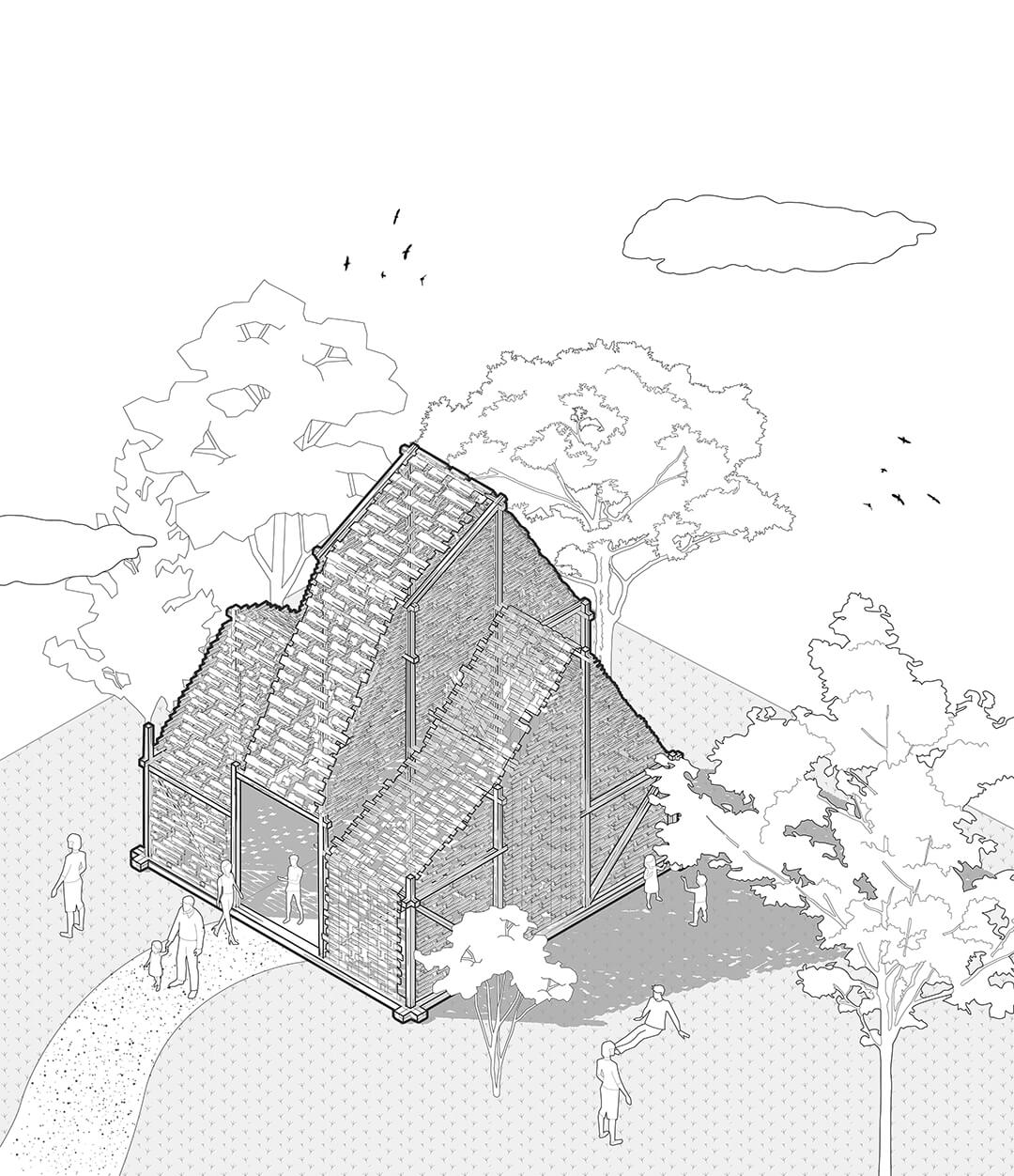
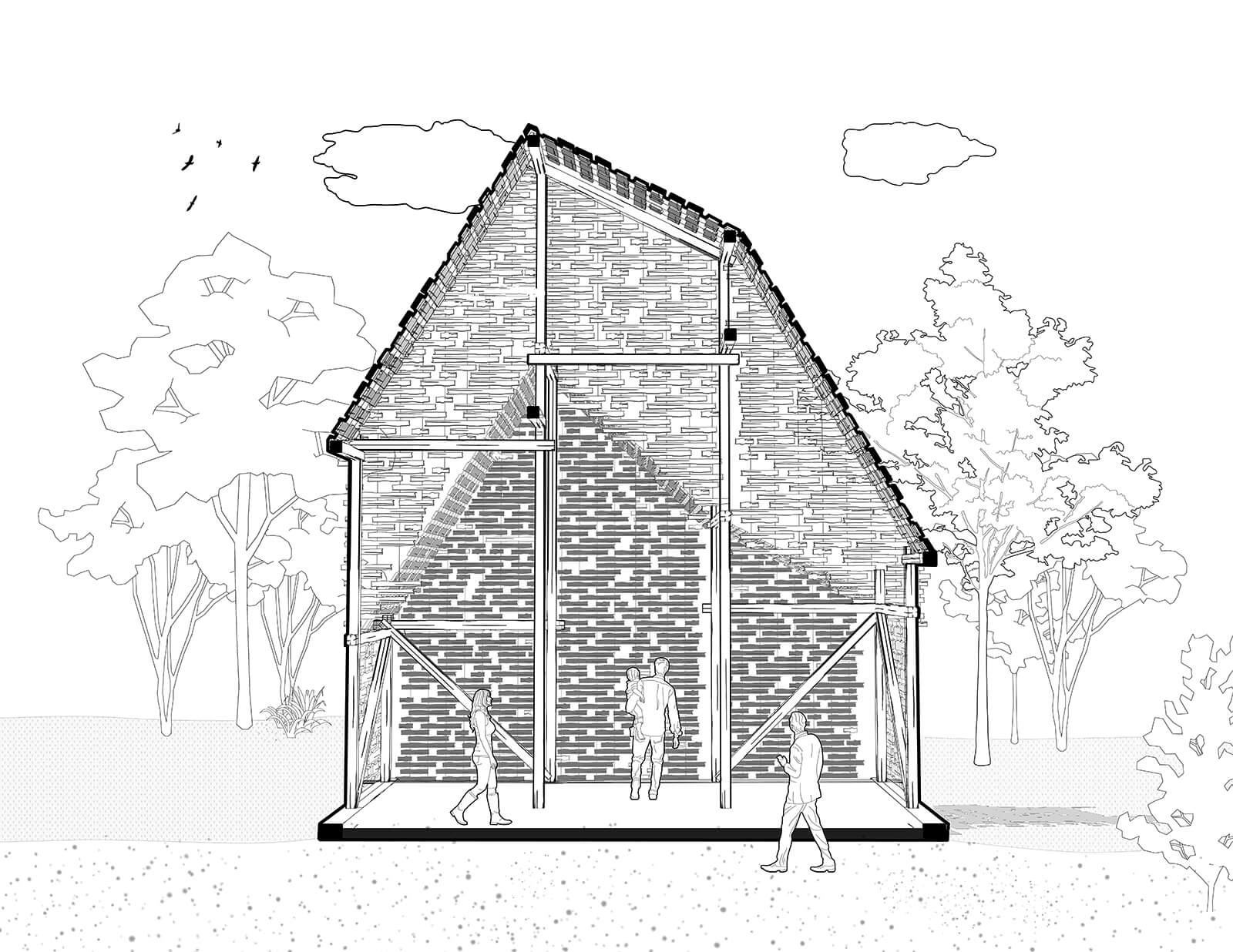
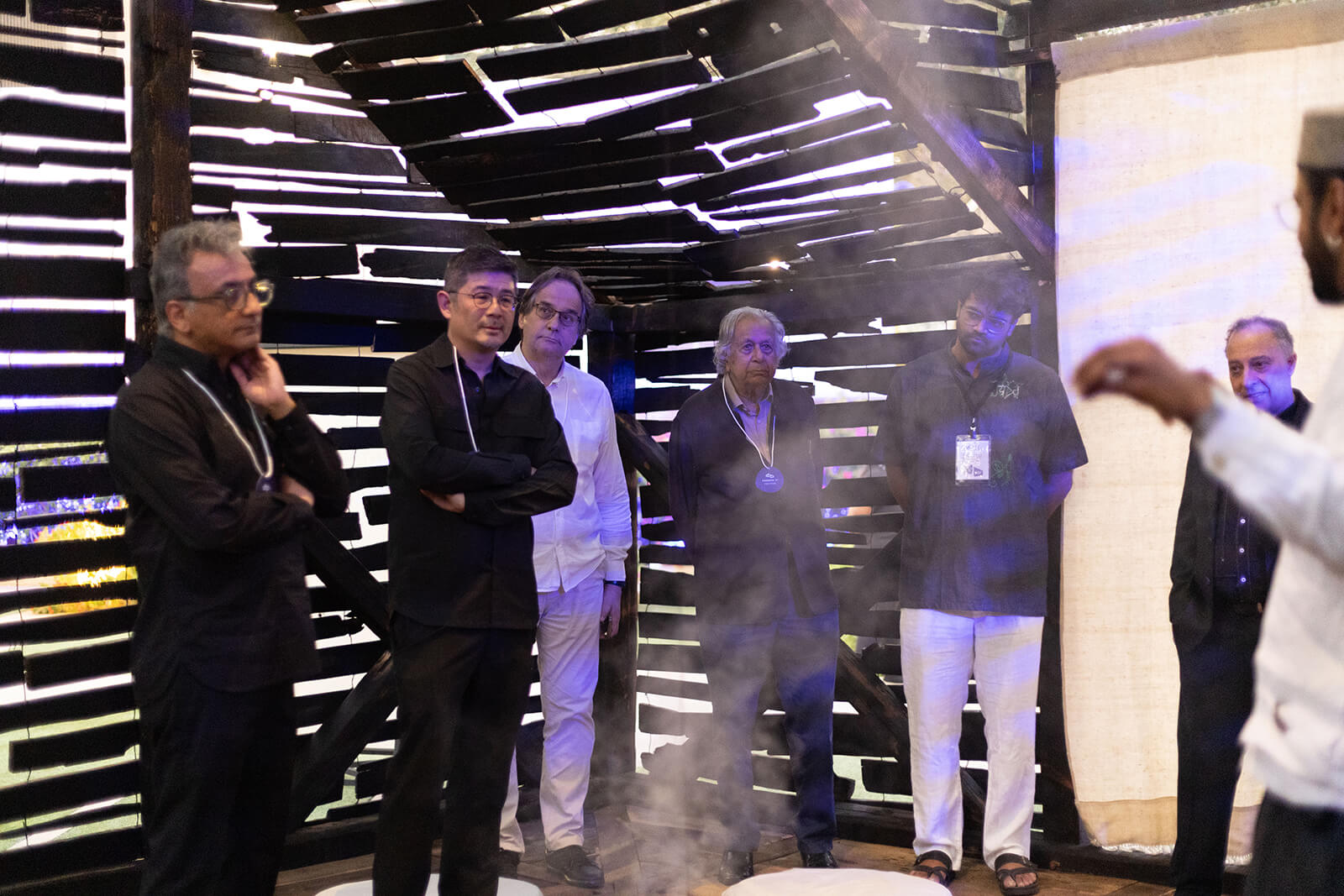
Entry into the pavilion marks a sensory shift. The city’s noise softens into a soundscape of ritual drums and ceremonial trumpets, recorded from Himalayan deity processions. Juniper incense, cut with bare hands on bare feet from sacred mountain passes burns in a large brass bowl, its smoke catching beams of light as it drifts upward as incantations. “The joinery reveals the intelligence of the hand,” Bhushan explains. “It speaks of patience, care and collective knowledge shaped over time.” Architecture here is not to be observed from a distance or engaged with as a mere object; it is to be felt, inhaled, inhabited. “The soundscape,” he continues, “records the ancient drum beats and ceremonial trumpets which are played during community rituals and while invoking the local deities. All of these actions, which have gone behind the making of this pavilion will definitely reflect on what one feels as they ground themselves.”
Moreover, Mountain Transcripts unfolds through experience, carrying the energies of the Himalayas. Within and around the pavilion, the body slows. The visitor is folded into the spatial ritual. Craft operates as an intangible cultural heritage, activated through sound, scent and structure, reminding visitors of regeneration and connectedness to land. Nature as parent, friend, lover. “It’s not the lost art of the Himalayas anymore,” Bhushan says. “It’s a living museum—one that people can enter and take something back from… It reminds people of regeneration, of connectedness to the land and speaks for a future that is both climate responsive yet human.”
Sustainability is embedded as a system, not merely as rhetoric. Timber stores carbon, the absence of metal avoids corrosion and dry assembly allows the pavilion to be dismantled without scarring its materials. After the festival, the structure will continue its afterlife, first through extended public engagement in the city itself, and then relocated to the Godrej Campus, in Mumbai, India, where it will serve as a living classroom, cultural gathering space and a site of ongoing exchange. Temporality, here, does not mean complete disposability; it signals a certain continuity across contexts.
“Socially, it asks humanity to look at what's needed for a more conscious future. Natural regenerative materials, the wisdom of indigenous cultures and time tested technologies as a way forward to safeguard the intangible heritage along with a long term vision for a healthy, non toxic and environmentally conscious way of living,” Bhushan shares.
In a city defined by acceleration and maelstrom, Mountain Transcripts by NORTH offers a different, calmer, almost spiritual register of attention. It holds its timbre within Mumbai’s spectacle and overstimulation, without wholly retreating from it. It introduces another, much reserved tempo constructed by ritual, craft and ecological awareness. Within Mumbai Transcripts at the architecture and design film festival, the pavilion demonstrates how architecture can become or is consciousness: a shared event and worship where material intelligence, human presence and cinematic experience converge.
The 2026 edition of the Pavilion Park at ADFF:STIR Mumbai 2026 is presented by Jaquar.
You can now book your passes for the festival here. Full schedule for the festival is available here.

by Pranjal Maheshwari Oct 19, 2026
The Mumbai-based architects integrate courtyards, mesh screens and north light trusses to create a dining space that doubles up as a community hub at SR University, Warangal.
by Mrinmayee Bhoot Oct 17, 2026
The Rotterdam-based institute centres the Indian Ocean as a network for exploring material histories and transnational links shaping coastal cultures, positing them as future models.
by Pranjal Maheshwari Oct 16, 2026
At the 2026 Stirling Prize ceremony, Mary Duggan with RUFF Architects, MAKER Architecten and Nakshabid Architects were felicitated for proffering quality housing and social equity.
by Mrinmayee Bhoot Oct 12, 2026
The new Centre for Contemporary Arts, fostering public engagement with art in Uzbekistan, is housed in a tram depot refurbished by the French studio, emulating local craftsmanship.

make your fridays matter with a well-read weekend
Enter your details to sign in
Don’t have an account?
Sign upOr you can sign in with
a single account for all
STIR platforms
All your bookmarks will be available across all your devices.
Stay STIRred
Already have an account?
Sign inOr you can sign up with
Verification link sent to check your inbox or spam folder to complete sign up process
Tap on things that interests you.
Select the Conversation Category you would like to watch
Please enter your details and click submit.
Enter the 6-digit code sent at


Mountain Transcripts unpack Himalayan ritual and craft at ADFF:STIR Mumbai 2026
by Jincy Iype | Published on : Jan 06, 2026


 Sign in with Google
 Sign in with email
What do you think?