Architecture07 mins. read
Transcribing the maximum city with Jaquar Pavilion Park at ADFF:STIR Mumbai 2026
by Jincy IypeDec 24, 2025



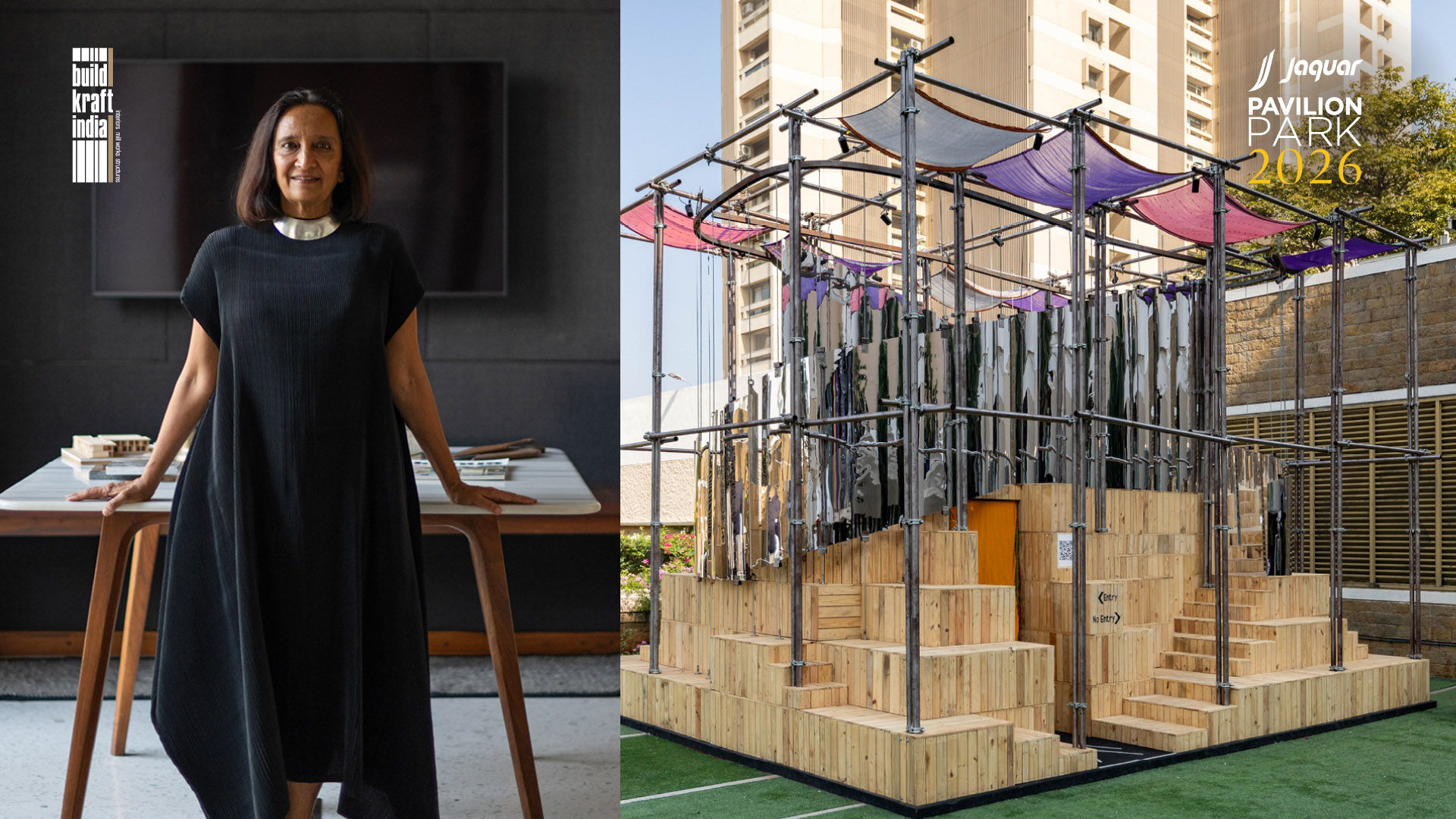
by Jincy IypePublished on : Jan 02, 2026
In Mumbai, a seat is never incidental. It is searched for on train platforms glazed with sweat and anticipation, inside local coaches pressed beyond capacity, along footpaths that narrow without warning and at street corners where rest is often bargained for. To sit or stand idle, even briefly, is to interrupt momentum in a city like this. Stillness, in this city, is an action. Thriving on paradox, Mumbai holds drunk ambition and malignant fatigue, riches beyond ambition and the poorest of the poor, strange kindness and unvarnished harshness in equal measure.
Streets of Aspiration, designed by SJK Architects for the Jaquar Pavilion Park at ADFF:STIR Mumbai 2026, begins from this everyday negotiation. Conceived through a collective studio-wide process, the pavilion takes the street as both subject and material—its rhythms, its interruptions, its uneven hierarchies—and distils them into a spatial proposition centred on pause. Shimul Javeri Kadri, founding partner of the Indian architectural firm, states how “Mumbai is a city built on contradictions”, where aspiration and exhaustion, privilege and precarity coexist, often within the same stretch of pavement. Supported by BuildKraft India Systems LLP, a premier Indian millwork and interior contracting enterprise led by Ankush Seth and Abhay Pandey, the pavilion design reflects on the ‘street’ not merely as infrastructure but as the city’s most active social commons.
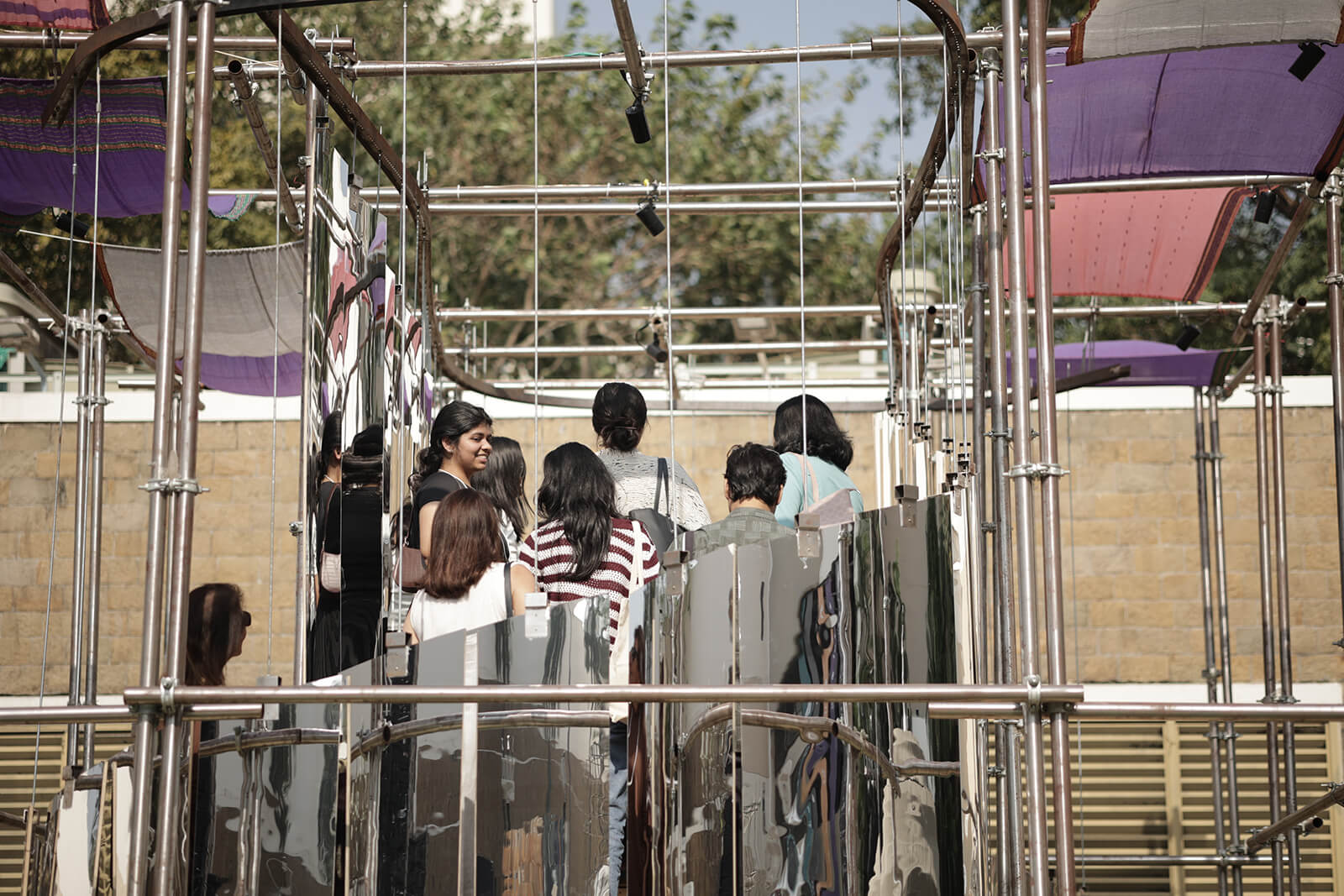
“A city that never stops building mirrors its inhabitants’ pursuit of dreams, yet moments of stillness become acts of quiet resistance,” reflects SJK Architects, describing Mumbai’s innate noise, where nearly two-thirds of the population lives in informal settlements, sustaining the city through labour that remains largely unseen. The street, they suggest, is where these tensions are lived daily, holding density and breathing room, urgency and pause, aspiration and fatigue, all at once. Streets of Aspiration stages this duality as a gentle interruption, offering a place to lean, sit or linger at the architecture and design film festival—an unassuming pause within the city’s unrelenting motion.
To be displayed on the lawns of the National Centre for Performing Arts (NCPA) from January 9 – 11, 2026, the pavilion forms part of the Jaquar Pavilion Park curated by Aric Chen, under the theme Mumbai Transcripts. Here, architecture is understood and framed as event—shaped by movement, by sequence and encounter, by what unfolds over time. SJK’s intervention responds with a compact yet layered structure that positions rest as an urban condition shaped by access, inequality and survival.
“At BKI, we embrace challenges and collaboration,” Seth and Pandey remark. “The ADFF Pavilion, a 30-day design and engineering project, blended frugal ingenuity, craftsmanship and sustainability. Working closely with our talented team and collaborators, including SJK, we captured Mumbai’s layered spirit—resilient, diverse, and ambitious. Look out for SJK+BKI at ADFF 2026!”
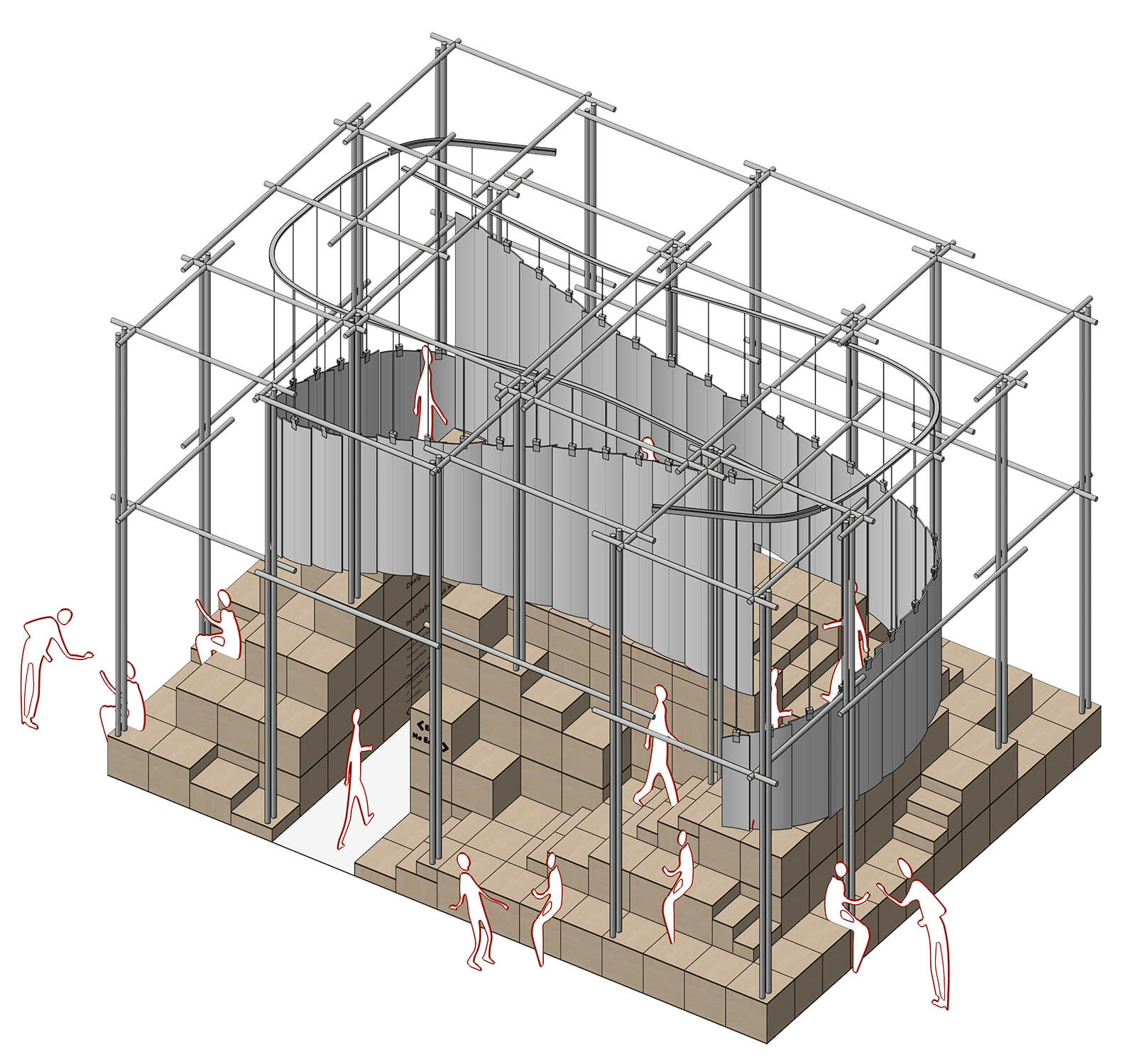
The pavilion unfolds through a 900mm modular grid, assembled using recycled wooden packing crates, mild steel frames and a uniform MS scaffolding system—materials directly synonymous with Mumbai’s informal and temporary architectures. These elements form a stepped, street-like terrain that accommodates gestures of sitting, leaning, waiting and gathering. Descending through the structure, visitors will encounter a compressed underbelly that references the informal city beneath Mumbai’s aspirations: spaces often denied light, ventilation or permanence, yet central to the metropolis' functioning.
Rising above this ground plane is a reflective vertical element, an ‘ivory tower’ constructed from waste commercial plywood, clad in mirror-finished acrylic panels. Access is possible but indirect, shaped by narrow passages and uneven transitions. Inside, reflections fracture and distort, bending perception and implicating the viewer within the hierarchy they observe. “The mirrors shift how one sees oneself within the space,” Kadri adds, revealing how perspective itself is shaped by power and proximity.
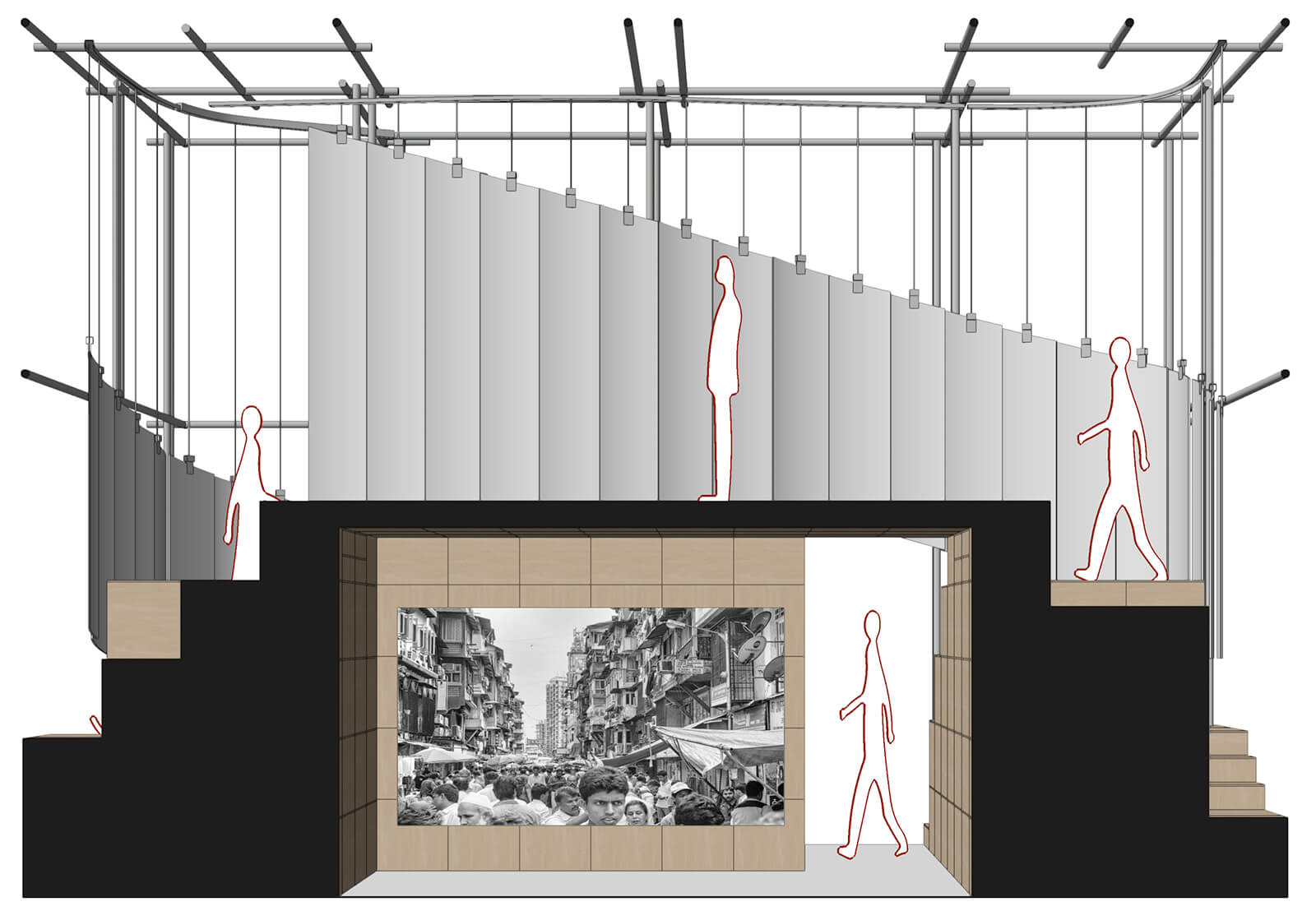
Cinematic fragments and ambient sound are embedded within the pavilion architecture, activating it through fleeting encounters rather than linear narratives. These mediated glimpses echo how the city is often experienced—partial, overheard, momentary. The entire pavilion is framed by scaffolding, a material shorthand for Mumbai’s perpetual state of construction, while reclaimed saree fabric is introduced as shading and surface, softening the industrial palette. The textile reuse explicitly foregrounds sustainability, memory and domestic labour, bringing tactility and cultural residue into an otherwise hard-edged urban language.
Temporality anchors the project’s environmental intent. Designed as a fully demountable structure, Streets of Aspiration is conceived with a clear afterlife. The modular seating units will detach and re-enter the city as benches or street furniture, while scaffolding returns to construction use. Acrylic panels and plywood cores can be reused elsewhere. “The pavilion is designed to leave nothing behind but experience,” Kadri notes, ensuring that its ecological footprint remains as light as its physical presence is brief.
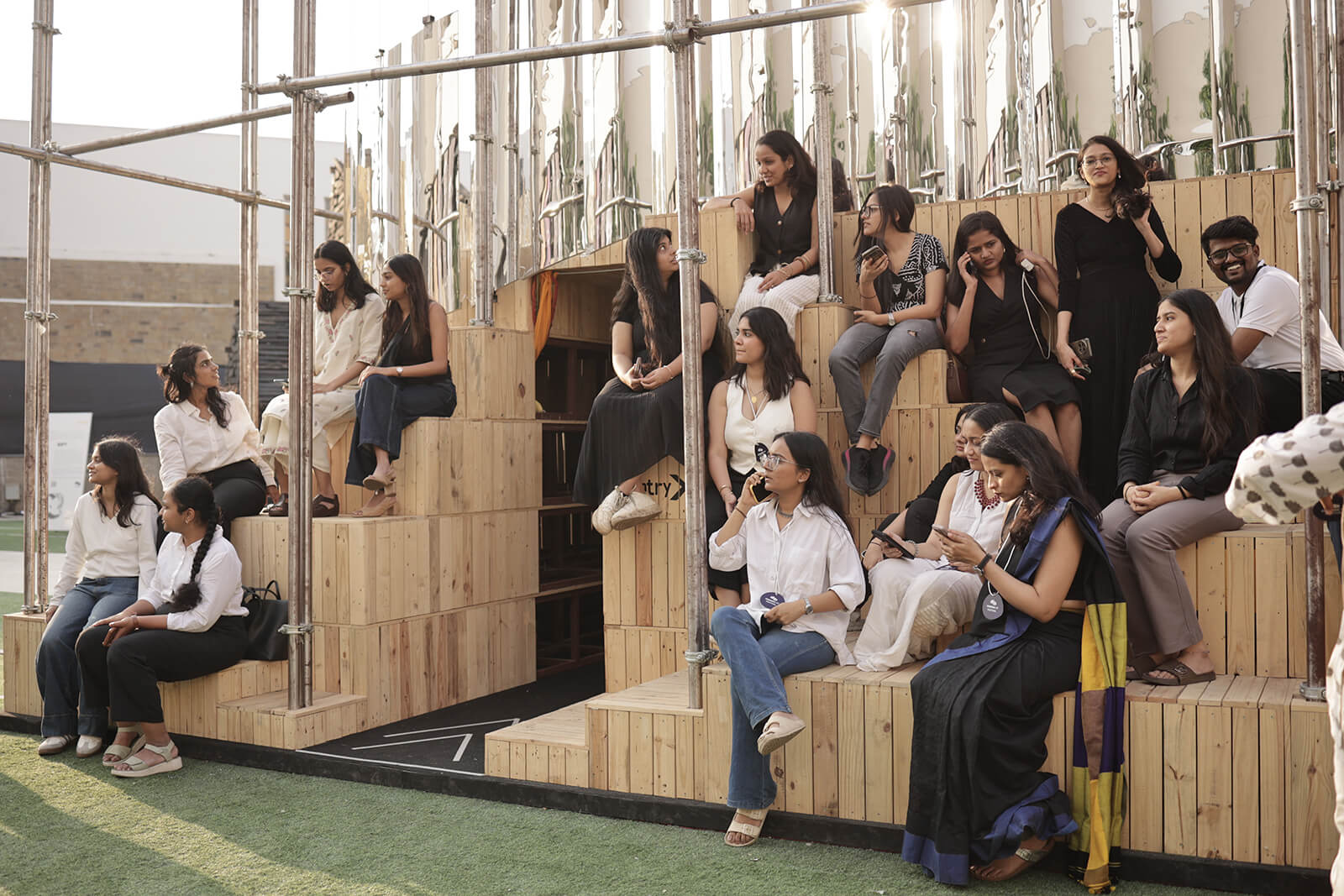
This emphasis on reuse and memory aligns the project closely with the ethos of the Jaquar Pavilion Park. Like cinema, the pavilion’s meaning unfolds through duration and encounter. Visitors move through it, pause within it and leave with impressions that are shaped as much by experience as by form. The street, temporarily staged within a cultural institution, becomes legible as both infrastructure and shared narrative.
In its fleeting presence, Streets of Aspiration by SJK Architects mirrors the condition it names. Within Mumbai Transcripts, it positions architecture as a medium capable of slowing the city, briefly, deliberately. As the Mumbai-based firm elaborates, “Despite everything—the grit, hustle, exhaustion, and inequity—our memories of the city are not only of hardship. They are of kindness, humour, and familiarity. Of a vada pav vendor slipping in an extra pav after a tiring day, of strangers steadying you when you trip on an uneven pavement, of unexpected generosity in the most crowded moments. Our pavilion attempts to hold all of that: the aspiration and the discomfort, the harshness and the humanity, the city as it is and the city as it hopes to be.”
The 2026 edition of the Pavilion Park at ADFF:STIR Mumbai 2026 is presented by Jaquar.
The Streets of Aspiration, by SJK Architects, is supported by BuildKraft India.
You can now book your passes for the festival here. Full schedule for the festival is available here.

by Pranjal Maheshwari Oct 19, 2026
The Mumbai-based architects integrate courtyards, mesh screens and north light trusses to create a dining space that doubles up as a community hub at SR University, Warangal.
by Mrinmayee Bhoot Oct 17, 2026
The Rotterdam-based institute centres the Indian Ocean as a network for exploring material histories and transnational links shaping coastal cultures, positing them as future models.
by Pranjal Maheshwari Oct 16, 2026
At the 2026 Stirling Prize ceremony, Mary Duggan with RUFF Architects, MAKER Architecten and Nakshabid Architects were felicitated for proffering quality housing and social equity.
by Mrinmayee Bhoot Oct 12, 2026
The new Centre for Contemporary Arts, fostering public engagement with art in Uzbekistan, is housed in a tram depot refurbished by the French studio, emulating local craftsmanship.

make your fridays matter with a well-read weekend
Enter your details to sign in
Don’t have an account?
Sign upOr you can sign in with
a single account for all
STIR platforms
All your bookmarks will be available across all your devices.
Stay STIRred
Already have an account?
Sign inOr you can sign up with
Verification link sent to check your inbox or spam folder to complete sign up process
Tap on things that interests you.
Select the Conversation Category you would like to watch
Please enter your details and click submit.
Enter the 6-digit code sent at


SJK Architects brings respite at ADFF:STIR Mumbai 2026 with Streets of Aspiration
by Jincy Iype | Published on : Jan 02, 2026


 Sign in with Google
 Sign in with email
What do you think?