Art08 mins. read
India Art Fair 2026 and more in Delhi: The STIR list of must-see exhibitions
by Srishti OjhaFeb 04, 2026



by Srishti OjhaPublished on : Aug 10, 2026
Inhale. Hold. Exhale. Hold. This is the rhythm at the heart of our world, older than clocks and sundials, ETAs and deadlines. Breath is universal, somewhere between the ephemeral and material, the commingling of air that connects people to each other, to plants and animals, to the sky and atmosphere, to life and death. Although breath is autonomic, the character of its speed and rhythms can be a visceral expression of emotion and experience, disturbed or calm. What is the difference in the breaths you take in a pastoral countryside versus in a smog-choked city? Whose breathing is laboured and who gets to breathe deep and uninterrupted? Indian artist Sudarshan Shetty explores and navigates his hometown (and that of around 27 million others), Mumbai, through the rhythms of breath in his solo exhibition, Sudarshan Shetty: A Breath Held Long, at the Ludwig Museum Koblenz in Germany. The exhibition is centred on a film of the same name and seems almost like an extension of it, a site or set where stories and actions are captured in medias res.
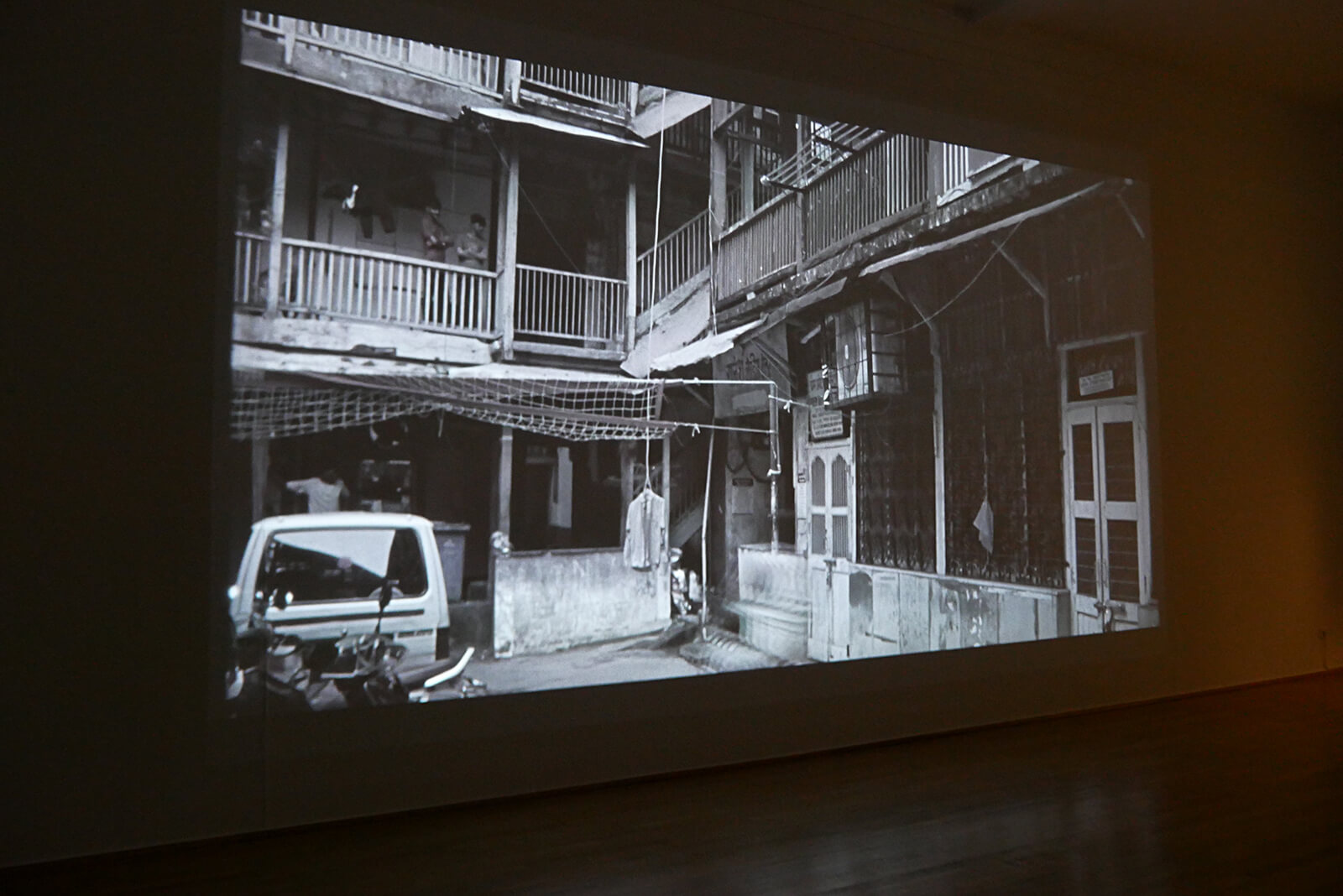
In a conversation with STIR, Shetty introduced the exhibition, saying, “In the film, breath operates as a palpable life force and an underlying metaphor for existence in a city like Mumbai. It weaves through a nonlinear fabric that collapses the boundary between the city’s collective roar and the performer’s internal state. The objects that accompany the work become the residual remnants of the stories narrated by the film’s various characters.” The film, which lies somewhere between documentary and fictional narrative, follows the lives and movements of people in one of the most densely populated places in the world, tracing characters from crowded local trains to pockets of quiet in a system of perpetual motion. The static camera grounds the 31-minute-long film as voices, bodies, songs, narration and the ambient sounds of the city pack into and layer relentlessly onto the 16-mm film. Like much of Shetty’s work, the film is an assemblage of collective existence, culture, movement and emotion rendered in fragments. The exhibition also features three additional film works by Shetty, including Age of Love (2019), Navarasa (2016) and The Juggler (2012).
“The film and the objects are not separate gestures but parts of a single field of experience: the film offers a (somewhat) narrative thread, and the objects pick up, interrupt or extend those threads in another space. I see the objects as a way of recontextualising fragments so they can be reactivated by viewers…Rather than resolving the film’s questions, the assemblage aims to multiply them—to produce openings rather than conclusions,” said Shetty. Just as the film speaks in fragments rather than acts, the exhibition speaks in traces, cyphers, afterimages, deferrals and gestures rather than in props or straightforward sculptures.
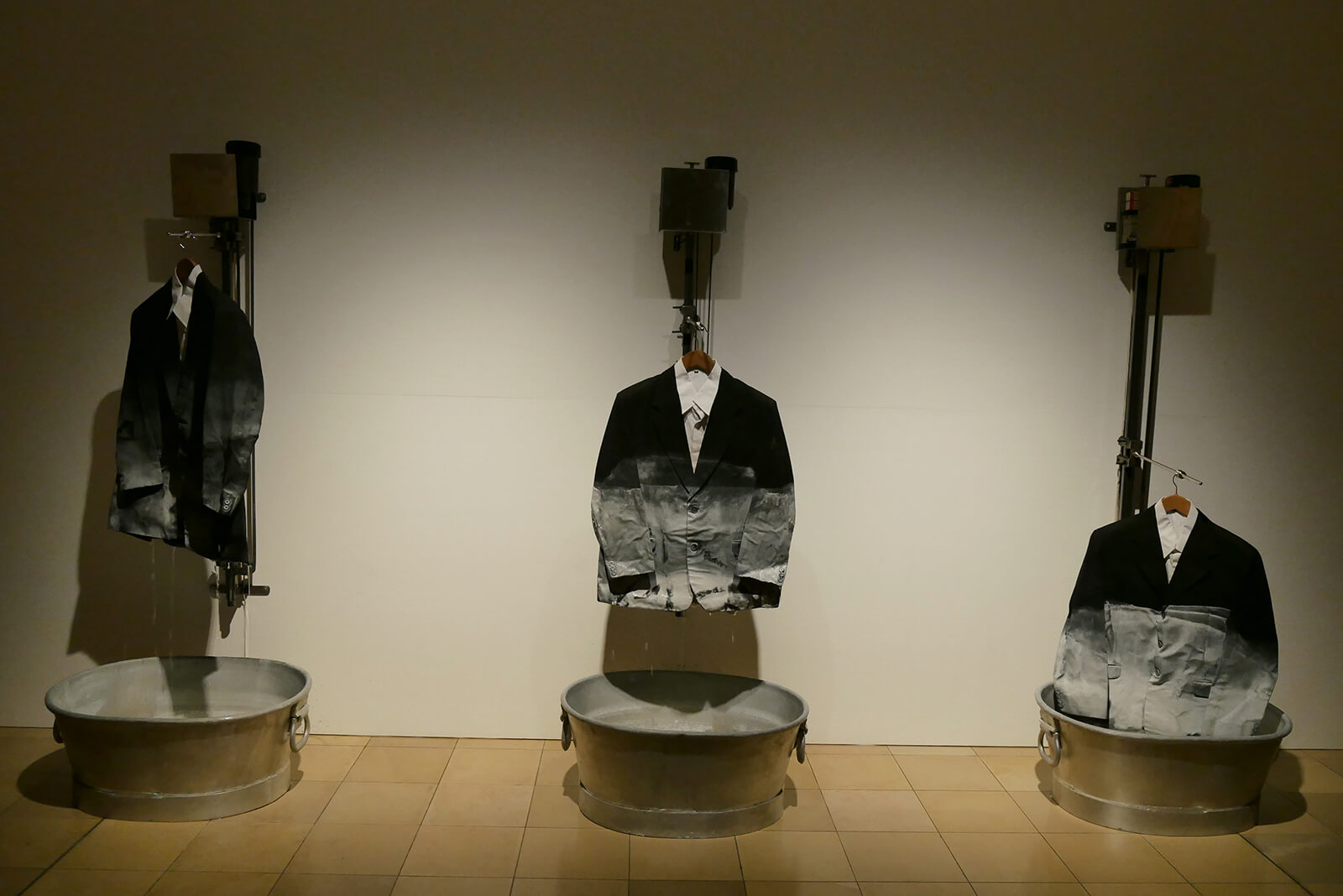
Instead of pedestals and glass boxes, many of Shetty’s objects are suspended from the ceiling by ropes, laid on the floor or presented in cases, as in the work The Trophy Cabinet (2025), where they also act as an extension of the artwork. Domestic objects are turned into statues created using polyester resin and marble dust, while others are reimagined in carved wood or hybrids of both materials. Shetty’s focus on materiality has been central to his practice throughout his career, and creating juxtapositions between materials—cold, immortal, minimal, white stone and organic, historied, detailed wood—allows a visceral investigation into other contradictions like manmade and organic, crowds and loneliness, real and illusory, absent and present.
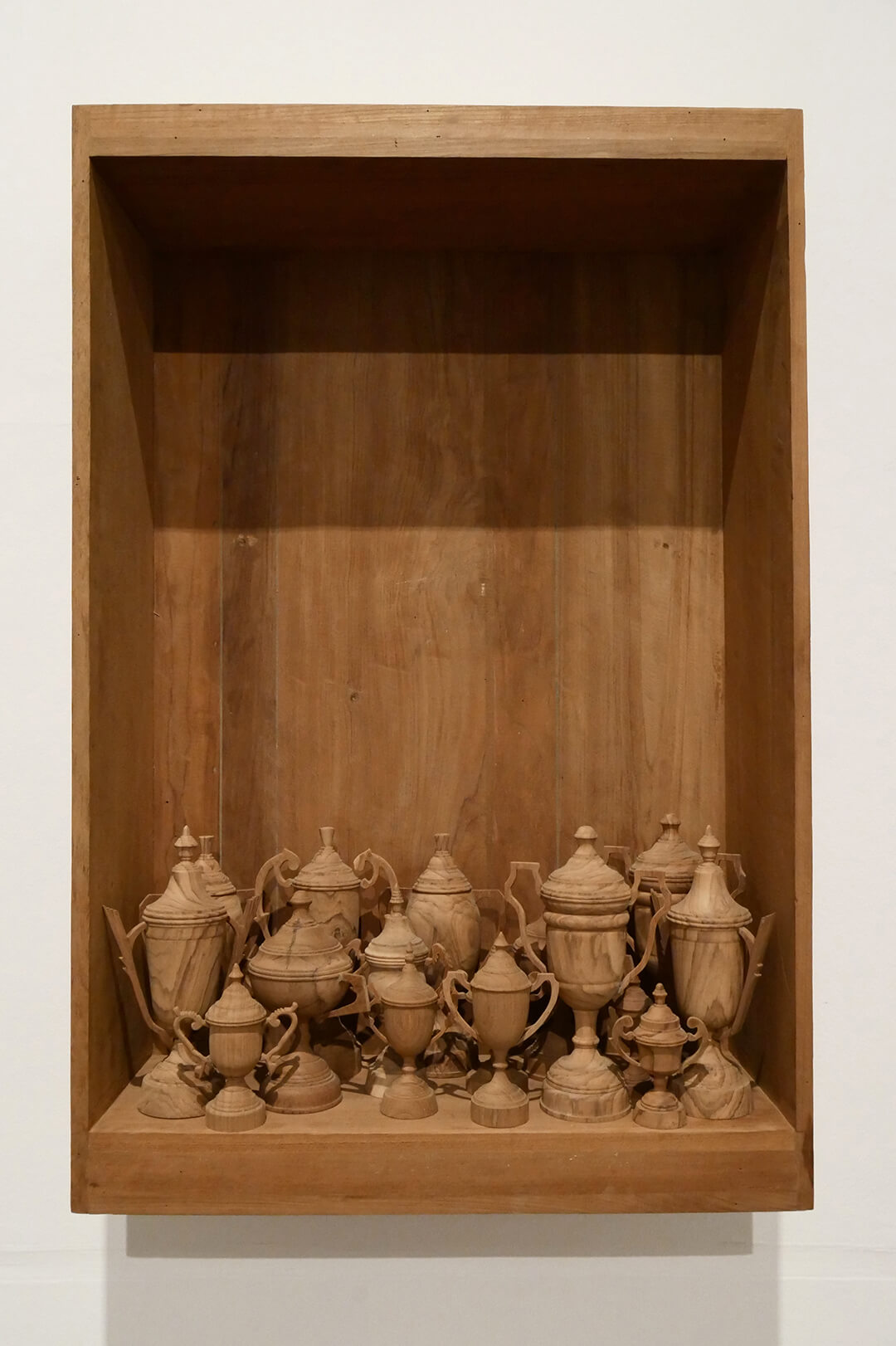
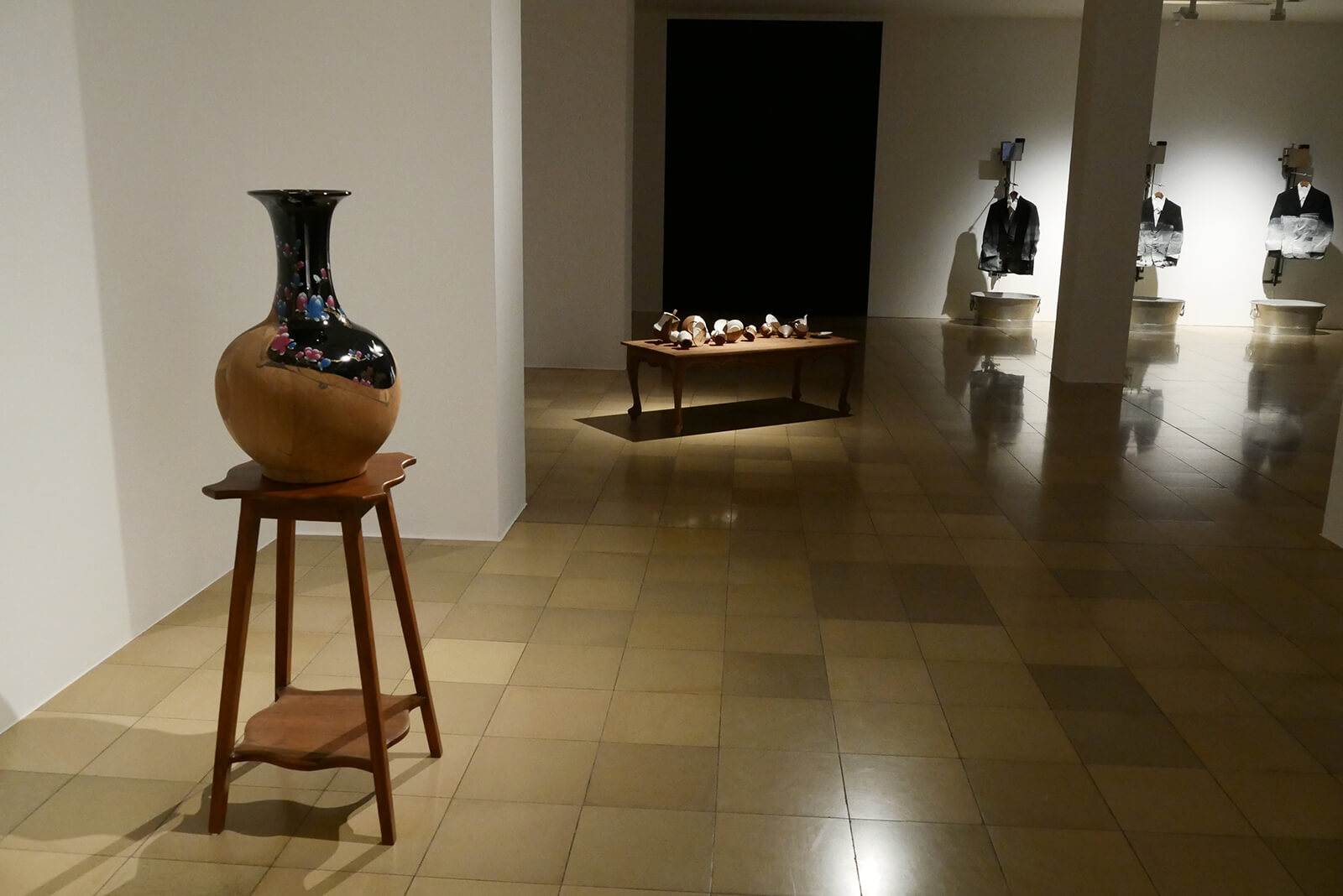
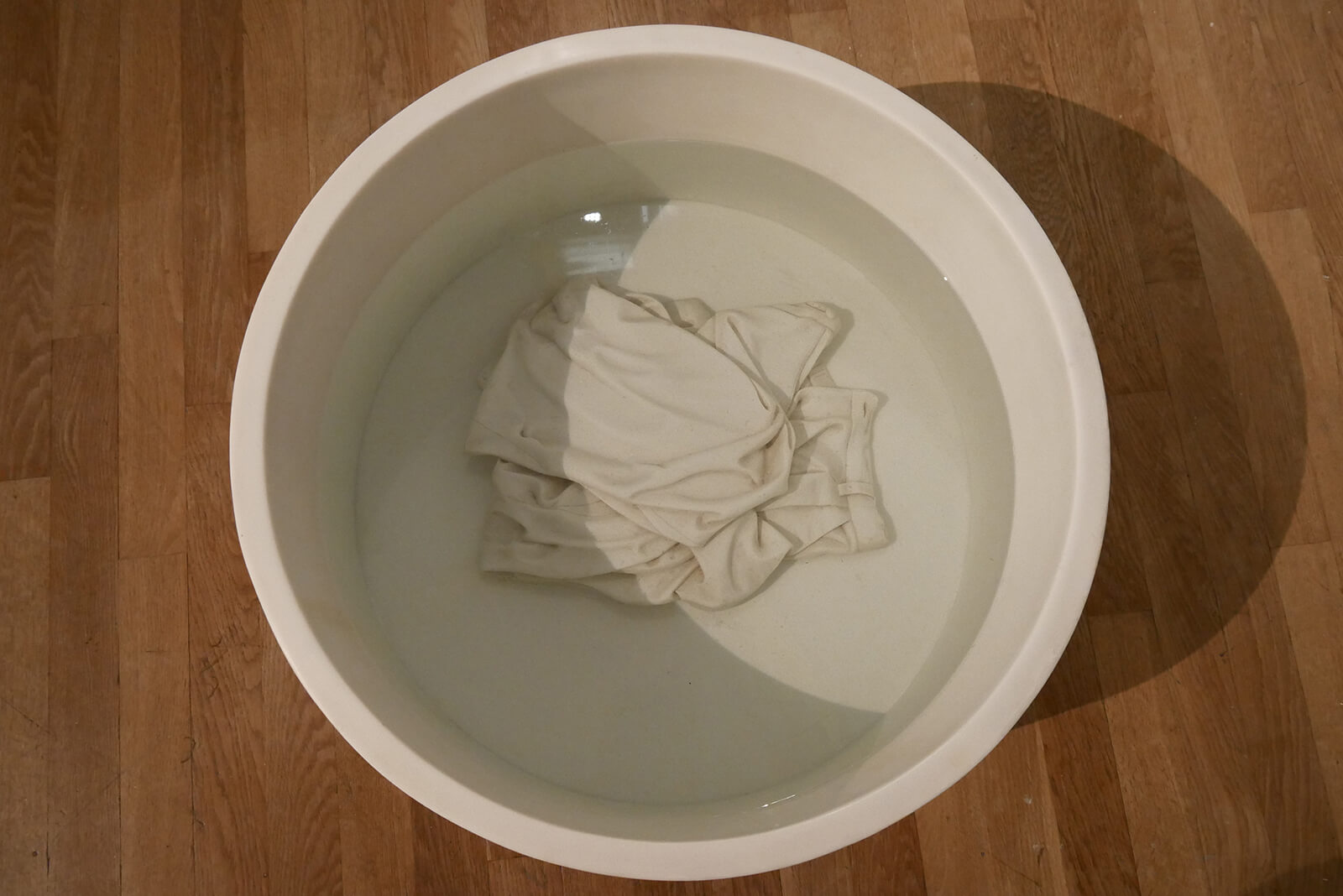
Suit jackets are seen on hangers that move up and down mechanically, being dipped into water that is dyed white, transforming their lower halves into negatives of themselves. Another suit jacket is seen in the same stone-like finish along with its hanger (making them inseparable and therefore, unwearable). The human, familiar nature of these objects makes the absence of bodies and characters in the space starkly visible. Another ‘marble’ tub filled with water holds a sculpture of a pair of rumpled pants, a companion to the suits that implies an incomplete sequence of actions undertaken by absent narrative and actors. The white on white creates the effect of the objects dissolving into each other, the differences between them eroding.
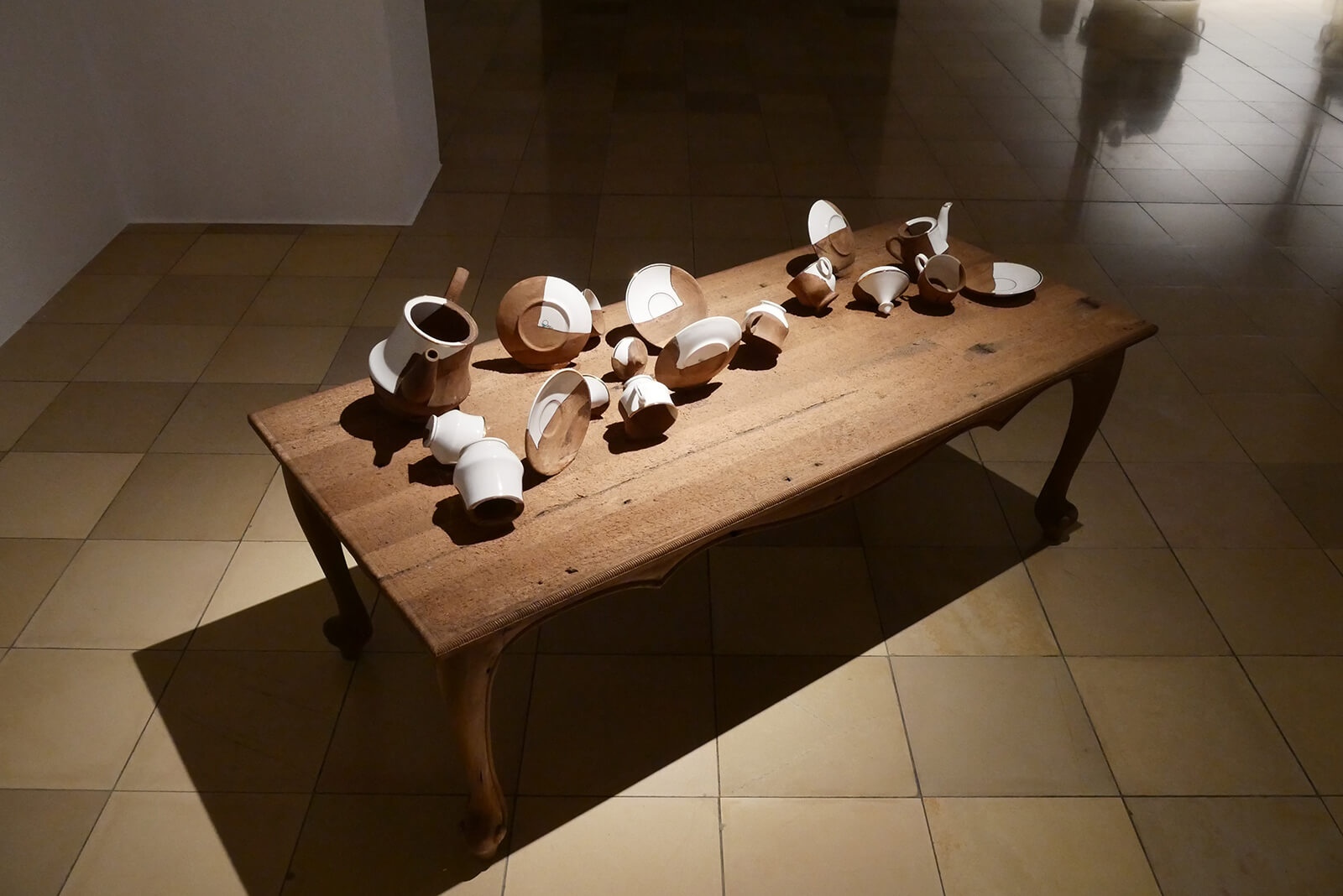
This is echoed in another installation where teapots, cups and saucers are placed on a wooden table. The crockery looks like a take on Japanese kintsugi—the art of visualised mending—where cracks in the objects divide them between white ceramic and wood. Beyond creating a visual interruption and defamiliarising the everyday objects, this appearance also makes part of the objects appear to fade into the matching wood of the table, making the remaining white parts seem like disembodied fragments. The objects, as synecdoches of their own history and the history of the people and cultures they imply, fade from the specific materiality into broader, existential symbols of what Shetty has termed ‘memory at large’ in his practice.
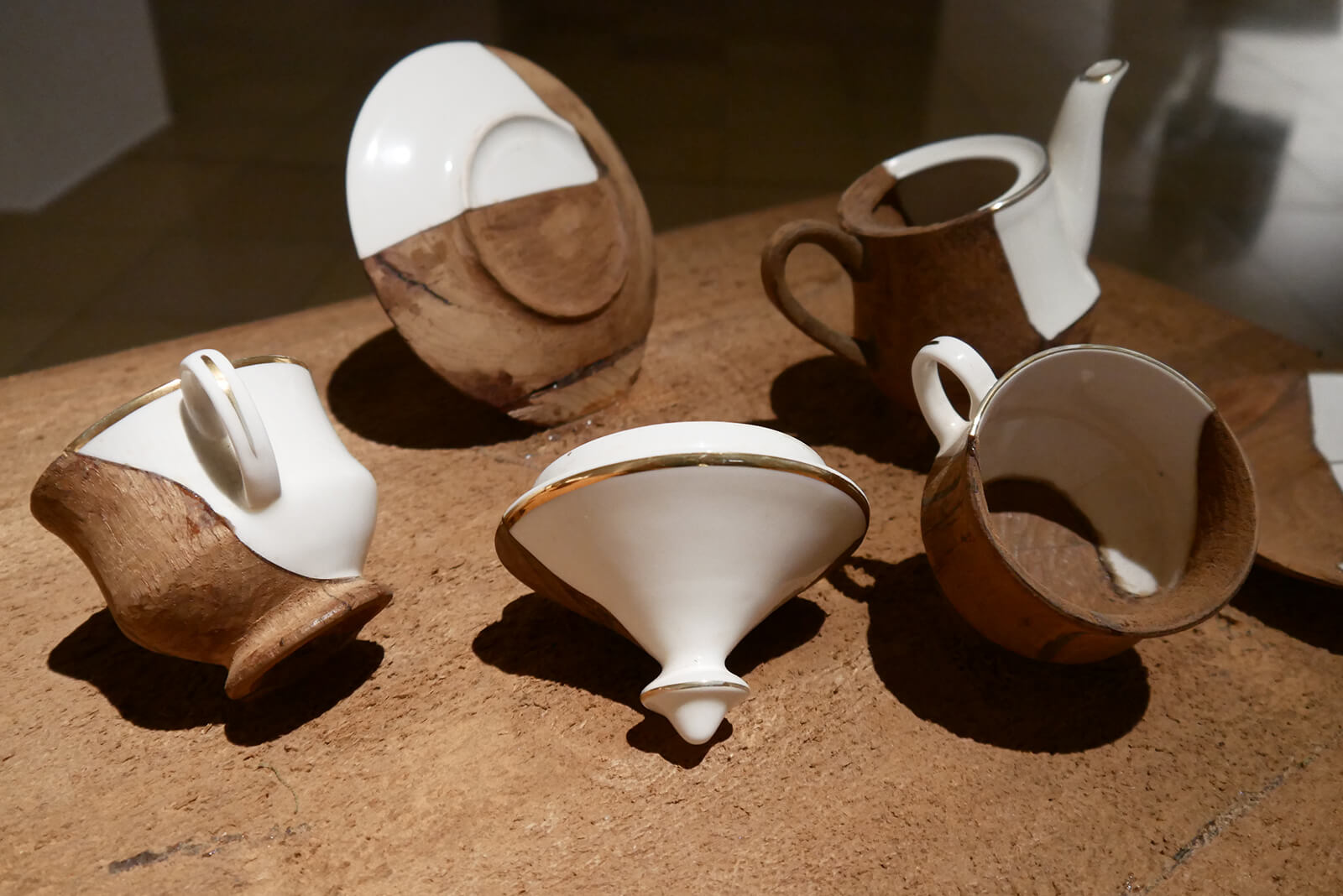
The multimedia artist states, “I let found materials arrive with their own histories rather than forcing them into neat stories. Formally, my work has become more cumulative—layers of image, sound and objects that sediment and erode, revealing traces rather than tidy resolutions. I’ve grown more interested in distributed authorship and indeterminacy. Memory is not something I fix; it’s a field that the work opens onto fictional spaces and into non-linear arcs.” The modifications Shetty makes to everyday objects challenge what French aesthetic philosopher Jacques Rancière called the ‘distribution of the sensible’—what society decides is sensible, normal or common sense; who can participate and be visible within this realm and therefore how perception is organised, politically and aesthetically, in the everyday. Shetty’s objects reveal the porous nature of the seeming divide between the existence of an object as ‘real’ or as a cultural construct. By shifting the normal slightly, Shetty tilts it on its axis, allowing objects to produce new, unpredictable affects and narratives that reveal the artifice in the ‘natural’.
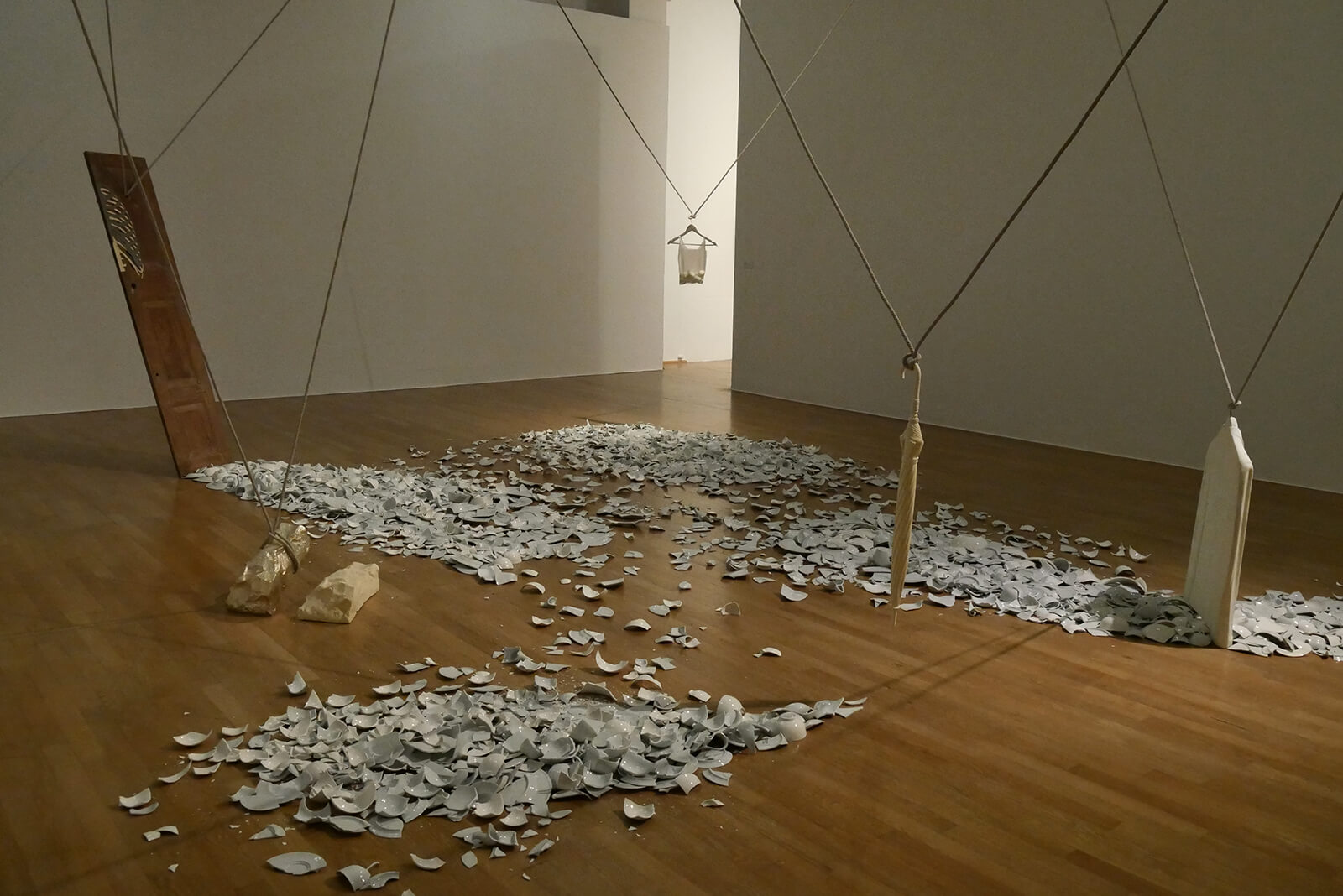
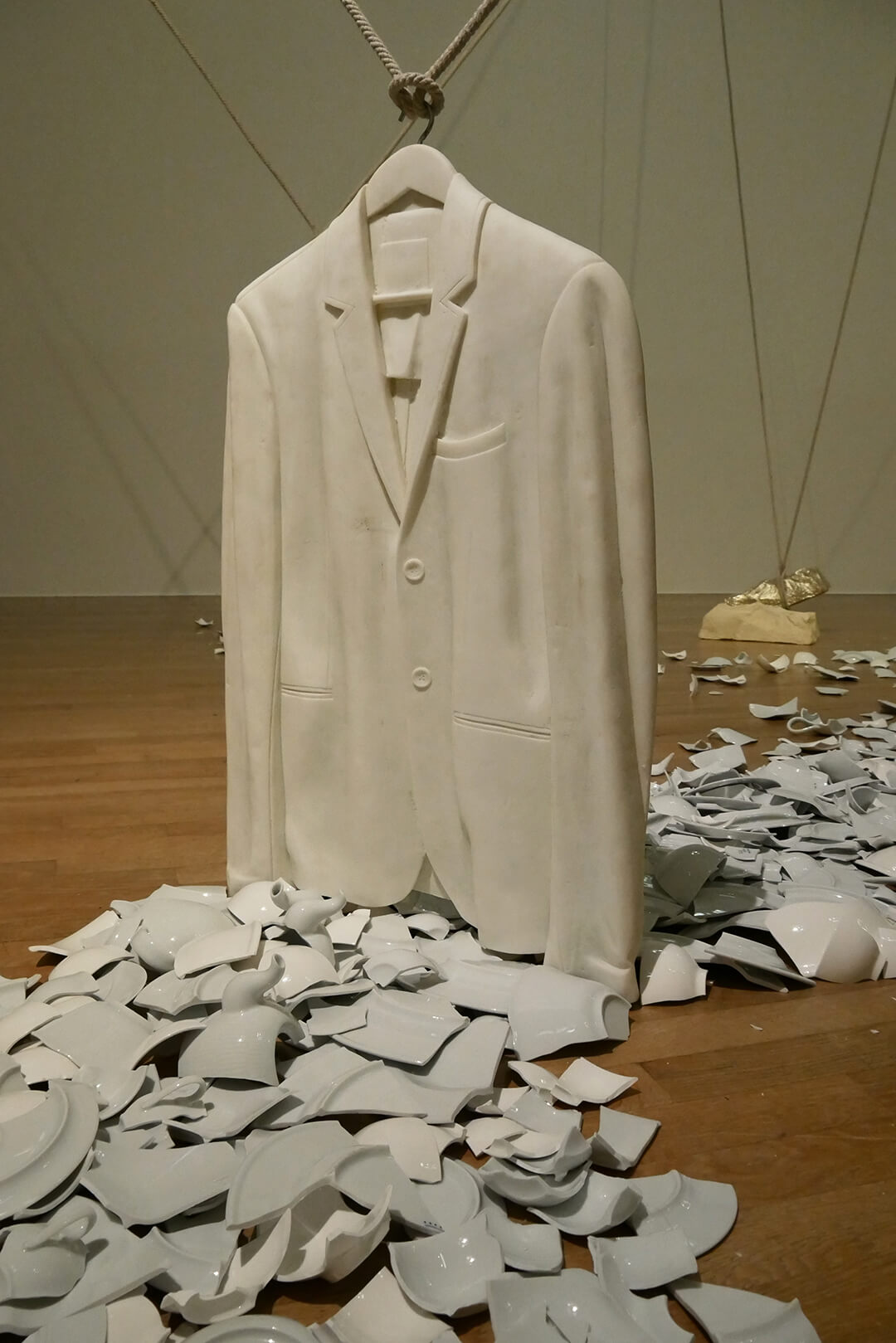
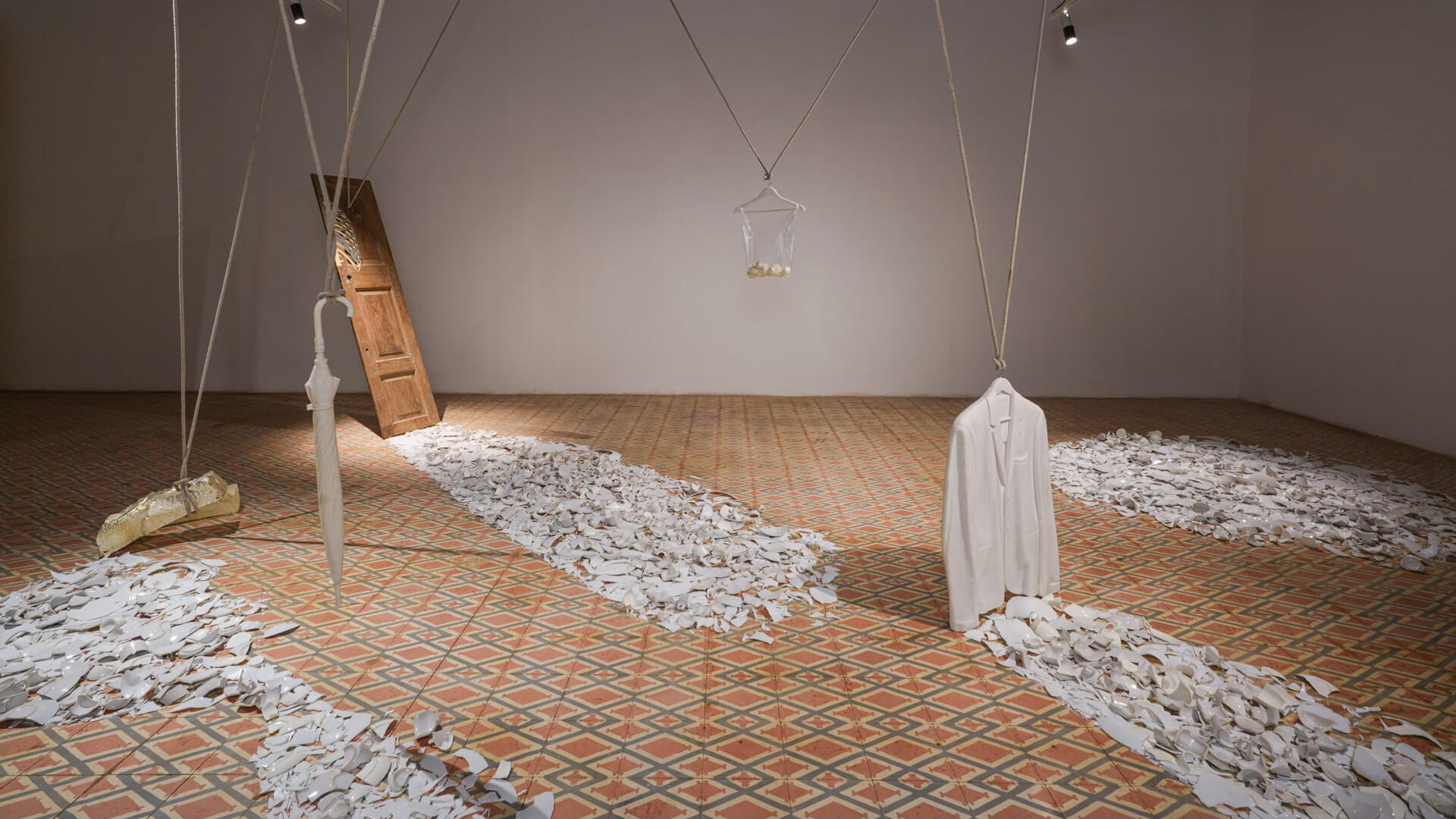
One of the most striking ways in which Shetty makes absence and the intangible material is through his use of pause. A Breath Held Long imagines absence not merely as emptiness but as one extreme of a continuum (with presence at the other pole) that mirrors the rhythms of life. Just like a held breath, stillness and emptiness are not definite, barren and unchanging, but pauses, rife with anticipation and potential energy ready to materialise. ‘Absence’ becomes a liminal space—neither here nor there, not fully of the past or of the future. This idea of suspension is channelled literally in a room where an umbrella, suit jacket, rocks, a plastic bag of egg-like shapes made of the same ‘stone’ and a wooden door are displayed hanging from ropes. The materials seem at once heavy and brittle, hanging precariously in a moment that cannot last. Although the installations are static, it is difficult not to imagine the ropes giving way, the objects clattering down onto the floor and the cacophonous noise that would follow. Each object casts a ‘shadow’ of shattered white porcelain, multiplying this effect and adding to a soundscape that exists only in implication and imagination, but is no less effective for it.
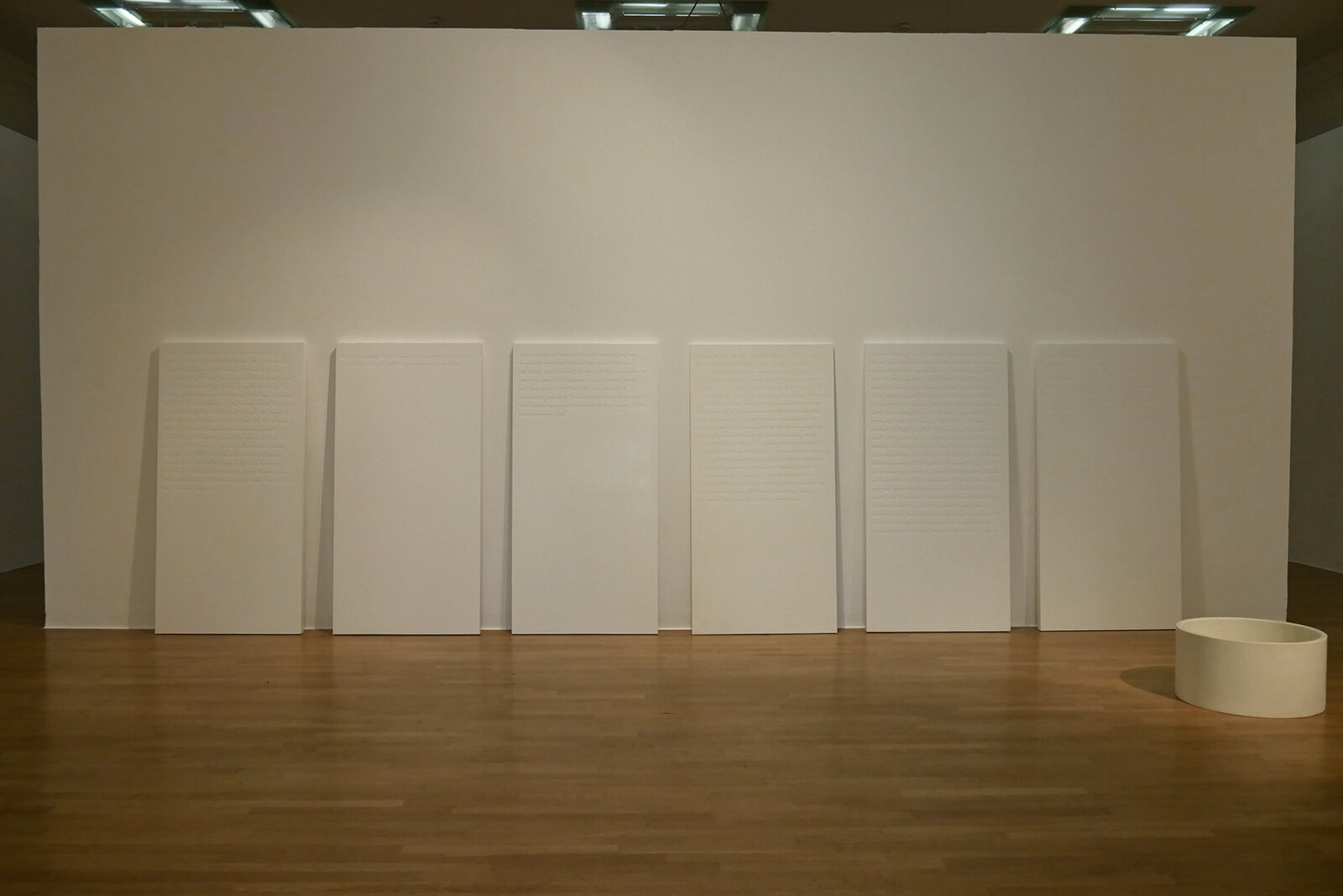
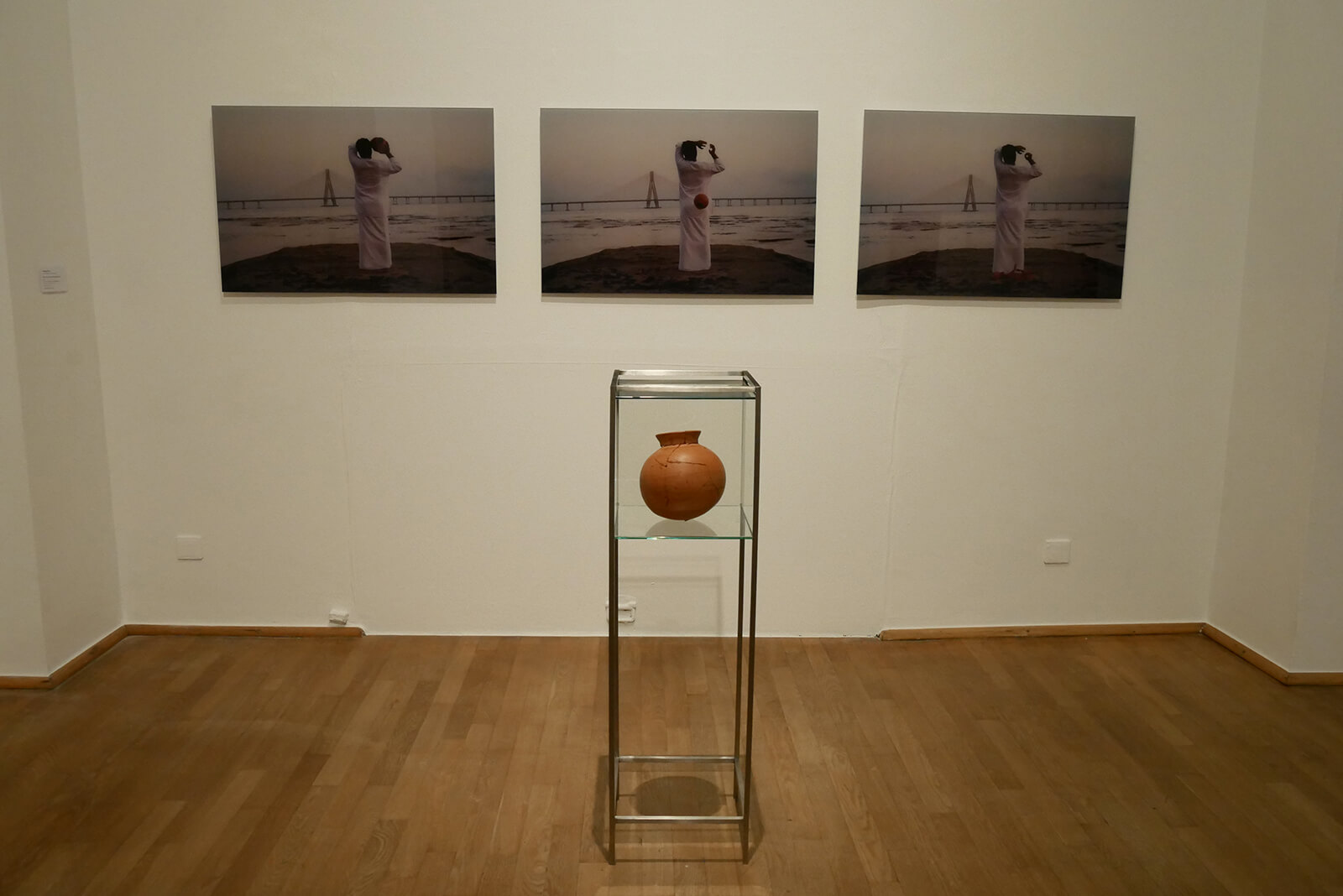
The ideas of the static and durational warp over the course of the exhibition—for example, in the text that is inscribed onto white Corian panels that lie side by side, where information is arranged horizontally rather than from the top-down. A slow-motion short film, The Juggler (2012), almost resembles a lenticular artwork. It shows a man juggling a ceramic pot referenced in an earlier film as part of a death ritual, inhabiting the limbo and ambiguity between states. The films throughout the exhibition are not contained traditionally, but, as Shetty explains, swell out from the projector into the exhibition space and the objects it holds.
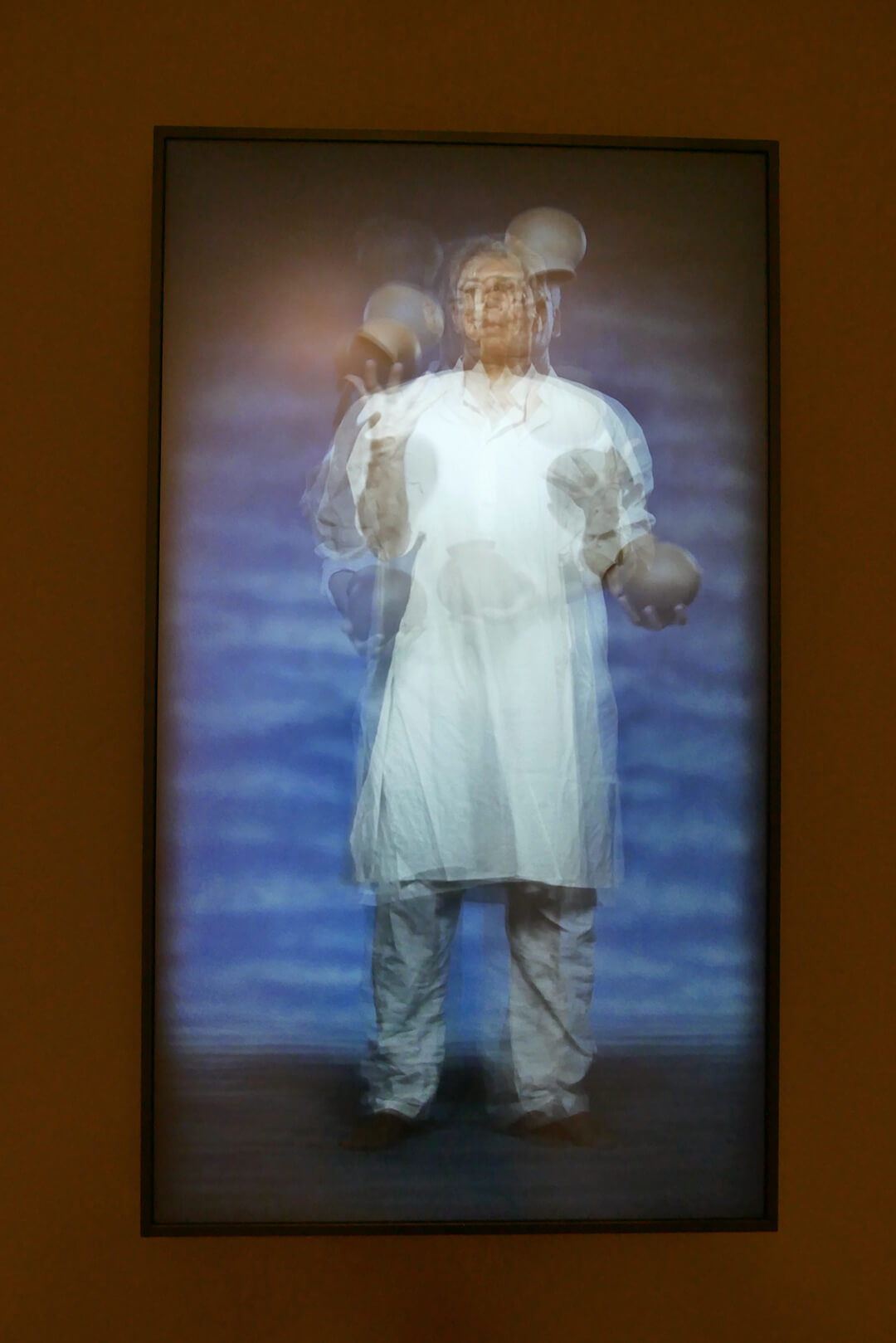
Through restraint and focused repetition of materials and motifs, A Breath Held Long thrums with the energy and tension sparked by the contradictions that animate a city like Mumbai. In a place that is constantly shifting, change becomes a kind of stasis and movement and stagnation no longer seem opposed. Shetty’s works and his commitment to ambiguity, rather than settling such contradictions, allow them to expand into sites for broader aesthetic and political inquiries on the nature of reality, presence, memory and collective existence.
‘A Breath Held Long’ will be on view from June 12 – August 16, 2026, at the Ludwig Museum Koblenz in Germany.
by Srishti Ojha Oct 09, 2026
In his ongoing exhibition, the South African artist creates two post-apocalyptic futures to explore society’s relationship with textiles, patterns and technology.
by Srishti Ojha Oct 07, 2026
The Kolkata-based film festival shone a spotlight on local and international filmmakers and artists who are pushing the boundaries of what a film can encapsulate.
by Samar Jodha Oct 05, 2026
Looking at Ahmed Ali’s photographs of workers and industry within the wider history of industrial photography, from Soviet state imagery and Sunil Janah to Lewis Hine.
by Srishti Ojha Oct 02, 2026
The Indian artist’s exhibition at the Bruce Museum in the US thinks through fundamental questions of humanity by focusing on the Sun and the cosmological timescale.

make your fridays matter with a well-read weekend
Enter your details to sign in
Don’t have an account?
Sign upOr you can sign in with
a single account for all
STIR platforms
All your bookmarks will be available across all your devices.
Stay STIRred
Already have an account?
Sign inOr you can sign up with
Verification link sent to check your inbox or spam folder to complete sign up process
Tap on things that interests you.
Select the Conversation Category you would like to watch
Please enter your details and click submit.
Enter the 6-digit code sent at


Sudarshan Shetty's A Breath Held Long reflects Mumbai’s contradictions
by Srishti Ojha | Published on : Aug 10, 2026


 Sign in with Google
 Sign in with email
What do you think?