Art04 mins. read
Kyoto City KYOCERA Museum of Art presents Takashi Murakami’s vibrant world
by Manu SharmaMay 23, 2024




by Avani Tandon VieiraPublished on : Feb 07, 2026
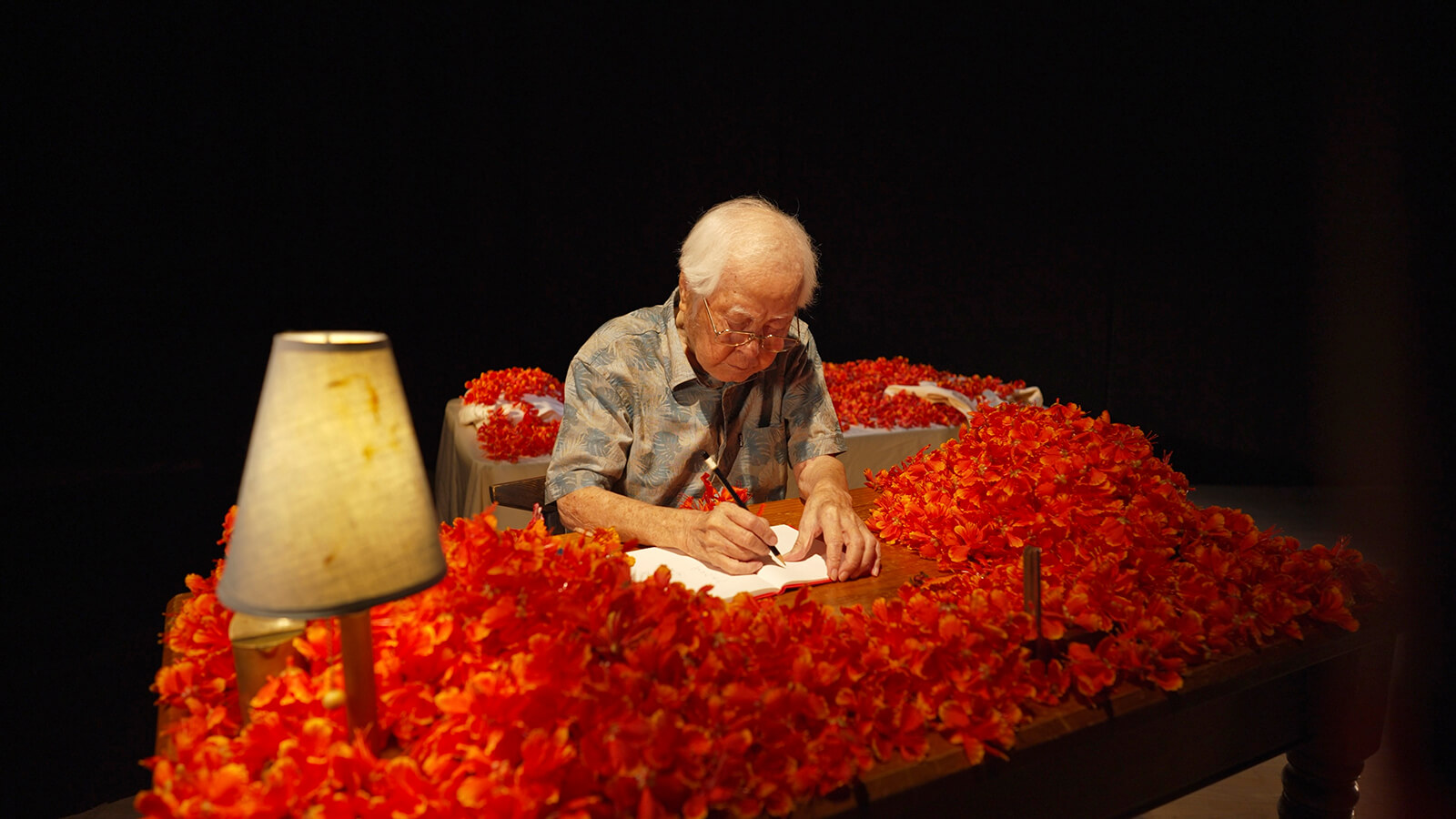
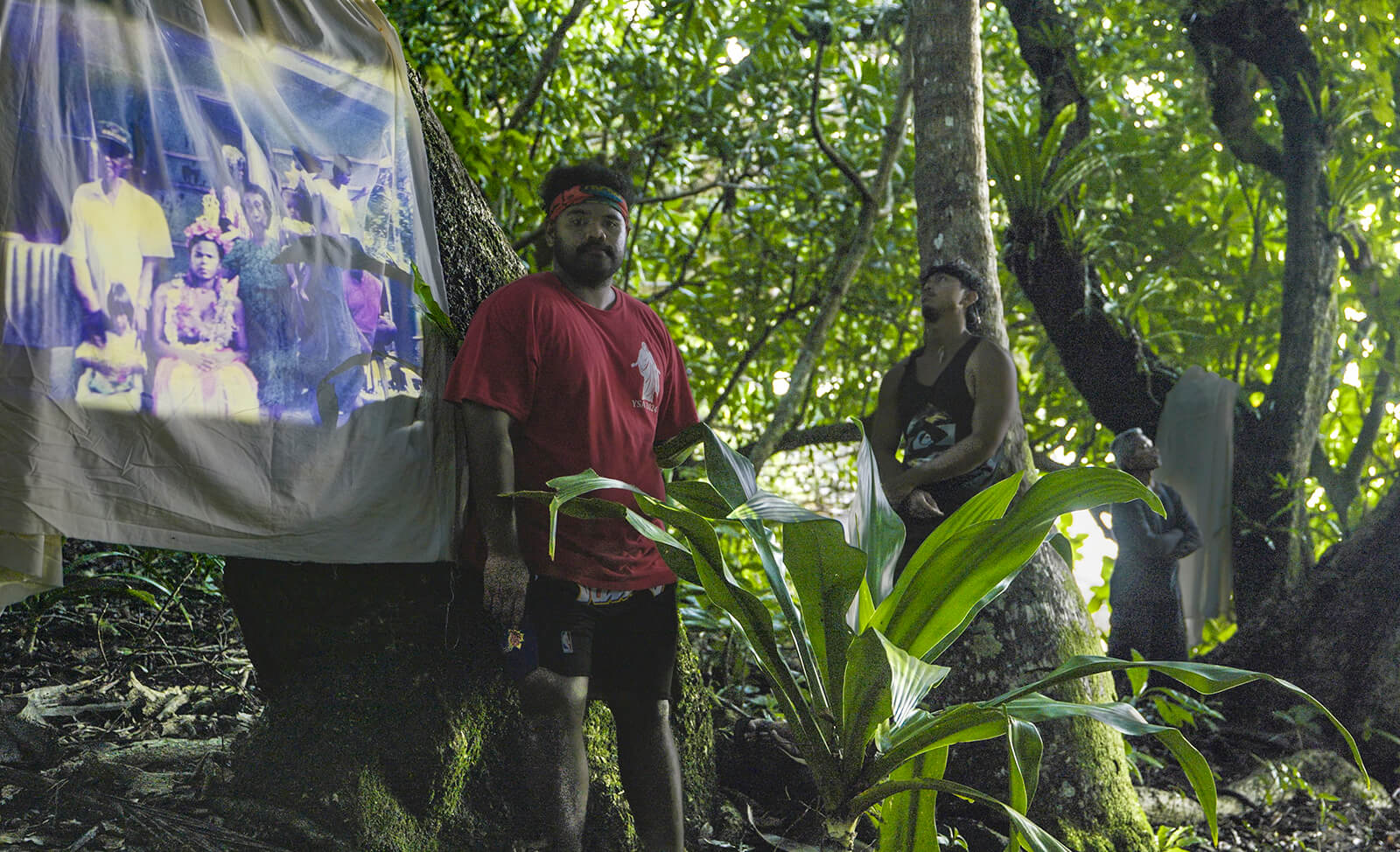
On a spotlit stage, an old man raises his arms towards the sky. The gesture is ambiguous, suggesting flight or dance or greeting. ‘Tuiya Tuiya’, a child’s voice calls out. Bird, in Okinawan dialect. In the background, a collection of household objects – pianos, clothing, luggage. From above, a soft rain of red flowers, settling on the man’s lap and around his feet. The man is artist Yamashiro Chikako’s father, the voice that of his childhood self, the setting both past and present.
In his work on the gothic, literary theorist Julian Wolfreys suggests that all narrative is spectral. “To tell a story,” he argues, “is always to invoke ghosts, to open a space through which something other returns”. This idea of haunting or, more generously, return animated the galleries of the Artizon Museum earlier this year, serving as a central thread of In the midst of, an exhibition concerned, per curator Utsumi Junya, with the “complex vacillations of history and memory”. In the midst of was the sixth edition of Jam Session, an annual exhibition that pairs contemporary artists with works from the Ishibashi Foundation Collection. Its most recent iteration, running from October 11 2025 – January 12, 2026, featured site-specific installations by Japanese artists Yamashiro Chikako and Shiga Lieko alongside four works from the collection. The exhibition’s Japanese title, Hyochaku, translates loosely to drifting or organic convergence. The artists’ works, subsequently, were presented not in manufactured dialogue but as discrete engagements with place, held together by a shared concern with the in-between.
While the curatorial vision of In the midst of foregrounded indeterminacy, its artists approached the idea through the geo-temporally specific. Both Yamashiro and Shiga have profoundly located practices, informed by the politics and landscape of their respective homes in Okinawa and Tohoku. Within the framework of the exhibition, each artist presented a permutation of video, photography and soundscapes, immersing the viewer in a deeply particular intersection of place and time. Yamashiro’s concern was with colonial trauma and place memory, Shiga’s with the slow violence of disaster. Viewed together, not through the lens of continuity but that of resonance, their works suggested a many-layered understanding of liminality: as opportunity, as inevitability and as precarity.
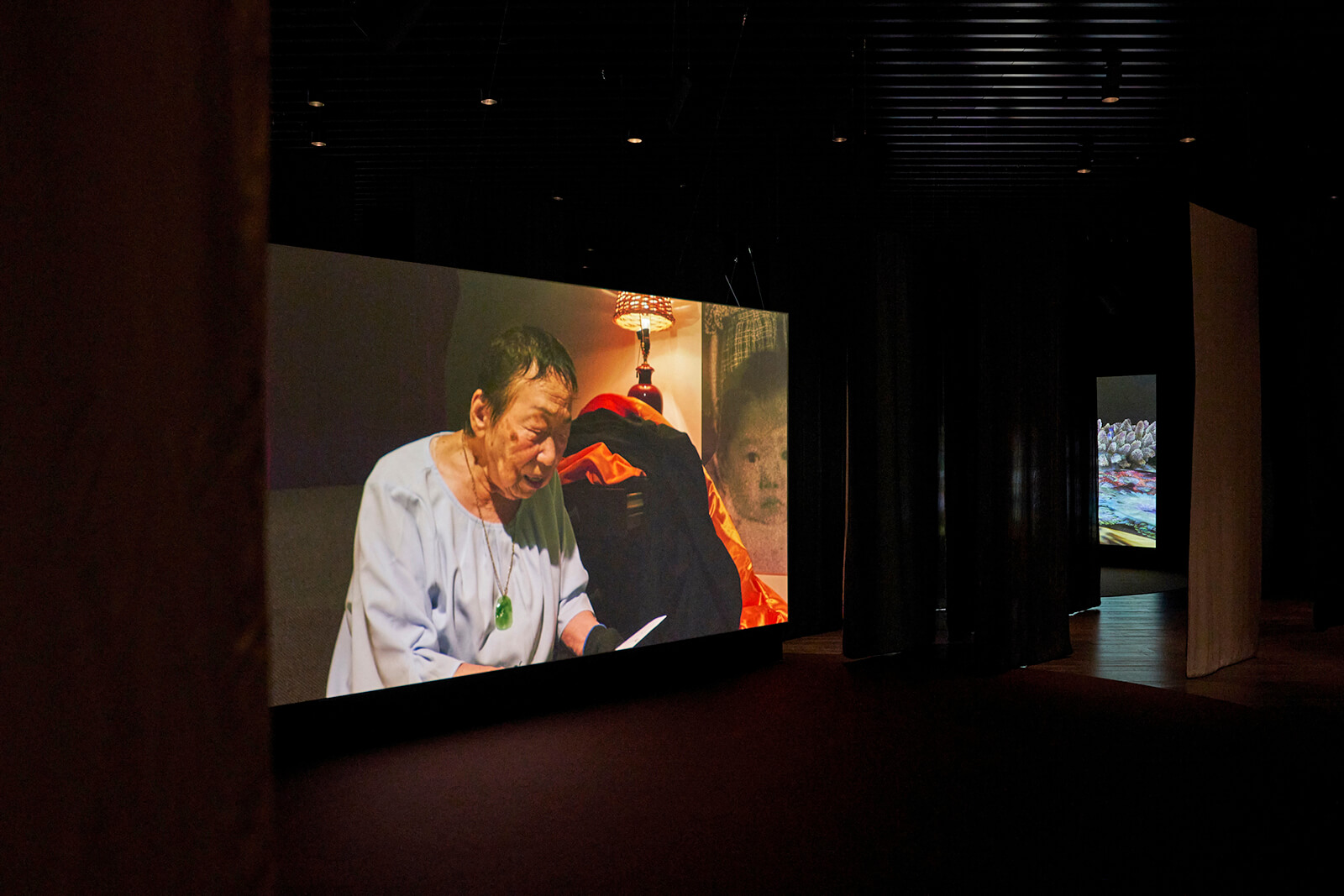
In a 2021 interview with Dundee Contemporary Arts, Yamashiro expresses a desire to convey the "circulating voices of all who live together". In the context of In the midst of, the temporal limits of this collective were chosen to extend from Japanese colonialism of the early 20th century, through the atrocities of World War II and to American imperialism in modern-day Okinawa. Fittingly titled Recalling(s) (2025), Yamashiro’s work is a reenactment of these histories, performed through the memories of her Okinawan father. As a child, Yamashiro’s father lived on the Micronesian archipelago of Palau, then occupied by Japan. Among his clearest memories is spotting a bird while on a boat bound for Palau and calling it by its Okinawan name, only to be corrected and told to use the Japanese word instead. The historical layers of this sonic encounter are many: a native of one colony en route to another, a familiar world made unfamiliar through language. In Yamashiro’s treatment, it is a starting point for a circuitous journey through trauma and dislocation, realised through six videos and accompanying textile compositions.
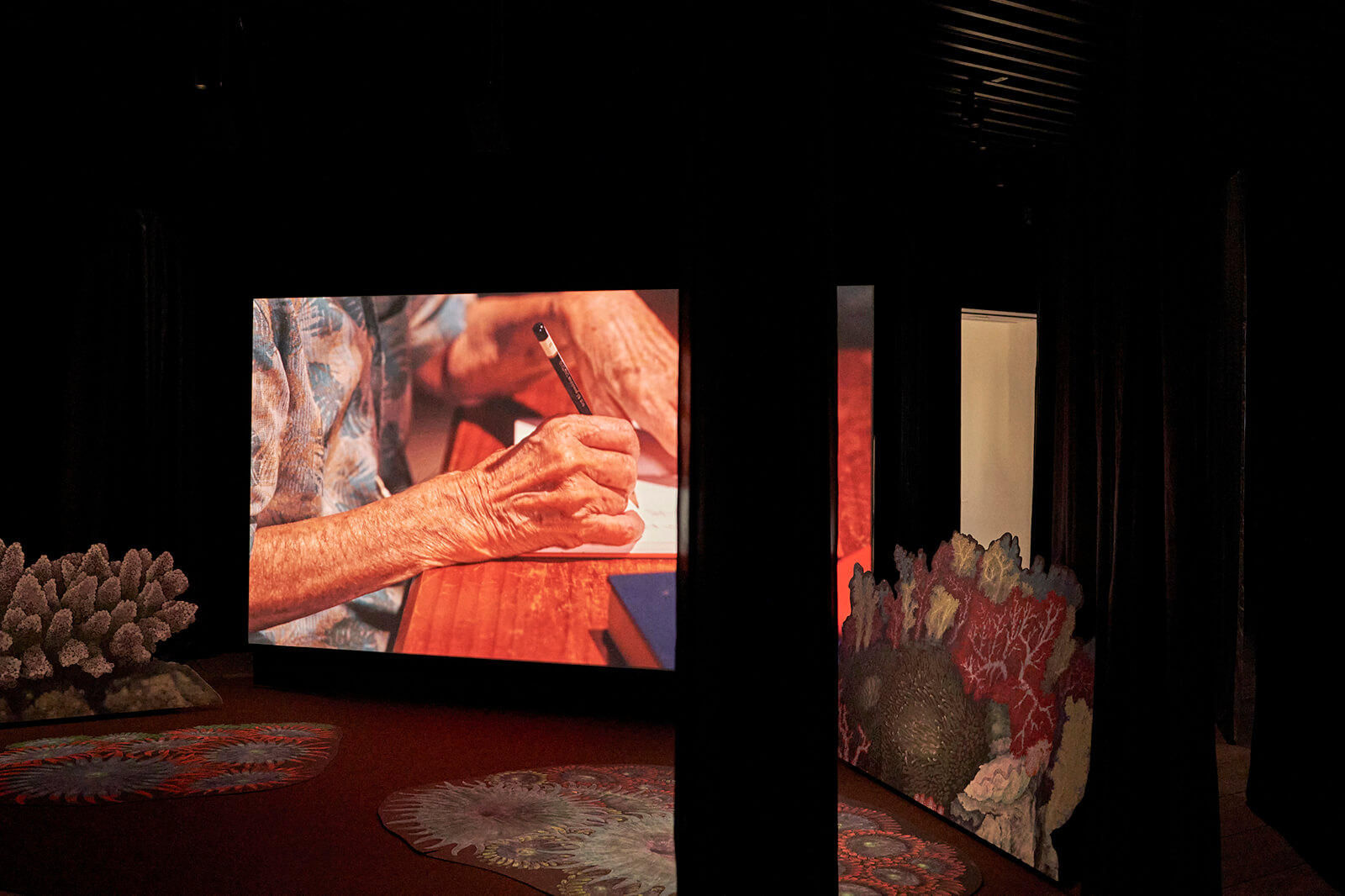
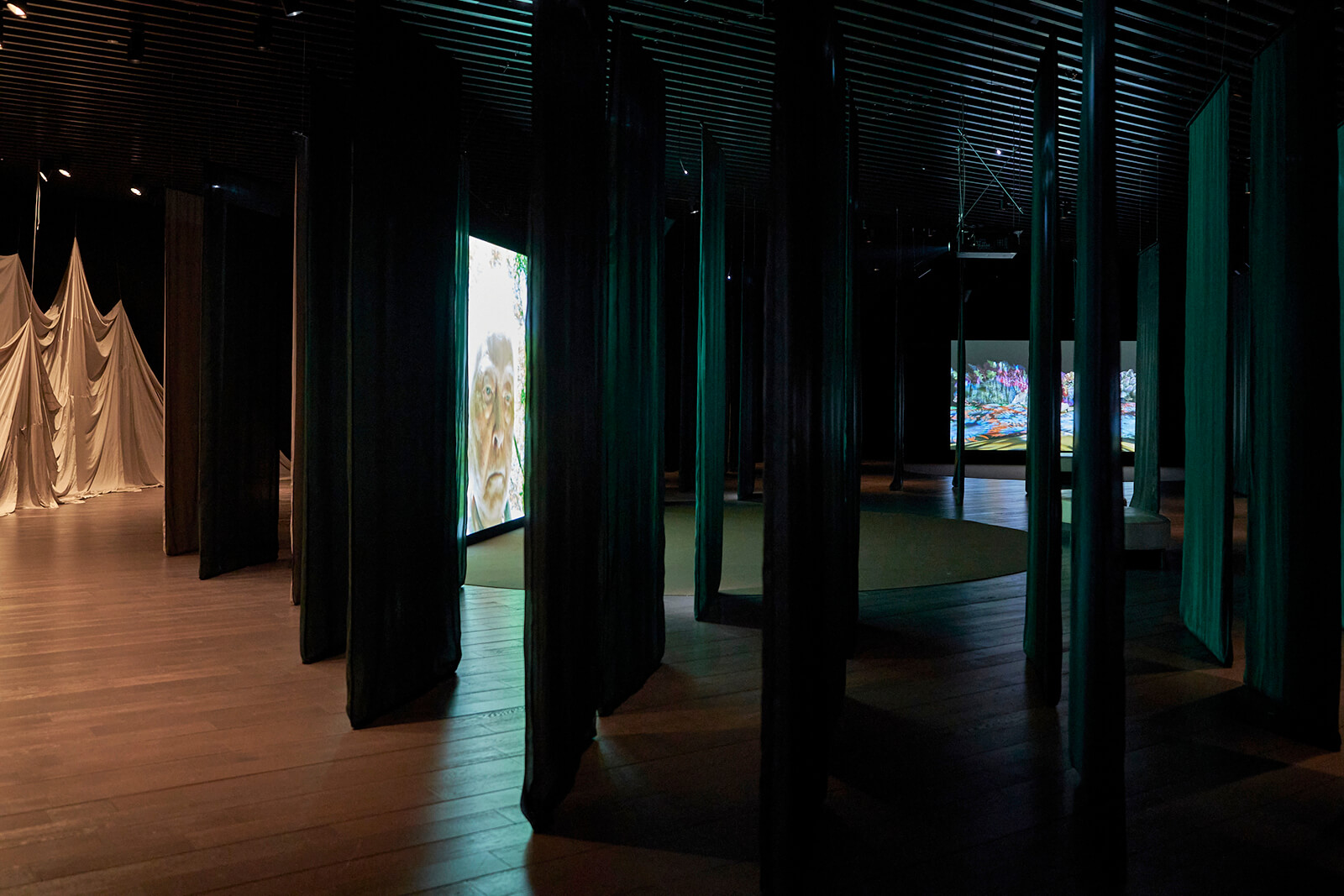
To produce Recalling(s), Yamashiro returned to Palau with her father, hoping to locate the landmarks of his childhood. Her camera follows the old man as he walks along forest paths, looks up at the sky, points at a bird or a rock, all in a doomed attempt at return. Overlaid with this journey, a constellation of other recollections: on one screen, a woman recounting her experiences in the firebombing of Tokyo, on another, a jazz rendition of Danny Boy, historically performed at U.S. bases, on a third, an Okinawan song about the aftermath of war. The work’s sonic density was augmented by its scenography – a forest of textile hangings producing atmospheric pathways between audiovisual works and worlds. While four of the six videos were synchronised, no viewing order was prescribed, so that the visitor had to literally drift from one to another, grasping fragments of an emerging narrative but never fully in possession of it.
Where Yamashiro’s work operated through sonic fullness, Shiga’s, staged in a gallery space one storey down, functioned through visual density. Titled Nanumokanumo (2025), the installation was developed over three years of field research in the Tohoku region, which was profoundly impacted by the Great East Japan Earthquake and subsequent nuclear accident. Informed by personal accounts of people recovering from the disaster, Shiga’s work addresses regional disparities and the violence inherent to the nuclear industry. Nanumokanumo is a regional phrase that can be translated as ‘anything and everything’, lending itself to a range of interpretations, from resignation to affirmation. First coming across the phrase on the windshield of a passing truck, Shiga used it as an entry point into the harsh realities of the region’s transportation industry. Her work at Artizon mapped this landscape through eerie visual and narrative encounters, assembling photographs and text into what the exhibition literature described as a monumental tarpaulin ‘scroll’.
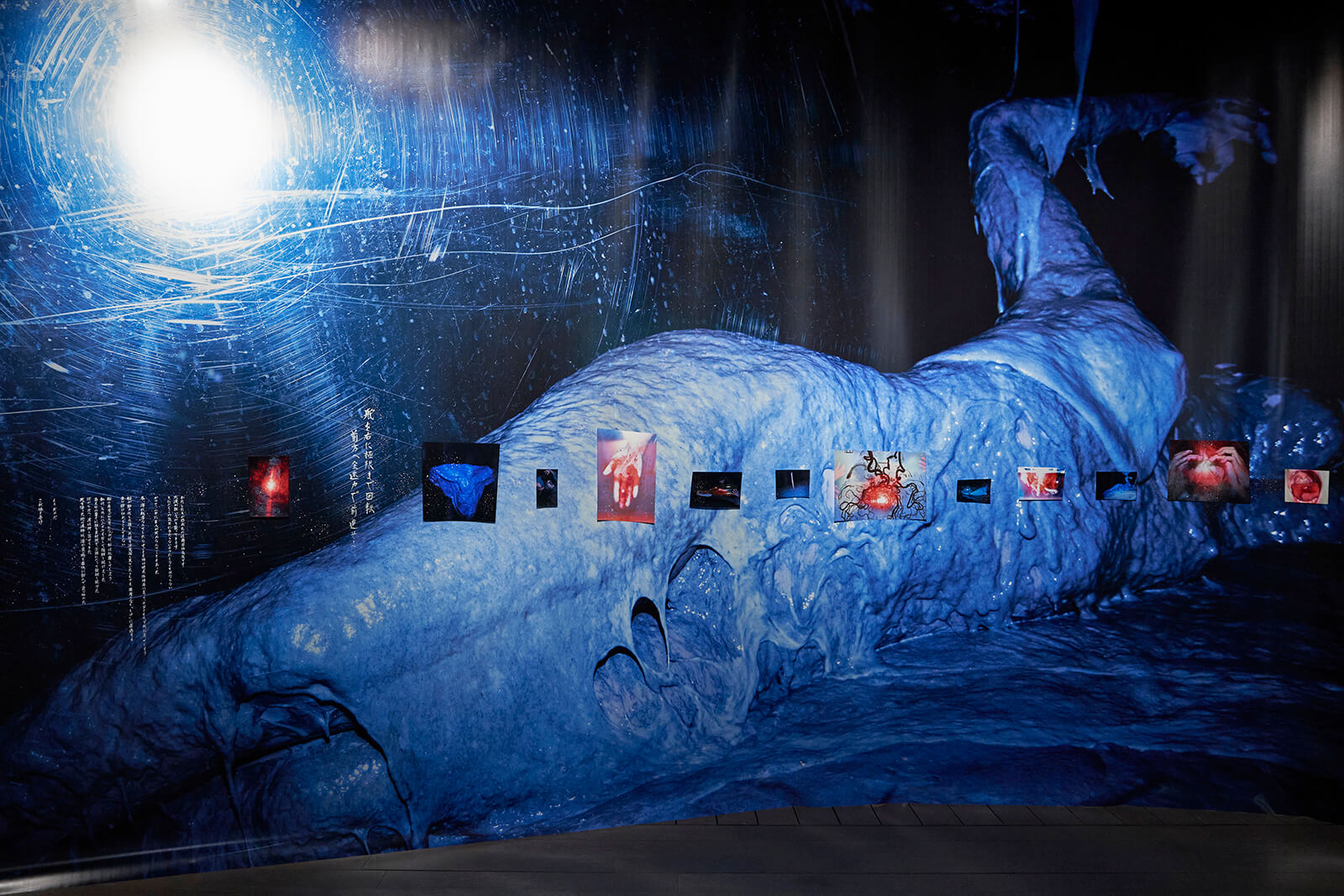
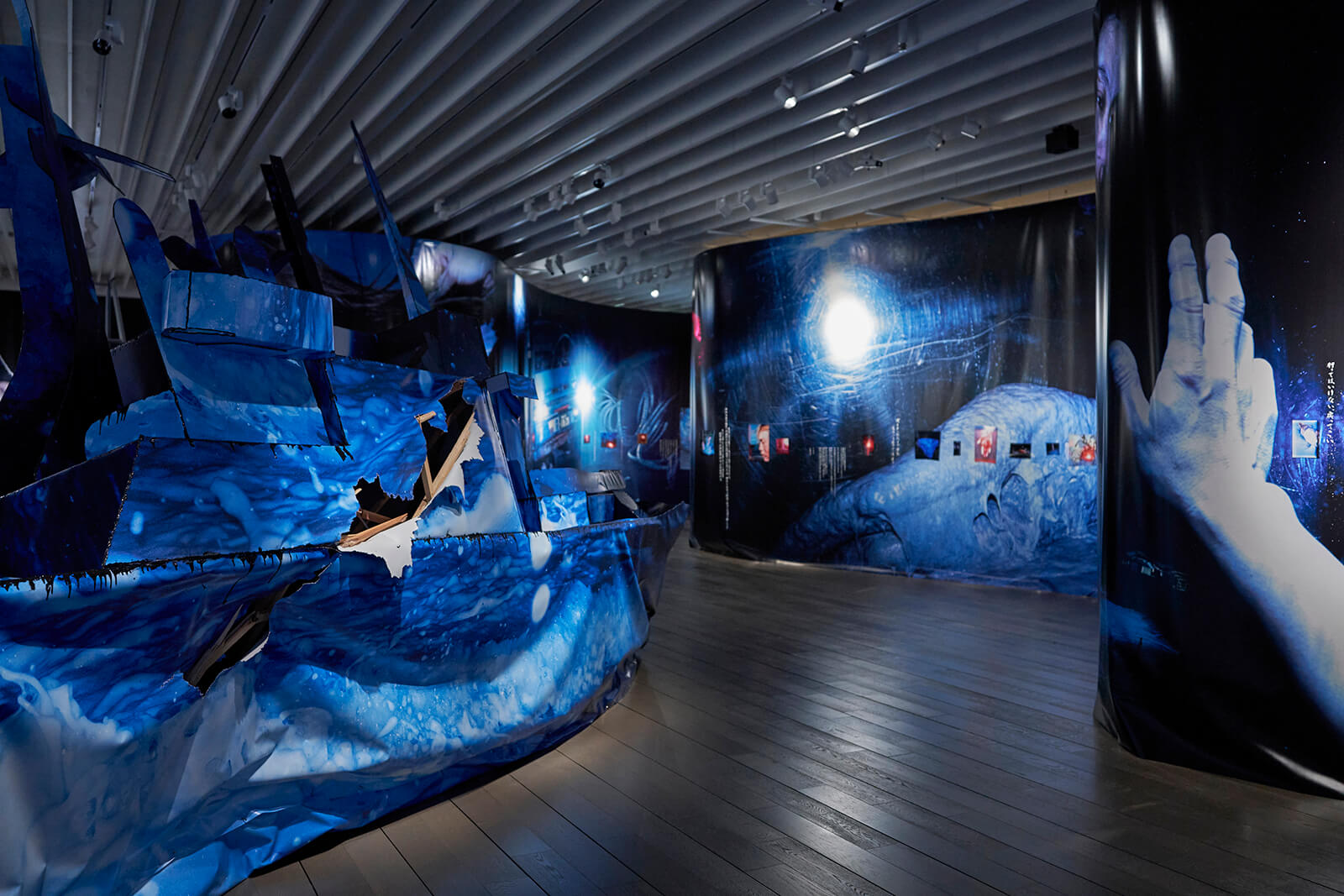
In grappling with the region’s long histories of suffering, in this and other works, Shiga’s primary tool is fiction. Nanumokanumo is driven by a sweeping, trans-historical narrative centred on a fisherman called Enao. Named after ena-garami, which evokes umbilical entanglement, Shiga’s character bridges past and future to reveal the continuities between moments of historical violence. Drifting between the real and the imagined, Enao’s first-person narrative positions him as both individual fisherman and omniscient witness to historical events: the 1954 Bikini Atoll bombings by U.S. forces, the 1974 radiation leak from the nuclear ship Mutsu, the naval warfare of 1945. At Artizon, this narrative was inscribed directly onto a photographic backdrop of haunting images: whale innards, fishing lines, bodies encased in mud. In one, particularly unsettling, set of images, two bodies running towards oncoming headlights, another two draped over train tracks, dead or asleep. In another, crude facsimiles of guns: a finger held to a bare back, an umbrella gripped like a rifle. Filling the space, a chorus of croaking frogs, at its entrance, a tarpaulin model of the Mutsu, its sides marked by gashes. With Nanumokanumo, Shiga offered a fractured portrait of the lands and lives that history has failed, both a record and an indictment of the nuclear project.
While distinct in their contextual frames, the project of both works was that of narrative immersion. Yamashiro and Shiga’s granular explorations demanded time, attention and care, a curatorial frame that made room for the discordant and particular. By refusing easy parallels between them, In the midst of provided this. Sitting alongside the two commissions, works from the Ishibashi Foundation Collection served as quiet complements: Ginger Riley Munduwalawala’s The Four Archers (1994) speaking to Yamashiro’s concern with communal history, Henry Moore’s Head of Prometheus (1949) reflecting Shiga’s critiques of scientific triumphalism.
The improvisatory logic of a ‘jam session’, reflected in these varied encounters, enabled a generous negotiation with history – across divides of centre and periphery and through the hands and eyes of multiple generations. At a time of uncertainty, both imaginative and geopolitical, it was a reminder of what it might look like to speak of site and moment with honesty. In place of fixed coordinates, flux. In place of legibility, dissonance. If the job of a collecting institution is stewardship, perhaps its work, today, must also encompass movement: between past and present, collection and commission, narrative opening and inevitable return.
‘In the midst of’ was on view from October 11, 2025 – January 12, 2026, at the Artizon Museum, Tokyo.
The views and opinions expressed here are those of the author(s) and do not necessarily reflect the official position of STIR or its editors.
by Anmol Ahuja Oct 15, 2026
How do heaps of souvenirs and relics with racist Aboriginal motifs and features become art? MCA Sydney’s winter showcase—the artist’s largest to date—beckons a possibility.
by Vandana Kalra Oct 14, 2026
With his latest exhibition as a point of departure, the modernist discusses his decades-long practice, the spontaneity of drawing and the social responsibility of artists.
by Srishti Ojha Oct 14, 2026
The first Dutch publication on the Turkish artist, the eponymous book centres on Refik Anadol: Latent City, his living data sculpture of Bruges, exhibited at BRUSK gallery.
by Srishti Ojha Oct 09, 2026
In his ongoing exhibition, the South African artist creates two post-apocalyptic futures to explore society’s relationship with textiles, patterns and technology.

make your fridays matter with a well-read weekend
Enter your details to sign in
Don’t have an account?
Sign upOr you can sign in with
a single account for all
STIR platforms
All your bookmarks will be available across all your devices.
Stay STIRred
Already have an account?
Sign inOr you can sign up with
Verification link sent to check your inbox or spam folder to complete sign up process
Tap on things that interests you.
Select the Conversation Category you would like to watch
Please enter your details and click submit.
Enter the 6-digit code sent at


Being and becoming: Embracing in-betweenness in Artizon's In the midst of
by Avani Tandon Vieira | Published on : Feb 07, 2026


 Sign in with Google
 Sign in with email
What do you think?