Art08 mins. read
India Art Fair 2026 and more in Delhi: The STIR list of must-see exhibitions
by Srishti OjhaFeb 04, 2026



by Ranjana DavePublished on : Mar 20, 2026
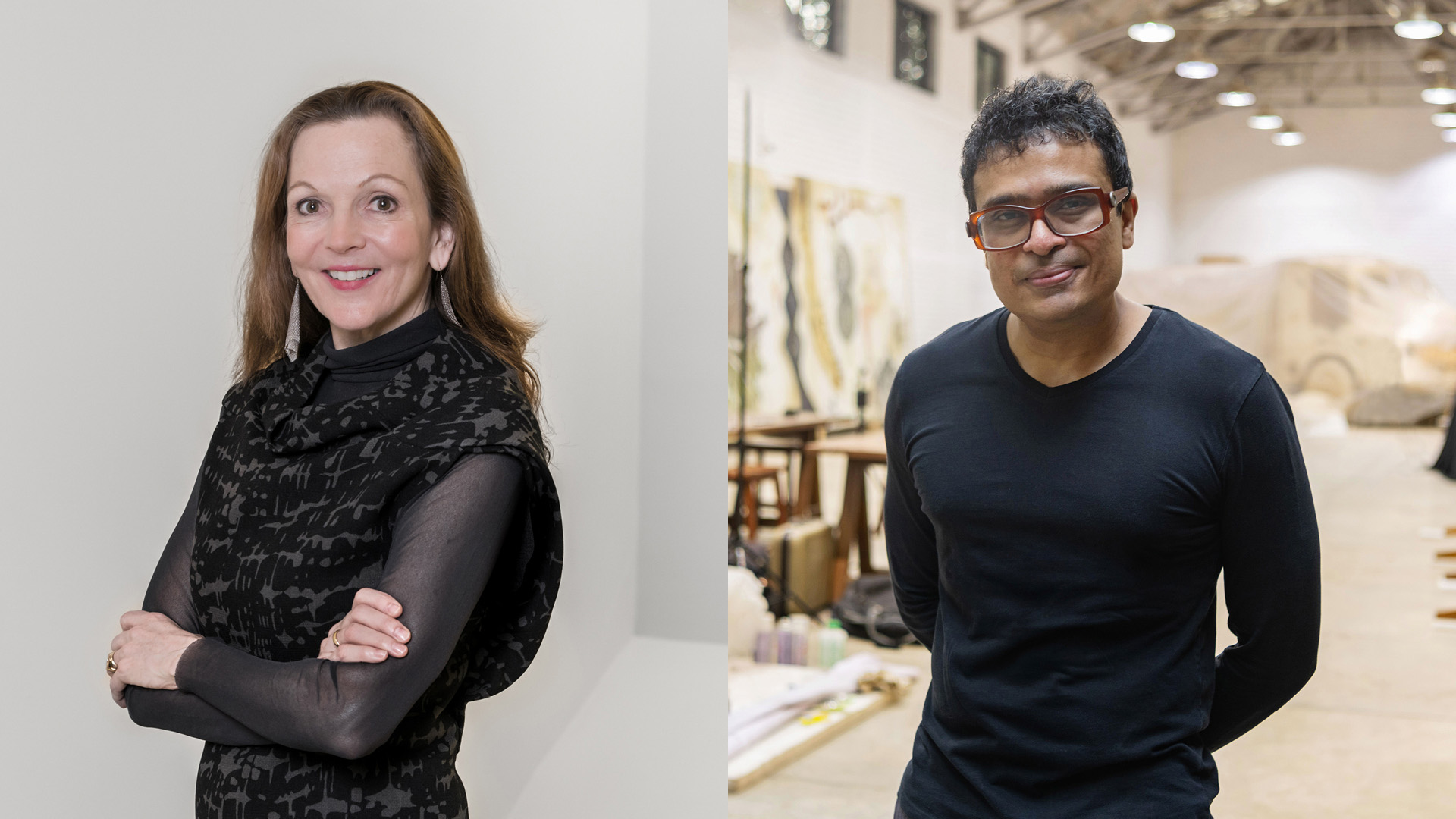
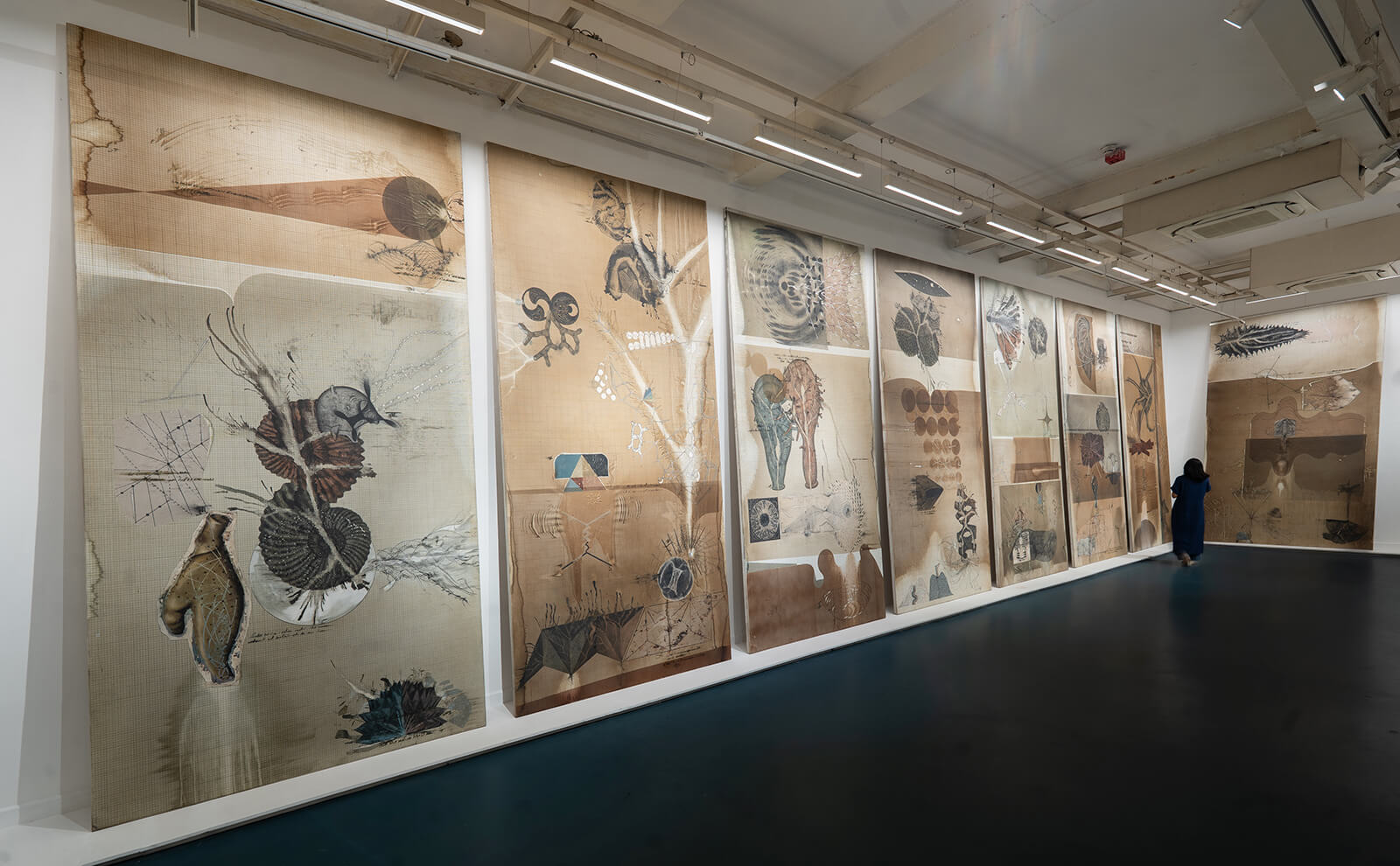
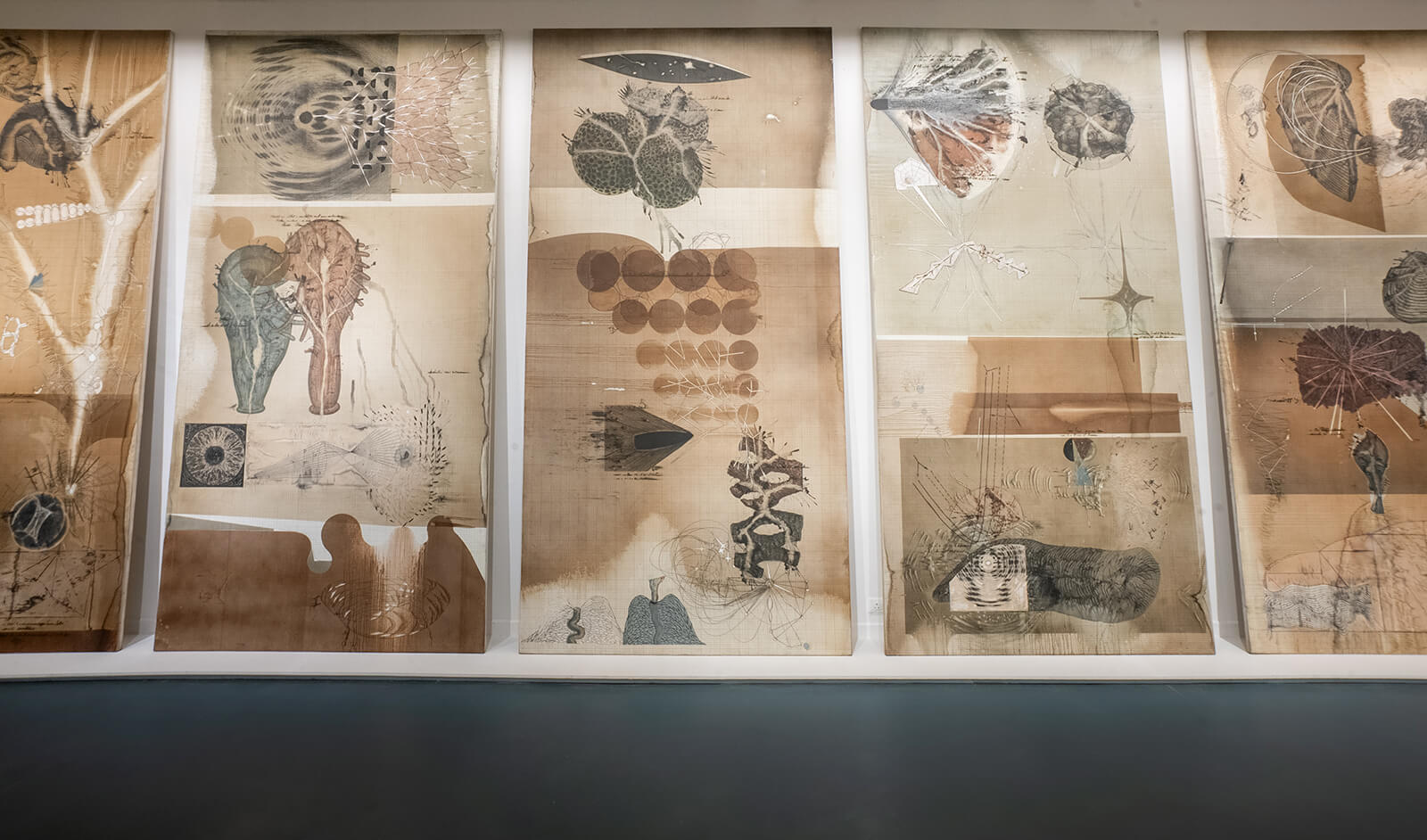
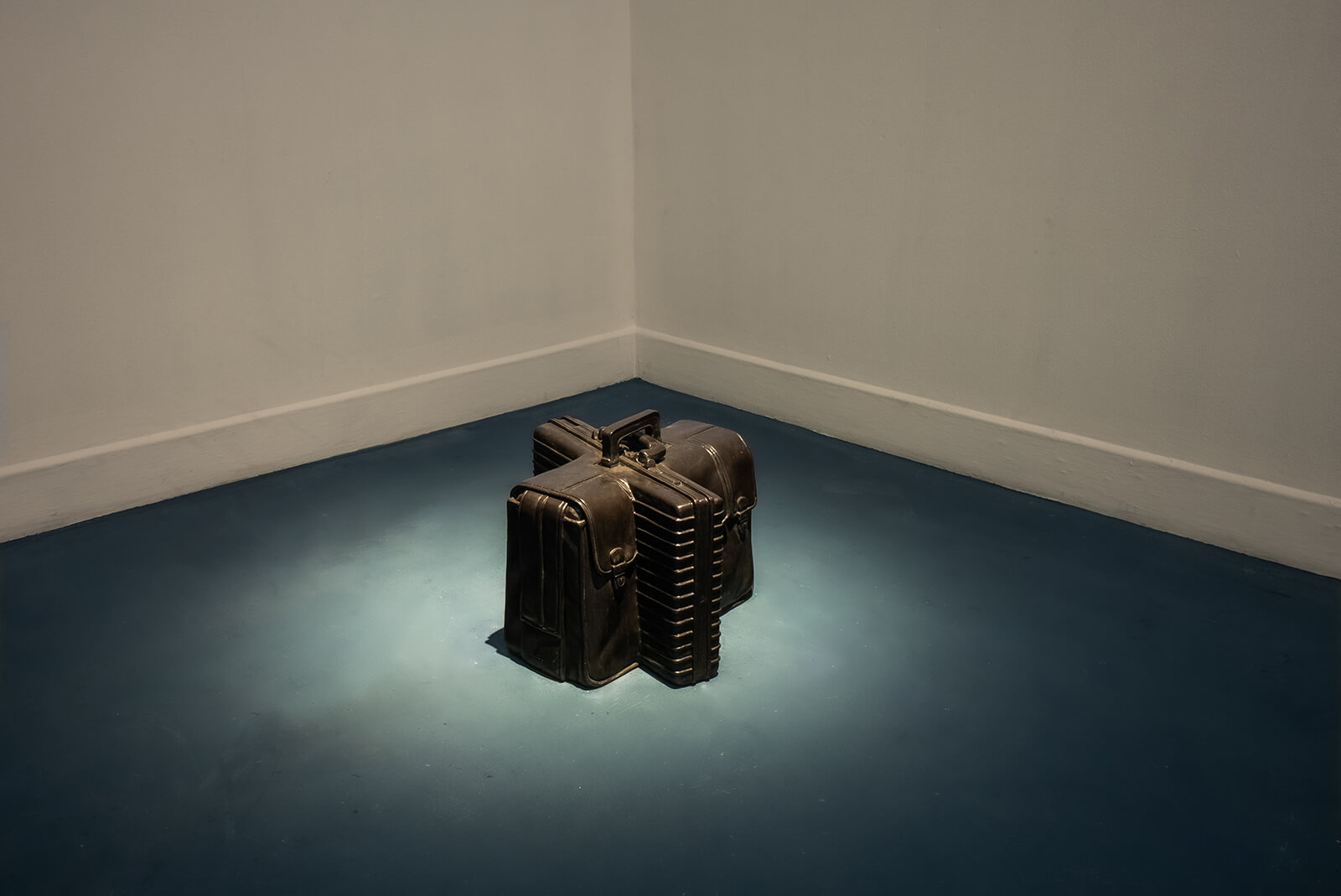
Jitish Kallat’s exhibition, Conjectures on a Paper Sky, was on view at the Centre for Contemporary Art, Bikaner House, New Delhi, in the early weeks of February 2026. Curated by Asia scholar Alexandra Munroe of the Solomon R. Guggenheim Museum, the exhibition weaves together the Voyager space missions, the nuclear anxieties of the Cold War and humanity’s long, unresolved desire to communicate across the unknown. Kallat and Munroe spoke with STIR about the generative process of artmaking, the challenge of staging expansive ideas in a particular building, and the question that runs through their entire enterprise—what language do you speak when communicating with beings you can’t comprehend and have never encountered? The interview has been lightly edited and condensed for clarity.
Ranjana Dave: I've been reading Secondhand Time: The Last of the Soviets by Svetlana Alexievich. I was in Kazakhstan recently, and that sparked an interest in understanding this region that's very close to India, but also very different. How they see themselves culturally—even as a visitor, you see evidence of a Soviet past, and that past is, in a way, unspoken. What about that moment—the Cold War, the space race—interests you?
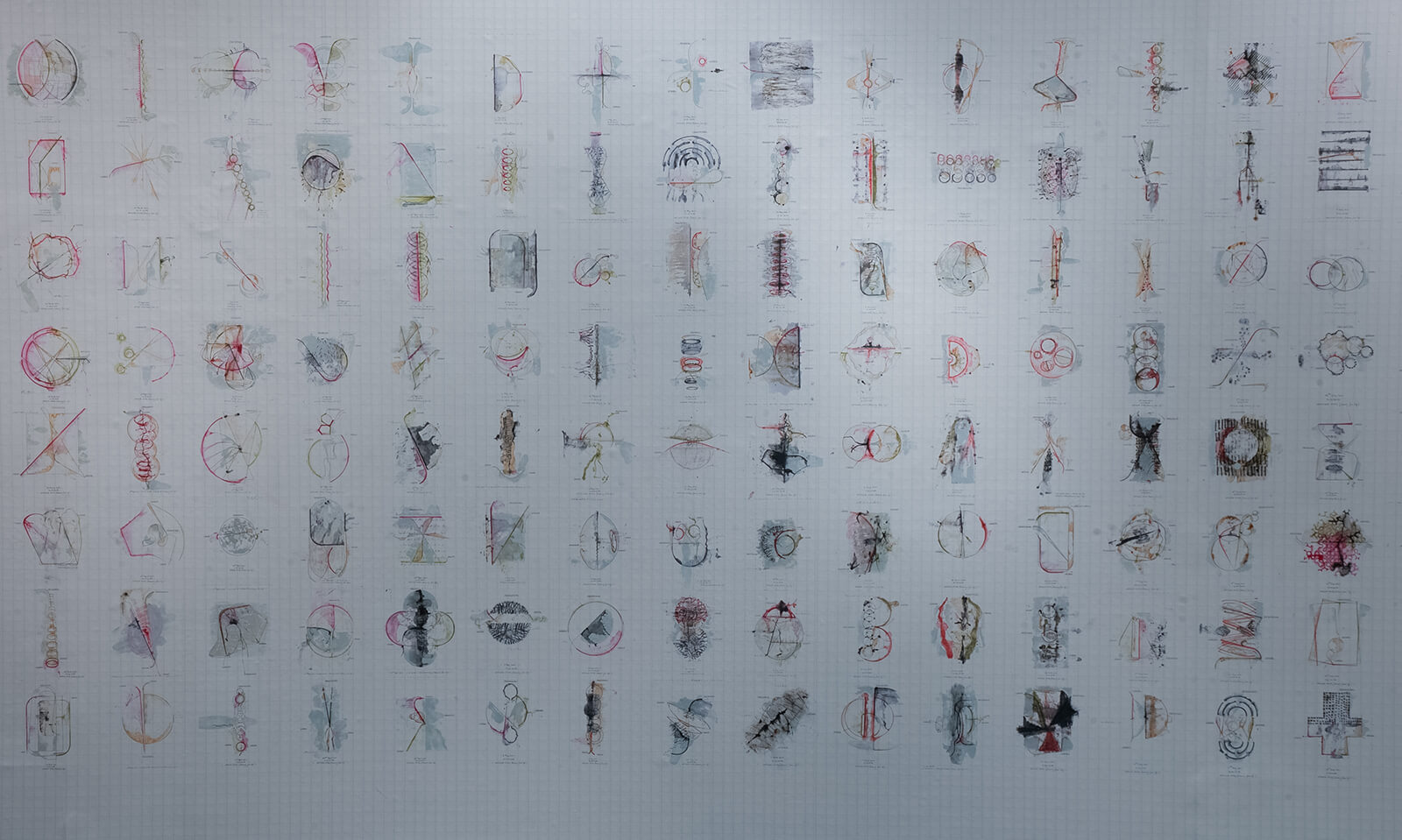
Jitish Kallat: Often, one artwork handholds you to the next, and you only realise what happened when you finally arrive there—how you were relayed like a baton from one to the other. This work, Conjectures on a Paper Sky, comes out of a previous work referencing a large corpus of images that left planet Earth in 1977 on the Voyager 1 and 2 space missions. Those missions carry images drawn from The Family of Man, the 1955 MoMA exhibition made up of photographs from 68 countries—possibly one of the most viewed exhibitions in the scope of its global tour. It is a snapshot of humanity from a particular moment gone by. I was encountering it within the solitude of the studio in the midst of the pandemic, entering it through the figure of bodies that existed a few decades before us. It documents an arc of human life from different parts of the world, putting the human at the centre.
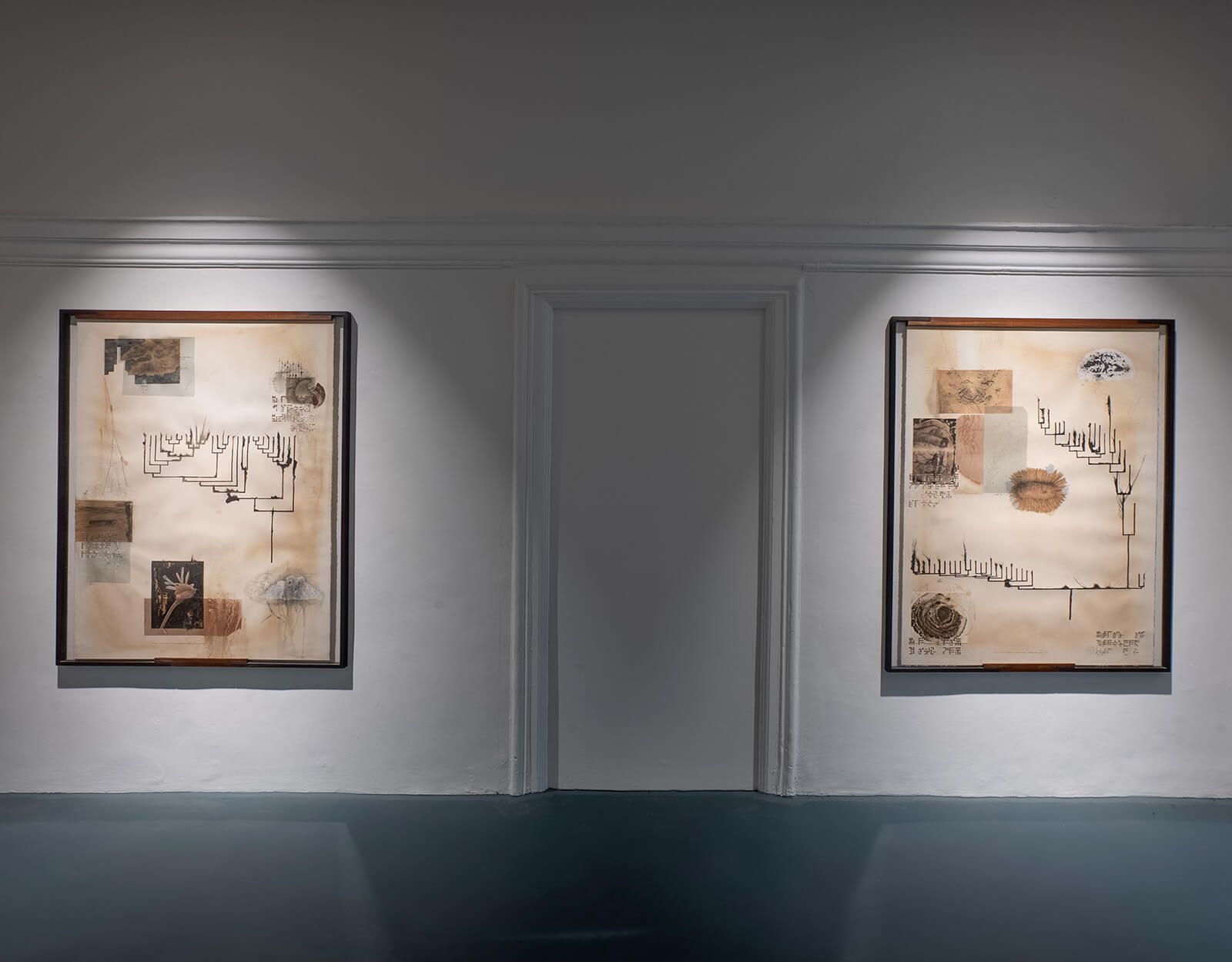
…In this case, The Family of Man took me to another document from the same period—the mid-1950s, specifically the US Air Force's effort to drop a nuclear bomb on the moon. That brought together a rich site for thinking about our current world. The alignments and misalignments of our present world have some of their roots there.
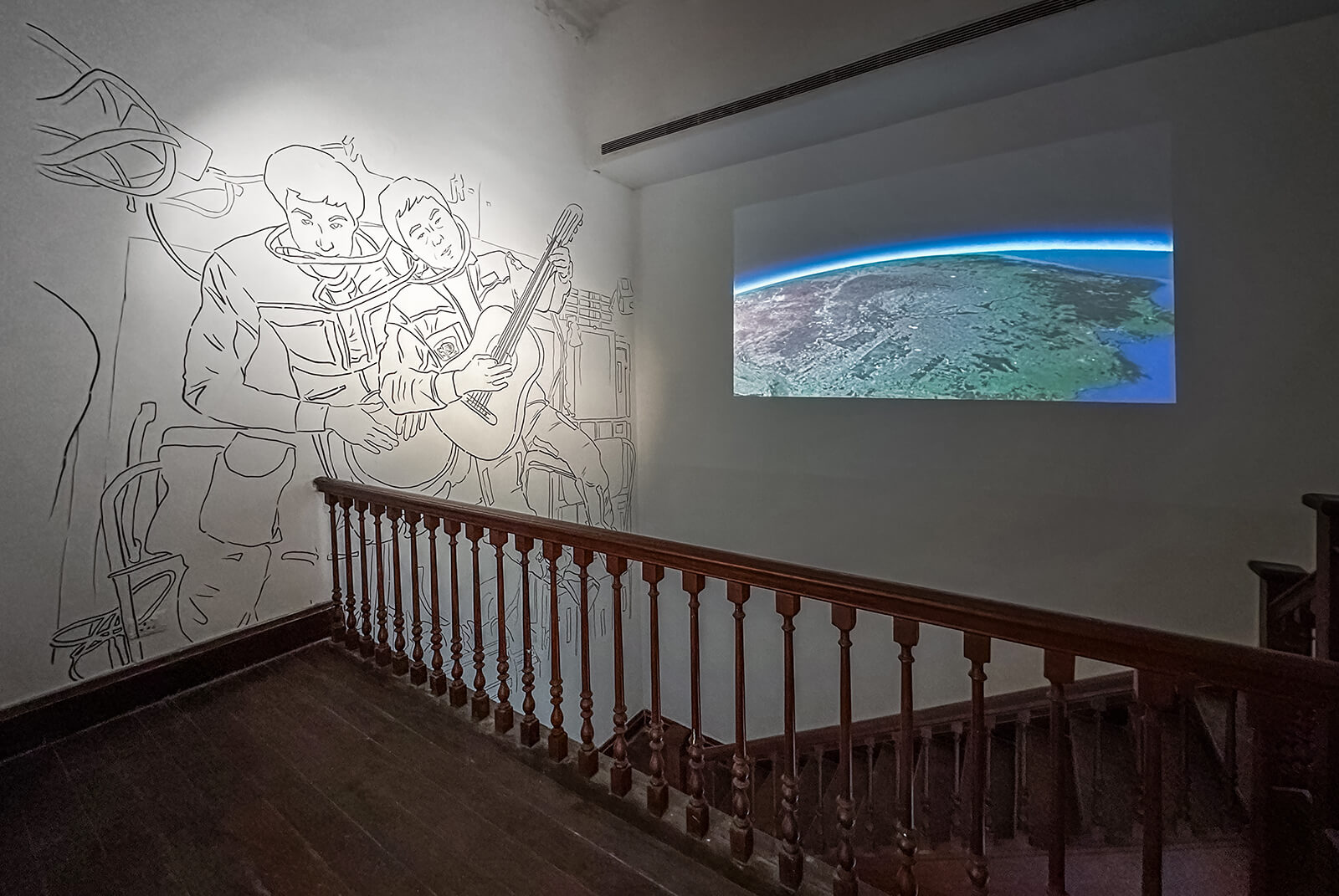
As an extension of that project, we wound up at Pushkin House in London, where Alexandra [Munroe] and I thought we could stage the work within the staircase. There's a conduit that connects the reflections on the lower floor to the far more complex political dimensions of the upper floor. These two allegorical figures, stateless in orbit, became a passage between them.
Alexandra Munroe: Most of my curatorial work and scholarship has been on what we've traditionally called the post-war period, primarily in Japan—the way World War II affected histories, the avant-garde, the political revolutions within East Asia, all directly linked to 1945. It's far less [definitive] in South Asia. The Partition is consequential. Liberation from the British Raj is hugely consequential. But I don't think we use the word ‘post-war’ in South Asia the way it is absolutely defining in Europe, East Asia, Japan, Korea and China. Within that post-war period, I've recognised that people are now refocusing on the Cold War. Everything we understand about the longer post-war period is completely defined by it—political, militaristic, technological, cultural, propagandistic and occasionally diplomatic competition. The space race has become the real locus of examination of all of that: what the political circumstances were, what the catastrophic potential was, because technology becomes so tied to militaristic dominance, and militaristic dominance to the space race and the domination of celestial bodies.
As AI is today. I think there is far less interest in the space race right now—it is dwarfed by AI, because AI holds the same potential for weaponisation. …In fifteen years, there will be an entirely different form of weapon, and we do not want to be second in finding out what that is. That is exactly the way people were thinking in the 1950s [during the space race]. It was quasi-scientific, just as AI is quasi-scientific. It has commercial and medical applications, but it is [fundamentally] driven by military ambition.
All these ‘Venn diagrams’ remind us that Jitish’s work is constantly recurring within the terrestrial and the celestial, the geopolitical and the cosmic and the human and possibly the extraterrestrial. So the space race is not a surprising place for this investigation to land. …It is art that, by looking back, helps us understand the perils of where we are today. Not in a reprimanding way, not telling us what to do or what to think, but reminding us of the perils we have narrowly missed in the past.
Ranjana: There was always, with the Voyager capsule, the possibility of an encounter. I remember that for decades newspapers made a great deal of Kesarbai Kerkar's recording being on the Voyager—this possibility that music from somewhere on Earth might be discovered across the galaxy…
Jitish: If they have ears!
Alexandra: They definitely have ears. Sound is too fundamental.
Ranjana: Is that of interest to you?
Jitish: Also, if sound travels in the vacuum of interstellar space. There are many ‘ifs’, and they are what is beautiful. Every counterintuitive ‘if’ has been mitigated. For instance, the struggle to find a language. If you look at the cover of the Golden Record, the return address was made using mathematics, which was thought to be fundamental—there are numerical elements throughout. But then, how would an alien know the number two? There is a beauty in this need to find language across a vast aisle of impossibility between this interlocution. And yet a language of sorts does exist. These images were uploaded as sound files because, in 1977, they couldn't store that many images on a disc—they were encrypted as sound disturbance. Based on the code on the disc, an alien who decoded it would find images. A California-based programme named Ron Barry later decoded that sound, and hence these images in my work are bleached of colour. This abstraction in my work is a result of the return journey of the image.
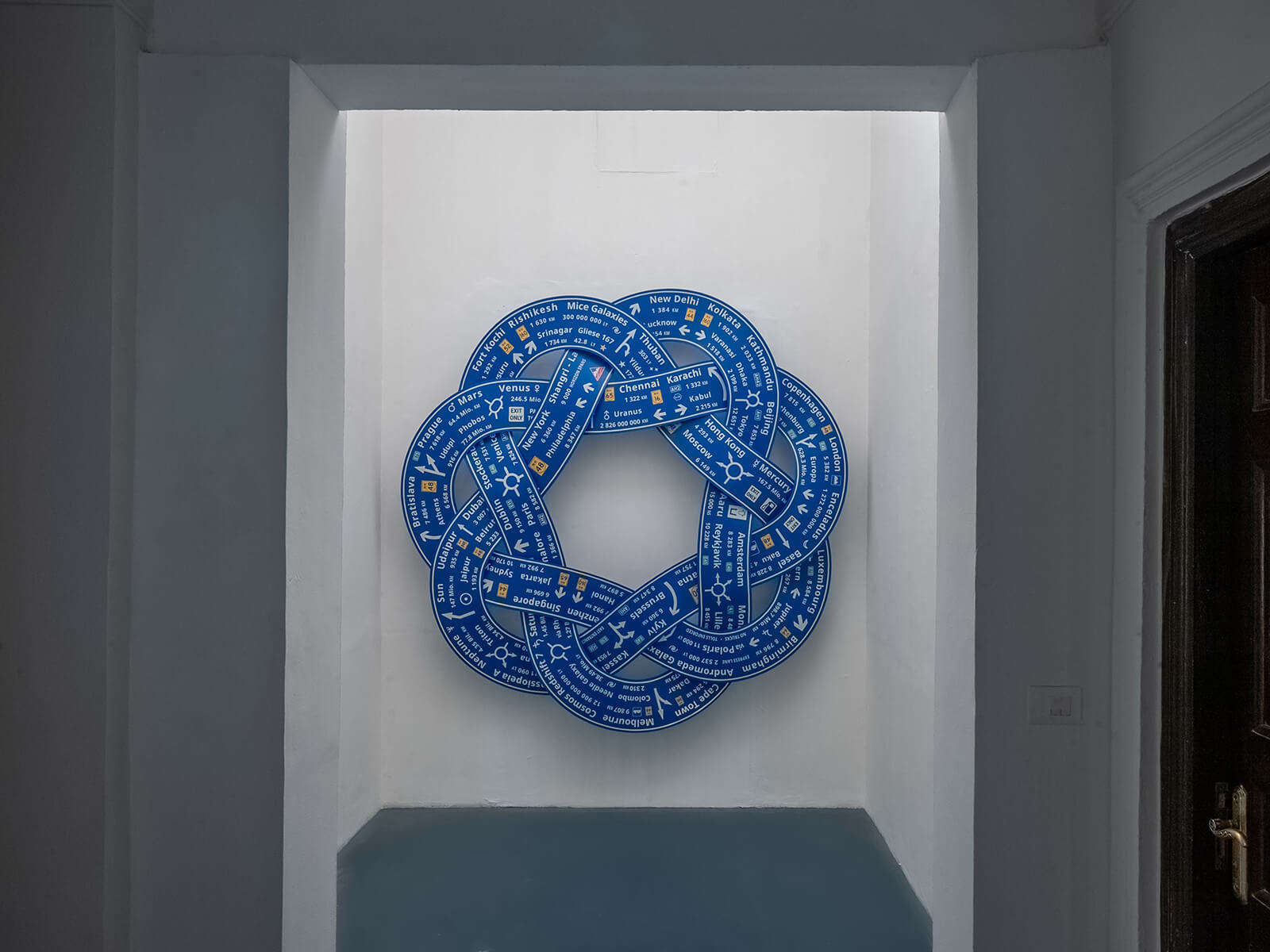
I have been very interested in this need to find language across this vast aisle of difference, where the other is unknown in space, time, constitution, instruments of cognition. Whether they would never know that the human is the sender and not the reptile. A crocodile could look like the more intelligent species, with four good limbs—the human doesn't look that good [in comparison]. Interstellar communication is far more interesting to me as a reflection on our need to communicate and our need for vocabulary, in a world where the known other seems unknowable and existing language seems unusable, because that vocabulary is now loaded with preconceived meta-vocabularies.
Alexandra: What strikes me about what Jitish is saying, and what is a real theme of this exhibition, is these shifting scales and the fragility, contingency and precarity of knowledge. Whose knowledge? How knowledge is defined by our position—our position in time and space, our location, identity, nationality, the language we use and the language we cannot use.
One of the themes that recurs in this exhibition is that interest in communication alongside the impossibility of communication…What is science but a pursuit to communicate with nature, with the stars, to understand? The more we understand, the more we think we can communicate. But…it is insatiable and unstable, because what we know is always changing—what we thought we knew. To embrace that as a constant is very fundamental. That is what makes Jitish's work very philosophical and metaphysical, on his own terms. He is not following any school.
But of course, some of these ideas about the instability of knowledge are decolonial. He was raised at a time when those assumptions were already being profoundly questioned. From a position in South Asia, I find it interesting that as a citizen navigating this period of the non-aligned world—the USSR and the US are the two protagonists of the Cold War—but they don't feel charged in his work. He's not projecting any kind of political accountability onto either of those national entities.
Ranjana: In school, we were taught that India didn't have a position in relation to the USSR or the USA. Alexandra, you’ve often worked with art histories outside of the Western canon, but often within Western institutions. What does that look like, and is there a sense of responsibility that comes with it?
Alexandra: Most of my work has been dedicated to expanding art histories and institutional parameters in the West as regards their definitions and accommodations for art from outside the Eurocentric modernist canon. ...But it has also been very important to me, when I’ve had the opportunity, to stage exhibitions in the region itself. My first big show, Japanese Art After 1945, was organised by and opened at the Yokohama Museum of Art, and it completely changed the art history of the post-war Japanese avant-garde, even though I was in my thirties and an American woman. It was something that no Japanese [curator] at that time would have attempted. My naivete helped. In that case, it was because the art world there was very regional…the Kansai world and the Tokyo world had very different visions of what the post-war avant-garde was. Even in the late eighties and early nineties, [there] was no academic field of art history for post-war Japan, only critics writing about the artists in their own circle. Being oblivious to that, one could synthesise from a different perspective and plug that history into a wider global [narrative]...recognising that the experimentation happening in Gutai or Mono-ha was ahead of, not behind, their counterparts elsewhere.
I am very moved to be doing this exhibition here in Delhi. We think a lot about our public…I've also been working in Abu Dhabi for 20 years, imagining what the future museum will be, always thinking about how the stories we are making with our collection [will be read] for a regional population.
Ranjana: How did the two of you end up working together?
Jitish: It is a result of many years of friendship and conversation. Every time I've met Alexandra, I felt like the time [we had together] was too short. This is a way to extend that time, to intersect our intellectual biographies. Our conversations over the last year in Delhi have been invaluable.
Alexandra: I want to acknowledge my dear colleague Sandhini Poddar. I've been coming to India for many years, primarily focused on the great Buddhist, Hindu and Islamic sites…But it was really after joining the Guggenheim and founding and heading a South Asia initiative—my first hire was Sandhini…she is really the one who mapped for me the artists and the trajectory of relationships that has become the foundation for how I navigate India. Jitish was one of the first artists she introduced me to, and he became part of a conversation as we were building our programme in New York and Abu Dhabi. That was a foundational source of intelligence—because where do you start?
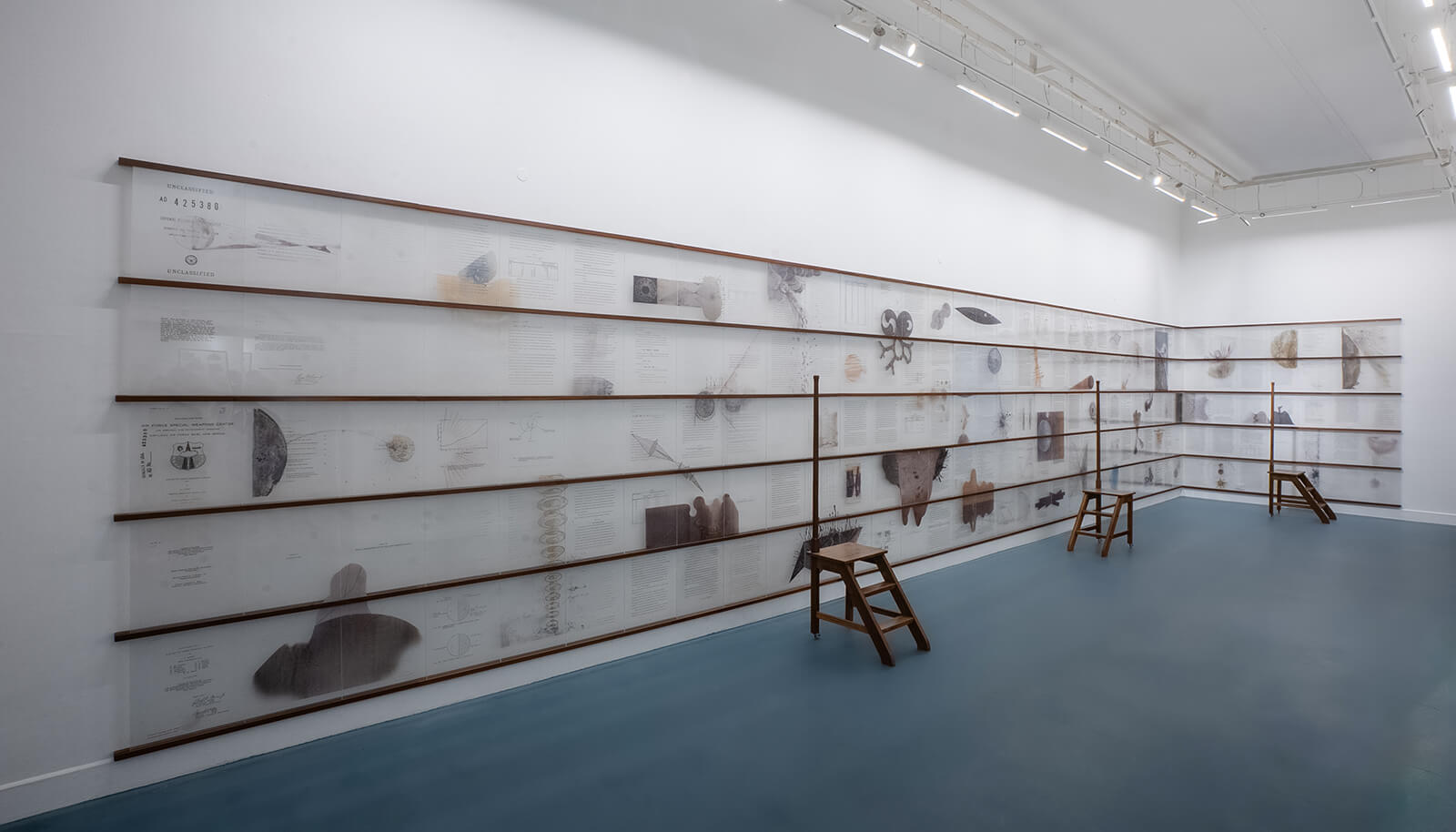
Ranjana: In terms of both your interests and your exhibition-making, Conjectures on a Paper Sky looks at very small movements in time and space and very large ones simultaneously. You've also had to think about what it looks like to bring it into a building where there is very little you can change. How do you think beyond a human scale, both in practice and in the making of an exhibition? How do you think beyond material constraints? When the ideas are this big, how do you fit them into real spaces?
Alexandra: I work at the Guggenheim Museum. The building is designed by Frank Lloyd Wright. It is unmovable. There are no walls. It is a ramp, a spiral. One learns very quickly that Frank Lloyd Wright is always my co-curator. Those curators and my shows that have fought that fundamental, irrevocable truth have failed. You have to take the conditions of the space and use them as meaning-making limits. You can't transcend the space. You have to occupy it. The space has to become a character within the journey of the exhibition.
I was very excited to work in this space (the Centre for Contemporary Art at Bikaner House). But I felt we had to accept the character and layout as our meaning-making form. And then within that, your language can begin to make sense. The I Ching has a very famous image of a pond. The pond is very limited in its contours, but it is very deep. Within that limitation…a great deal can happen in that strange shape. I feel this is a perfect pond for us to make very deep meaning.
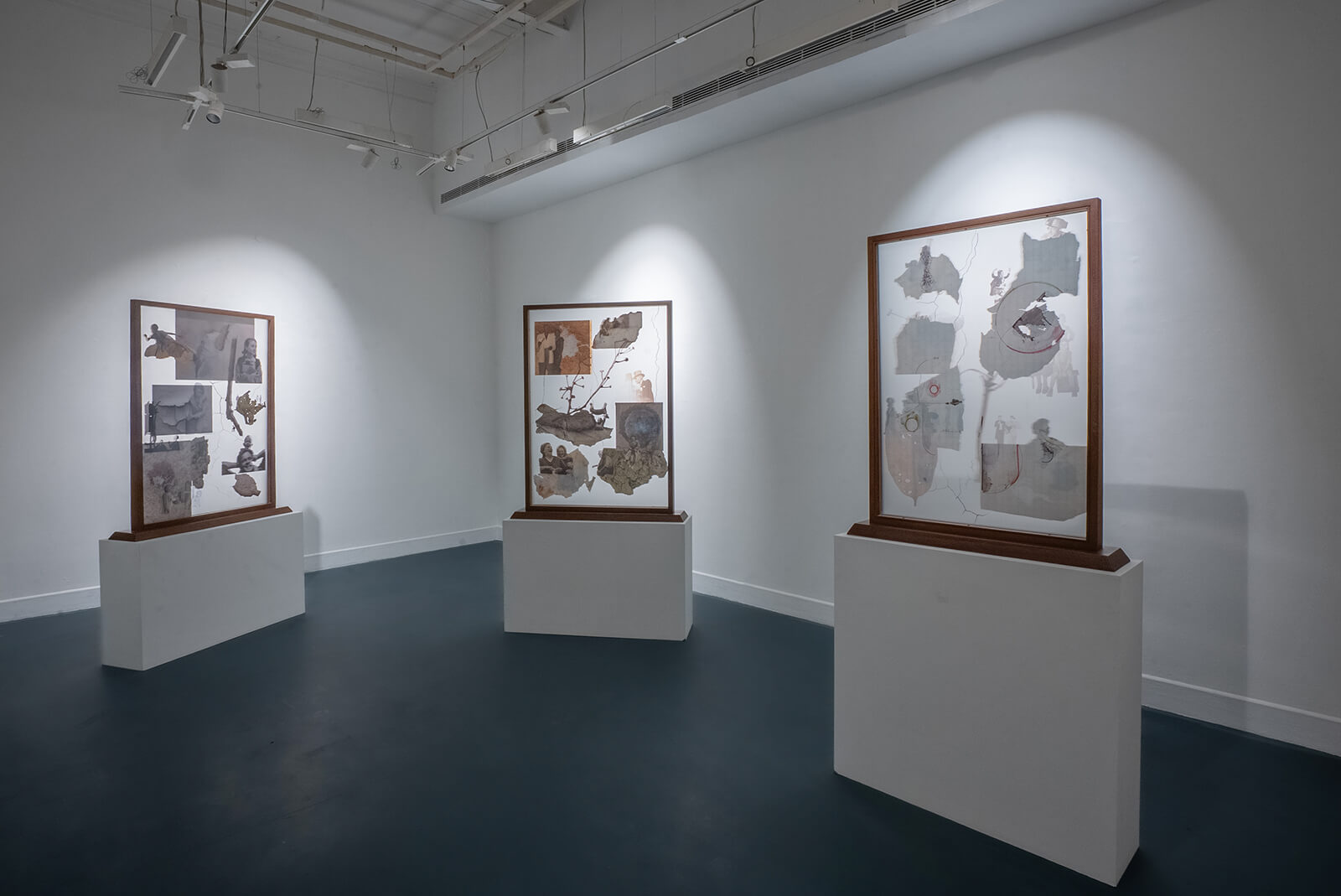
Jitish:There's often such a short turnaround time [between exhibitions] that the building is constantly being pushed. I really appreciate Alexandra's ‘wabi-sabi’ embrace of all the inconsistencies. I've enjoyed the spirit with which she hasn't pushed the building but nudged it here and there.
Alexandra: It is a small show. The ideas are very big. …But within the fractal structure of this building, our argument is crystalline. You couldn't change one angle, one molecule of this show. It really locked in once it was in space. You can't move one thing without the whole show falling apart. In the many shows I've curated, I don't think I've felt a show as well-argued. It's very tensile—not rigid, but very set.
‘Jitish Kallat: Conjectures On A Paper Sky’ was on view from February 4 – 10, 2026, at Bikaner House, New Delhi.
by Srishti Ojha Oct 21, 2026
Increasingly, artists, filmmakers and activists are turning to VR to create more personal, tangible accounts of the climate emergency and its impact on vulnerable communities.
by Mirra Lynn Oct 20, 2026
The Indian artist paints the old wadas of central Pune, capturing the traces of everyday life that cling to these structures, battered by time but unbowed.
by Anmol Ahuja Oct 15, 2026
How do heaps of souvenirs and relics with racist Aboriginal motifs and features become art? MCA Sydney’s winter showcase—the artist’s largest to date—beckons a possibility.
by Vandana Kalra Oct 14, 2026
With his latest exhibition as a point of departure, the modernist discusses his decades-long practice, the spontaneity of drawing and the social responsibility of artists.

make your fridays matter with a well-read weekend
Enter your details to sign in
Don’t have an account?
Sign upOr you can sign in with
a single account for all
STIR platforms
All your bookmarks will be available across all your devices.
Stay STIRred
Already have an account?
Sign inOr you can sign up with
Verification link sent to check your inbox or spam folder to complete sign up process
Tap on things that interests you.
Select the Conversation Category you would like to watch
Please enter your details and click submit.
Enter the 6-digit code sent at


Alexandra Munroe and Jitish Kallat on art, space and interstellar encounters
by Ranjana Dave | Published on : Mar 20, 2026


 Sign in with Google
 Sign in with email
What do you think?