Architecture07 mins. read
New Currents: probing collaborative oceanic futures with Nieuwe Instituut’s symposium
by Mrinmayee BhootOct 17, 2026



by Srishti OjhaPublished on : Nov 20, 2026
Nations in the Global South have long been associated with the past, the ancient, the ‘natural’ and the untouched. This is a rhetoric that discredits and conceals technological, agricultural and social technologies, knowledge and innovations in these regions. Futurity, development and progress are defined and imagined in Western terms, and then imposed on the Global South as colonial tools through science, popular culture, technology and fiction. To strip communities of an imagined future rooted in their own lived experience, Indigenous knowledge systems and culture is to strip them of sovereignty and power of self-determination. Imagining a future here is not a daydream with flying cars, solarpunk and space colonies, but a decolonial act of reclamation, a site for processing the injustices of the past and for locating emancipatory possibilities.
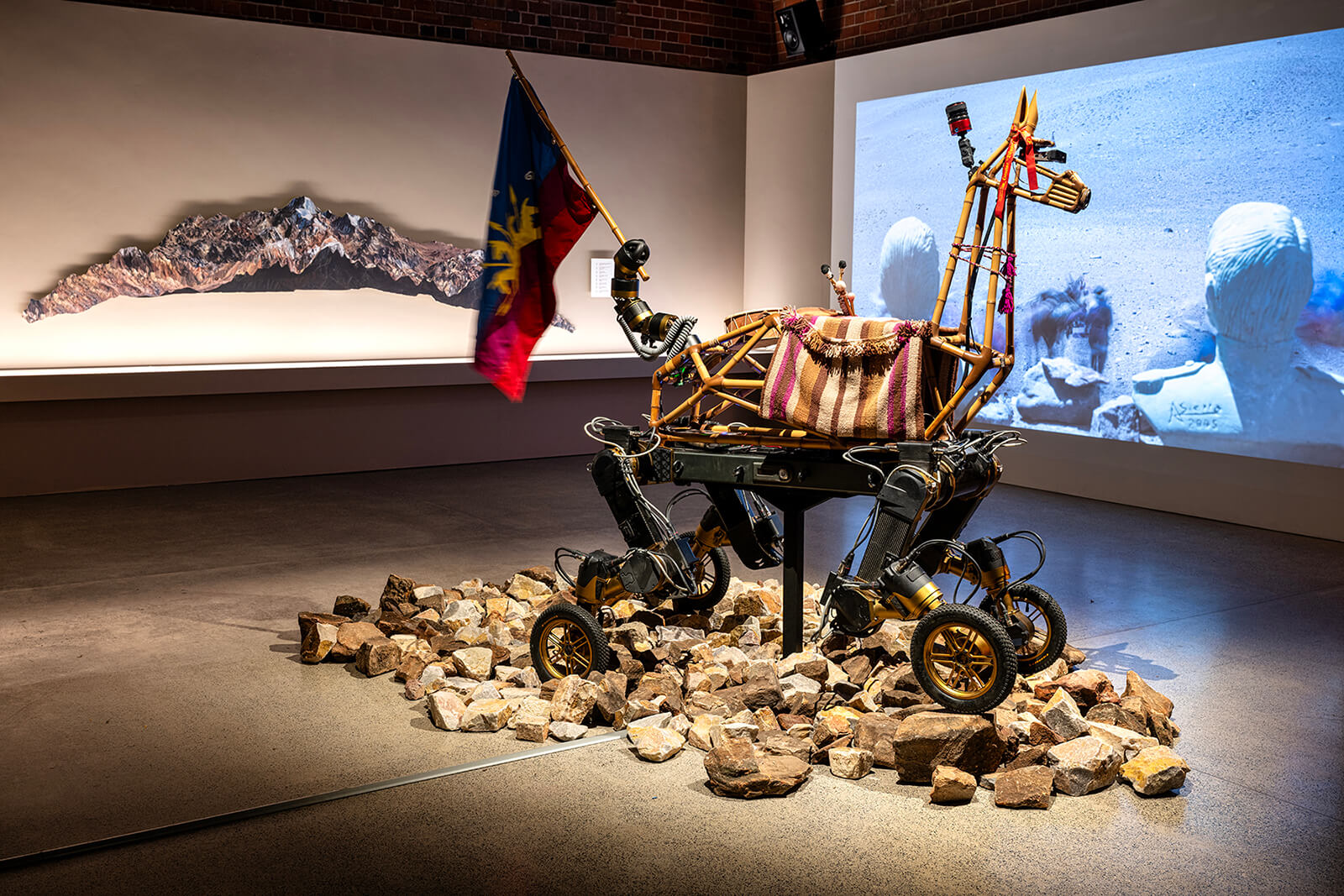
This desire forms the core of the group exhibition Reverse Futures at the Joburg Contemporary Art Foundation (JCAF) in Johannesburg, South Africa. The term ‘reverse’ here not only alludes to the subversion of mainstream future imaginaries but to the fact that any future of the Global South must address its past to eclipse it. Clive Kellner, executive director of JCAF, spoke to STIR about the exhibition’s concept, saying, “Reverse Futures is derived from Nairobi-based architectural studio Cave_bureau, which formulated the term to address the effects of colonialism in Africa and specifically Kenya. The Reverse Futures exhibition contrasts the ideas of an extractivist, exploitative and militaristic future with a world that learns from the Global South, engendering ideas of repair, community, regeneration and equity, by addressing the issues of the past to build a better future.”
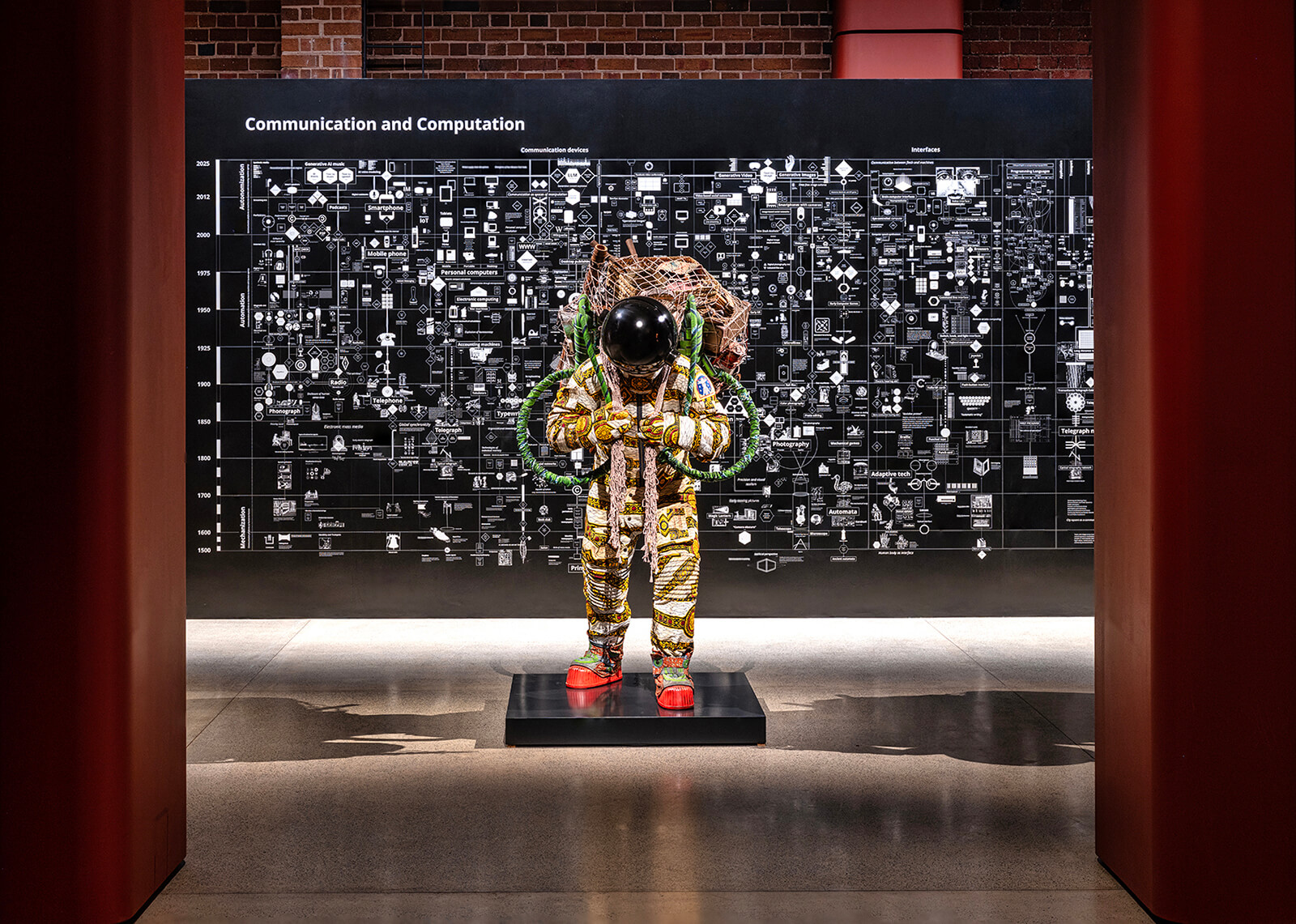
The exhibition is divided into three sections—Space, Time and Place. Before encountering them, visitors are confronted by the monumental data visualisation Calculating Empires (2023) created by researchers and new media artists Kate Crawford and Vladan Joler. The 24-metre-long installation uses the aesthetics of progress—blueprints, technological diagrams, motherboards—to map patterns of colonialism, militarisation and automation from 1500 to the present day. A kind of techno-futuristic tapestry, Calculating Empires lays bare the social, economic and global technologies and supply chains that have shaped the world we live in, structured on the hierarchy between empire and colony.
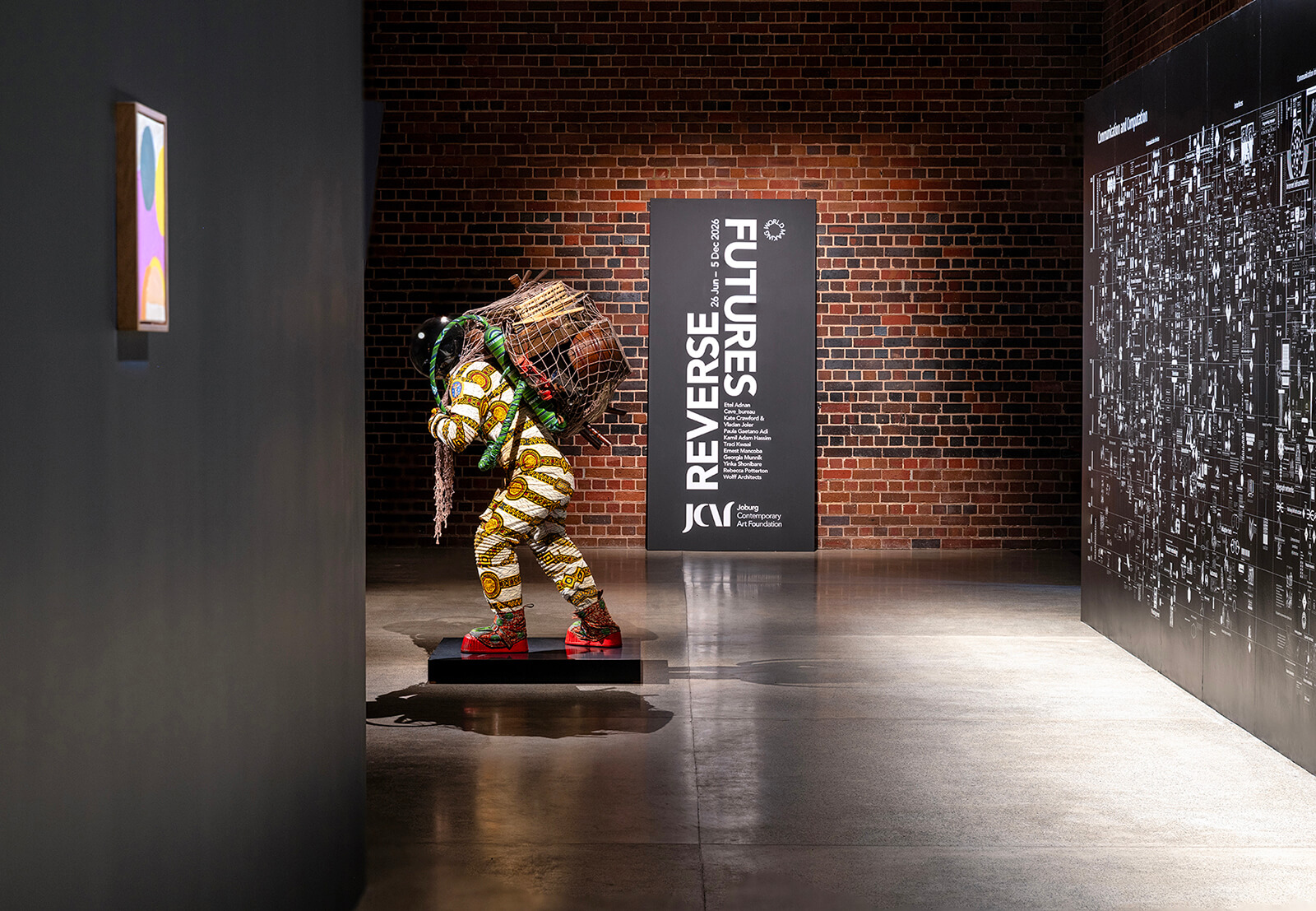
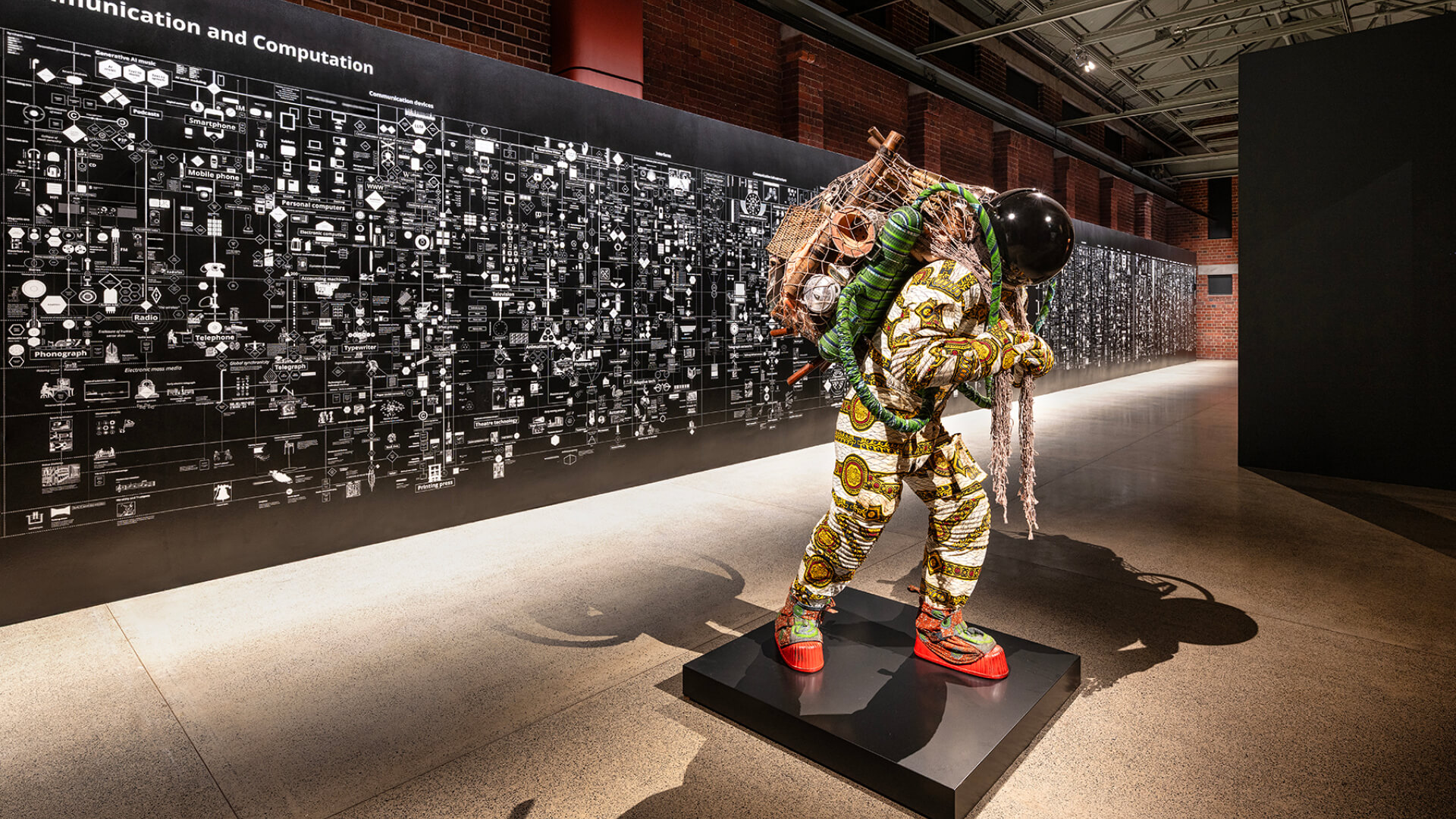
Moving into the first section, one comes across Refugee Astronaut X (2024)—a life-size fibreglass sculpture of an astronaut with a suit clad in textiles with African print. He carries his possessions on his back in a mesh sack resembling the refugees, migrants and nomads of the world. Created by British-Nigerian multimedia artist Yinka Shonibare, the astronaut is transformed from a figure of conquest (someone who plants a flag on an ‘unclaimed’ territory) to someone who has lived through its consequences. Space here is not another frontier for ownership and colonisation. Instead, it offers the possibility of escape and hope of refuge from the ecological and humanitarian crises in the home world.
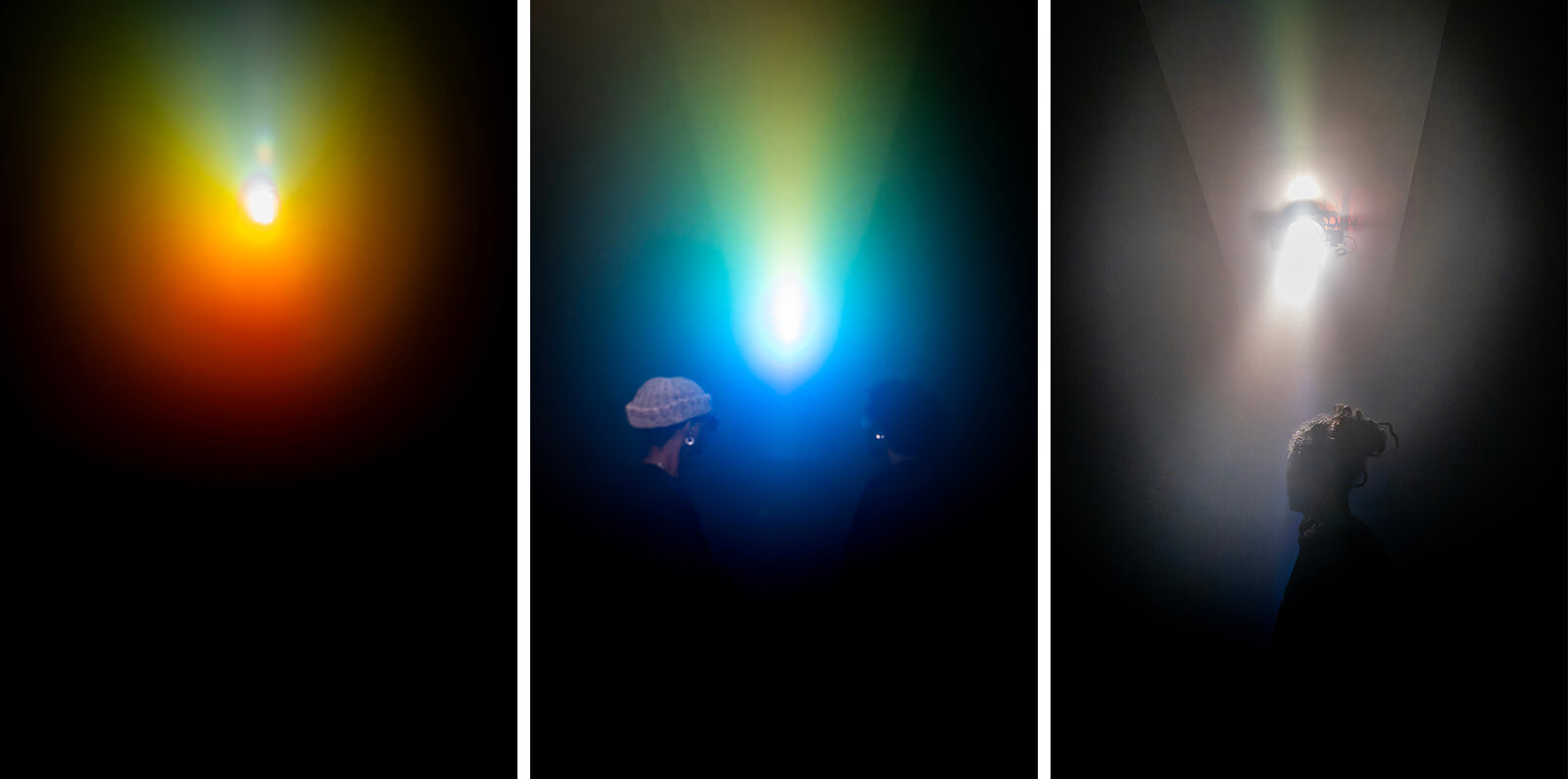
Similarly, in Event Horizon (2026), Kamil Adam Hassim brings his perspective as a South African artist to astronomy, turning particle and astrophysics into an embodied experience through his immersive installation. Visitors step into a dark chamber that recreates a night in the Karoo desert. The astronomical instrument at the centre of the installation silences the ambient electromagnetic noise. The only sounds are small clicks that signal every time an invisible, subatomic muon particle passes through visitors’ bodies, drawing one’s attention to the constant quantum background of existence. Hassim highlights the dual and interlinked identities of the Karoo region in South Africa—it is home both to new, modern radio telescope arrays and to the Xam people (one of the oldest known communities in the world) and their indigenous understanding of the universe. The ancient and the futuristic have more similarities than differences here—each showcasing sophisticated knowledge, philosophy and tools to interface with the sky and universe.
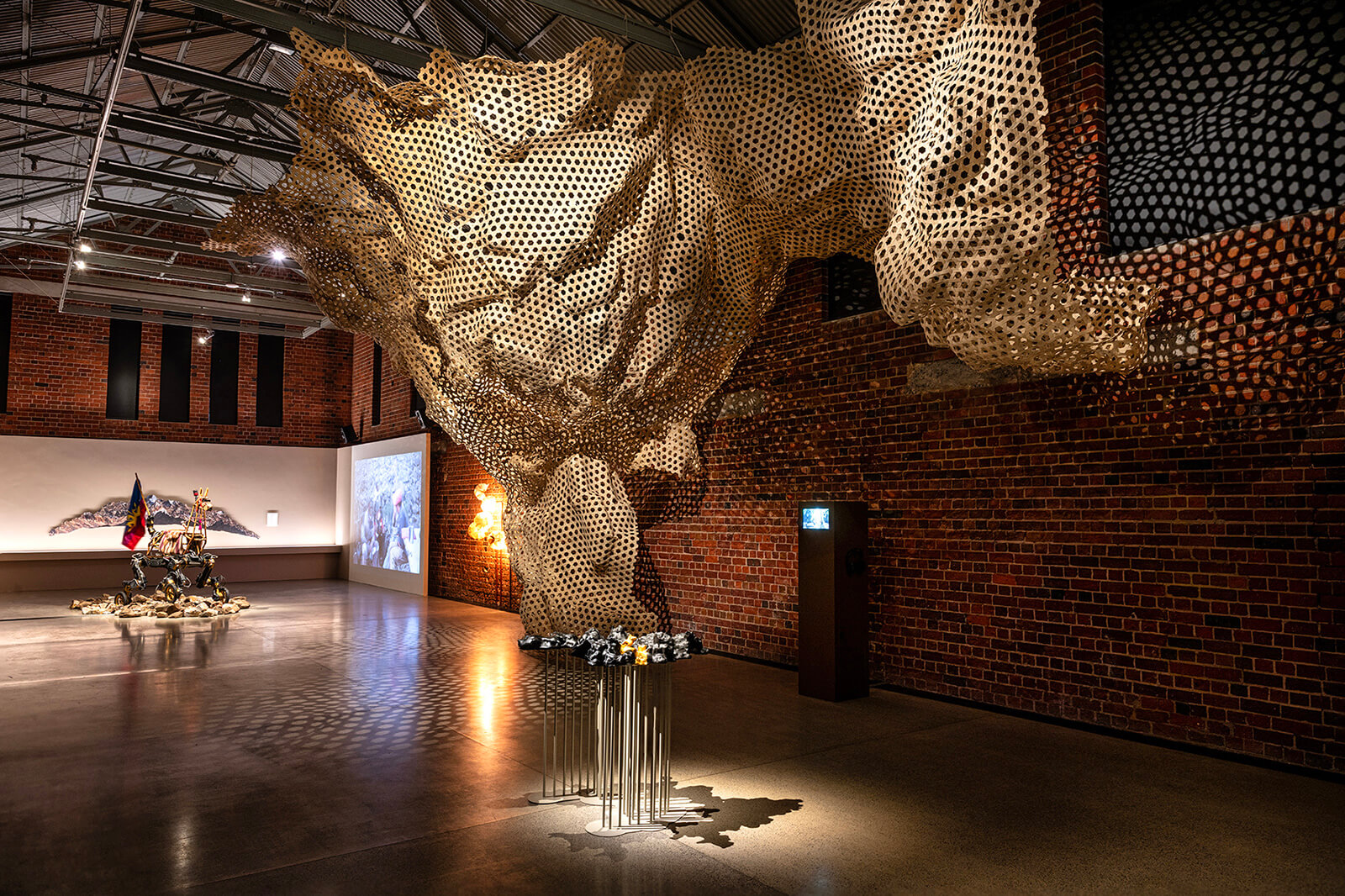
This idea—refuting the linearity of time and reinforcing an interconnected, circular view of it—is explored further in the second section, Time. Here, one encounters the epic works of the architecture and research collective whose work lends the exhibition its name—Cave_bureau. This name refers to their engagement with African landscapes and geology as sites where deep time and knowledge accumulate, and social and ecological healing can birth alternative futures connected to the practices of our early ancestors. The large-scale installation Shimoni Slave Cave (2022 – 2023) and accompanying video and architectural model constitute the second part of their ongoing Anthropocene Museum series.
The researchers engaged with the locals in the coastal town of Shimoni, Kenya, to uncover the traumatic, lesser-known history of the East African transatlantic slave trade. Local caves were once used by British colonisers as holding chambers for the enslaved, some of whom escaped to find refuge in the Three Giant Sisters caves nearby. Three-dimensional scans are used to create a 1:1-scale reproduction of the interior of one such cave, as a space for uncovering lost histories and reimagining sites of trauma as ones for repair and connection. The past is not settled or merely archaeological to Cave_bureau; it is a site of knowledge waiting to be enlivened and repurposed in acts of indigenous resistance.
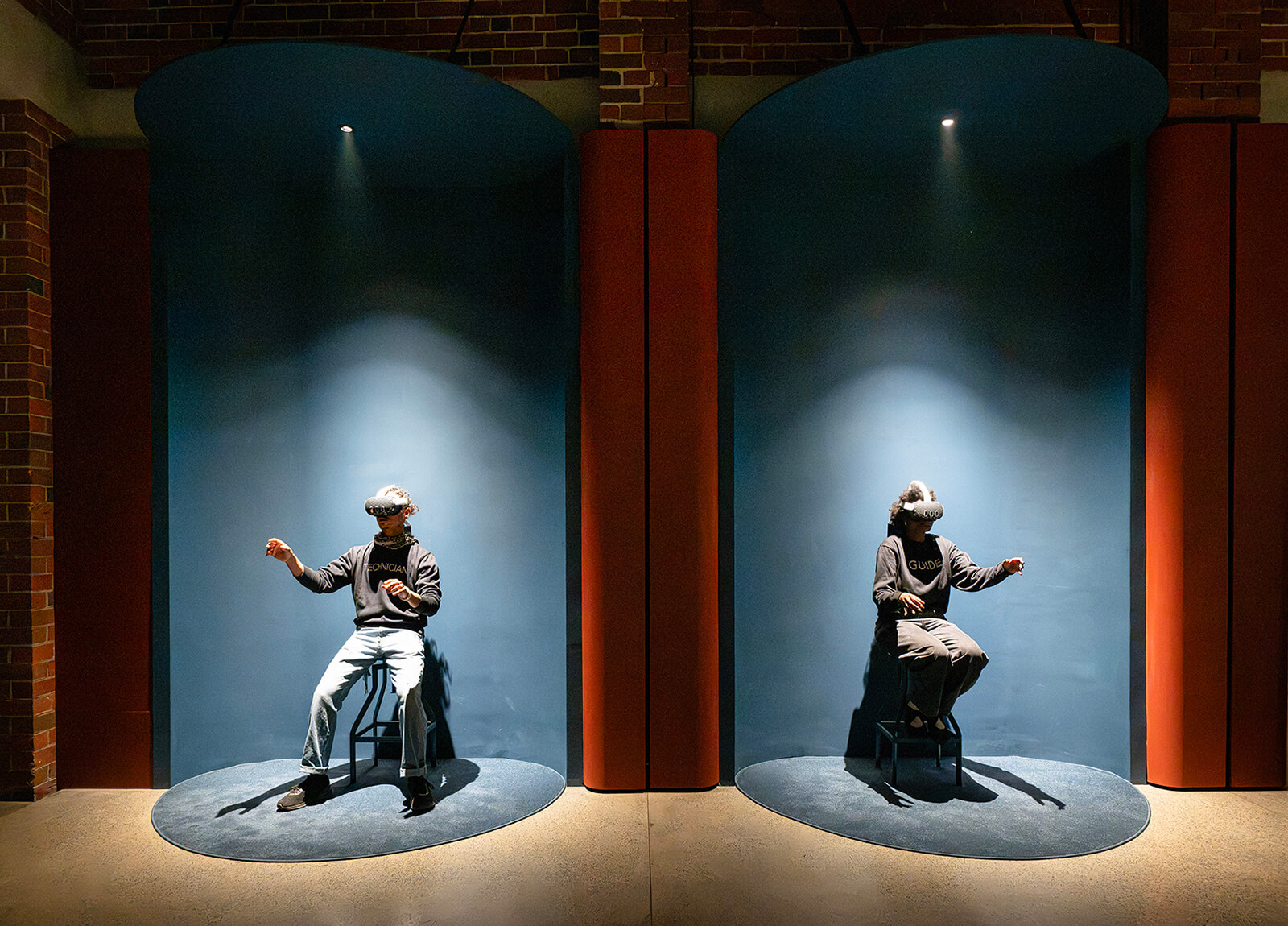
The final section, Place, holds amongst other artworks, Fisher Child (2025)—a VR installation by activist and story keeper Tracy Kwaai, part of the sixth generation of the indigenous fishing community of Kalk Bay, Cape Town. The installation is part of the Virtual Reality Living Museum driven by Kwaai’s Fisherchild Project, which brings the culture of the indigenous Kalk Bay to life not just for outsiders, but for elder community members and future generations who must be initiated into the culture, stories and history of their home. It is a massive archival undertaking, presented imaginatively, sensorially and interactively, using 360° video, photogrammetry and virtual reality. Viewers are submerged in a marine world where pulling fishing lines brings up oral storytelling, artefacts and cultural sites. It embodies what Cave_bureau termed ‘Indigenous resistance’ by working to counter the erasure and assimilation pressure created by the community’s restricted access to marine ecosystems and resources.
The exhibition design and gallery’s approach echoes these embodied artistic and storytelling techniques. Instead of using wall texts, visitors experience the exhibition independently and are led through by guides who engage them in a conversation on the artworks before entering a reading room with additional contextual material. Kellner explains these choices, saying, “Our primary aim is the production of knowledge about ourselves within the broader Global South community. This approach allows us to bring diverse practices and perspectives together in the exhibition, and build shared knowledge through meaningful interaction.”
Reverse Futures rejects a hierarchical, oppressive idea of progress that sees the ancient as part of a fixed past which must be left behind to reach the future. Instead, indigenous and ancient knowledge, philosophy and cultural sites become the catalyst to imagining a future that is rooted in community, justice and healing. “The overall message of the Reverse Futures exhibition is really contained in one question: whose future are we talking about? Is it a future defined and mediated by Western media, popular culture and corporate America?” says Kellner. The response, from artists and thinkers across disciplines and Global South communities exhibited here, is a resounding and emphatic ‘No.’
‘Reverse Futures’ will be on view from June 26 – December 5, 2026, in Johannesburg, South Africa.
by Samar Jodha Nov 19, 2026
More than three decades after first meeting the photographer as a schoolboy, Samar Jodha reflects on his distinctive vision of Rajasthan, beyond its familiar spectacle of colour.
by Srishti Ojha Nov 16, 2026
The second edition of Ahmedabad Cultural Week brought contemporary art on climate change into closer conversation with the realities of those most affected by it.
by Vandana Kalra Nov 12, 2026
Doryun Chong, Kamini Sawhney and Raphael Chikukwa, among others, expand on ways museums can better connect with audiences and acknowledge colonial histories.
by Mirra Lynn Nov 10, 2026
The Chilean artist’s first major UK show traces six decades of work shaped by exile, ecology and Indigenous cosmologies.

make your fridays matter with a well-read weekend
Enter your details to sign in
Don’t have an account?
Sign upOr you can sign in with
a single account for all
STIR platforms
All your bookmarks will be available across all your devices.
Stay STIRred
Already have an account?
Sign inOr you can sign up with
Verification link sent to check your inbox or spam folder to complete sign up process
Tap on things that interests you.
Select the Conversation Category you would like to watch
Please enter your details and click submit.
Enter the 6-digit code sent at


At Reverse Futures, creating a decolonial future is inseparable from history
by Srishti Ojha | Published on : Nov 20, 2026


 Sign in with Google
 Sign in with email
What do you think?