Art10 mins. read
Cao Fei’s Swiss exhibition reimagines what an art gallery can (or should) be today
by Srishti OjhaJul 02, 2026



by Srishti OjhaPublished on : Mar 19, 2026
Tai Kwun Contemporary in Hong Kong presents Stay Connected: Supplying the Globe, the second chapter of their comprehensive survey exhibition series, Stay Connected: Art and China Since 2008. Following Stay Connected: Navigating the Cloud, the new exhibition shifts focus from the material to the digital world, examining the social, ecological and relational impacts of China’s meteoric economic rise. Since 2010, China has been the world’s leading manufacturer, with goods ‘Made in China’ becoming ubiquitous and inextricable from the international perception of the country. Curators Dr Pi Li and Ying Kwok move beyond this tag and stereotypical images of factory line workers by tapping into communities of labourers, artists and researchers to portray the experiences and lives of the people driving global supply chains. The exhibition features over 70 works, each investigating the unseen, ignored and concealed elements and effects of globalisation and consumerism, and the unprecedented levels of manufacturing required to sustain them. 40 contemporary artists from different countries and economic backgrounds take on the roles of artist, labourer, client, interviewer, observer and storyteller to build experiences and narratives that bring abstract processes and technologies to life.
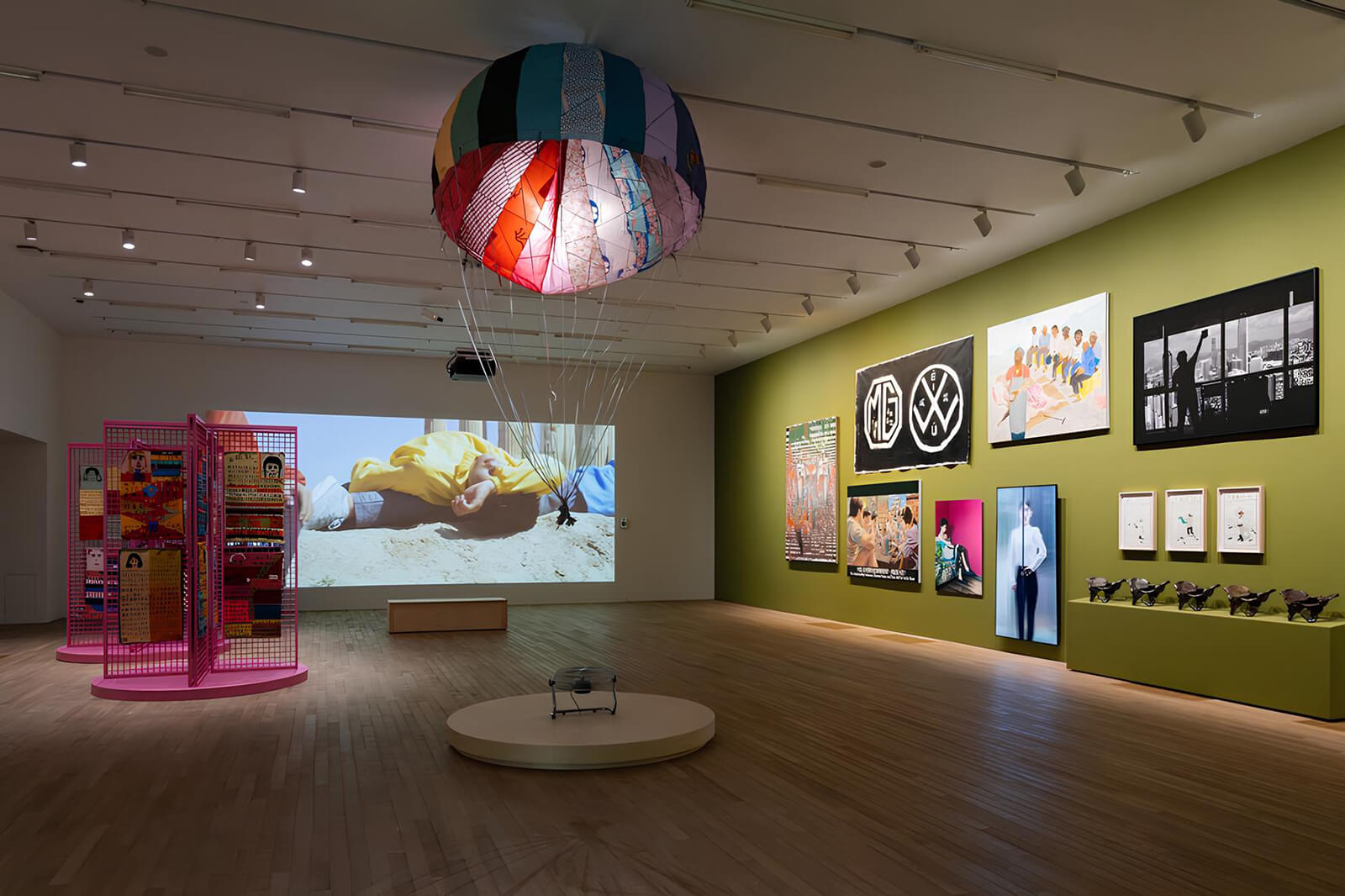
In one of the many gallery rooms housing the exhibition is the portrait wall, where a host of artists’ portraits of workers hang as a collective. The section is an overturning of the Parisian salon tradition, its values and gatekeepers, where inclusion and a grassroots approach bring the working class to the context that was once reserved only for the elite. This ethos of multiplicity and collectivity undergirds the exhibition; curator Kwok said in a conversation with STIR, “It was important for us to be able to accommodate more artists because the second [exhibition] really looks at people and community. We don’t directly work with those communities, but the artists who are putting together projects do [so] through fieldwork and conversations, which allow personal and familial stories to be told and create a diverse voice.”
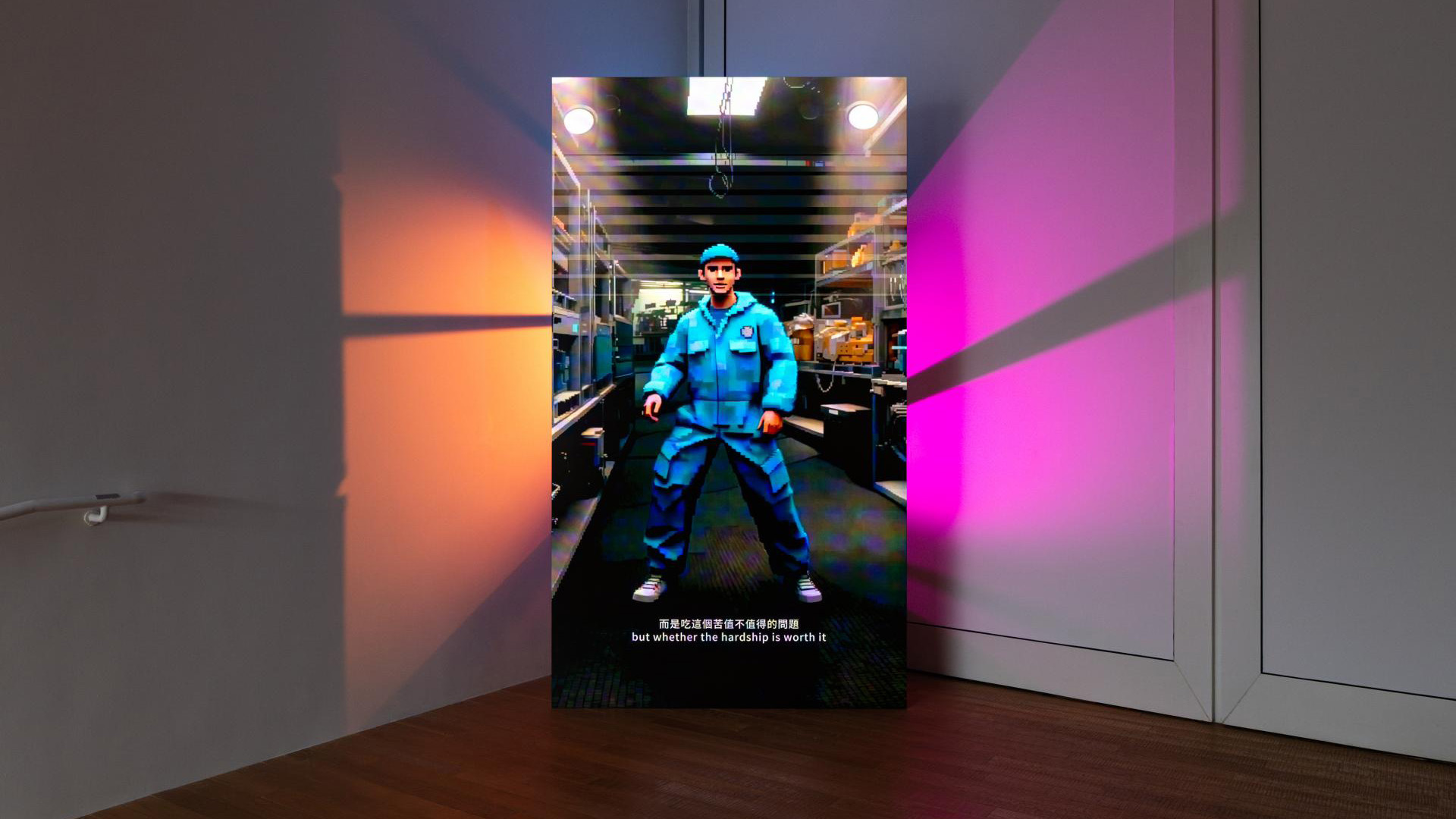
One such artist is Chongqing-based Li Yifan, whose video works, Why Not Dance 1 and 2 (2025), were commissioned by the gallery to bring attention to the lives of young factory workers and their social culture. In the first video, Yifan uses AI to turn an interview with a migrant worker into a rap video that balances disillusionment with humour, animating a life marked by constant movement between industries and forms of labour. Why Not Dance 2, meanwhile, follows an influencer known online as ‘Wan Ci Wang’ (King of Ten Thousand Resignations), revealing migrant workers’ perspectives on new employment opportunities triggered by rising labour costs in Southern China factories. Works like these form the connective tissue between the first and second chapters of the Stay Connected exhibition series, showing how the proliferation of smartphones and social media has changed perceptions of and attitudes towards labour.
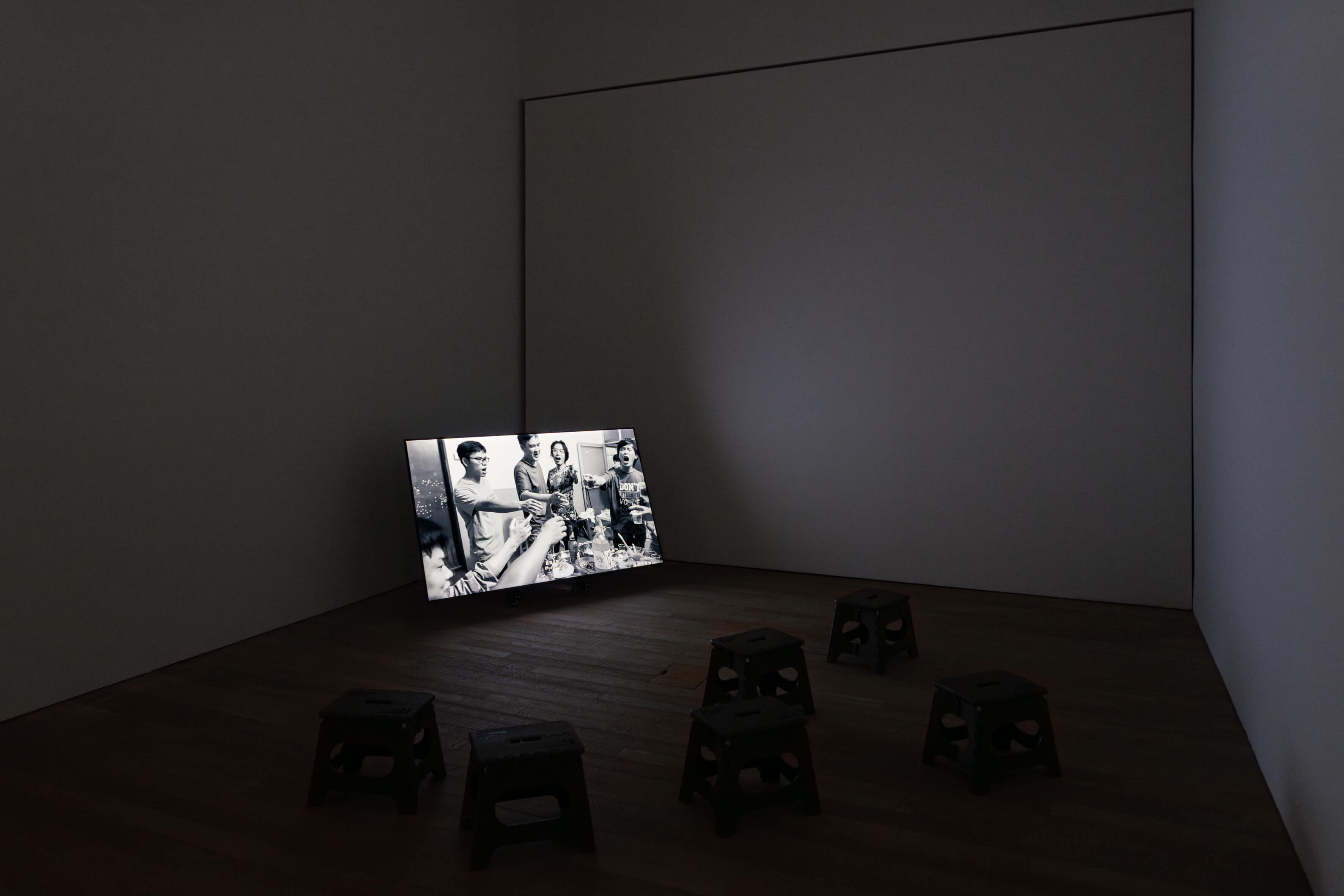
Other works, like Shenzhen-based artist Li Liao’s 2012 installation, Consumption, combat the alienation of workers’ time and wages from the commodities they manufacture. Here, the artist took on the role of a factory worker for 45 days at a consumer electronics factory in Shenzhen until he could afford the product he spent his time assembling—an iPad. He highlights the alarming disparity between the value of a worker’s time and the value of commodities they produce, demystifying the tense monetary relationship and inequalities between worker, owner and consumer. Comb (2008) by performance artist Li Ming moves from the abstract to the visceral, depicting the absurd level of alienation between humans and their built environment following industrialisation. His video work shows an extractor combing the long hair of a woman with great gentleness and, it seems, care. They sit together in an abandoned building, a dreamlike fantasy of an environment suffused with love, concern and companionship dropped into the grey reality of an uncaring world that is itself uncared for.
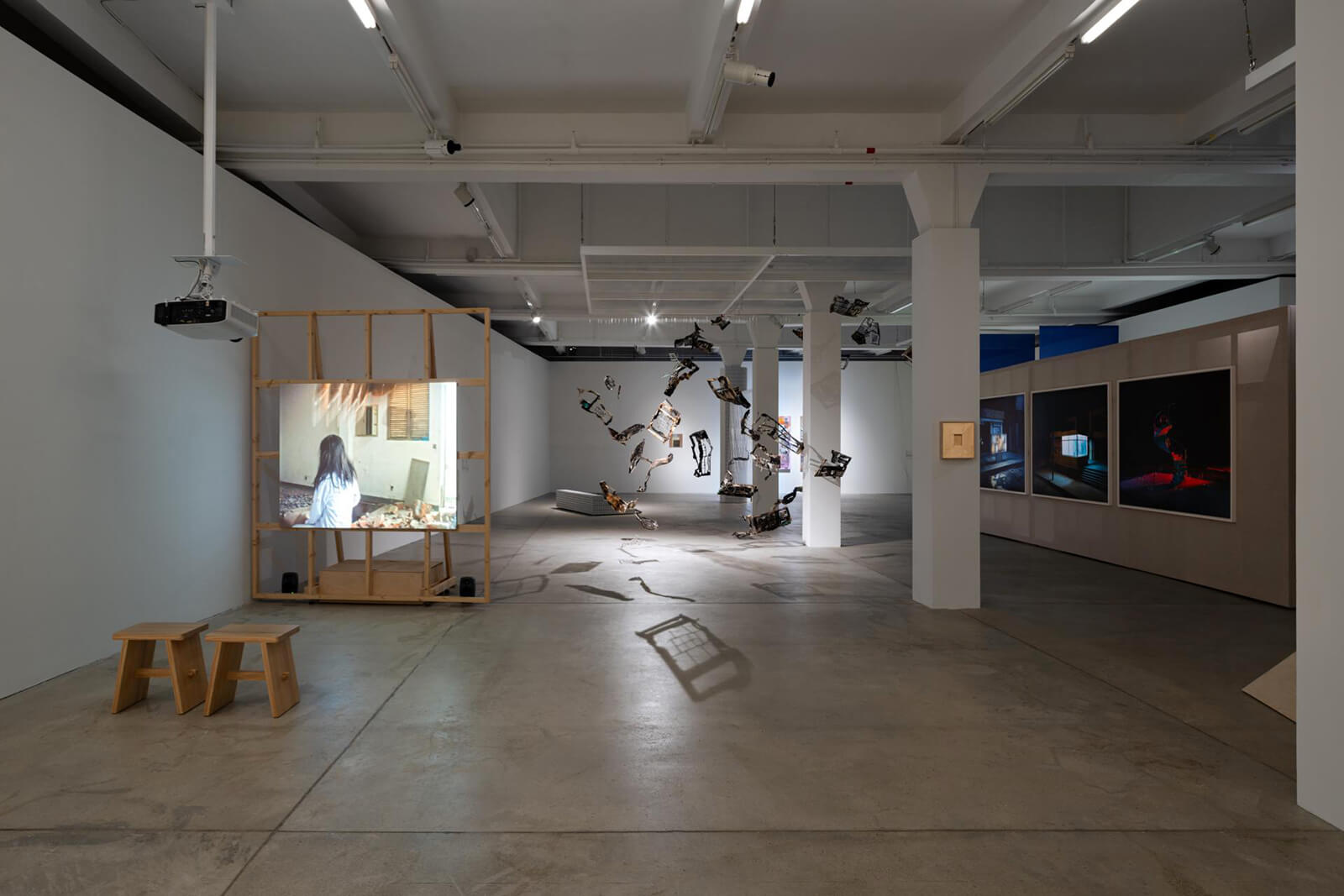
A section of the exhibition is devoted to works that investigate the relationship between people and urban environments. A work that could be adapted with little to no changes in every major city of the world is Yang Guangnan’s Smog (2016), which shows a closed mechanical system filled by the artist with smog-filled air from Beijing. The machine works constantly, circulating the air and trying to purify it in a Sisyphian labour that evokes despair and desperation without any anthropomorphisation. Ecocentric artist Long Pan finds the beauty within the damage with her series of ceramic leaves that shift from pale yellow to brown and dark green. Leaves (2022) incorporates the appearance and plant ashes of ‘hyperaccumulators’—vegetation that absorbs excess heavy metals from soil, a symbol of nature’s often silent acquiescence to a world hostile to the organic.
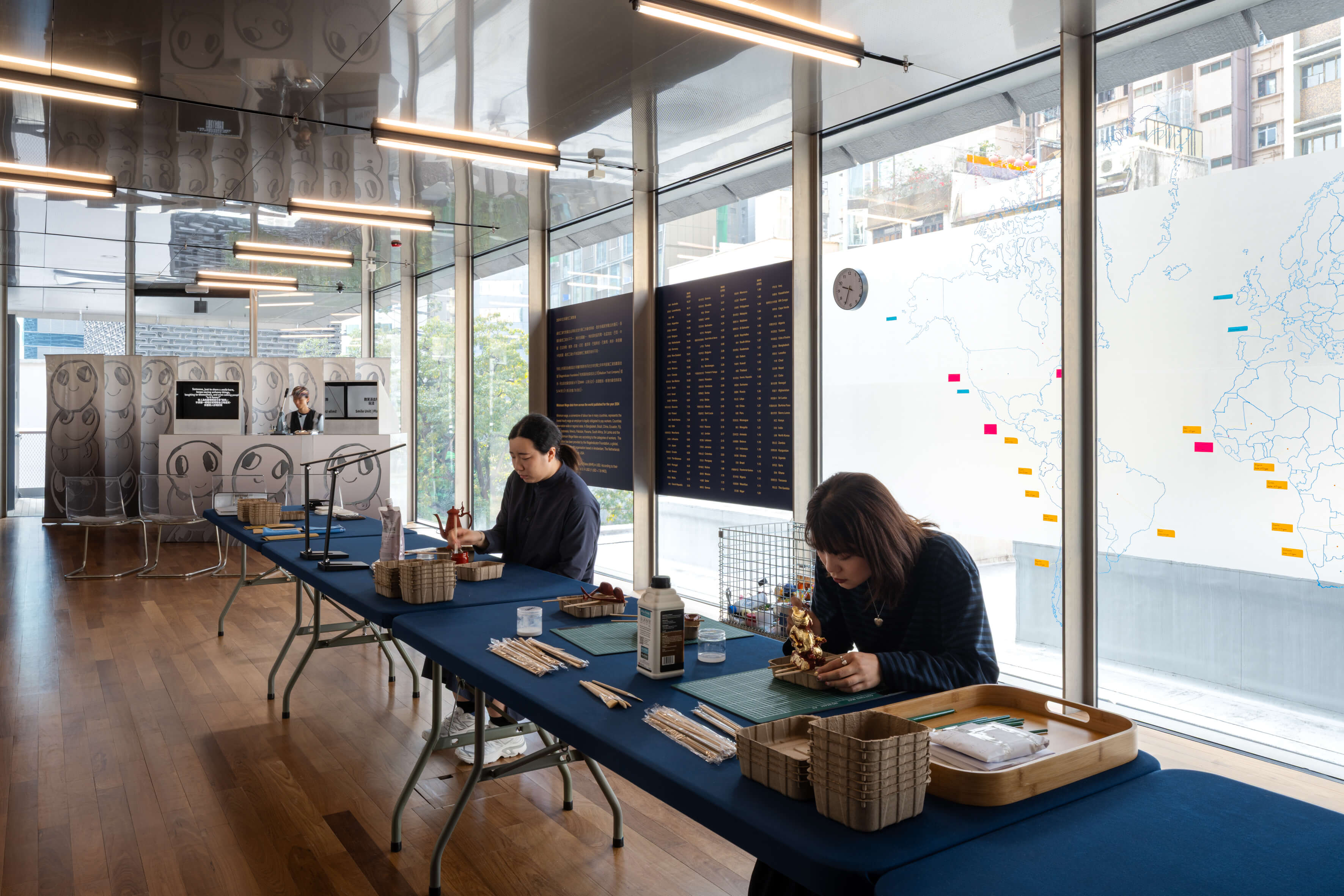
The exhibition is designed to encourage viewers’ personal connections with the abstract economic concepts behind the exhibition through the inclusion of diverse, unconventional media and participatory projects. Works like Smile Unit (2026) by Ocean Leung operate on multiple levels to appeal to different demographics—viewers are invited to write down something that made them smile in exchange for a smiley badge, which is then displayed into a scrolling text on a screen. Viewers contribute to the exhibition while their attention is drawn to the commodification of personal experiences in an economy ruled by speed and ease of consumption. Kwok said, “Even after Tai Kwun has been open for nearly eight years, there are still people telling us this is the first time they are seeing contemporary art, so we have to think about how we layer our message and its interpretation. We introduce participatory works so people of all age groups and levels of experience won’t feel too distant.” WANTED, UNWANTED AND WANTED AGAIN: THE ALCHEMY PROJECT (2026) by London-based collective Foreign Investment, for example, subtly invites viewers to rethink the legitimacy of value and the basis on which it is assigned by transforming unwanted household objects given by viewers to sitting artists through gold gilding.
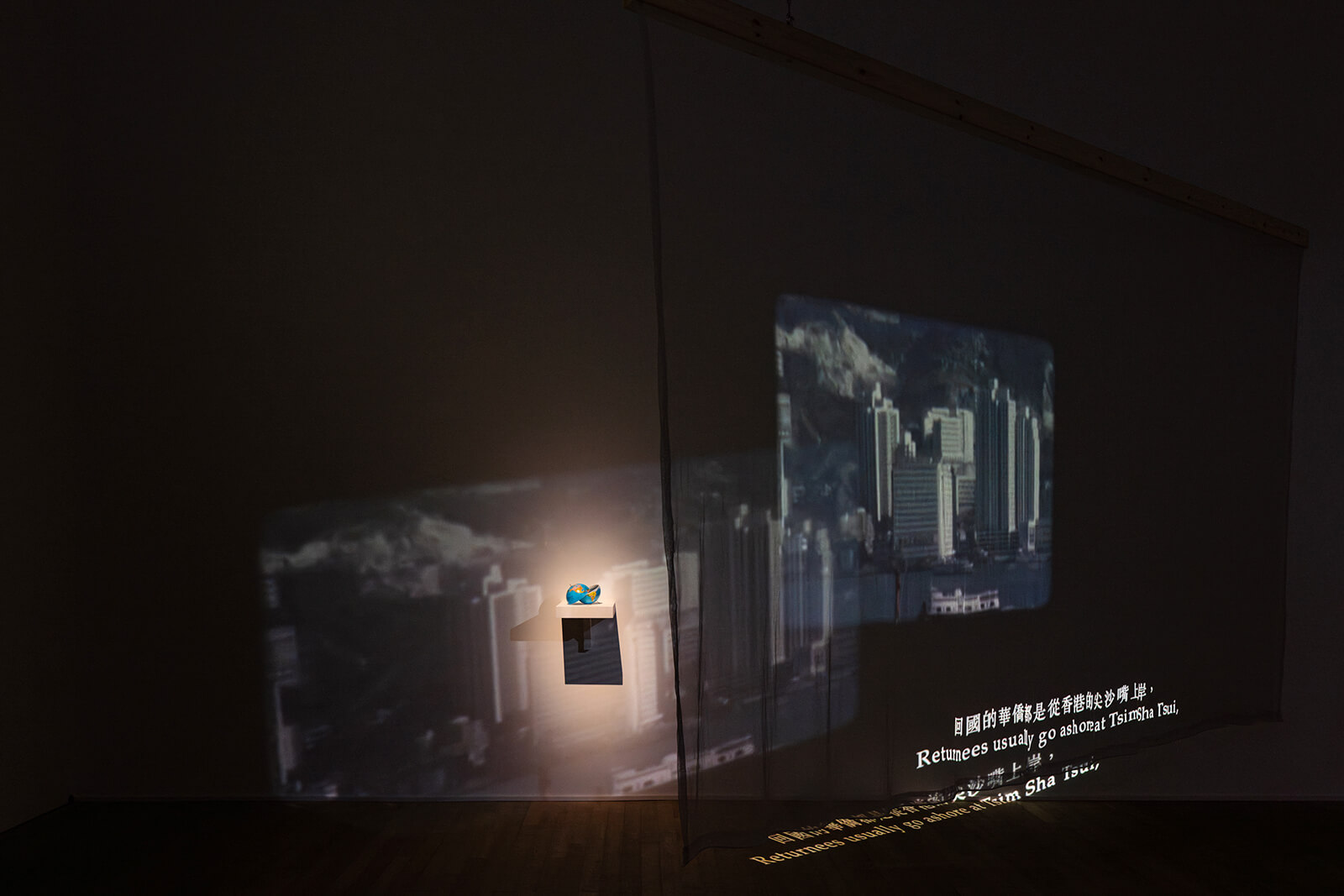
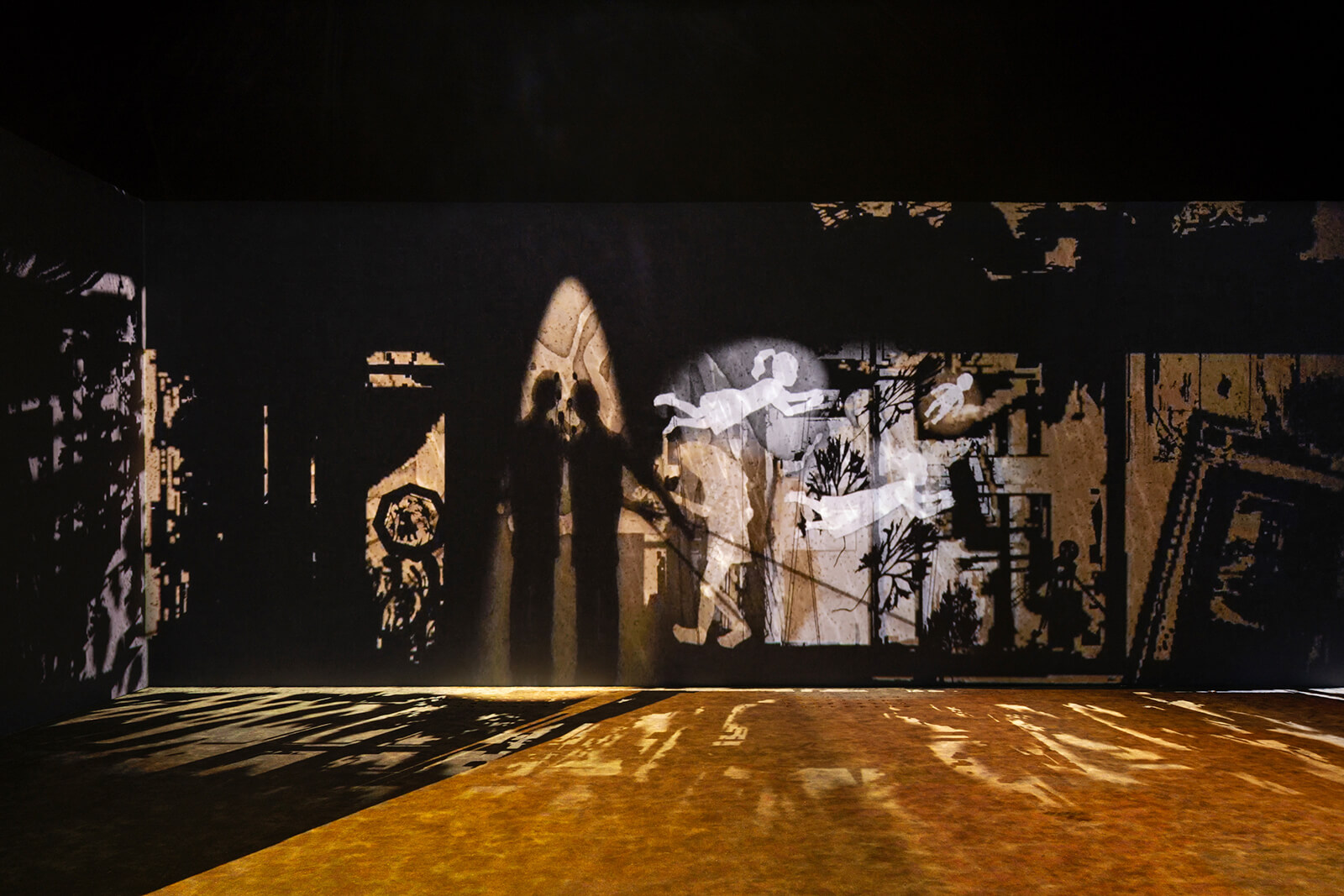
The final segment of the exhibition, titled Global Realignments, takes a step back from the specific and personal, taking a bird’s eye view of China’s transformation and its international impact. New Territories (2025) by Gordon Cheung, for example, is a sprawling multimedia painting that turns to the tradition of symbolising power dynamics through naval scapes. The foreground shows a British gunboat positioned at the archway of Yuanmingyuan (sometimes called the Imperial Palace), a Qing dynasty palace and estate that was looted by the British and French in 1860, during the Second Opium War. The buildings were destroyed, the estate looted and its riches and artefacts stolen to be displayed in European museums and private collections. This scene is dwarfed, however, by the 3D-printed Kowloon skyline laid out behind it and the mountains rising above it. The mountains are made of fragments of stock market news from Financial Times newspapers, and the constellations in the sky above form the shape of China’s Belt and Road Initiative. The juxtapositions in medium, scale and historical subject tell the story of a storied culture vulnerable to imperial aggression, that, following a dramatic shift in its relationship with technology and international relations, sees a new form of itself. The epic landscape charts centuries of shifting power structures and capital flows, born and dying empires and the echoes of these changes into the material world as it exists today.
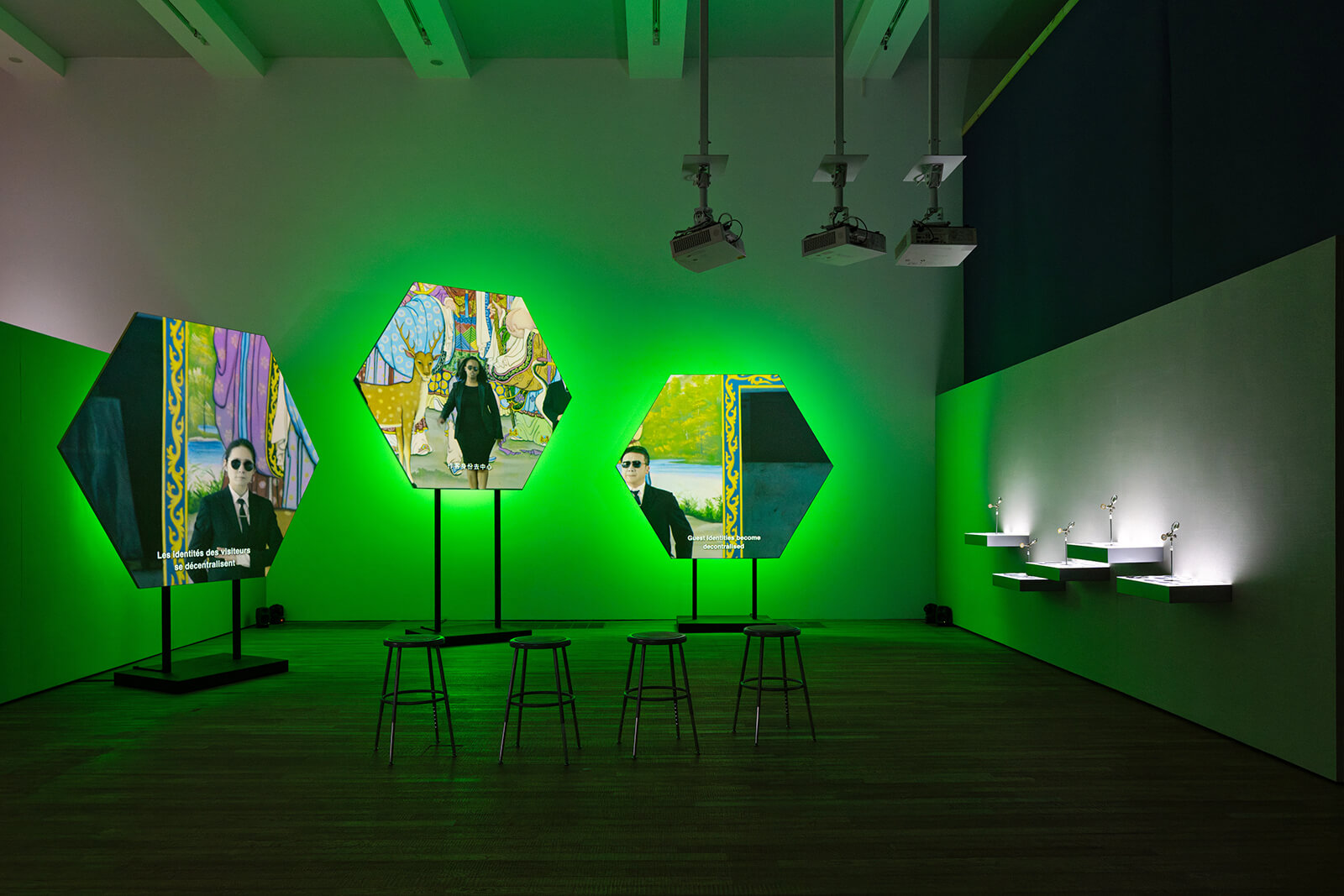
This view of globalisation is rounded out by projects that discover networks of solidarity amidst dry, often exploitative supply and demand. I Want to Sleep More but by Your Side (2019) by Li Shuang details the faraway connections facilitated by otherwise impersonal import-export relationships. The film switches between the monologues of a mother in France and a young factory worker in China. The latter produces the fluorescent safety vests that became a symbol of protest in France in 2018, becoming a point of connection between the two women. They describe their lives, desires and work, their experiences becoming more entangled as they speak. Shuang’s work shows that commodities can become a conduit for the exchange of ideas, emotions and experiences under globalisation.
Stay Connected: Supplying the Globe embraces complexity and multiphony, finding beauty in unlikely places and the violence in the everyday. Through works that are experimental and unconventional while being deeply rooted in lived realities, the survey exhibition invites every kind of viewer to reexamine not just the global economy, supply chains, China’s manufacturing centres and factory workers, but the artifice of monetary value itself.
‘Stay Connected: Supplying the Globe’ will be on view from February 28 – May 31, 2026, at Tai Kwun Contemporary, Hong Kong.

by Srishti Ojha Oct 21, 2026
Increasingly, artists, filmmakers and activists are turning to VR to create more personal, tangible accounts of the climate emergency and its impact on vulnerable communities.
by Mirra Lynn Oct 20, 2026
The Indian artist paints the old wadas of central Pune, capturing the traces of everyday life that cling to these structures, battered by time but unbowed.
by Anmol Ahuja Oct 15, 2026
How do heaps of souvenirs and relics with racist Aboriginal motifs and features become art? MCA Sydney’s winter showcase—the artist’s largest to date—beckons a possibility.
by Vandana Kalra Oct 14, 2026
With his latest exhibition as a point of departure, the modernist discusses his decades-long practice, the spontaneity of drawing and the social responsibility of artists.

make your fridays matter with a well-read weekend
Enter your details to sign in
Don’t have an account?
Sign upOr you can sign in with
a single account for all
STIR platforms
All your bookmarks will be available across all your devices.
Stay STIRred
Already have an account?
Sign inOr you can sign up with
Verification link sent to check your inbox or spam folder to complete sign up process
Tap on things that interests you.
Select the Conversation Category you would like to watch
Please enter your details and click submit.
Enter the 6-digit code sent at


Connection/consumption: human stories of industrialisation
by Srishti Ojha | Published on : Mar 19, 2026


 Sign in with Google
 Sign in with email
What do you think?