Architecture07 mins. read
Transcribing the maximum city with Jaquar Pavilion Park at ADFF:STIR Mumbai 2026
by Jincy IypeDec 24, 2025



by Jincy IypePublished on : Jan 23, 2026
Describing ADFF:STIR Mumbai’s evolving format as “a new model—part biennial, part pavilion park, part spatial experiment—capable of generating new kinds of cultural production, especially in the Indian context”, Aric Chen, director of the Zaha Hadid Foundation and jury chair of the Jaquar Pavilion Park offered a precise framing for what unfolded at National Centre for the Performing Arts (NCPA) in Mumbai, from January 9 – 11, 2026. Alongside an invite-only premiere evening that opened the Jaquar Pavilion Park to architects, artists, partners and early visitors, the venue transformed into an eclectic spatial laboratory—altogether porous, social and speculative.
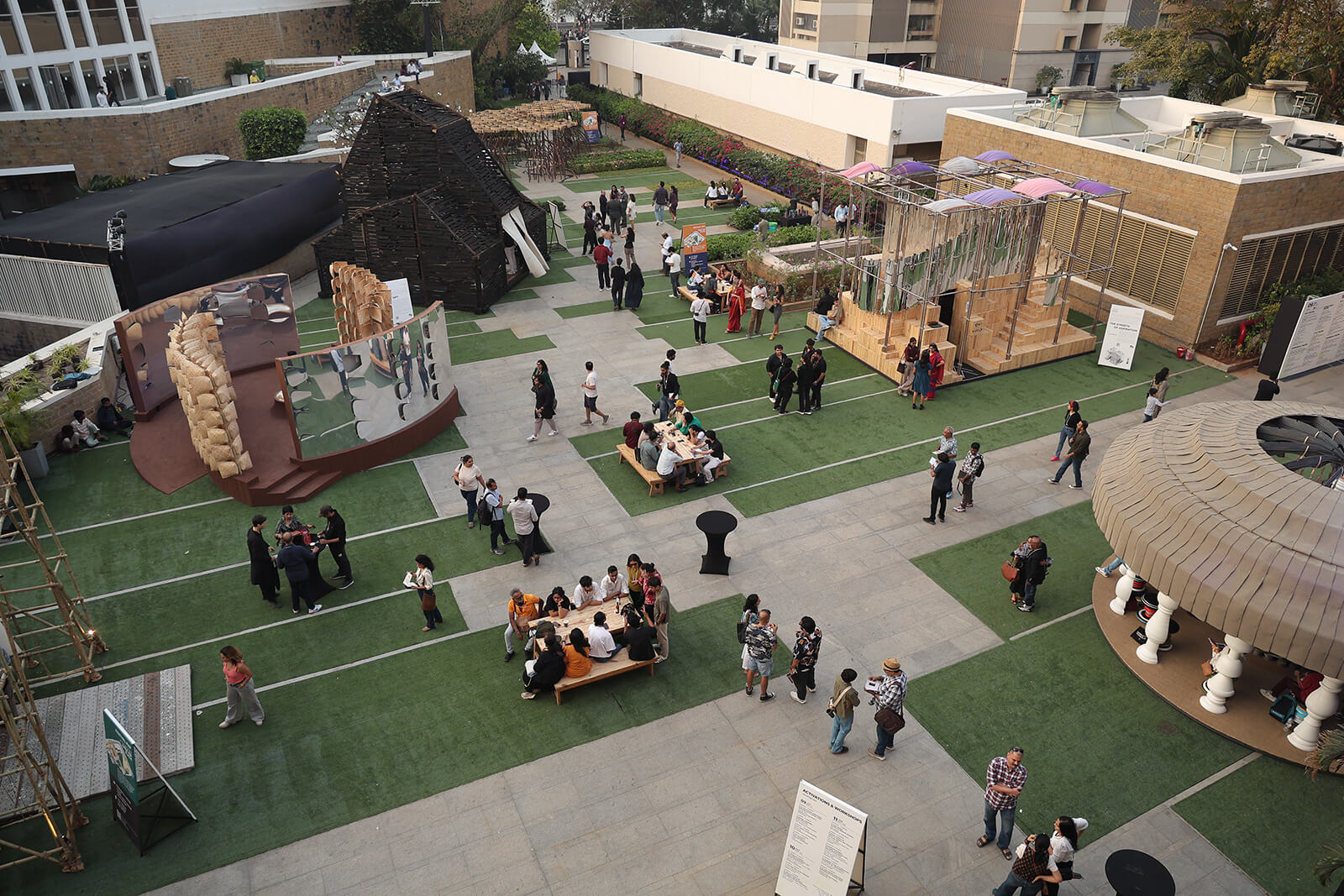
During these charged days of ADFF:STIR Mumbai 2026, the Jaquar Pavilion Park, positioned as one of the festival’s four dynamic pillars, unfolded as a public field of choreographed as well as spontaneous architectural encounters: a landscape of movement, pause, conversation and observation. Across its gardens, plazas and myriad thresholds, 10 pavilions operated simultaneously as sites of temporality, discourse, material experimentation, cultural memory, as well as collective meaning-making—as intentional atmospheres to inhabit.
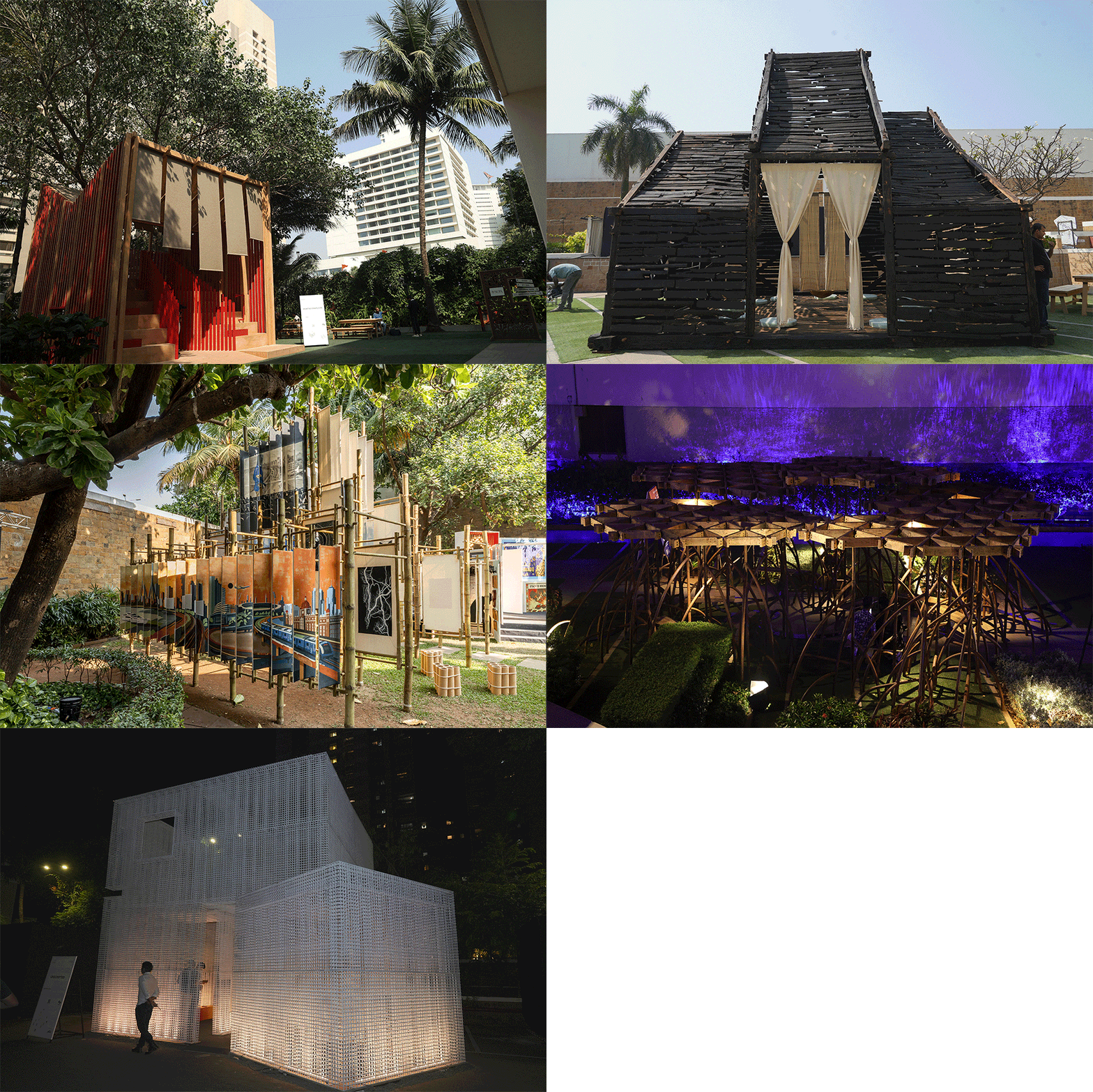
Curated by Chen, the pavilions responded to the overarching curatorial theme, Mumbai Transcripts. Reflecting on the project’s realisation, Chen told STIR on site how “it’s been really fantastic to see this project come to life… The creativity, the ideas, the response to Mumbai’s cityscape expressed through very social, communal spaces created for this event is incredible”.
Within this collective framework, each pavilion design produced its own architectural mood, spatial vocabulary and rhythms of inhabitation.
Inspired by Bernard Tschumi’s Manhattan Transcripts, where space, movement and event are co-protagonists, the Mumbai Transcripts brief posed a challenge to architects from India and beyond to treat architecture not as a static form, but as a catalyst of experience, encounter and narrative. It asked how architecture might articulate new social relations through space, movement and event within an urban condition as that of Mumbai.
In response to this brief, a distinguished international jury, comprising Chen, Hans Ulrich Obrist (artistic director, Serpentine Galleries, London), Lesley Lokko OBE (founder, African Futures Institute and curator of the Venice Architecture Biennale 2023), Indian architect Raj Rewal (founder, Raj Rewal Associates), Ma Yansong (founder, MAD Architects) and Martha Thorne (former exec. director, Pritzker Architecture Prize) selected 10 proposals for realisation from a field of 52 architects, designers and artists invited to submit responses to the curatorial call for the project.
And so, at the heart of the Jaquar Pavilion Park stood a lived experience of the city itself. Positioned between gardens and plaza thresholds, the assembled forms created zones of activation, contemplation and rest. Here, attendees encountered space as movement, surface as encounter and structures as public choreography, sentient, expressive and multi-modal.
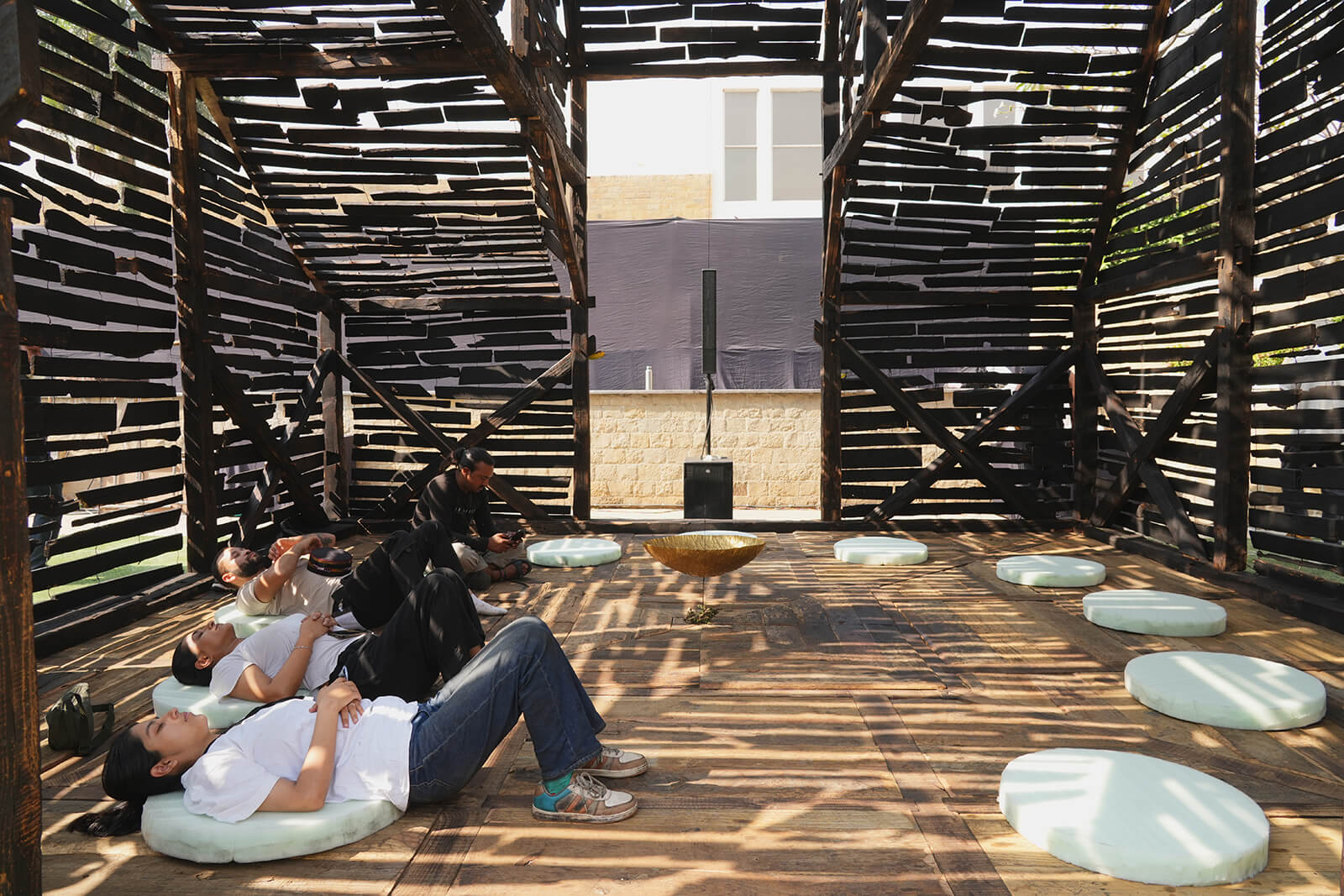
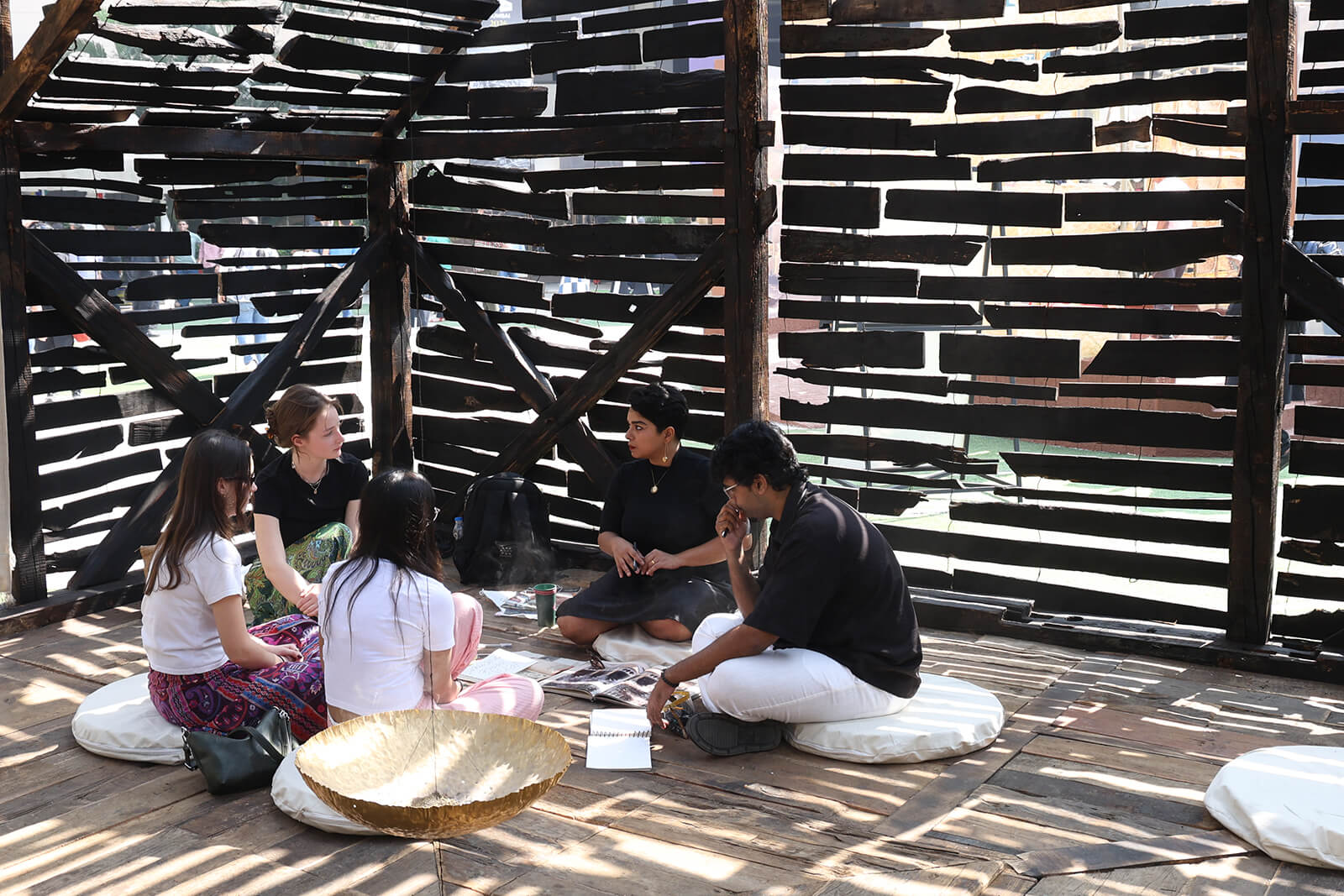
Supported by the Pirojsha Godrej Foundation, Mountain Transcripts by NORTH, designed by Rahul Bhushan, and his dedicated team of artisans, emerged as the park’s quiet emotional centre, a liminal chamber of pause, especially within the larger experience of the design festival’s kinetic programming of film screenings, ~log(ue) sessions and special projects. Burning juniper incense, streaks of sunlight, soft acoustics and circular, white, padded floor cushions created a meditative limbo. Visitors, at various points of the day, sat cross-legged or simply lay down, closed their eyes, lingered. Bhushan also brought craftspeople from Himachal Pradesh (the same team that built the pavilion) to Mumbai for the first time, enabling intimate exchanges between makers and visitors. The artisanal and spiritual undercurrent shaped the pavilion’s presence throughout, translating Kath Kuni construction into the film festival’s tangible midst.
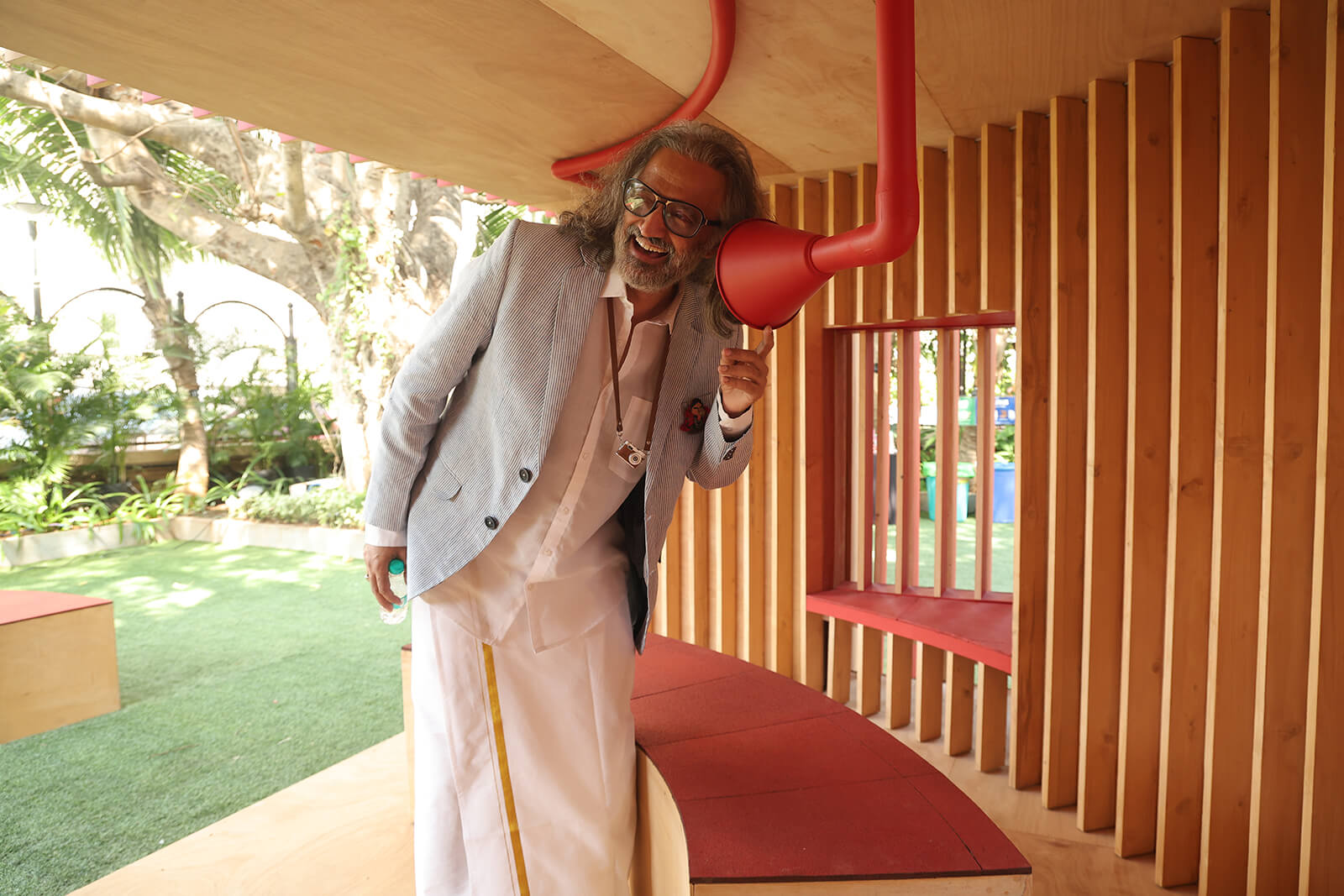
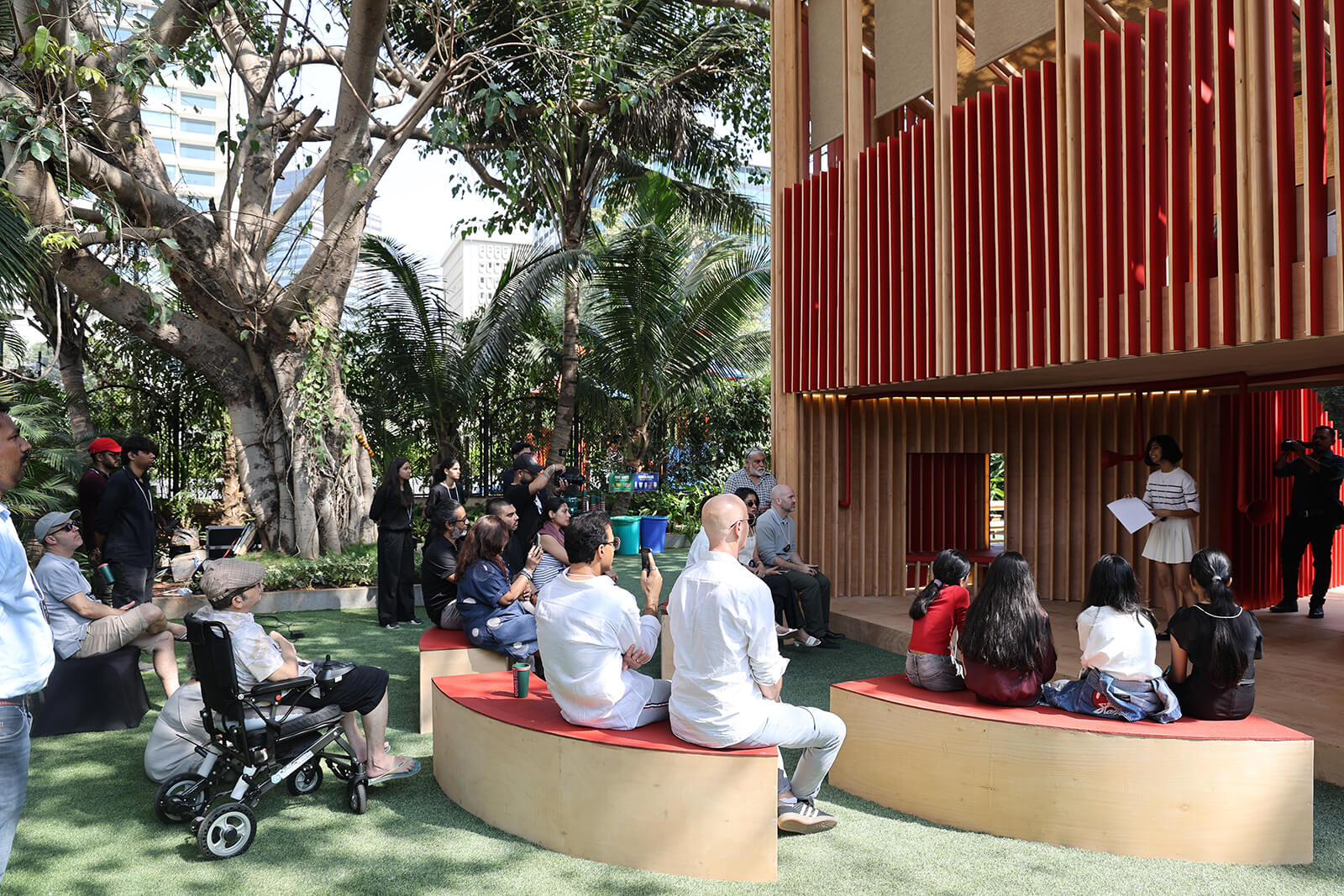
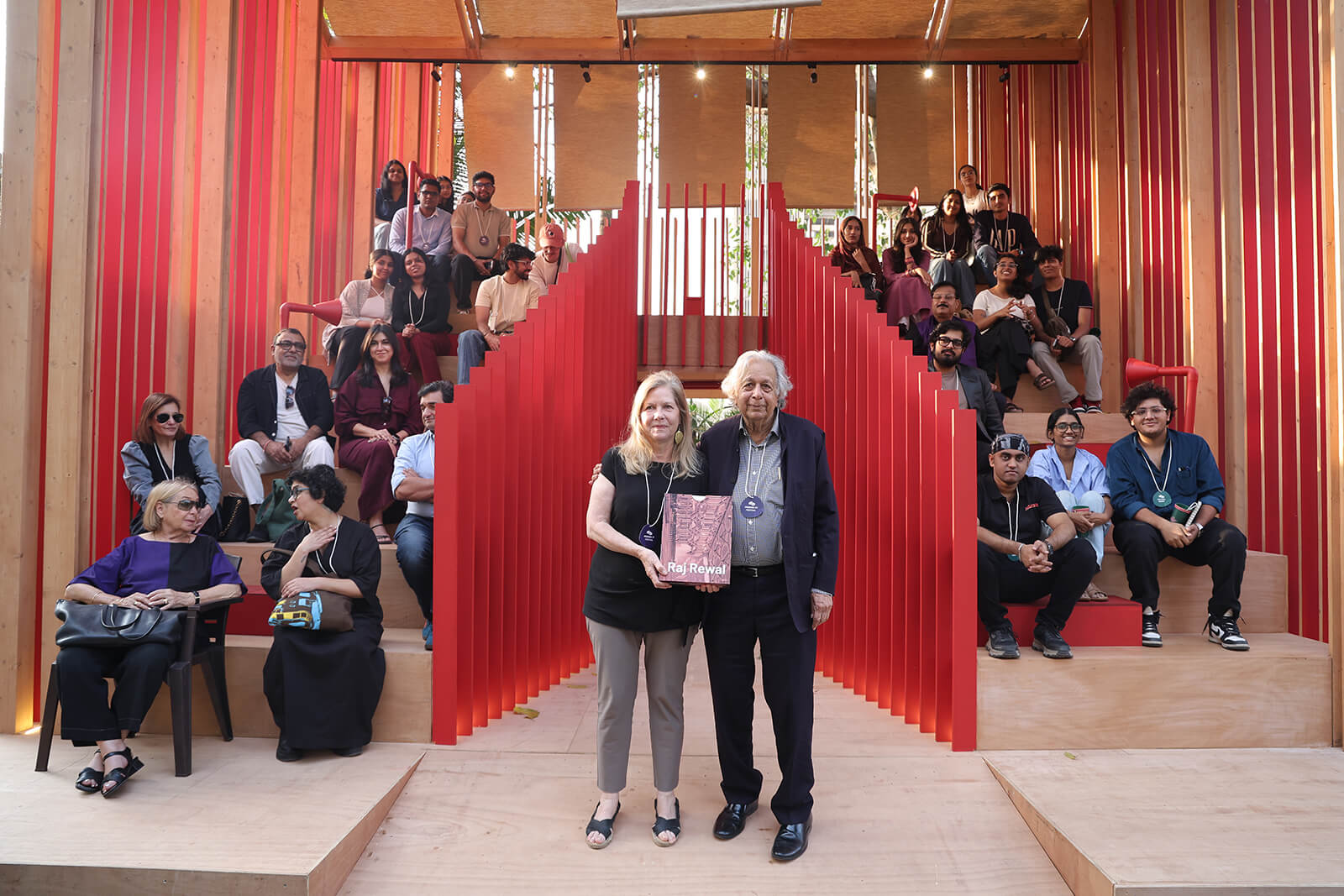
If NORTH’s pavilion proffered rest, the rather handsome Pentad Pavilion by UHA, in contrast, hosted social density, drawing from global parliamentary layouts to reference shared civic space within its fair wooden, stepped structure. A concealed network of bright red acoustic tubes threaded through the pavilion’s architecture, allowing voices and sound to travel between its spaces. The result was playful, participatory and social—a semi-enclosed form, where steps and seating arrangements became informal auditoriums animated by spontaneous conversations, book launches and workshops layered into the architecture itself.
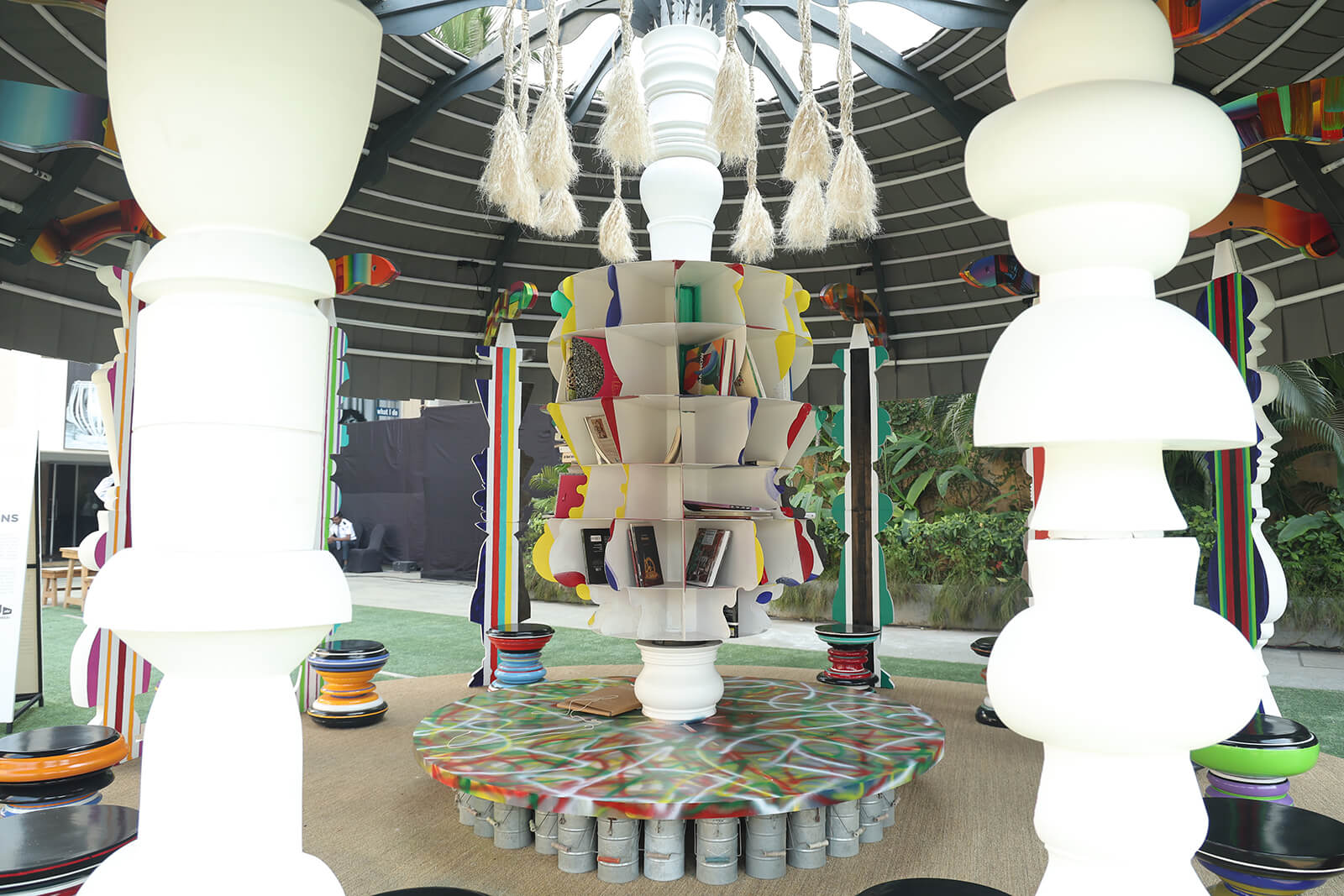
Nearby, The Pavilion of Conversations by Bose Krishnamachari remained energetic and socially charged through all the days of ADFF:STIR Mumbai’s second edition. Featuring 13 bespoke chair designs and an open-access plan, the pavilion drew from Tom Marioni’s proposition that “the act of drinking beer with friends is the highest form of art”, performing as a gathering lounge for many. A rotating bookshelf and a central coffee table made from steel tiffin boxes anchored acts of reading, sketching and informal dialogue.
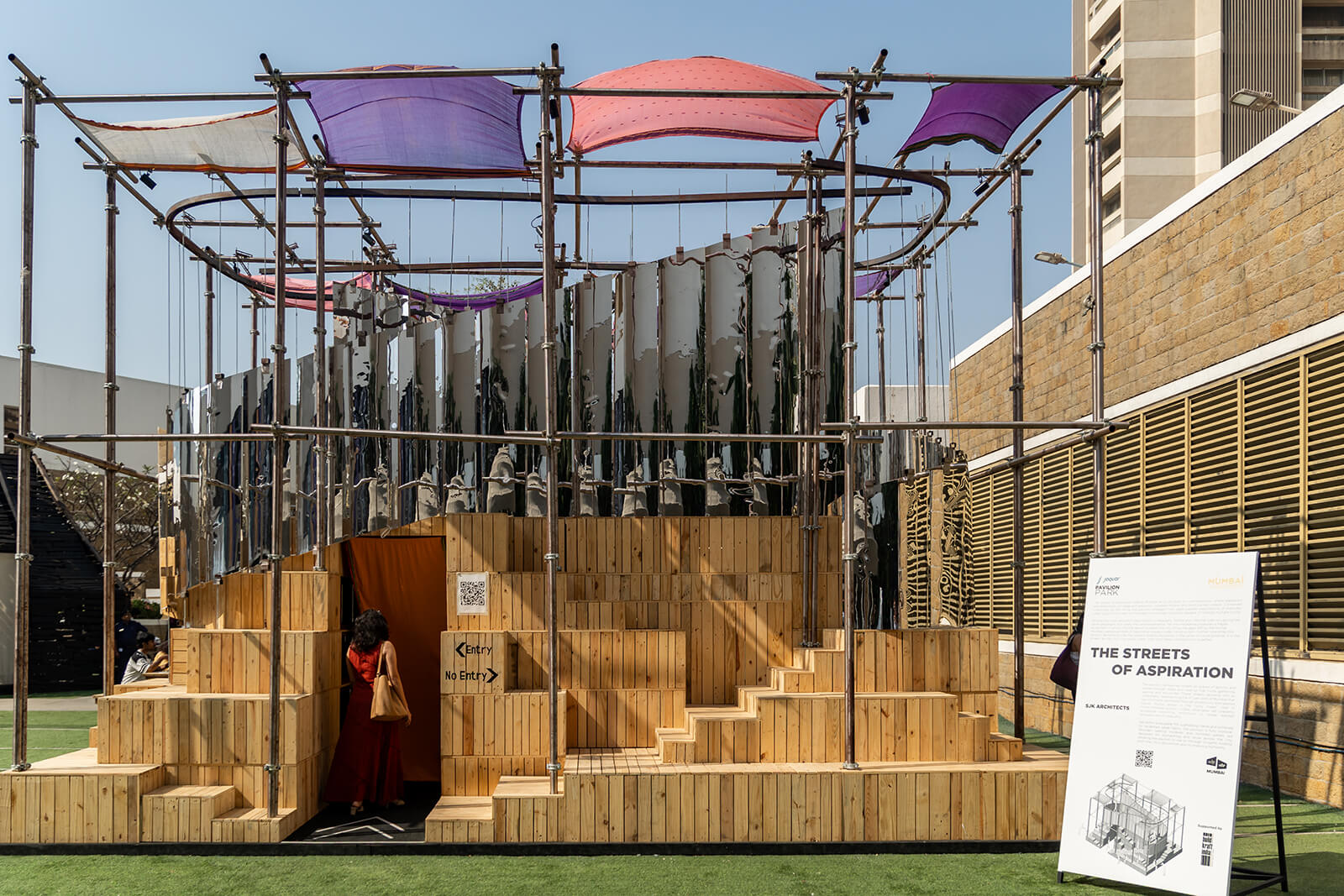
Right across, at the Streets of Aspiration by SJK Architects, supported by BuildKraft India Systems LLP, reflective surfaces intensified sunlight and heat, producing almost vertiginous effects that echoed the city’s relentless motion as one climbed to its top. The steps here, especially on its skin, became informal gathering zones, hosting conversations, with people taking ample photographs, many sitting down for a brief period of rest and shaded pauses from the day’s sun.
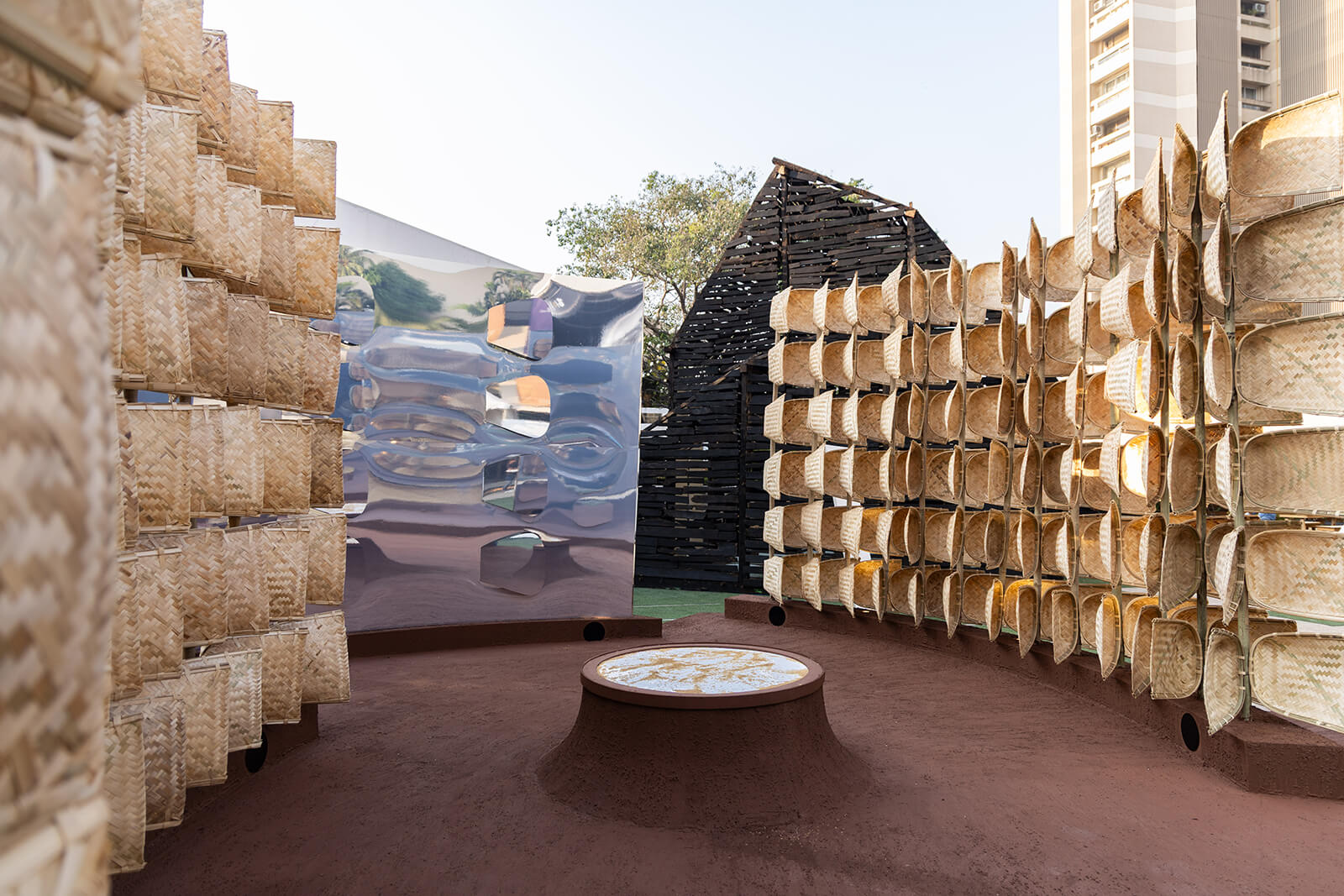
A few steps away, SIFT by Reddymade, supported by Godrej Properties, introduced a different sensory register, both industrial and reflective. Tactile surfaces, reflective materials and a sound-responsive installation encouraged slow movement and sensory engagement with aplomb. Its spatially organised spiral path formed by walls of rice sieves made of bamboo, as well as metallic, semi-enclosed ones, captured vibrations of sound while grains of rice danced across a small tensile spot in its middle, inviting visitors to engage with rhythm, materiality and perception.
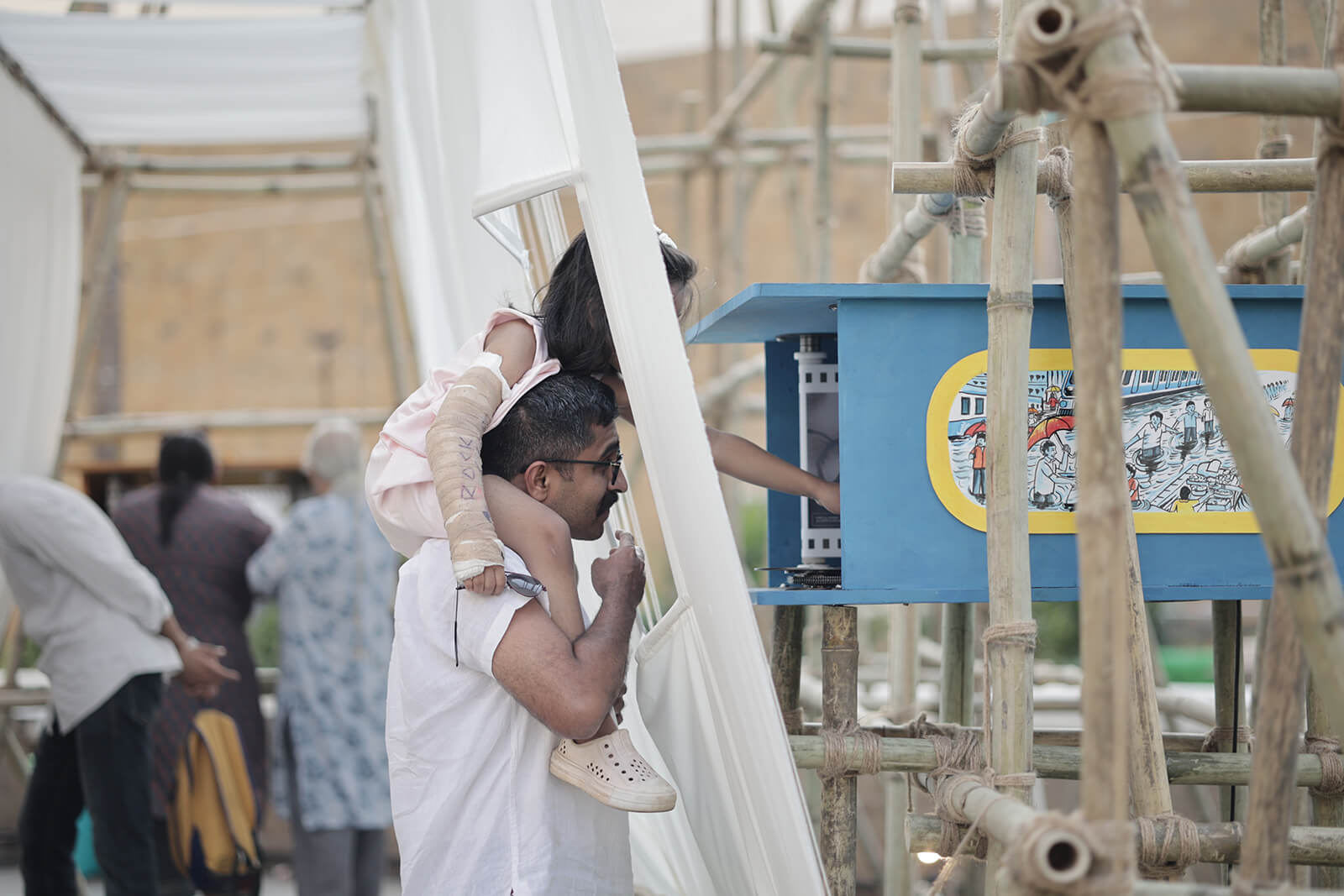
The Mumbai Transcripts by Nisha Mathew Ghosh, supported by ROCA, embodied impermanence through raw material logic, activated by three handcrafted bioscopes that visitors could move by hand, encouraging tactile interaction with memory and image. Each refracted a different cinematic condition of the city: its shifting geographies, economies of work and exchange, architectures of belief and landscapes of aspiration, positioning the one who interacts with them as both viewer and participant in Mumbai’s ongoing script. Built using bamboo scaffolding, wooden battens, coconut coir rope, jute twine, reclaimed plywood and stitched packaging sacks, the pavilion was assembled to be undone. No joints were rigid. Everything was tied, adaptable and temporary, mirroring the exposed infrastructures of the city itself.
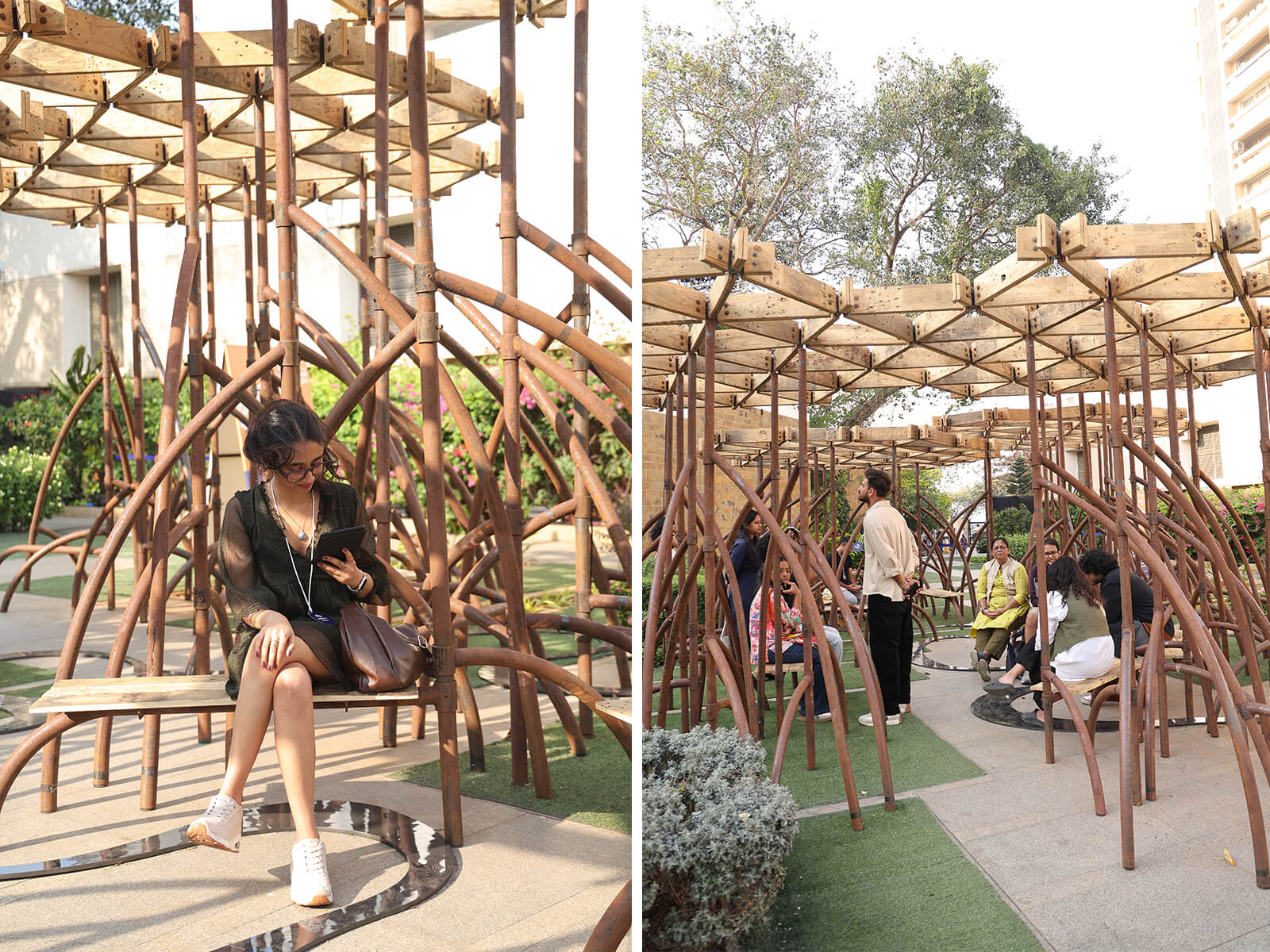
Walking ahead, the porous Mangrove Pavilion by Studio Sangath, supported by Arun Vadehra & Family, created the sensation of stepping into a coastal ecosystem, welcoming the wind and the day impartially. A gentle labyrinth of timber forms transformed tree limbs into benches and canopies, with a symbolic river form snaking underneath imperceptibly. Almost romantic in its openness and particularly animated during the evening hours, solitude and shared conversation coexisted here, with many occupying its semi-shaded pockets throughout the day.
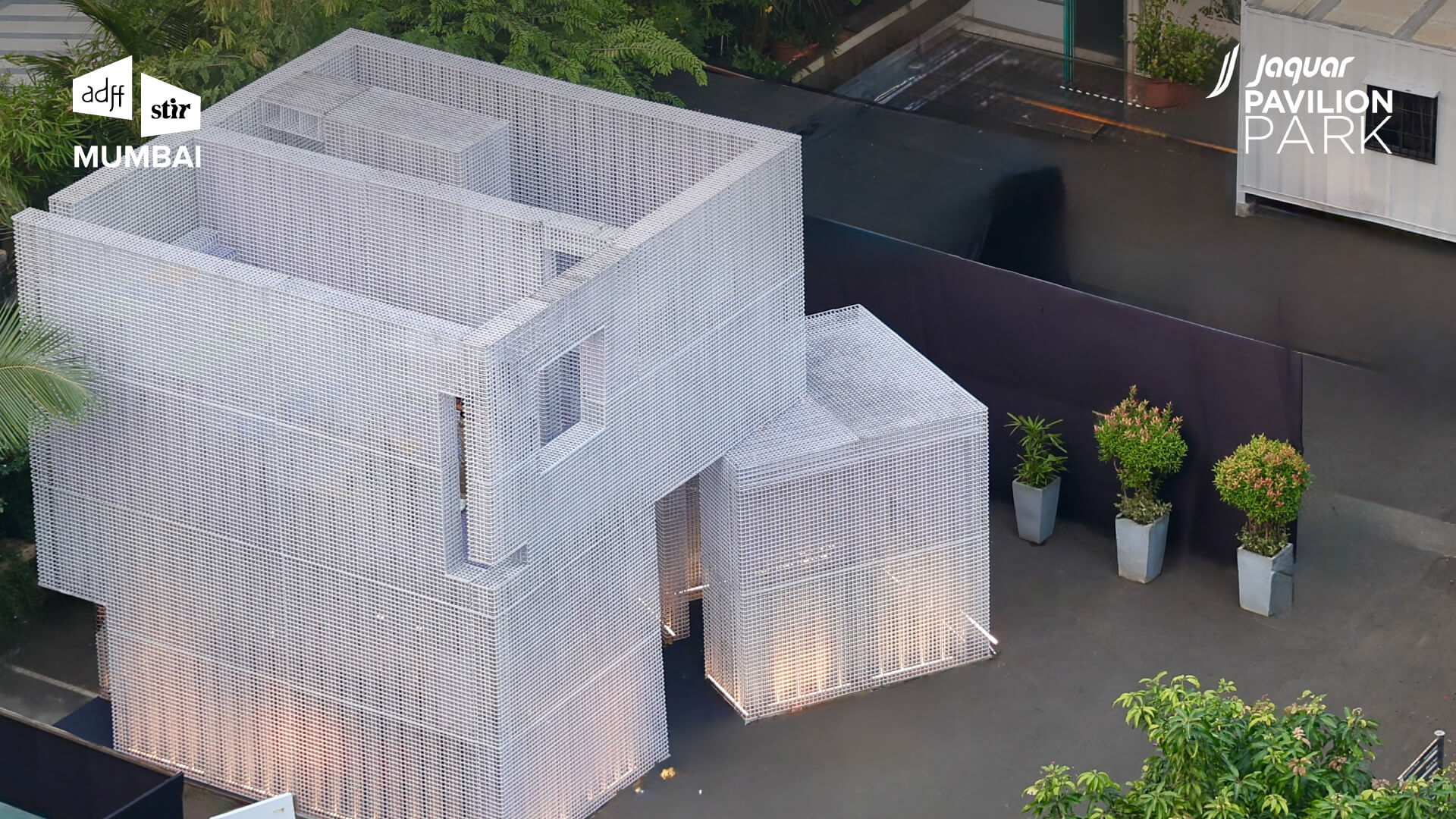
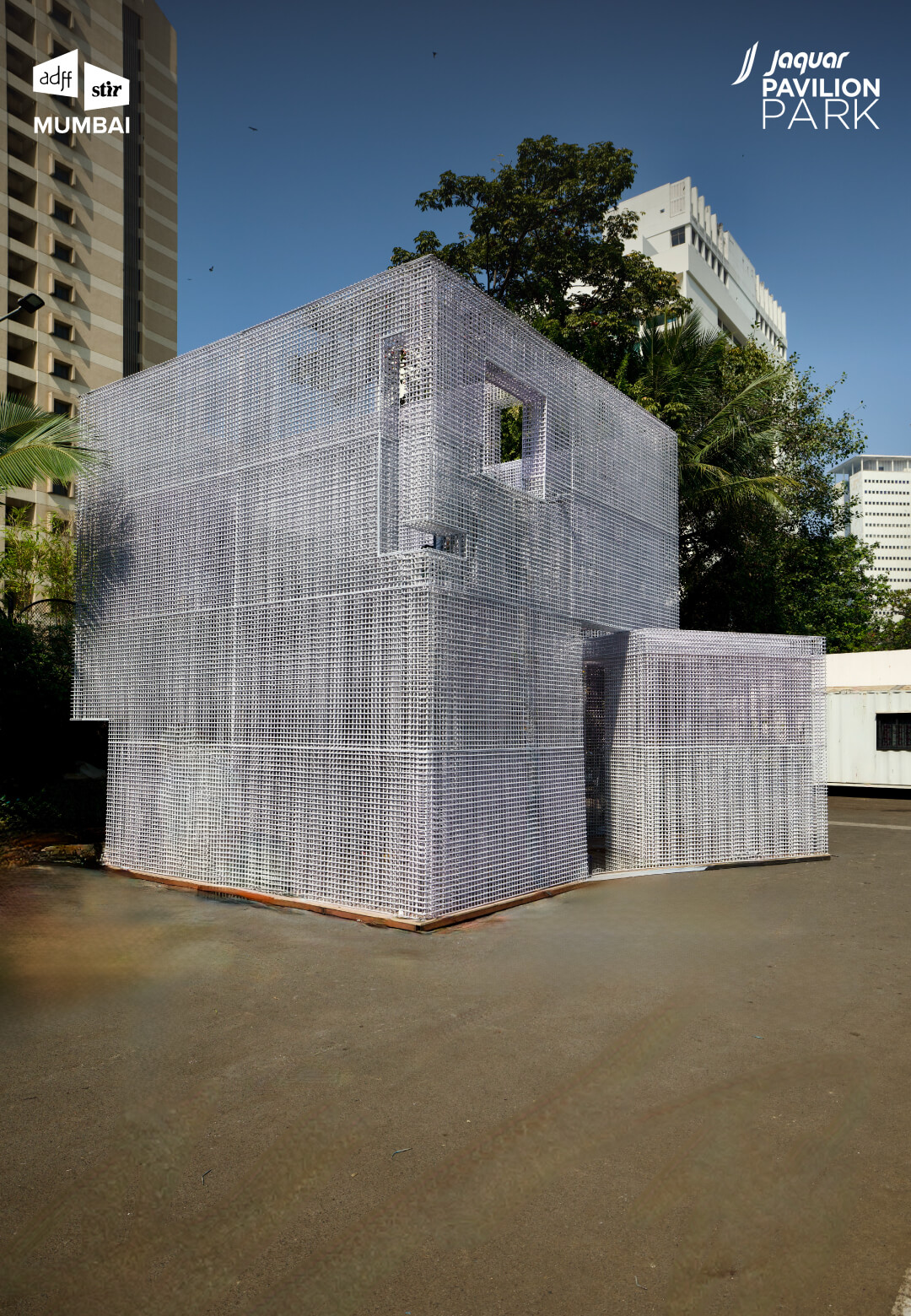
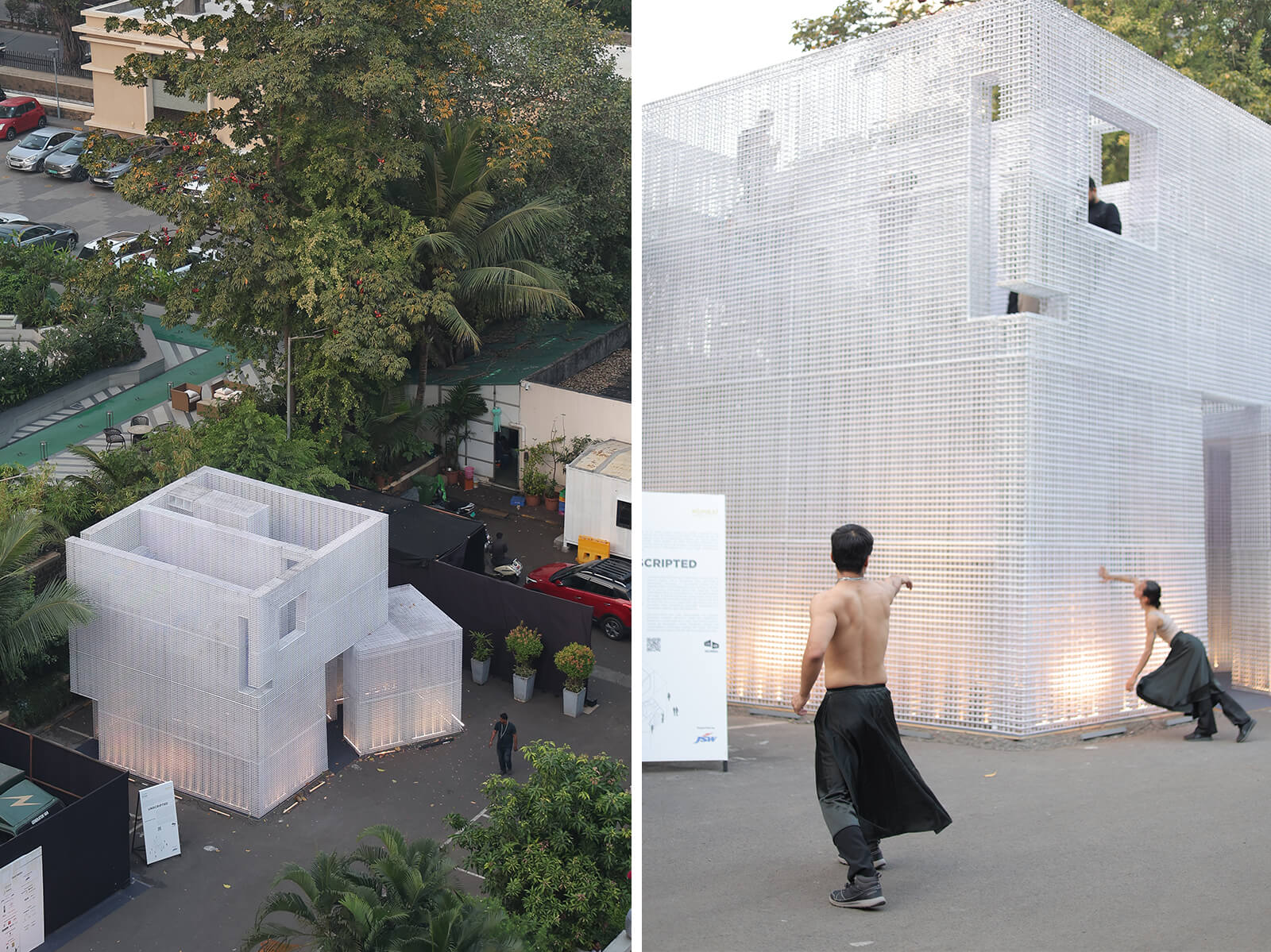
A little way from the central plaza, the gleaming, open-to-sky Unscripted pavilion by Abin Design Studio and supported by JSW, functioned as an urban condition rendered in hefty steel and see-through panels. Near white, near solid and catching the day’s light at shifting angles, its stairs, landings, balconies, terraces and window-like voids were compressed into a glittering cubic form punctured with apertures that allowed light, air and movement to pass through. Even the NCPA’s resident cats found refuge inside its reflective surfaces, offering moments of unexpected tenderness as visitors paused to pet them. Overlooking the Godrej sunken court, it became a popular photographic landmark, its social energy shifting with light.
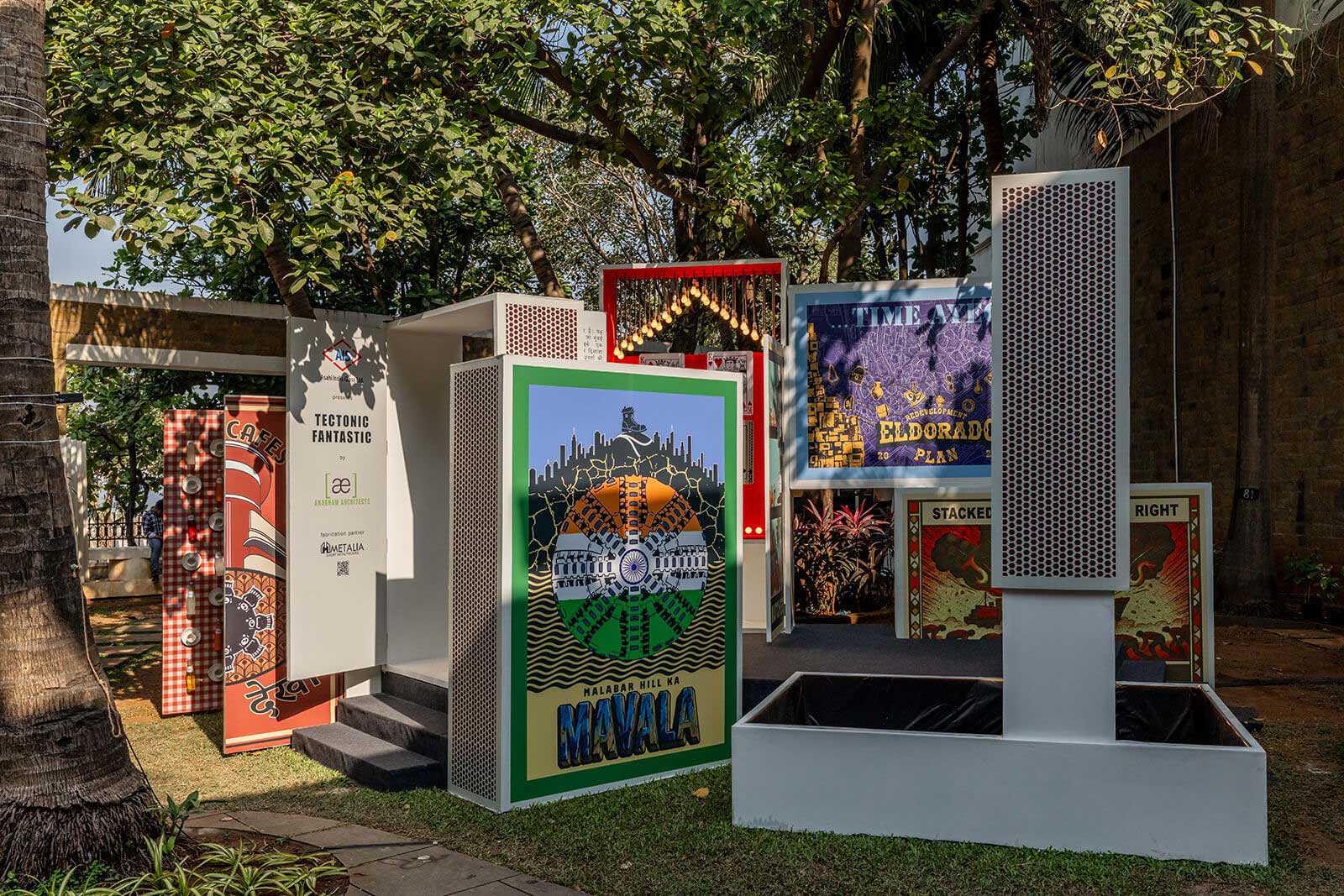
The Jaquar Pavilion Park’s spatial choreography extended beyond the central plaza. A brisk walk from here, the Tata gardens hosted Tectonic Fantastic by Anagram Architects, supported by Asahi India Glass Ltd., which unfolded as a diorama of human-scaled matchboxes referencing Bollywood posters, vintage playing cards, filament bulbs and everyday urban artefacts, apart from expressing the pulp graphic language of the 1980s matchbox covers themselves. An element of each box could be slid, pulled or swung open to reveal dioramic vignettes representing the average ‘everydayness’ of Mumbai, offering quieter photographic encounters.
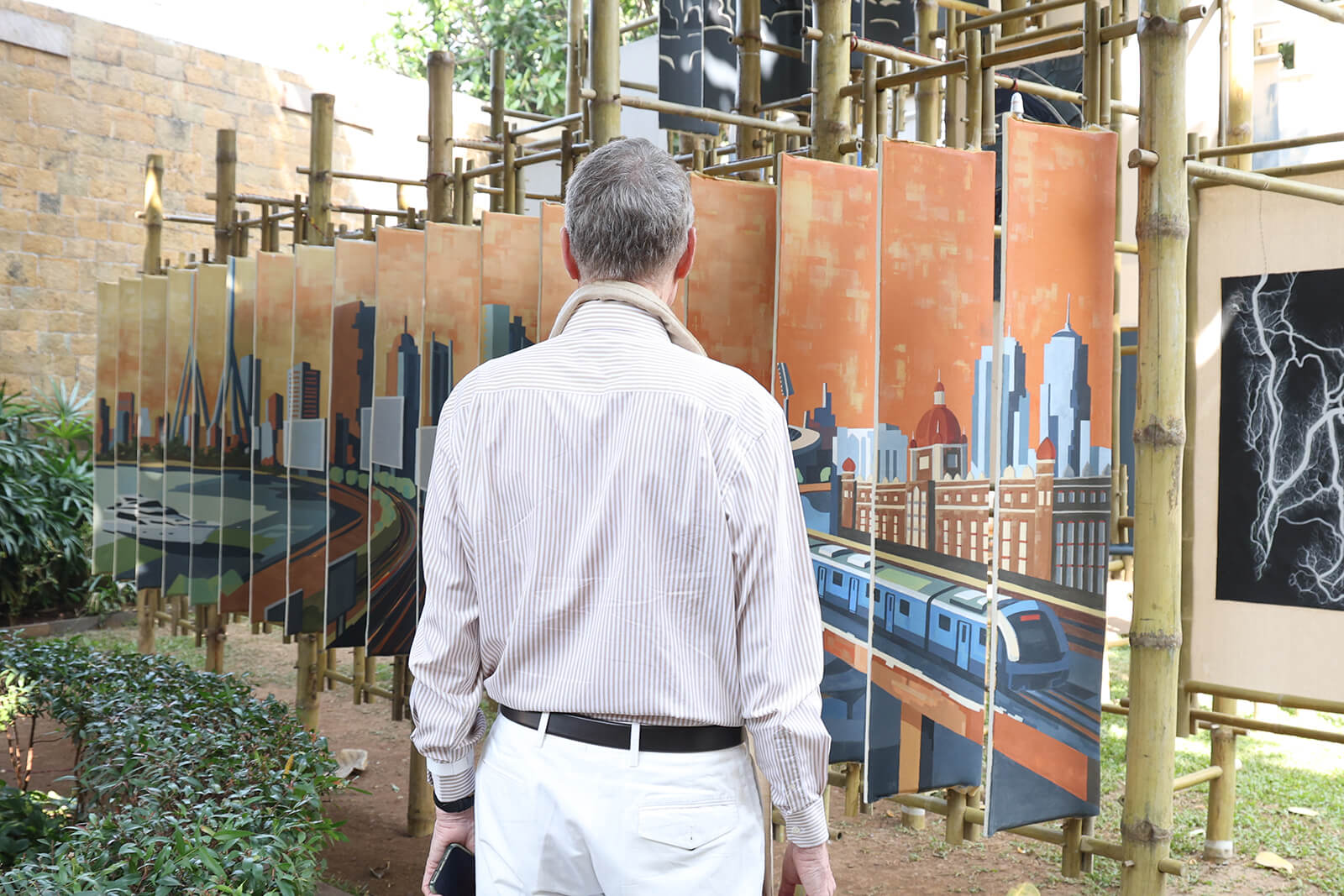
Alongside was The Script by Field Architects, supported by Royal Enfield, where visitors moved intentionally through layered tensile canvases depicting Mumbai’s graphic architectural frames. Framed by a unique vantage point to the sea and a window-like aperture carved into the NCPA’s external wall here, the pavilion’s reference to the city’s ubiquitous scaffolding was immediate and legible in its own light and fragmented bamboo grid structure, while its sheltered central space invited slow circulation. Across all the ten forms, subtle contrasts—between spectacle and introspection, noise and quiet, openness and enclosure—shaped the Park’s experiential offerings.
Following these spatial encounters, the Jaquar Pavilion Park expanded through a dense public programme across the festival’s three days. ~analog(ue) sessions, special book readings and curated workshops activated most of these including: Raj Rewal’s book launch and talk on his own life and works, moderated by Martha Thorne at the Pentad Pavilion; Unhinged Mumbai with Aastha D., Disobedience as Data , with Puran Kumar (principal architect, Studio PKA), Mansi Sahu (co-Founder of StudioPOD) and Aastha D. moderated by Samta Nadeem at Streets of Aspiration; the Bombay Imagined book reading by Robert Stephens (Architect, Urbs Indis) and subsequent talk at the Pavilion of Conversations moderated by Anmol Ahuja; the T.R.A.C.E hands-on lighting workshop by the Lighting Designers Association of India (LiDAI) near Unscripted; Team Tree! A Children’s Timber Workshop at the Pentad Pavilion led by Joseph R. Goodwin (head of brand and creative, UHA); and the Matters End book reading by Naresh V Narasimhan (managing partner, Venkataramanan Associates) and moderated by Sunena Maju at the Pentad Pavilion.
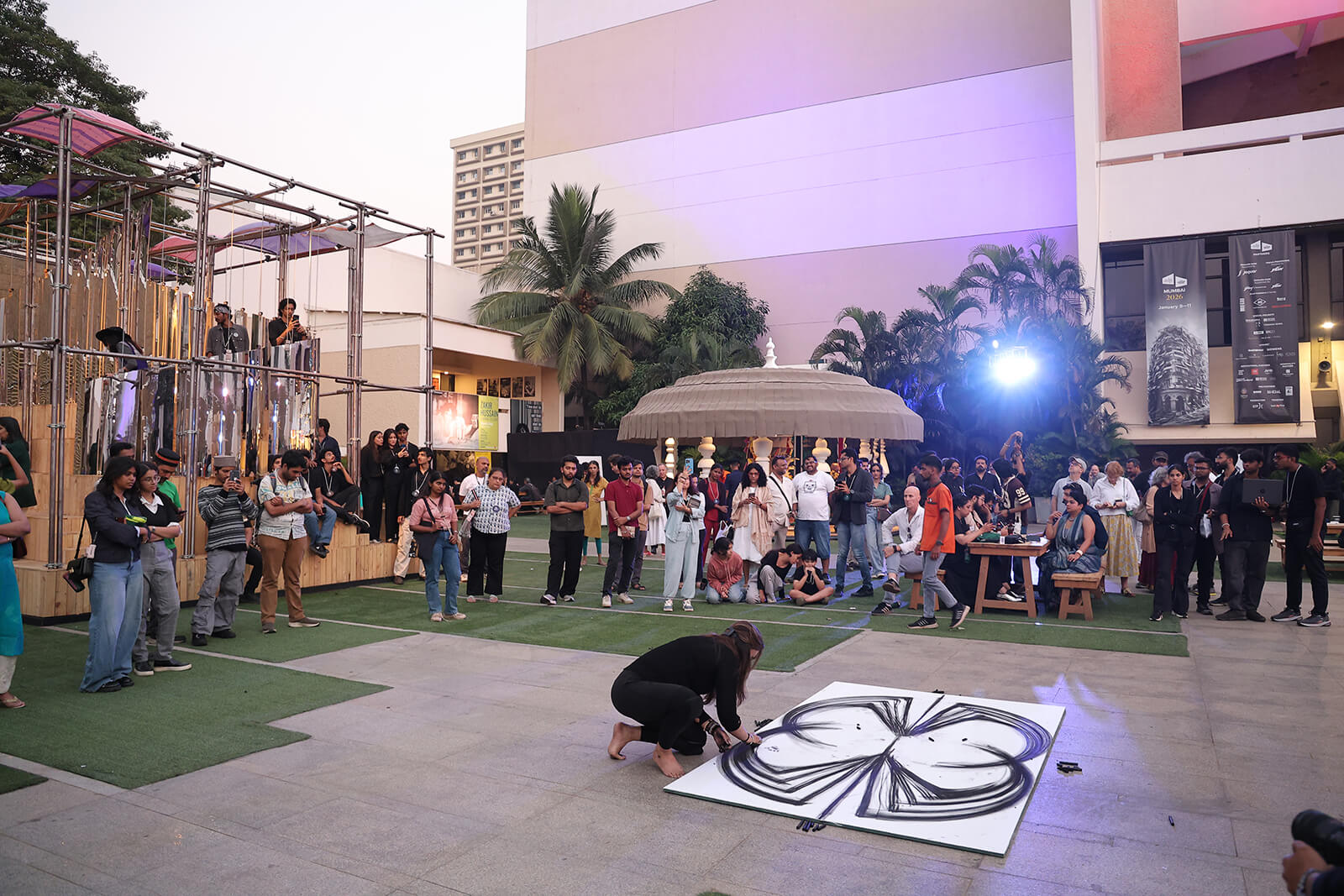
Further, the Urban Sketchers Mumbai live documentation sketchwalk also anchored the site along with the Architecture and Emotional Inhabitancy talk and workshop at SIFT with Rhael ‘Lionheart’ Cape (Multidisciplinary artist), Malloy James (Composer, musician, sound designer) and Suchi Reddy (founder, Reddymade); the workshops Thinking Cities In Narratives by the founders of Leewardists, Anuj Kale and Shreya Khandekar and A Book Readers Guide to Making the Leap with book reviewer Valeska Soni, both hosted at the Pentad Pavilion; along with the Juhu Reads’ satellite reading sessions which took place at the Pavilion of Conversations. The In-space live dance performances by Mukta Nagpal and Ashish Rao (Artists, founders, Myān Dance Company) further activated the Jaquar Pavilion Park at large, while writer, designer and artist Saheba Singh’s immersive art performance Catching Storms transformed the central plaza into a real-time canvas.
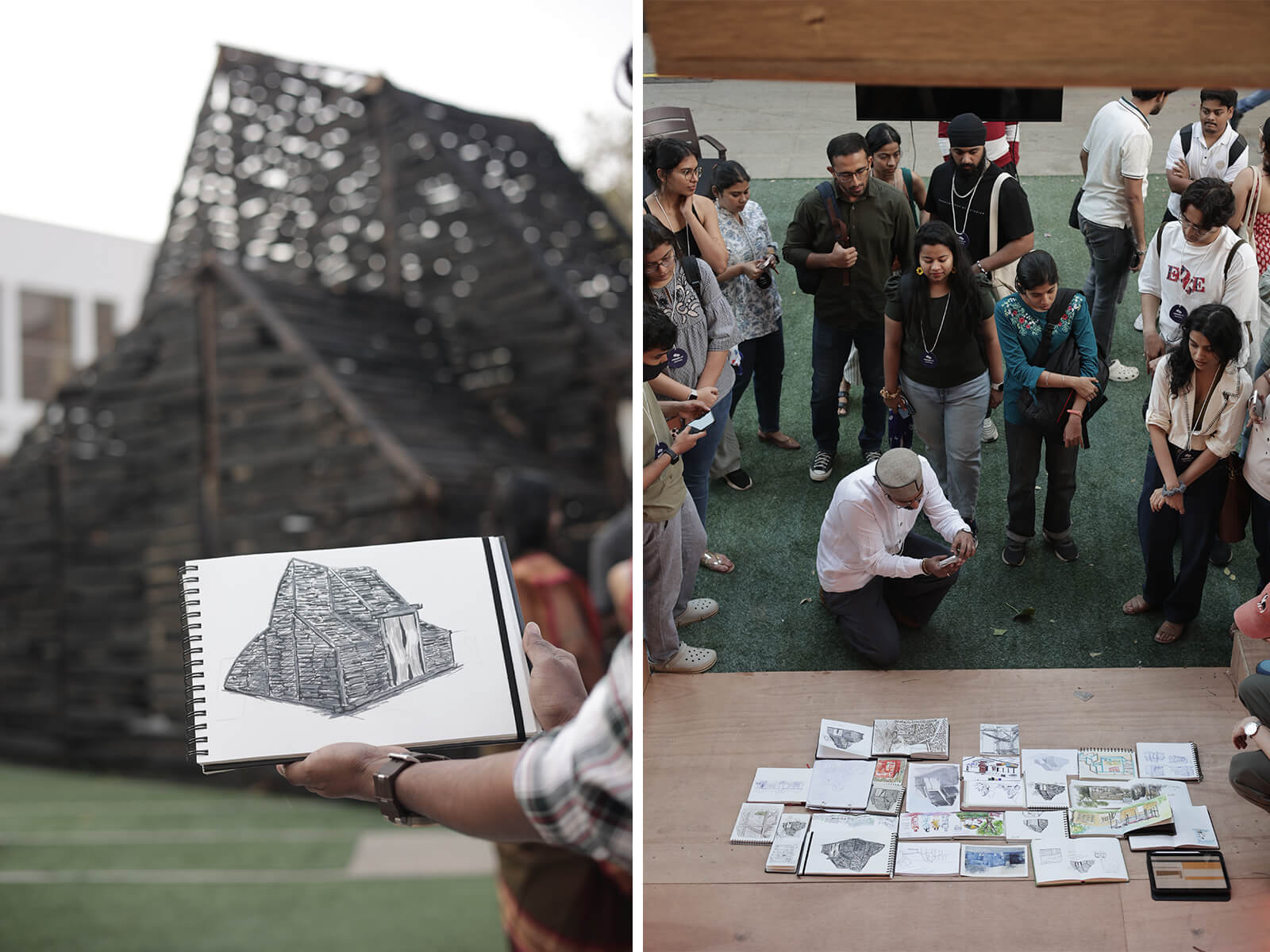
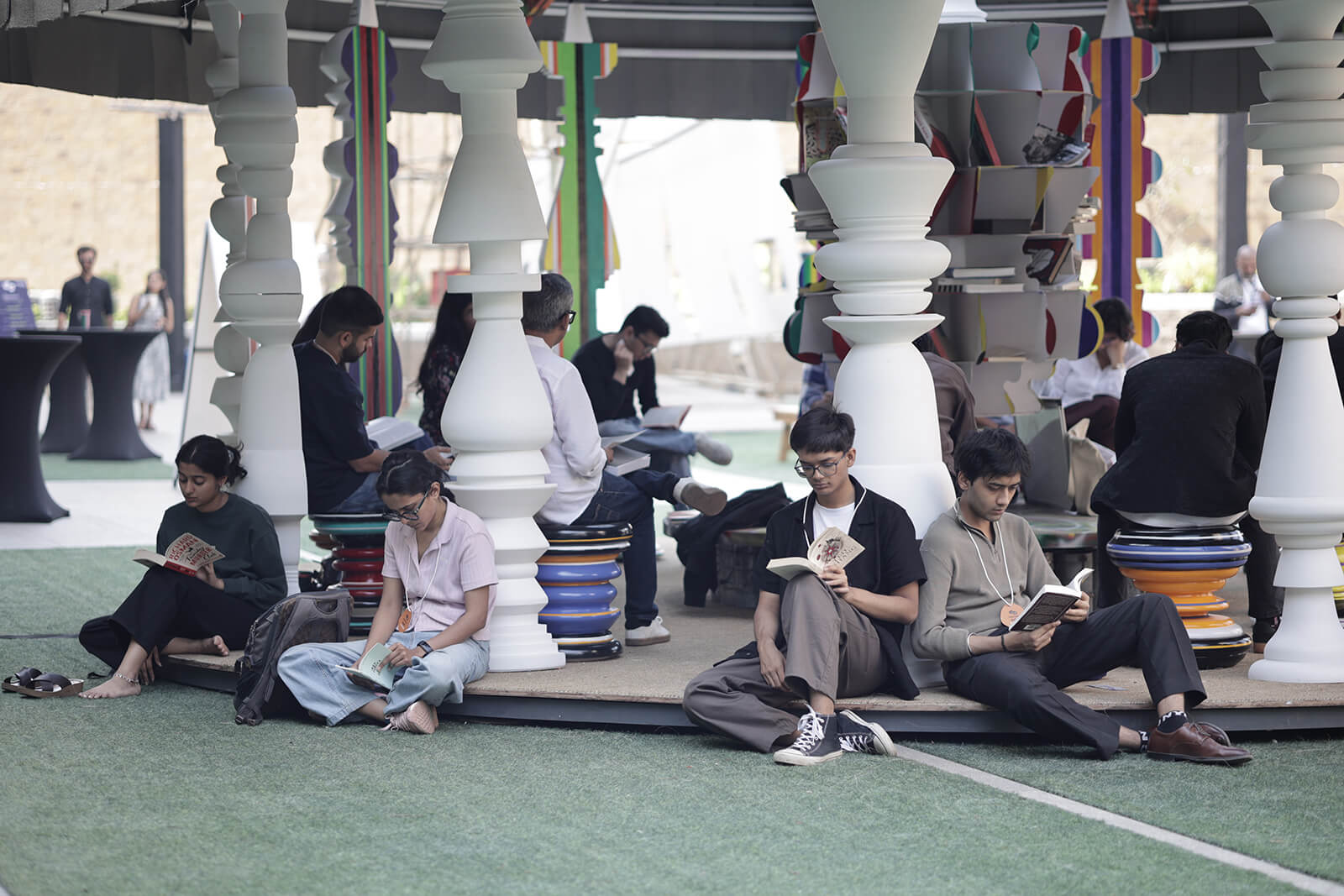
The Jaquar Pavilion Park ended up performing as a connective artery within the festival: a place for walking, getting a bite and a drink, waiting, meeting collaborators, fellow students, colleagues and industry people, reading schedules, exchanging ideas and receiving impromptu architectural tours from the architects and designers themselves. For the Jaquar Group, the Park represented a collaborative cultural ecosystem, something that went beyond brand patronage. Mohit Hajela, group vice president, Business Development – Global Operations at the Jaquar Group, commended the incredible energy and turnout, noting how the Pavilion Park inspired many on ground. “The engagement between design, art, cinema and architecture on one platform is phenomenal. It has become a space to learn and exchange,” he stated. Indeed, here, multiple patrons, studios, curators, organisers and cultural institutions worked under a singular umbrella to produce public value rather than isolated spectacle.
As the festival concluded, the Jaquar Pavilion Park’s legacy became more than the structures it temporarily facilitated and housed. It has, in many ways, demonstrated how architectural practice can operate as a site of plural, cultural positioning, generating meanings through encounters, proximity and public participation. Importantly, these were never conceived as permanent forms anyway. Their very brief emphasised adaptability and sustainability—structures designed to migrate, transform and acquire new meanings after the festival.
In this sense, the Jaquar Pavilion Park positioned and represented architecture as a comma, not a period, intensifying the idea that spatial practice can hold multiplicity, friction, reflection and continuity within a solo, temporary moment; to recognise that meaning and meaning-making, like in cities, are ever-perpetual and evolving.

by Pranjal Maheshwari Oct 24, 2026
A consortium of Copenhagen’s 3XN, Toronto’s B+H Architects and Shenzhen’s Zhubo Design has designed the museum to mimic the surrounding riverscape, topped with a public park.
by Pranjal Maheshwari Oct 19, 2026
The Mumbai-based architects integrate courtyards, mesh screens and north light trusses to create a dining space that doubles up as a community hub at SR University, Warangal.
by Mrinmayee Bhoot Oct 17, 2026
The Rotterdam-based institute centres the Indian Ocean as a network for exploring material histories and transnational links shaping coastal cultures, positing them as future models.
by Pranjal Maheshwari Oct 16, 2026
At the 2026 Stirling Prize ceremony, Mary Duggan with RUFF Architects, MAKER Architecten and Nakshabid Architects were felicitated for proffering quality housing and social equity.

make your fridays matter with a well-read weekend
Enter your details to sign in
Don’t have an account?
Sign upOr you can sign in with
a single account for all
STIR platforms
All your bookmarks will be available across all your devices.
Stay STIRred
Already have an account?
Sign inOr you can sign up with
Verification link sent to check your inbox or spam folder to complete sign up process
Tap on things that interests you.
Select the Conversation Category you would like to watch
Please enter your details and click submit.
Enter the 6-digit code sent at


Mumbai, transcribed: Inside the Jaquar Pavilion Park at ADFF:STIR Mumbai 2026
by Jincy Iype | Published on : Jan 23, 2026


 Sign in with Google
 Sign in with email
What do you think?